




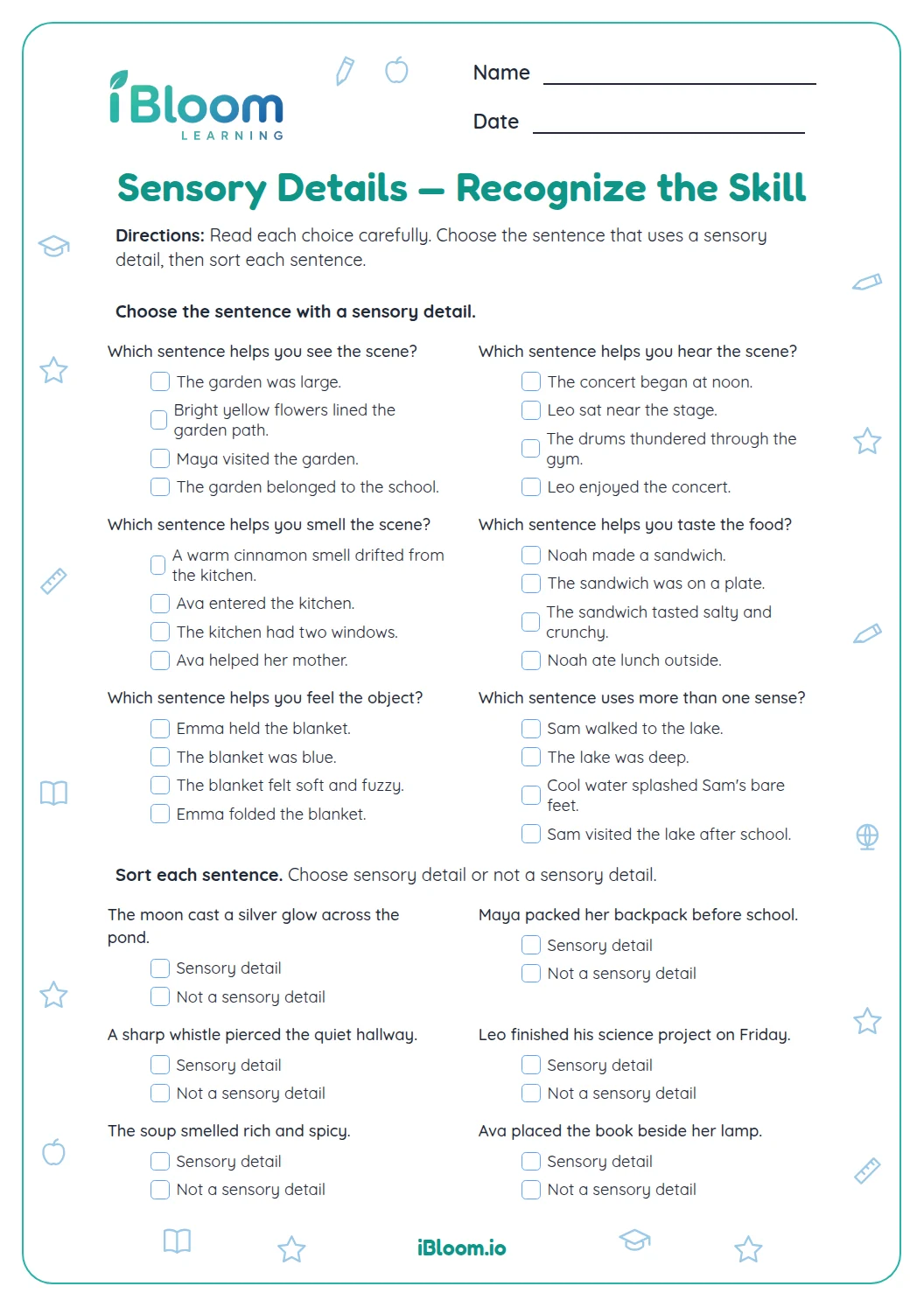


About this worksheet
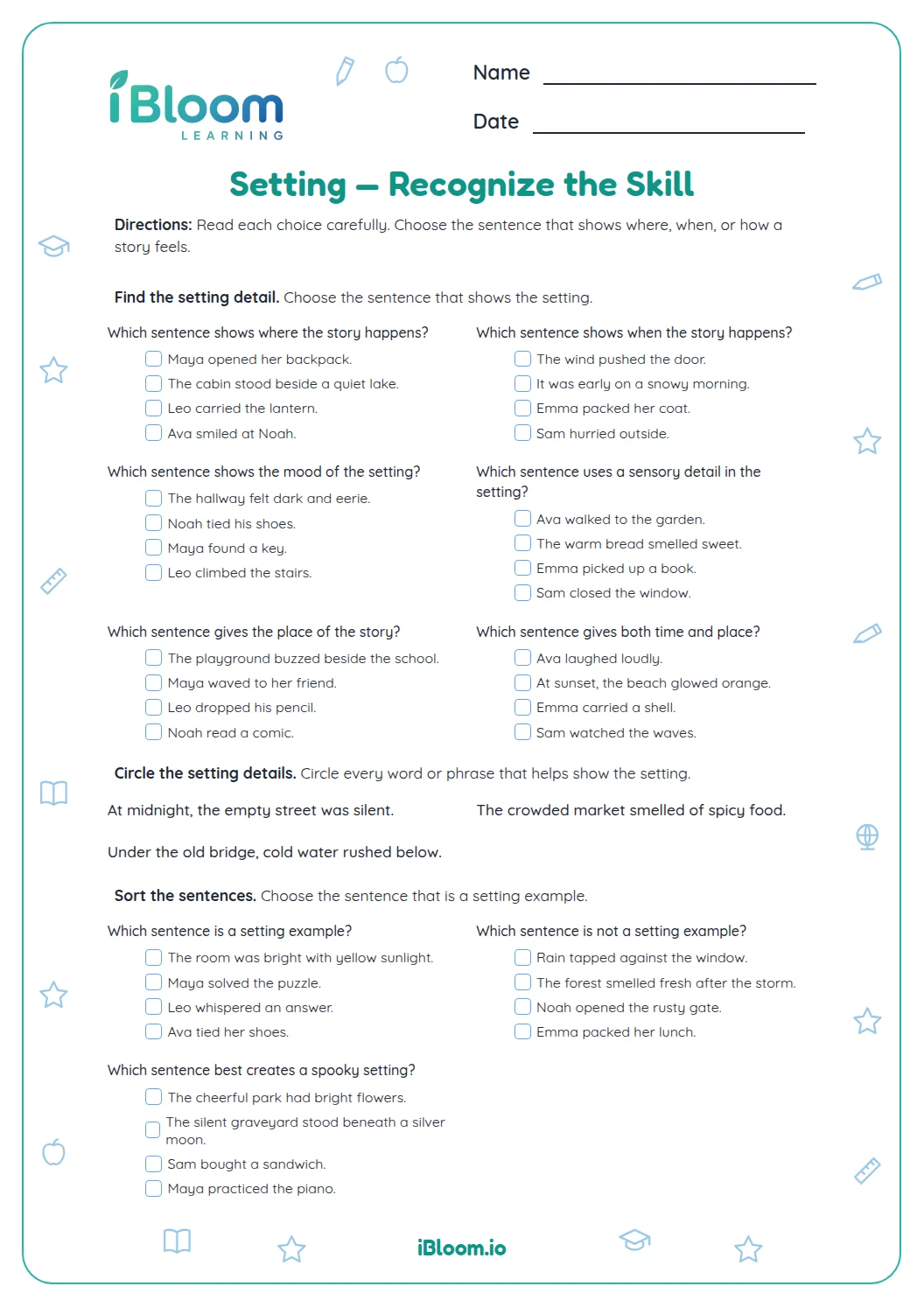
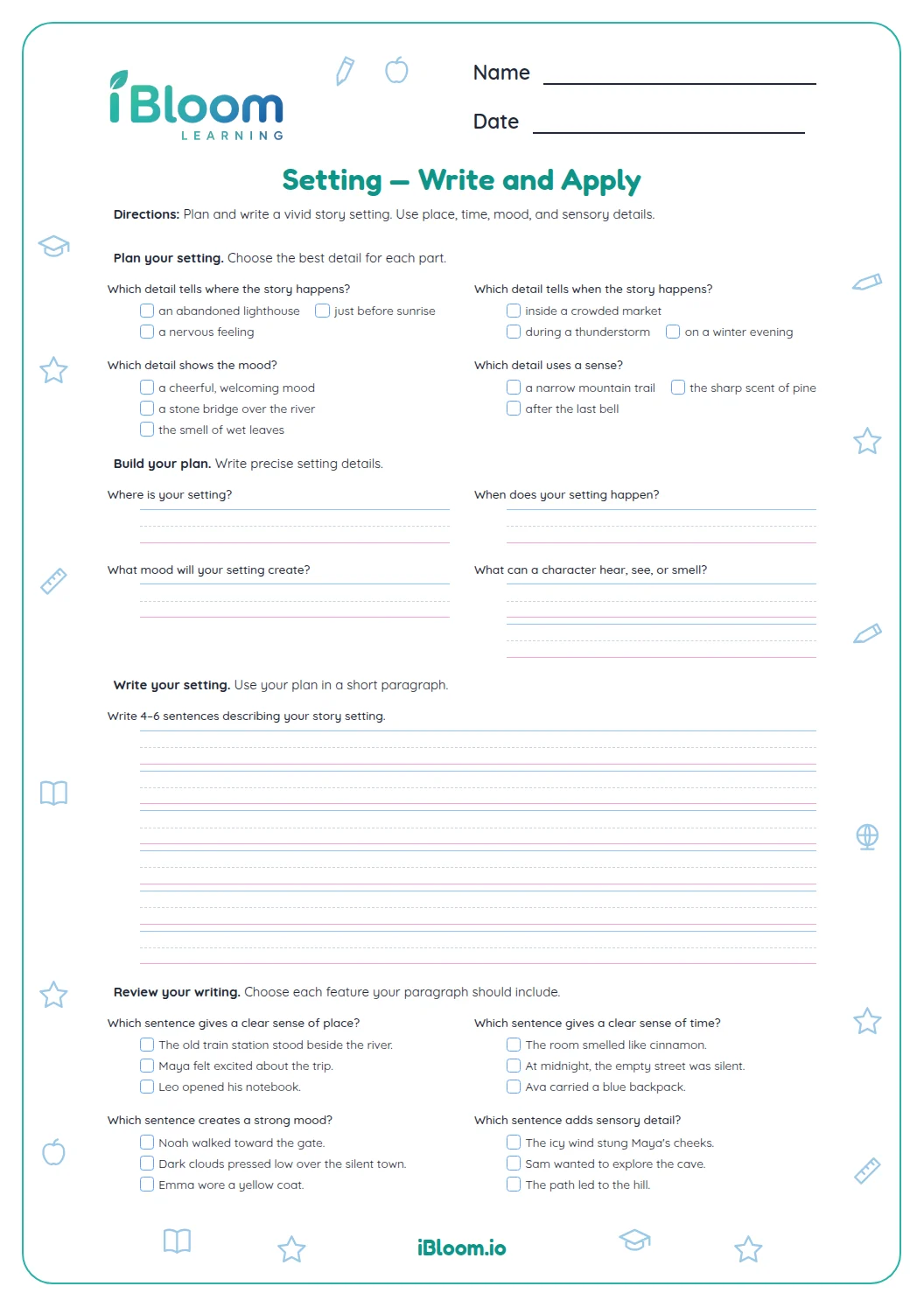
This Grade 5 printable helps students recognize and complete story-setting sentences, then use four clues to write a scene sentence. In Part A, they choose words that make a place, time, mood, or sensory detail clear. Part B asks them to complete six scenes with a word that fits the context. Part C brings place, time, mood, and sound together in one sentence. The word work practices CCSS L.5.6, and the guided scene writing practices W.5.3.d. A separate answer key gives target answers and a sample sentence.
Aligned to L.5.6 and W.5.3.d
How do setting clues shape a scene?
Place and time tell where and when a story happens. Weather, sound, and word choice can also create a mood.
- 1Dark clouds and sharp wind made the mood feel ___. → stormy
- 2A red moon rose above the quiet ___. → village
How should students choose a missing word?
Use the clue in the sentence and compare the choices. The best answer fits the scene naturally and gives the reader a useful detail.
- 1At dawn, pale light spread across the ___. → valley
- 2Sam heard leaves ___ in the autumn wind. → rustling
How can four clues become a setting sentence?
Name the place and time, then use the mood and sound detail to help a reader imagine the scene. Part C supplies all four clues so students can focus on combining them clearly.
- 1Clues: forest · evening · mysterious mood · owls
- 2Sample: In the forest, owls called in the mysterious evening.
How can students check each answer?
Read the completed sentence aloud. Check that each word matches its clue and makes sense with the rest of the scene. Compare the word answers with the key; use the sample sentence as one possible way to combine the four clues.
How to use this worksheet
- 1Read the entire scene before choosing a word.
- 2Notice whether a clue describes place, time, mood, or a sense.
- 3Compare the choices when they are provided.
- 4For a blank, use nearby words to infer the setting detail.
- 5Use all four Part C clues in one clear sentence.
- 6Compare word answers and the sample sentence with the key.
Common mistakes and quick fixes
The mistake
Treat mood and place as the same thing.
The fix
Ask whether the word names a location or the feeling a scene creates.
The mistake
Choose a sensory word that does not match the setting.
The fix
Check the scene details: a snowy hill can be cold, while a bakery may smell of bread.
The mistake
Leaving out one of the four clues when writing the setting sentence.
The fix
Check the sentence for the forest, evening, mysterious mood, and owls.
Common Core alignment
This practice connects the listed standard to the skill on the page.
Use precise setting and sensory words accurately in context.
On this sheet: Students choose and complete setting sentences with precise words for place, time, mood, and sensory details.
Show the official wordingHide the official wording
Acquire and use accurately grade-appropriate general academic and domain-specific words and phrases, including those that signal contrast, addition, and other logical relationships (e.g., however, although, nevertheless, similarly, moreover, in addition ).
Use concrete words and sensory details to make a setting sentence precise.
On this sheet: Part C combines supplied place, time, mood, and sound details in a narrative sentence.
Show the official wordingHide the official wording
Use concrete words and phrases and sensory details to convey experiences and events precisely.
What to practice next
Make more practice
Further reading
Questions parents and teachers ask
What counts as a setting detail?
Place is the location, such as a forest or city street. Mood is the feeling created by the scene, such as peaceful or stormy. A setting can include both, along with a time and one or more sensory details that help readers picture the moment.
Do the sentence completions have one right answer?
The six missing-word items have a target answer supported by the sentence clue, such as valley after “pale light spread across the” or rustling after “Sam heard leaves.” Part C has a sample sentence using its four clues; other clear sentences may also work.
How many questions are on the setting page?
There are 14 questions: seven choice questions, six missing-word sentences, and one guided setting sentence. The parts move from choosing setting clues to completing scenes and combining four details. The key lists target words and one sample sentence for the writing prompt.
What is the difference between place and mood?
Place names the location, such as a forest or city street. Time tells when the scene happens, such as at dawn or midnight. Mood describes the feeling created by details like dark clouds, quiet halls, or bright sunlight in the scene.
How can I help without writing the answers?
Ask the student to point to the clue that led to a word choice. For the final sentence, check together that it names the forest and evening and includes the mysterious mood and owls. The answer key offers a sample while leaving room for another clear sentence.