





About this worksheet
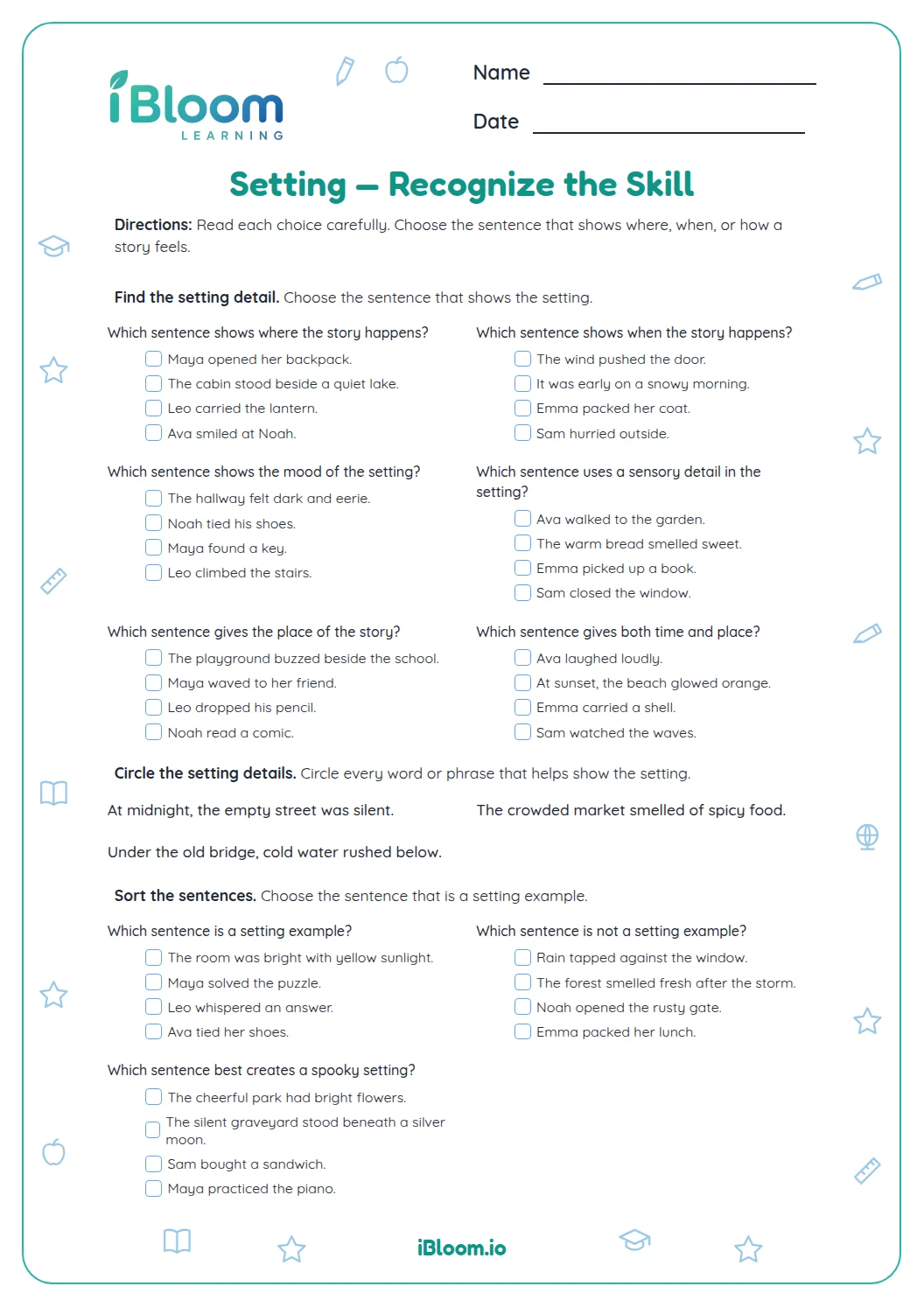
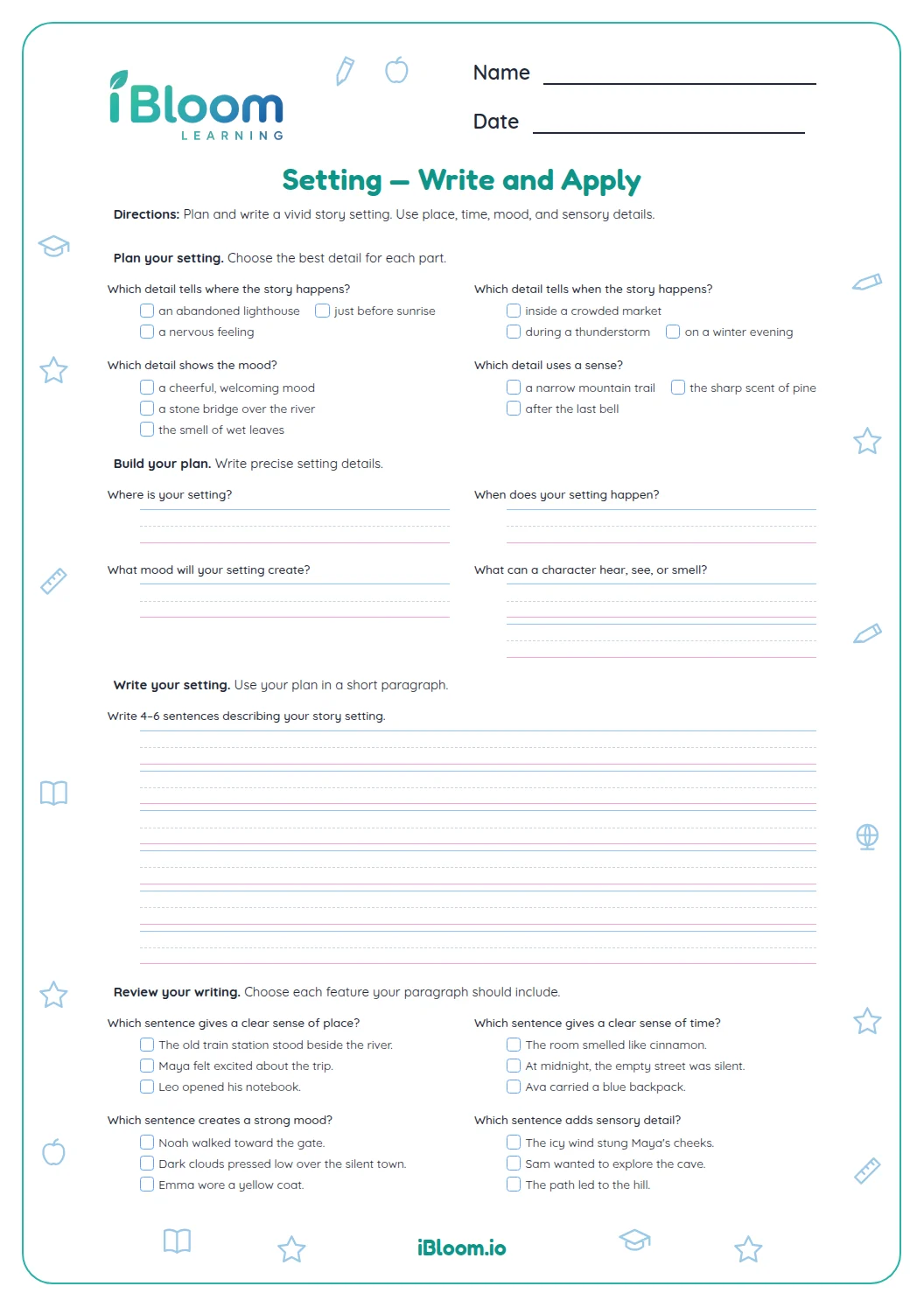
This Grade 5 narrative-writing worksheet focuses on setting: where and when a scene happens and how details shape its mood. Students identify place, time, and sensory clues, choose revisions that make a scene feel lonely, nighttime, or dangerous, and complete sentences with precise setting words. The last prompt asks for a three-sentence lighthouse scene. The two-page worksheet has 15 questions and a separate answer key with a sample response.
What counts as a setting clue?
Setting tells where and when a story happens. Words such as “at dawn” give a time; “harbor” names a place. Sound, smell, and other sensory details help a reader imagine what that place is like.
- 1“At dawn” tells when the scene happens, so it is a time clue.
How can a detail change the mood?
A setting detail can make a scene feel peaceful, lonely, or dangerous. Question 7 asks students to choose between revisions, including an empty road beneath a moonless sky, and select the detail that best creates a lonely mood. This mirrors the old sheet’s revision-choice practice.
- 1“Branches clawed across the narrow path” suggests a dangerous forest scene.
How do sensory details make a setting vivid?
Choose details tied to the senses: rain tapping a roof is sound, and warm bread may smell sweet. Precise details help the reader picture the scene instead of relying on a broad label such as “nice” or “scary.”
What should the final scene include?
The last question asks for a stormy lighthouse setting in three sentences. Include a clear place and weather, then choose a sound or other sensory detail that supports the stormy mood. The key gives one sample; other vivid, fitting descriptions can work.
How to use this worksheet
- 1Find the words that show where or when the scene happens.
- 2Name the sense used by a sensory detail.
- 3Notice the mood named in a revision question.
- 4Choose or supply a precise word that fits the setting and mood.
- 5For the final scene, include a place, storm detail, and mood-supporting image or sound.
Common mistakes and quick fixes
The mistake
Calling every descriptive word a setting clue.
The fix
Ask whether the word tells place, time, or what the place feels and sounds like.
The mistake
Choosing a detail that conflicts with the requested mood.
The fix
Read the mood word first, then check whether the revision creates that feeling.
The mistake
Using a broad adjective instead of a sensory image.
The fix
Add a sound, smell, texture, sight, or weather detail a reader can imagine.
What to practice next
Make more practice
Questions parents and teachers ask
What is setting in a story?
Setting is where and when the events happen. A harbor, a forest, or a bakery can name a place; dawn or midnight can name a time. Sensory details add what a character might see, hear, smell, or feel in that place.
How can setting create mood?
Writers select details that suggest a feeling. A still pond at sunrise can feel peaceful, while a narrow trail with branches clawing across it can feel dangerous. The worksheet asks students to connect the wording of a detail to the mood it creates.
What is a sensory detail?
A sensory detail refers to something a character could see, hear, smell, taste, or touch. “Rain tapped the roof” gives a sound. “Warm bread smelled sweet” gives a smell. These details help readers imagine the setting more clearly.
What does the final writing question ask?
The final prompt asks students to describe a stormy lighthouse setting in three sentences. A strong response establishes the lighthouse and storm, then adds details that fit the mood. The answer key includes one sample, while other accurate descriptions may also work.
How many questions are included?
The worksheet contains 15 questions in four parts: setting clues, sensory and mood choices, setting completions, and a written scene. It spans two worksheet pages and has a separate two-page key with answers and a sample scene. Students may use other accurate details in their scene.