




About this worksheet
This Grade 5 printable mixes narrative writing review with a short creative challenge set in a musical world. Students identify details that build a setting, choose a character goal, revise general language, edit dialogue and verb forms, then write a scene and ending. The 14 questions move from recognition to original writing, with sample responses in a separate key. The work connects to Common Core W.5.3, narrative writing.
Aligned to W.5.3
How do details help a reader imagine a scene?
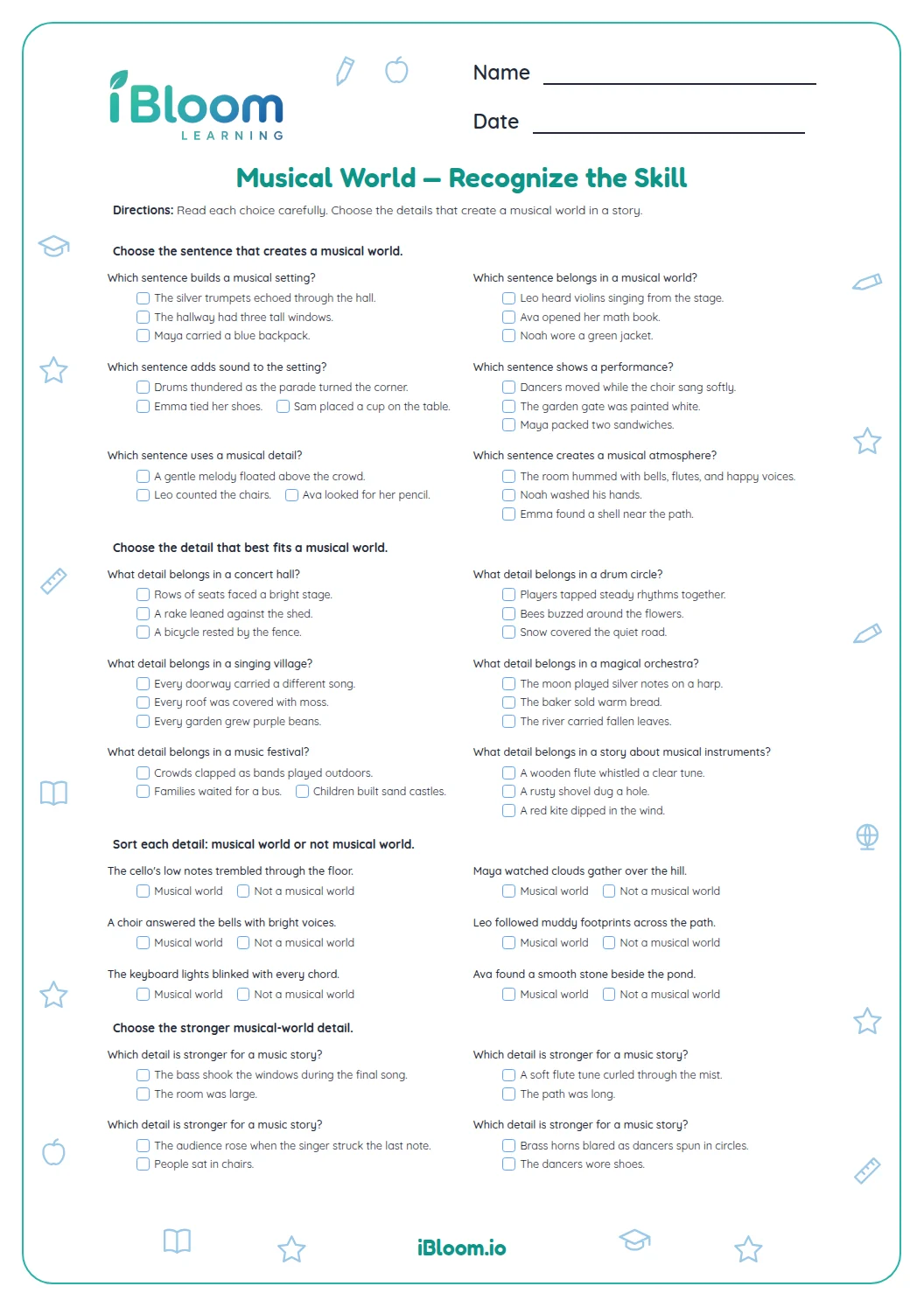
A specific detail gives the reader something to picture, hear or feel. Question 1 asks which sentence lets a reader hear the music city; “Trumpets echo between the towers” uses sound and place together.
Question 2 replaces a broad statement with an image and an effect. Brass notes crash, and windows rattle, so the reader can imagine how loud the concert feels.
- 1Original: The concert was loud.
- 2Revision: Brass notes crashed through the hall and rattled the windows.
- 3The revision adds sound and shows its effect.
What does the editing review ask students to notice?
The middle questions focus on choices that make a narrative readable: a verb form that fits its sentence, a precise word, and punctuation that clearly marks dialogue. The characters and setting remain part of the musical world.
- Part A: setting, sound and revision choices
- Part B: precise language and sentence editing
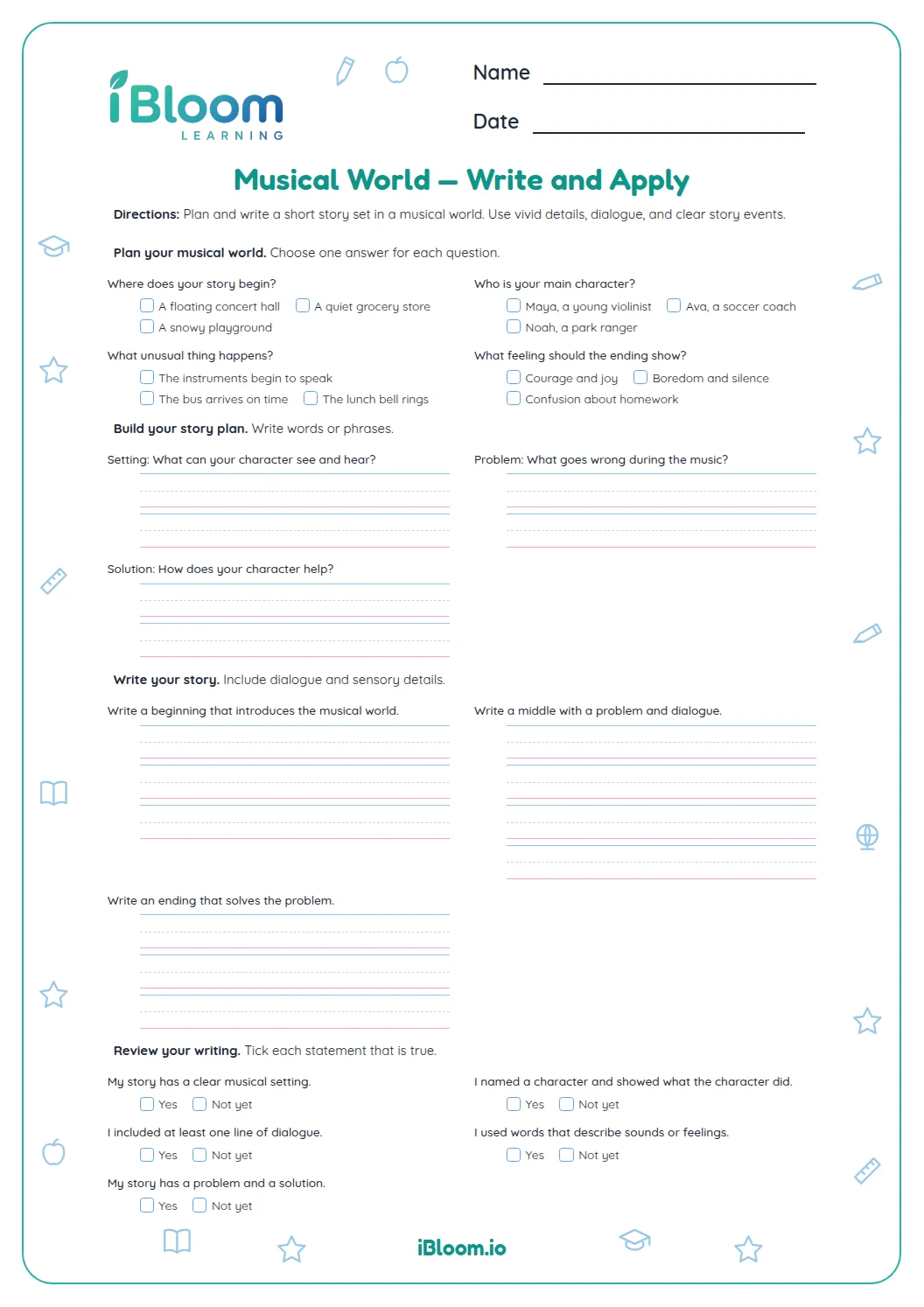
- Parts C–E: explain, revise and write musical scenes
How to use this worksheet
- 1Read the whole sentence before choosing a word.
- 2Ask what a sensory detail helps the reader picture or hear.
- 3Check that dialogue punctuation closes the spoken words and sentence.
- 4For writing tasks, give the character a goal or response.
- 5Reread each scene to make sure the details fit the musical world.
Common mistakes and quick fixes
The mistake
Choosing a vivid word that does not fit the sentence.
The fix
Read the whole sentence with the choice inserted.
The mistake
Using a general adjective instead of a concrete detail.
The fix
Name a sound or action and show what it changes in the scene.
The mistake
Leaving quotation marks open.
The fix
Read the speaker tag and spoken words together, then check both quote marks.
Common Core alignment
This worksheet practices the following Common Core skill.
Develop real or imagined experiences with characters and events.
On this sheet: Develop real or imagined experiences with characters and events.
Show the official wordingHide the official wording
Write narratives to develop real or imagined experiences or events using effective technique, descriptive details, and clear event sequences.
What to practice next
Make more practice
Further reading
Questions parents and teachers ask
What writing skills are included?
Students review sensory details, character goals, precise verbs and dialogue punctuation. They then write a short scene, a dialogue exchange, a corrected sentence and an ending. The settings and story details belong to a musical world, and sample responses in the key show one possible approach.
What makes a narrative detail strong?
A strong detail helps a reader imagine a moment and supports what is happening. In question 2, brass notes crash through a hall and rattle its windows, showing both sound and effect instead of only calling the concert loud. Concrete action gives a reader more to picture.
Are there open-ended writing questions?
Yes. Questions 11 through 14 ask for a scene, dialogue, sentence correction and ending. The key gives sample responses, but students can write different answers that meet each prompt. Look for the requested details, complete sentences and clear sequence rather than exact wording.
How does the worksheet teach dialogue punctuation?
Students select a correctly punctuated line of dialogue, then write a brief exchange between Leo and Ava. The prompt asks for quotation marks and a new line for each speaker so the conversation is clear. The answer key offers one possible two-line exchange.
How many questions are included?
The printable has 14 questions in five parts, followed by a four-page answer key. The items include choice and editing tasks, one explanation, and four written responses. The longer writing tasks have response space so students can develop short narrative ideas.
Which standard does this narrative work support?
The writing tasks support Common Core W.5.3 by asking students to write a narrative with characters, a situation and events. The scene and ending prompts invite sensory detail and a character reaction. Students can check that events follow a clear sequence and fit the prompt.