




About this worksheet
This Grade 5 worksheet asks learners to recognize how narrative parts work together. Across 16 questions, they identify characters, setting, plot events, point of view, suspense, and effective endings. It practices narrative writing skills named in CCSS W.5.3, with a separate answer key.
Aligned to W.5.3
How do story parts fit together?
A narrative introduces characters and setting, develops a problem through events, reaches a turning point, and then resolves the problem. Questions 1–6 practice those story parts.
How do details reveal character and build suspense?
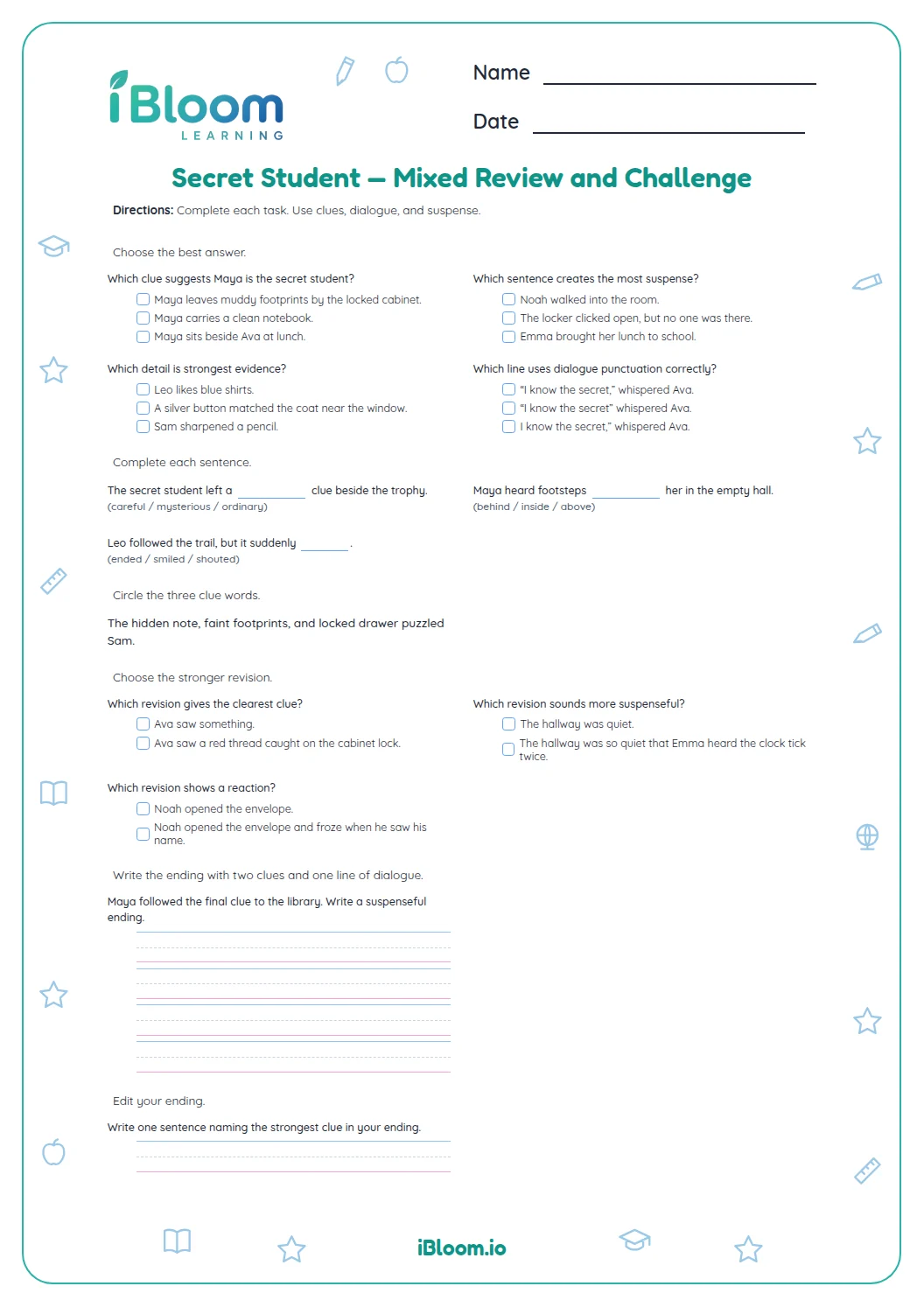
Actions and thoughts reveal feelings or motivation, while a vivid detail can help readers picture a place. A locked room with a quiet knock creates suspense because the reader wonders what is inside.
How do point of view and endings shape a story?
First-person narrators use “I” and “me.” A strong ending fits the events and gives the reader a sense of closure. The final questions ask children to recognize point of view and select a fitting ending.
How to use this worksheet
- 1Read all answer choices before selecting.
- 2Ask which choice moves a story forward.
- 3Separate setting details from character feelings and actions.
- 4Think about the order of events.
- 5Use the answer key to discuss why the other choices do not fit.
Common mistakes and quick fixes
The mistake
Confusing a setting detail with the story problem.
The fix
Ask what challenge the character must solve.
The mistake
Choosing a detail that names but does not describe.
The fix
Look for words that help a reader picture a scene or feeling.
The mistake
Mixing up climax and resolution.
The fix
The climax is the turning point; the resolution shows what happens after.
Curriculum alignment
Develop real or imagined narratives with characters, events, details, and a clear sequence.
On this sheet:
Show the official wordingHide the official wording
Write narratives to develop real or imagined experiences or events using effective technique, descriptive details, and clear event sequences.
What to practice next
Further reading
Questions parents and teachers ask
What story skills do the questions ask children to recognize?
The 16 questions cover character introductions, setting, problem, rising action, climax, resolution, point of view, dialogue punctuation, suspense, motivation, and story endings. Each question asks children to identify the choice that best serves that part of a narrative.
How can I identify a story climax?
Look for the moment of greatest tension or the turning point in the problem. In the secret-student story, the student steps onstage to help; that event is the climax because it changes what can happen next. The resolution comes afterward, when the characters finish the scene together.
What is the difference between setting and character detail?
Setting tells when or where a story happens, such as an old train station or a sunlit library aisle. A character detail tells about a person’s actions or feelings, such as twisting a program when nervous. Ask whether the detail locates the scene or reveals the character.
How does dialogue punctuation work in the practice item?
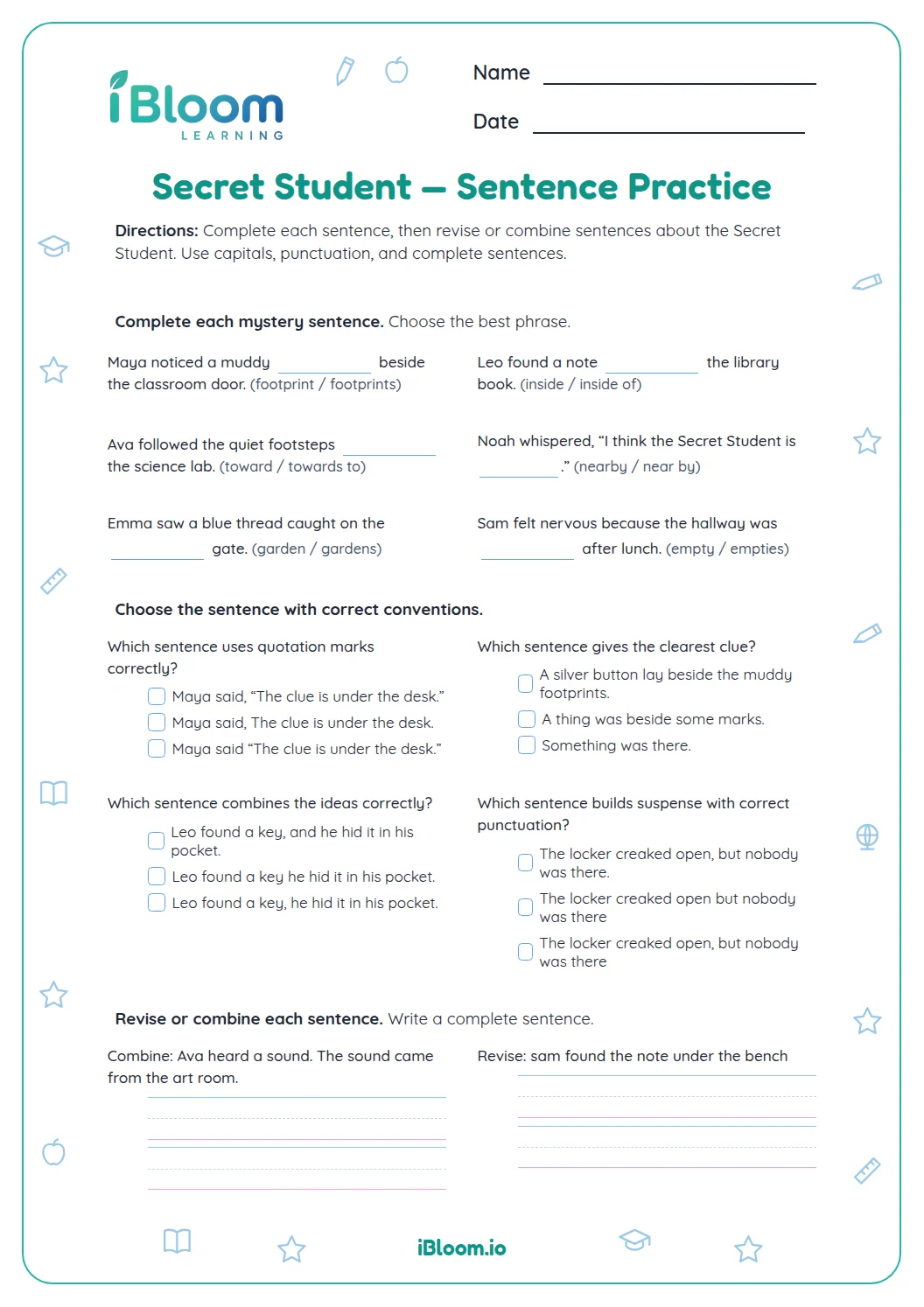
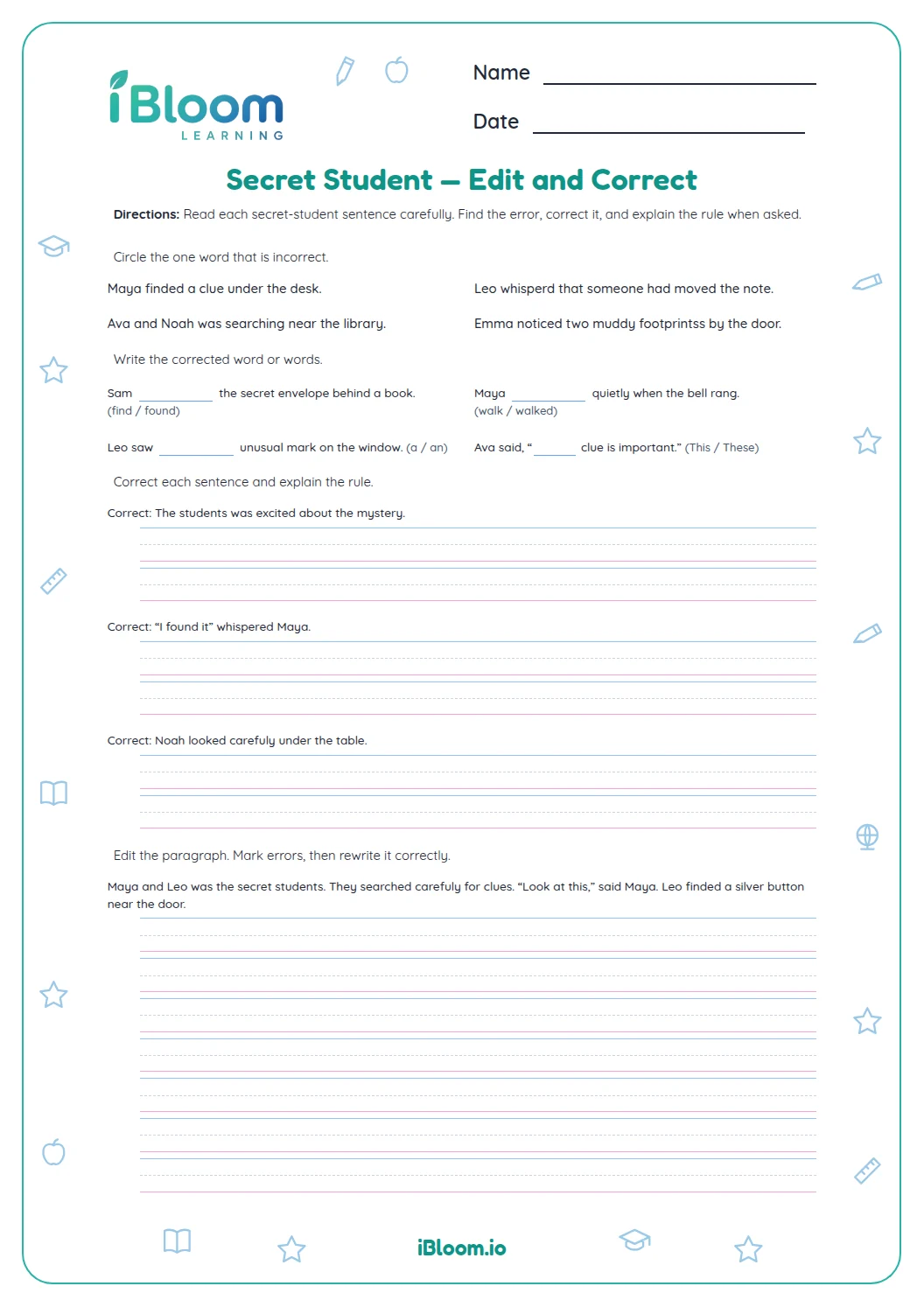
In the correct choice, the comma goes inside the closing quotation mark: “I found it,” said Lee. The comma connects the spoken words to the tag that identifies the speaker. Compare the punctuation and quotation marks carefully before choosing.
How many questions and pages are included?
The worksheet contains 16 multiple-choice questions on three worksheet pages, followed by a separate answer key page. Questions move from basic story parts to character choices, suspense, point of view, and a fitting ending. Families can work through one part at a time.