




About this worksheet
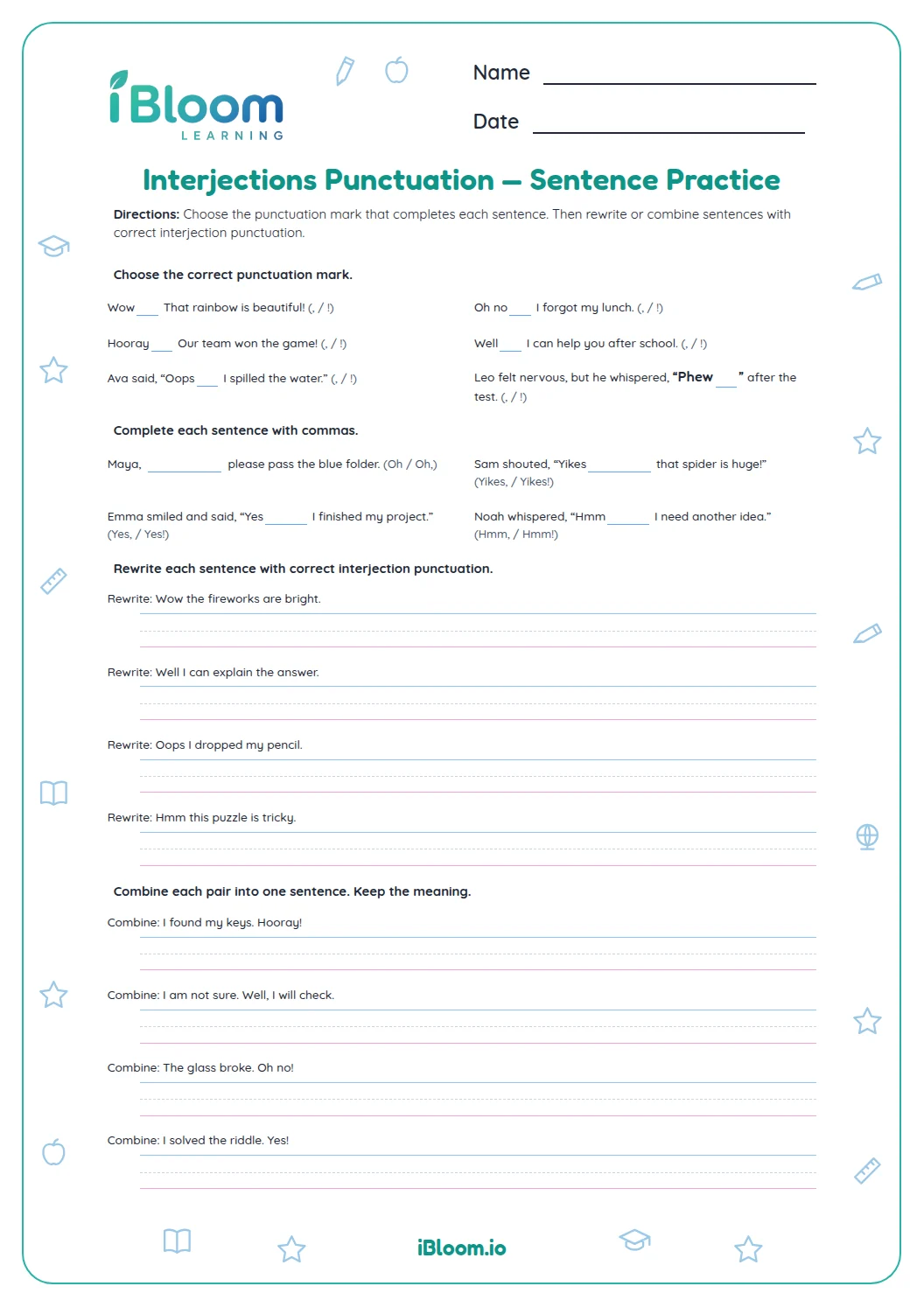
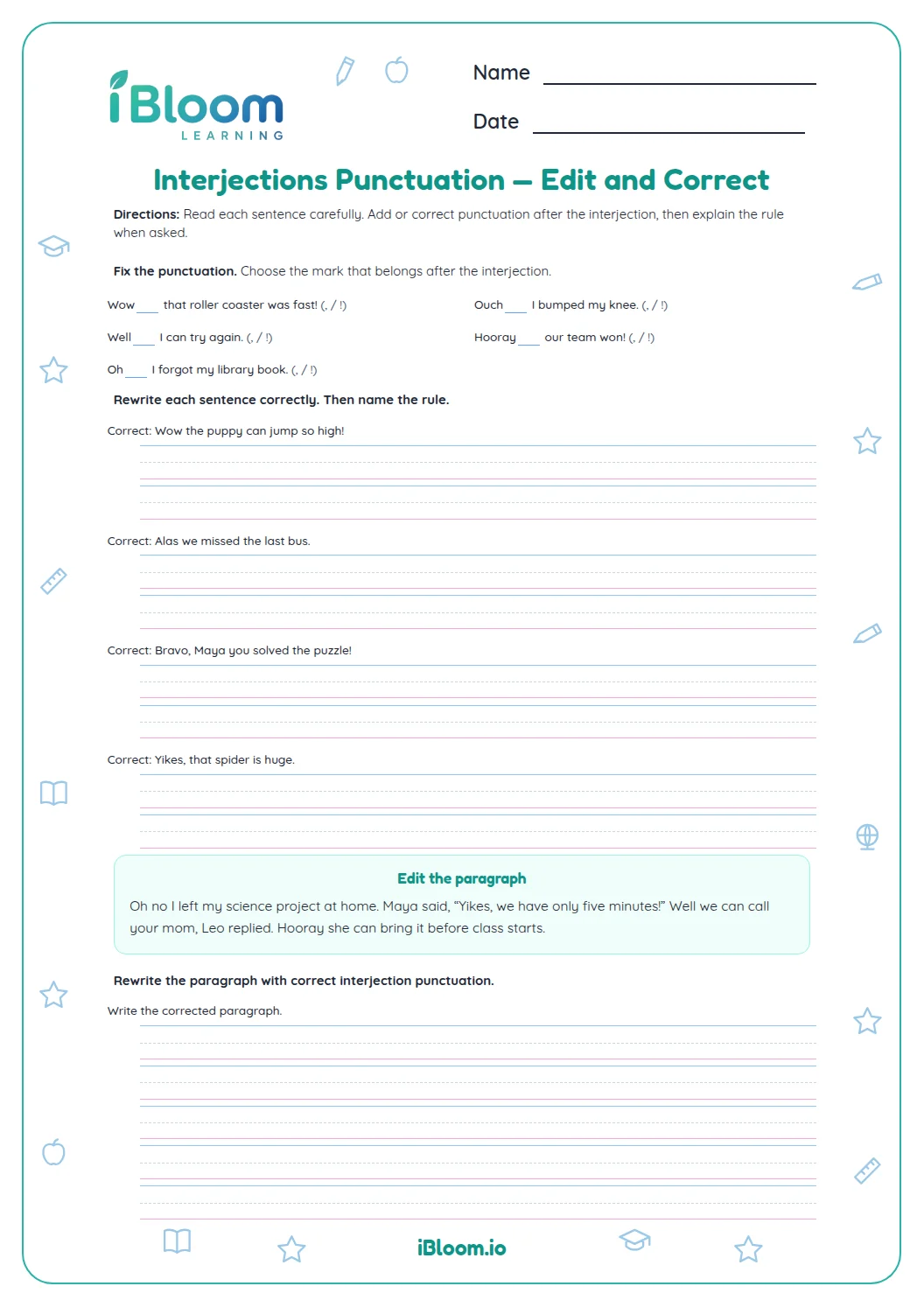
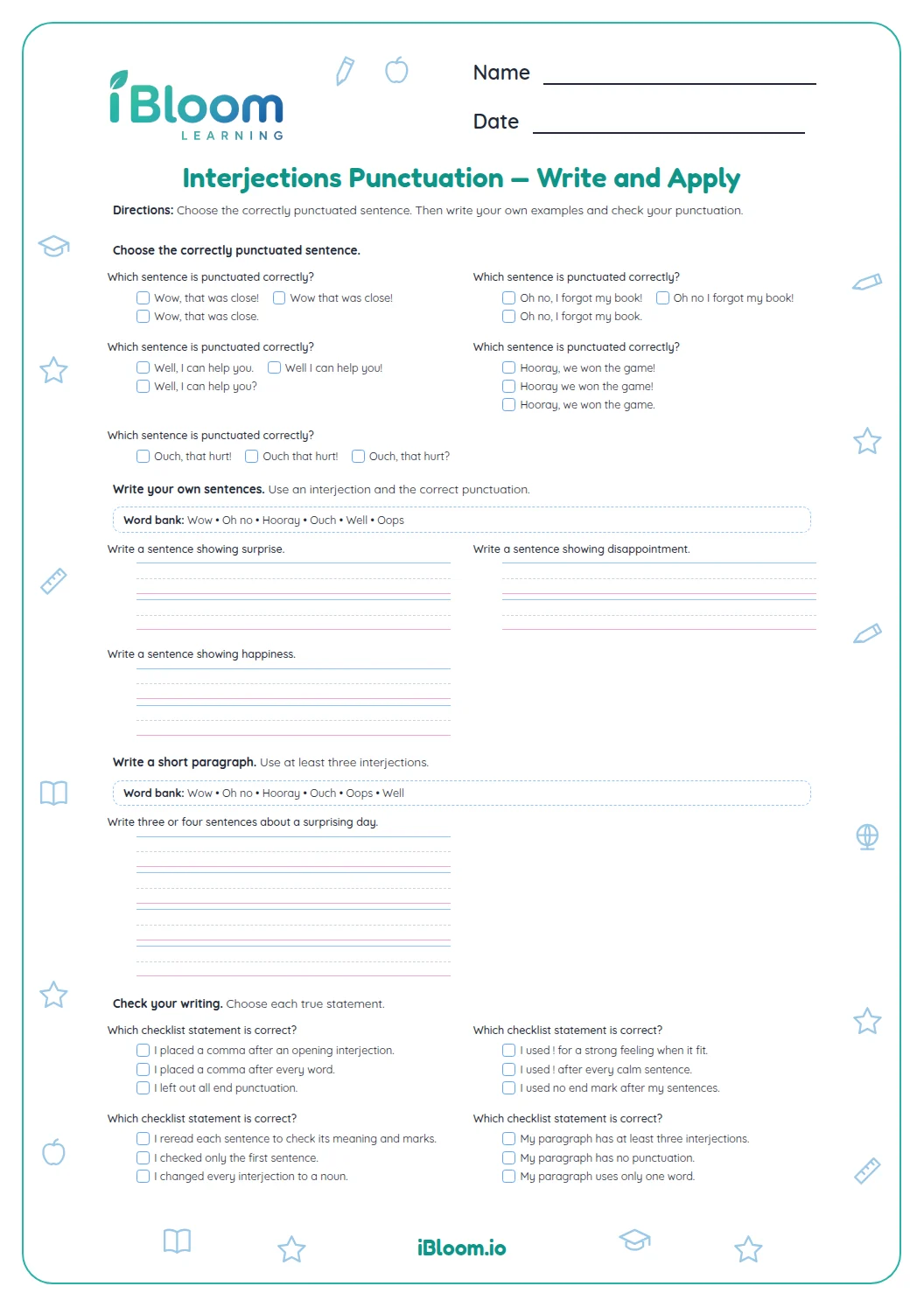
This Grade 5 printable has 14 questions about interjections and punctuation. Students choose a comma or exclamation point, check capitalization, and repair punctuation in context; a separate answer key gives the corrected forms.
How can students spot an interjection?
Questions 1–8 ask students to select punctuation after an opening interjection. Mild reactions take a comma; strong reactions may take an exclamation point.
When should an interjection take a comma or exclamation point?
Questions 9–14 check capitalization after interjections and punctuation in short sentence contexts.
How does the speaker’s feeling guide punctuation?
Students use the strength of a reaction to choose a comma or exclamation point, then check capitalization in the sentence that follows.
- 1Hmm ___ I am not sure.
- 2Answer: comma
How to use this worksheet
- 1Read the full sentence or situation.
- 2Find the word that expresses a reaction.
- 3For punctuation items, read the interjection aloud.
- 4Choose a comma for a mild opening or an exclamation point for a strong one.
- 5Check that the word’s feeling matches the context.
Common mistakes and quick fixes
The mistake
Choosing an exclamation just because a sentence is exciting.
The fix
Check whether the item asks for the word or its punctuation.
The mistake
Treating a reaction word as the noun it describes.
The fix
Ask whether the word names a thing or expresses a response.
The mistake
Choosing an interjection with the wrong feeling.
The fix
Match the word to the situation, such as mistake, praise, or relief.
What to practice next
Make more practice
Questions parents and teachers ask
What is an interjection?
An interjection is a word or short expression that shows a reaction or feeling. Examples on this sheet include Wow, Ouch, Well, Hooray, and Hmm. Students use the sentence around the word and its punctuation to decide whether the writing is clear and correct.
When should an interjection take a comma?
A mild opening such as “Well,” is commonly followed by a comma before the rest of the sentence. Question 2 uses that pattern. A comma separates the short reaction from the main thought that follows. Students can compare each mark with the speaker’s tone.
When does an interjection take an exclamation point?
A strong reaction can take an exclamation point, as in “Hooray! We won.” The next sentence begins with a capital letter. Questions 1, 3, 5, and 7 practice selecting that mark after a strong interjection. That pattern separates the reaction from the main sentence.
What happens in the final part?
Questions 9–14 ask students to choose sentence edits with correct punctuation after an interjection. They also check that the next word is capitalized after an exclamation point. The answer key gives each corrected form so students can review the rule.
How can students use the key?
Compare each selected sentence with the key. Reread the interjection and the words that follow to check that punctuation shows a clear pause or strong reaction. Ask why the chosen mark fits the speaker’s feeling and whether the next word needs a capital.