




About this worksheet
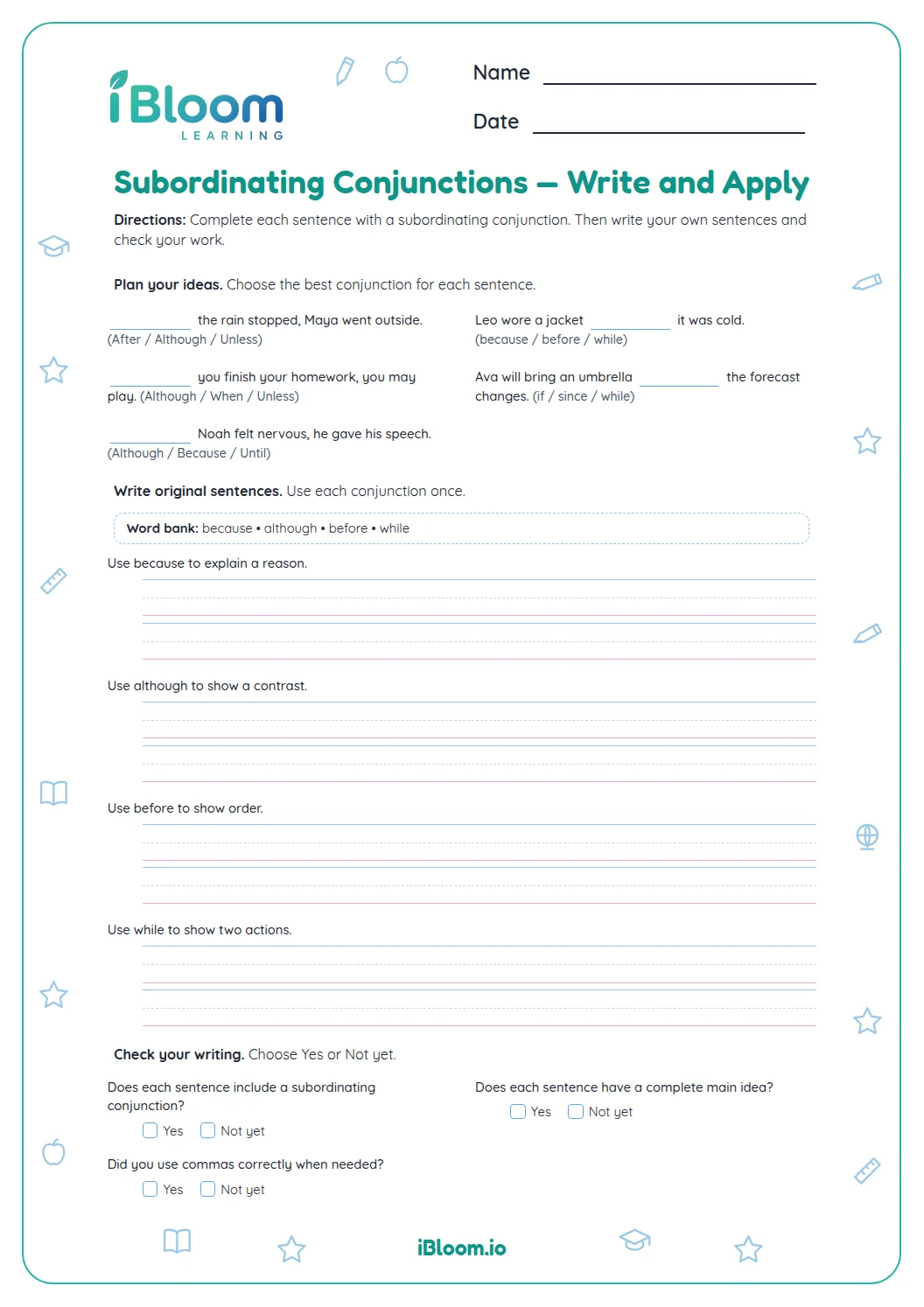
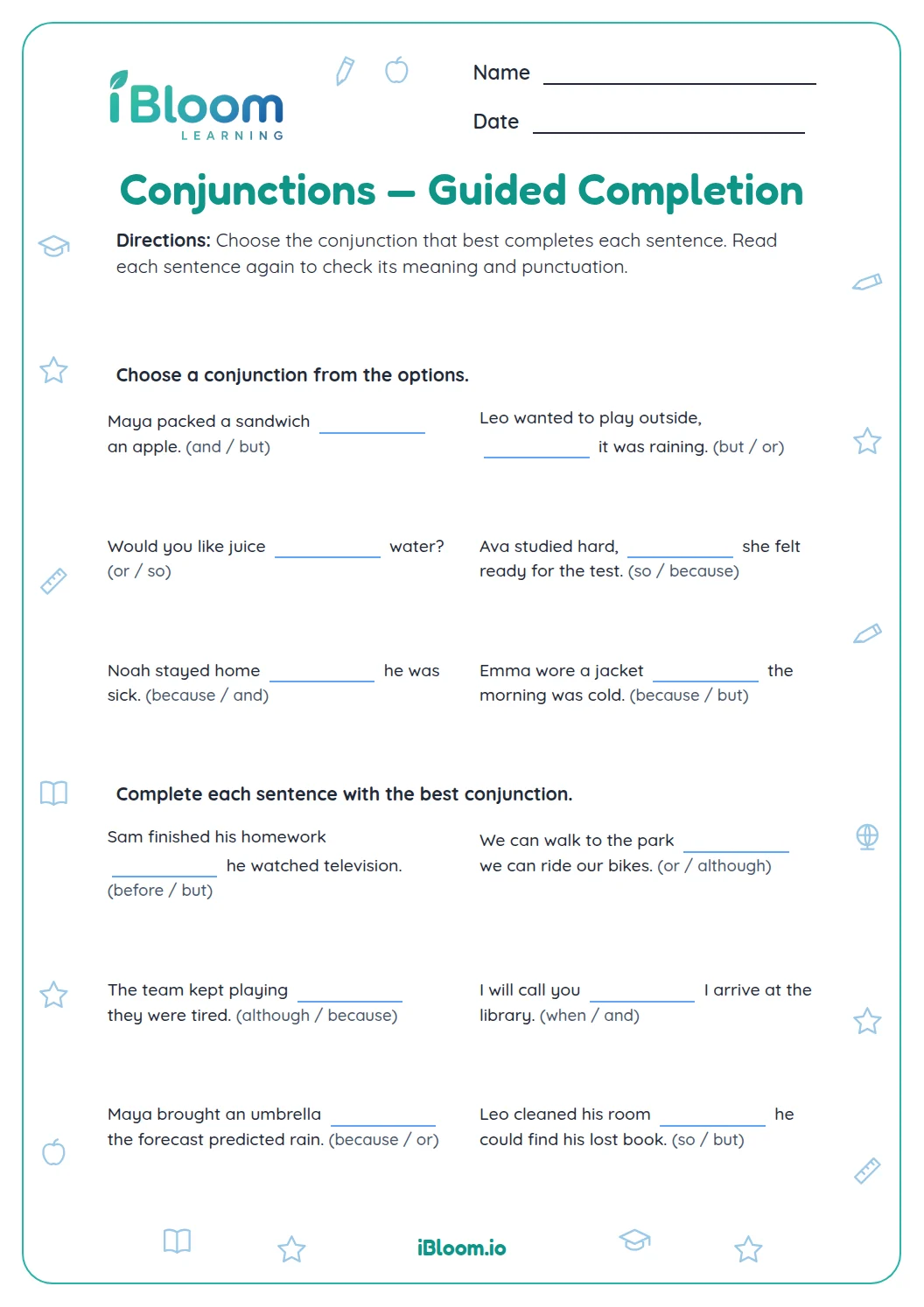
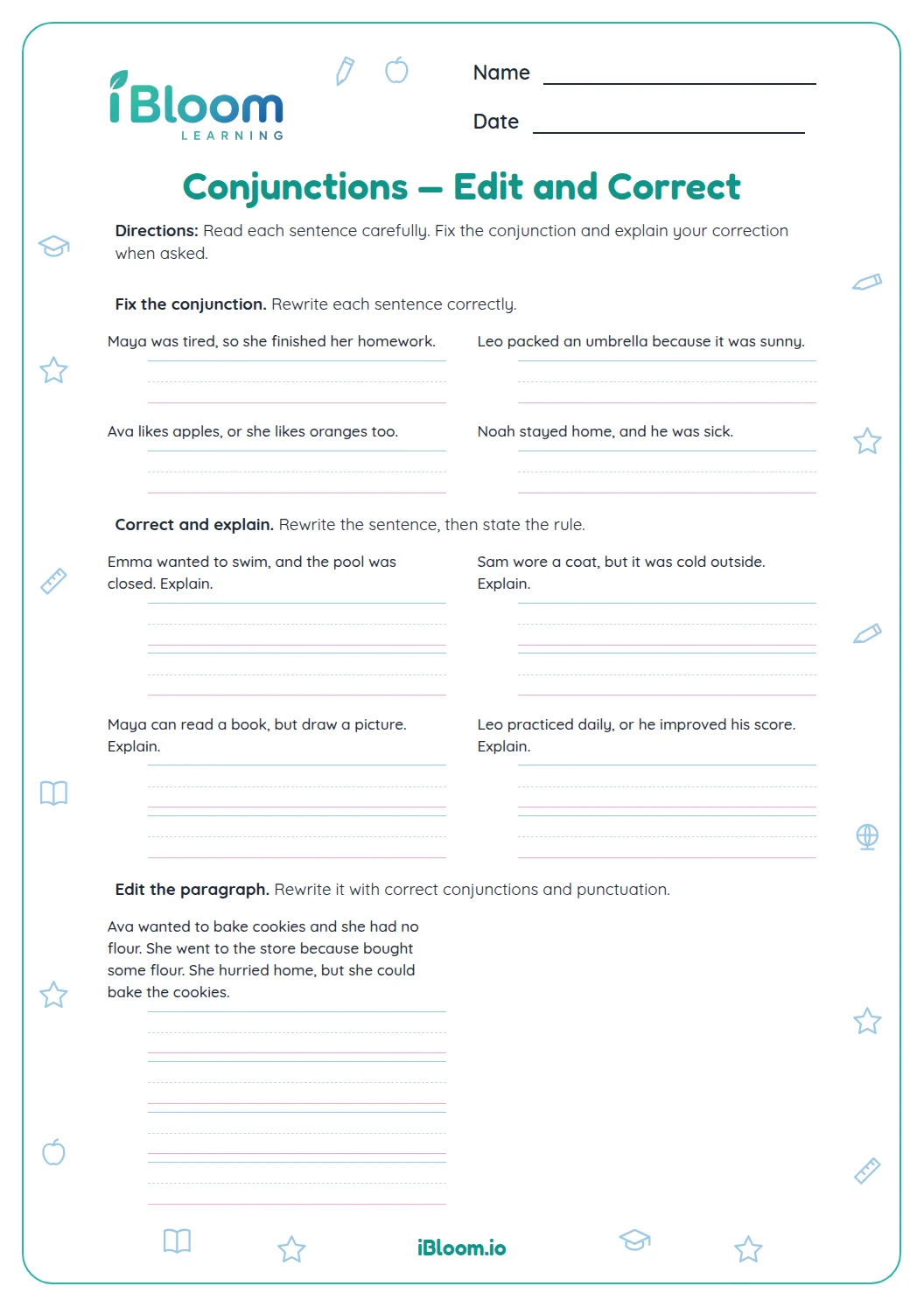
This Grade 5 worksheet practices subordinating conjunctions in two steps. Students use meaning cues to complete eight sentences, then copy the dependent clause from eight more. Cues such as “reason” and “contrast” make the intended relationship clear. The answer key provides each conjunction and clause. This work connects to CCSS L.5.1.a, which asks students to explain how conjunctions function in sentences.
Aligned to L.5.1.a
How does a subordinating conjunction connect ideas?
Words such as because, when, although, before, after, if, since and while can begin a dependent clause. The clause adds a reason, time, condition or contrast, but it does not make a complete sentence by itself.
Part A uses a cue in parentheses to name the relationship, so the conjunction choice is clear. For example, “The puppy barked because the doorbell rang” gives a reason. In Part B, students copy the entire dependent clause, including its conjunction.
- 1The puppy barked because the doorbell rang.
- 2because introduces the reason the puppy barked.
How can a reader find the dependent clause?
Find a subordinating conjunction, then read the words attached to it. Those words form the dependent clause. It may come before the main clause, as in “Although the path was muddy, we kept walking,” or after it, as in “Maya smiled after she finished her model.”
Copy the conjunction and all words in its clause, stopping where the main clause begins.
What practice is on the two parts?
The 16 questions use two parts: eight sentence completions with relationship cues and eight clause identifications. The answer key lists the conjunction or clause for each item.
How to use this worksheet
- 1Read the sentence aloud and notice the relationship between its ideas.
- 2Complete Part A by choosing the conjunction that makes the relationship clear.
- 3In Part B, locate a subordinating conjunction and copy its whole dependent clause.
- 4Check that the clause includes the conjunction and does not accidentally include the main clause.
- 5Use the key to review any sentence that was difficult to parse.
Common mistakes and quick fixes
The mistake
Copying only the conjunction in Part B.
The fix
Include the words attached to it that form the dependent clause.
The mistake
Treating a dependent clause as a complete sentence.
The fix
Read it alone; if it leaves the thought unfinished, find the main clause it depends on.
The mistake
Choosing a conjunction that changes the sentence relationship.
The fix
Ask whether the sentence shows a reason, time, condition or contrast.
Common Core alignment
This page connects the worksheet practice to the grade-level skills below.
Use conjunctions to connect words, phrases and clauses.
On this sheet: Questions ask students to use subordinating conjunctions and locate the clauses they introduce.
Show the official wordingHide the official wording
Explain the function of conjunctions, prepositions, and interjections in general and their function in particular sentences.
What to practice next
Make more practice
Further reading
Questions parents and teachers ask
What is a dependent clause?
A dependent clause has a subject and verb but does not express a complete thought by itself. In “because the doorbell rang,” the conjunction because signals that the clause needs a main clause. Part B asks students to copy the conjunction and the full dependent clause.
Which conjunctions appear in Part A?
Part A uses when, because, although, before, after, if, since and while. A parenthetical cue names the relationship, such as time, reason, contrast or condition, so students can choose a conjunction that fits. The answer key gives the intended word for every sentence.
How much should students copy in Part B?
Students should copy the subordinating conjunction and the words in its clause. For example, the clause in “Because the lights went out, we used a lantern” is “Because the lights went out.” The main clause begins after the comma.
Why can a dependent clause appear first or last?
A dependent clause can come before or after the main clause. When it comes first, a comma usually separates it from the main clause. When it comes last, the sentence often needs no comma, as in “Lena called her aunt after she got home.”
What is included with the worksheet?
The printable contains 16 questions across three worksheet pages, plus a separate answer key. Part A has eight cued sentence completions, and Part B has eight dependent-clause identifications. The key gives a response for every question for easy checking.