



About this worksheet
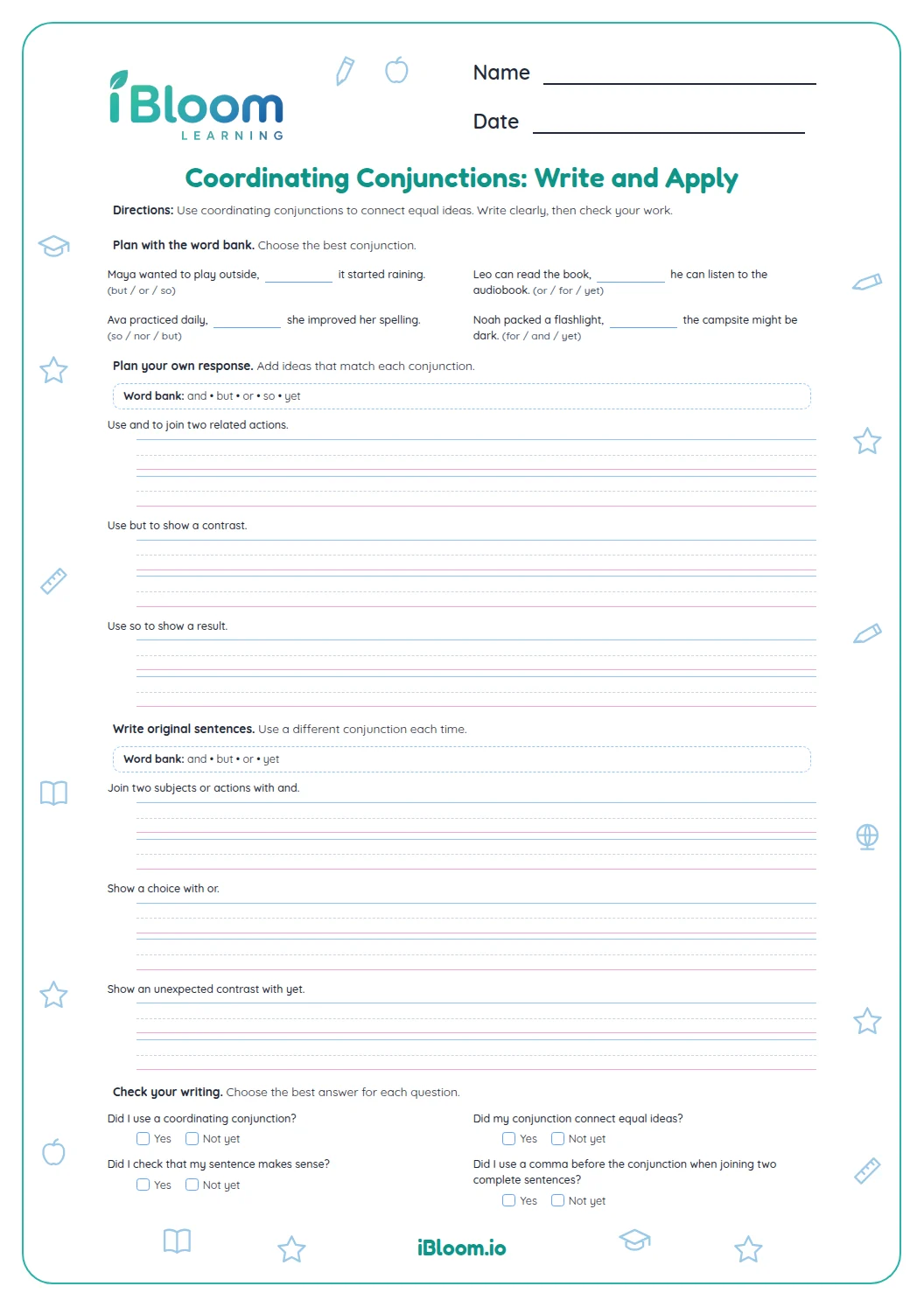
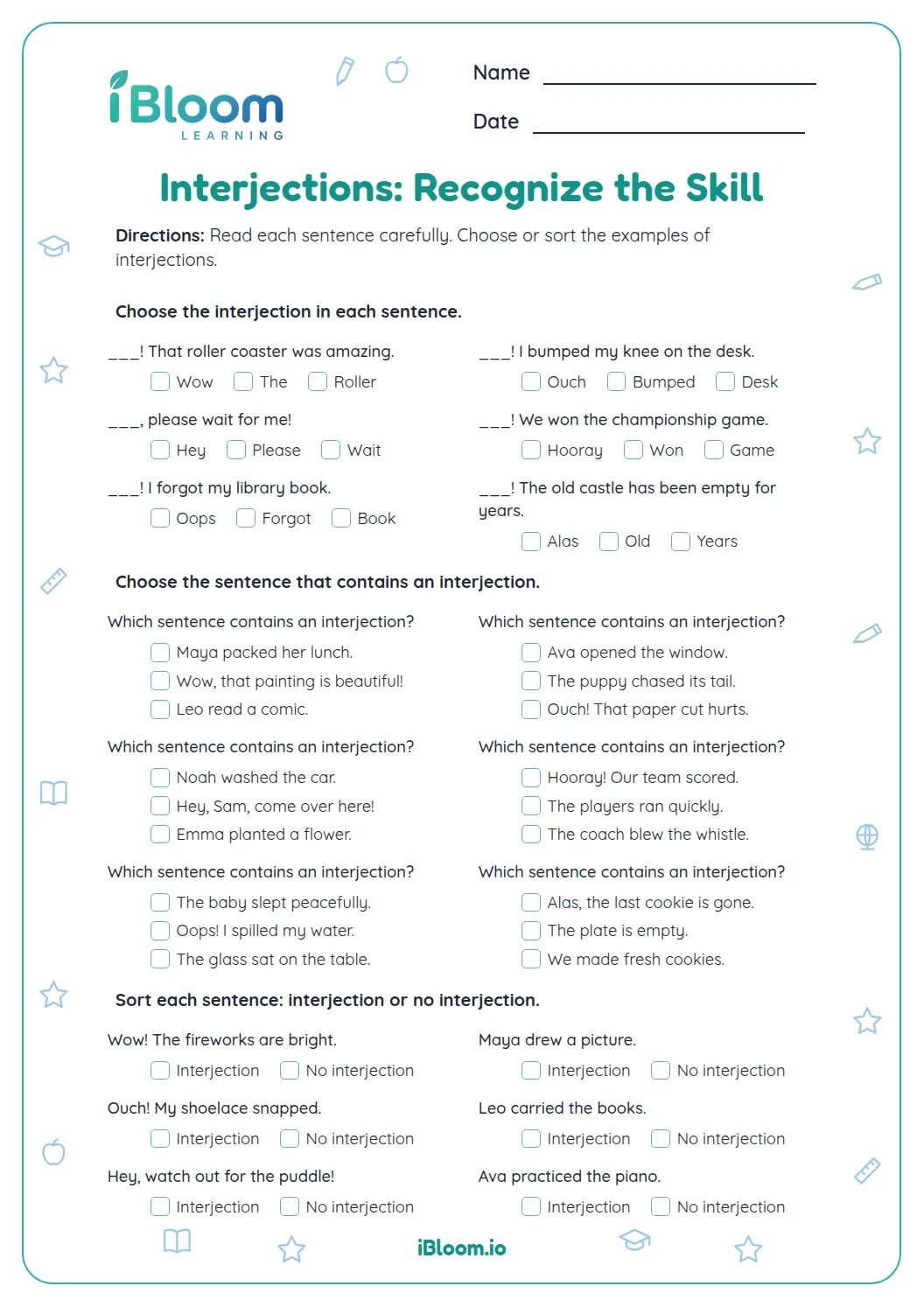
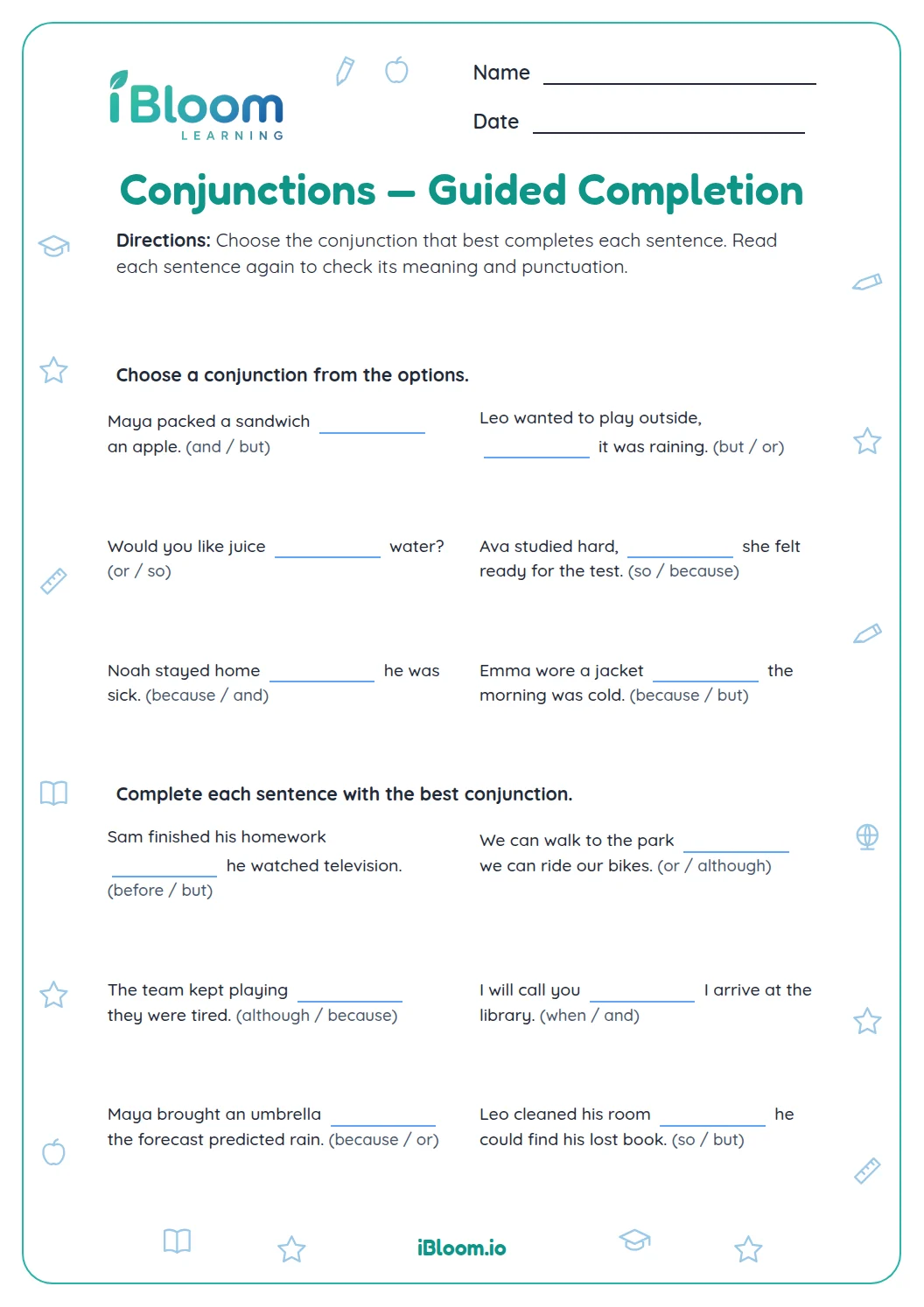
This free Grade 5 worksheet practices recognizing the seven coordinating conjunctions: for, and, nor, but, or, yet, and so. Students first locate the joining word in a sentence, then identify whether it adds information, offers a choice, gives a reason or result, or signals a contrast. A final item checks that a coordinating conjunction can join two complete thoughts. The 15 questions use short choices and a separate answer key. The page supports Common Core L.5.1a, which asks students to explain the function of conjunctions in sentences.
Aligned to L.5.1a
Which words are coordinating conjunctions?
The seven coordinating conjunctions are for, and, nor, but, or, yet, and so. Part A places each word in a sentence and asks students to identify it. Looking at the words on both sides helps show what the conjunction is joining.
How does a conjunction change the relationship between ideas?
A conjunction does more than connect words: it signals how ideas relate. “And” adds, “or” offers a choice, “but” and “yet” show contrast, “so” gives a result, “for” gives a reason, and “nor” adds a negative idea.
- 1Question: “What does but show?”
- 2Answer: “Contrast.”
- 3“But” links ideas that do not match expectations.
How can students recognize a complete conjunction join?
Question 15 asks students to pick a sentence in which a coordinating conjunction joins two complete thoughts. The comma before “and” separates the two independent clauses: “Maya sang, and Leo danced.”
How to use this worksheet
- 1Read the whole sentence before choosing a conjunction.
- 2Locate the word that links two words, phrases, or ideas.
- 3Ask what the second idea does: add, contrast, offer a choice, explain a reason, or show a result.
- 4For question 15, check that each side of the conjunction can stand as a complete thought.
- 5Use the answer key to name the relationship each word signals.
Common conjunction mistakes and quick fixes
The mistake
Choosing a word because it appears in the sentence, even when it is not a conjunction.
The fix
Check whether the word links ideas; the conjunction has a connecting job.
The mistake
Treating “but” and “yet” as words that show the same kind of relationship as “and.”
The fix
Both “but” and “yet” signal contrast, while “and” adds information.
The mistake
Calling every sentence with a conjunction a join of two complete thoughts.
The fix
Check for a subject and verb on both sides; a conjunction can also join two items.
Common Core alignment
This Grade 5 language practice asks students to explain how conjunctions function in sentences.
Explain what conjunctions do in general and in particular sentences.
On this sheet: Students identify coordinating conjunctions and the relationship each one signals.
Show the official wordingHide the official wording
Explain the function of conjunctions, prepositions, and interjections in general and their function in particular sentences.
What to practice next
Make more practice
Further reading
Questions parents and teachers ask
What are the seven coordinating conjunctions?
The coordinating conjunctions are for, and, nor, but, or, yet, and so. The worksheet includes all seven in Part A, with one sentence for each word. Students then connect each conjunction to the relationship it signals in Part B.
What does FANBOYS mean?
FANBOYS is a memory aid made from the first letters of for, and, nor, but, or, yet, and so. Students can use it to recall the list, then still read the sentence to decide what the conjunction means in that particular example.
How are “but” and “yet” alike?
Both “but” and “yet” can show a contrast between ideas. In question 13, the hill is steep, yet the hikers reach the top. The second idea contrasts with what a reader might expect after hearing that the hill is steep.
What relationship does “so” show?
“So” introduces a result. In question 11, the bell rings, so the students line up. The bell is the event, and lining up is what happens next as a result. Students should use the meaning of both clauses to confirm the answer.
Does every conjunction join two complete sentences?
No. A coordinating conjunction can connect individual words or phrases, as in “apples and oranges,” or it can connect two complete thoughts. Question 15 asks students to recognize the second pattern; the other examples also include lists and shorter parts of sentences.