


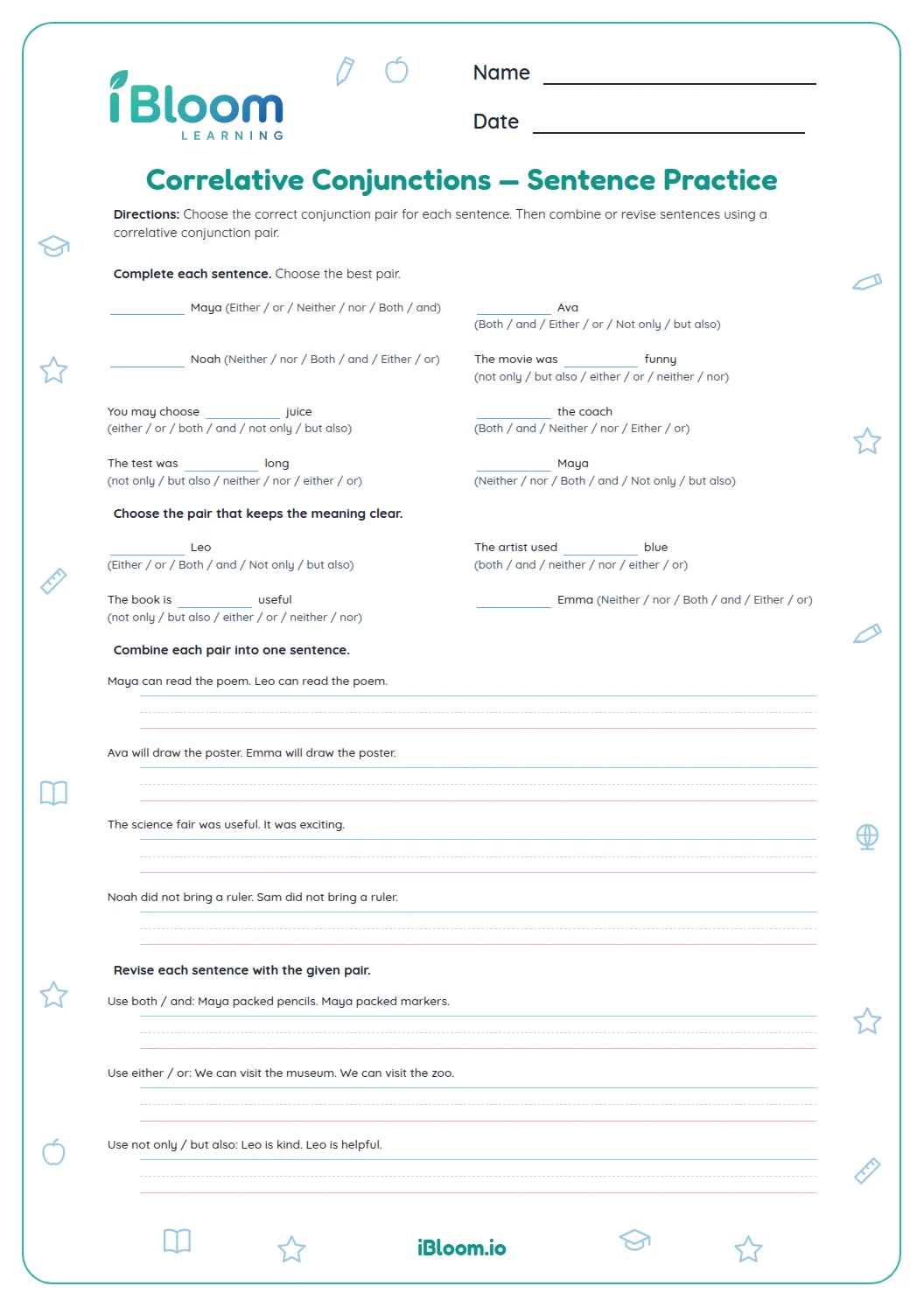
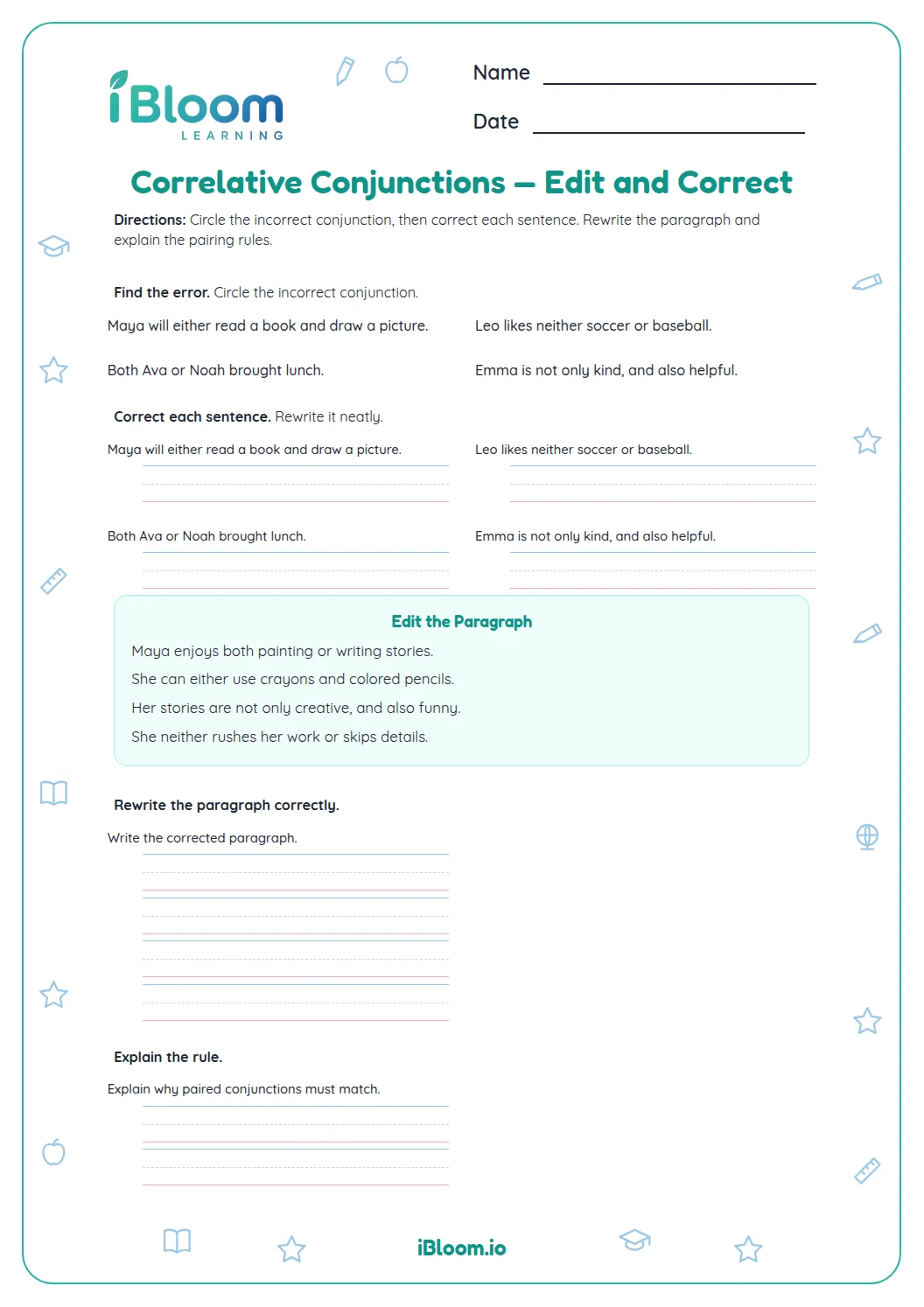


About this worksheet
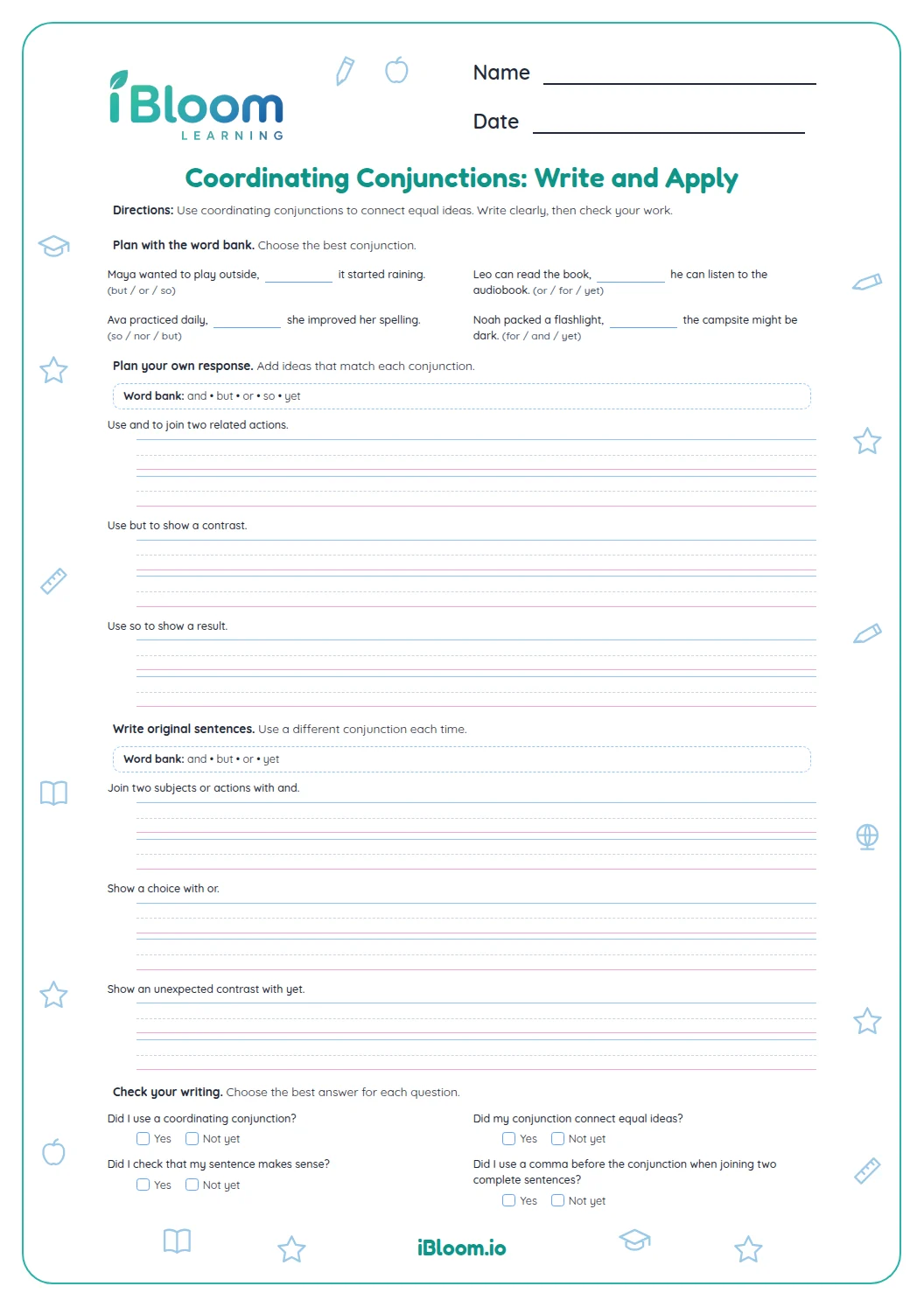
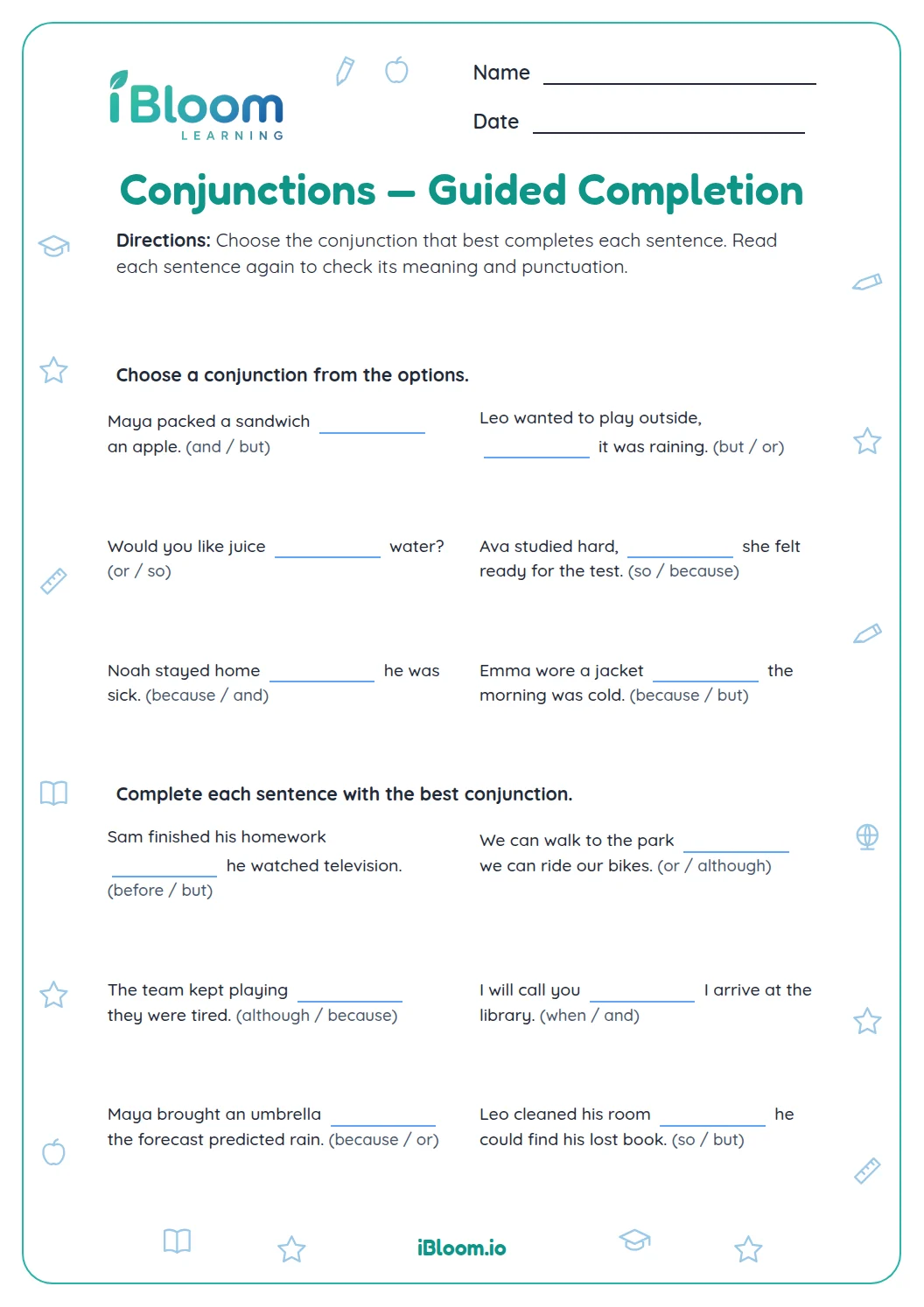
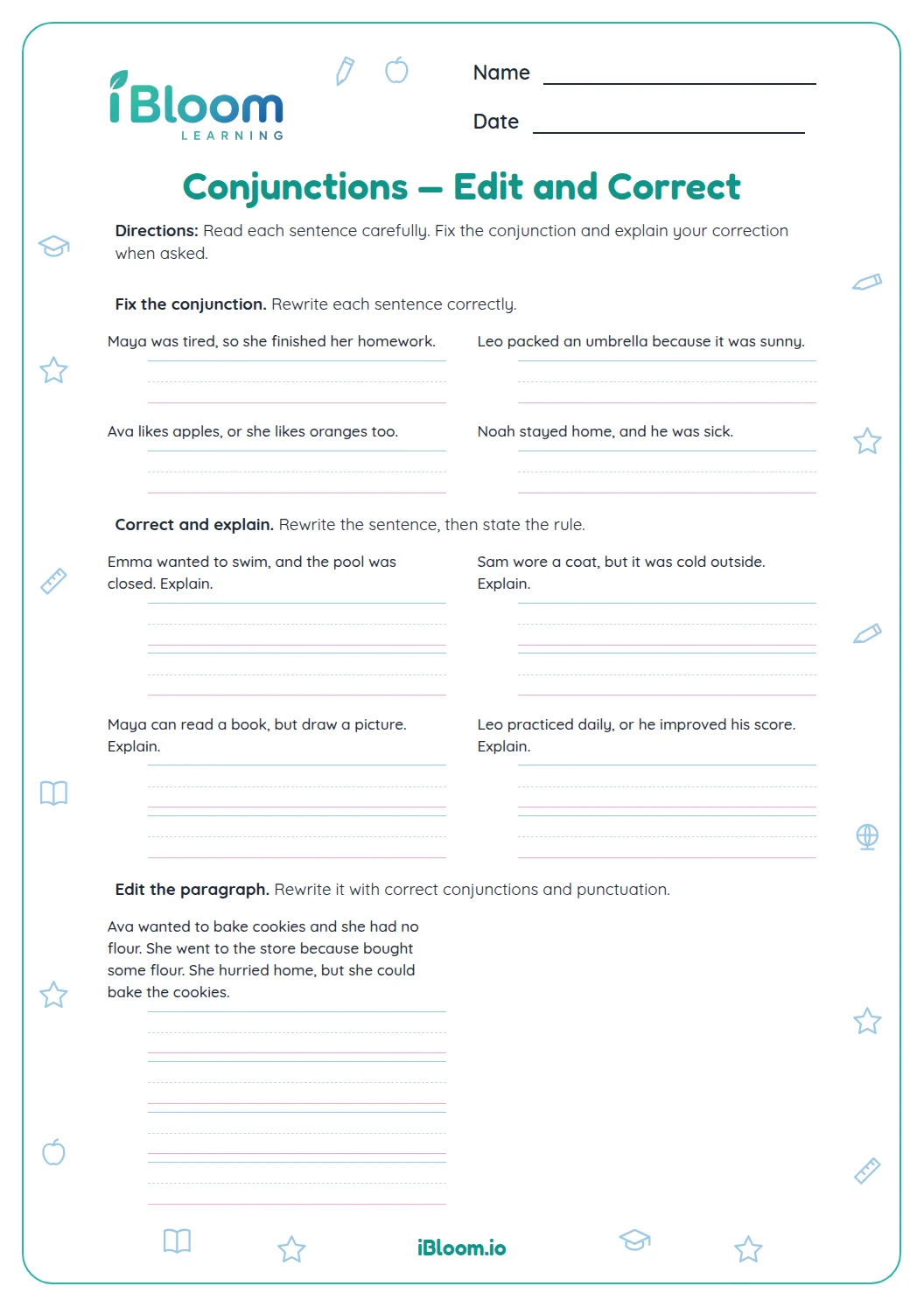
This Grade 5 worksheet gives students 16 sentences to edit and complete with coordinating conjunctions. Children choose a conjunction that matches the relationship between ideas, add commas where two independent clauses are joined, and apply the skill in sentence revisions. A separate key shows the expected edits and sample corrections.
Aligned to L.5.1.a
How do you choose a coordinating conjunction?
Part A asks students to complete sentences with a conjunction that matches the meaning. Look at how the two ideas relate before choosing and, but, or, so, or yet.
Where does the comma go?
Part B focuses on punctuation before a conjunction joining two complete thoughts. A comma does not belong between two nouns or actions in a single clause.
- 1The soup was hot, ___ I tasted it carefully.
- 2The ideas contrast, so yet fits the meaning.
- 3Correct: The soup was hot, yet I tasted it carefully.
How can you revise a sentence clearly?
Part C applies conjunction and comma choices in context. Read the revised sentence aloud and check that it keeps the intended relationship between ideas.
How to use this worksheet
- 1Read both ideas before choosing a conjunction.
- 2Name the relationship: addition, choice, contrast, or result.
- 3Check whether each side of the conjunction is a complete thought.
- 4Add a comma before the conjunction when it joins two independent clauses.
- 5Reread the corrected sentence for meaning and punctuation.
Common mistakes and quick fixes
The mistake
Putting a comma before and when it joins two nouns.
The fix
Use no comma when the conjunction joins words in one clause.
The mistake
Choosing a conjunction that changes the relationship between ideas.
The fix
Decide whether the ideas add, contrast, offer a choice, or show a result.
The mistake
Leaving out the comma between two independent clauses.
The fix
Check for a subject and verb on each side of the conjunction, then add the comma.
Common Core alignment
Students use coordinating conjunctions to join words and ideas, including independent clauses with correct punctuation.
Use and, but, or, so, and yet to connect ideas and punctuate joined independent clauses.
On this sheet: The worksheet questions practice this skill directly.
Show the official wordingHide the official wording
Explain the function of conjunctions, prepositions, and interjections in general and their function in particular sentences.
What to practice next
Make more practice
Further reading
Questions parents and teachers ask
What are coordinating conjunctions?
Coordinating conjunctions connect words, phrases, or independent clauses. This worksheet practices and, but, or, so, and yet in sentences where the relationship between ideas helps determine the best choice. The answer key lets students check the conjunction choice, comma placement, and sentence meaning.
When should a comma come before a conjunction?
Use a comma when a coordinating conjunction joins two independent clauses, each with its own subject and verb. Do not add one just because and connects two words or actions in a single clause. The answer key lets students check the conjunction choice, comma placement, and sentence meaning.
How many sentences does the worksheet include?
There are 16 questions across three parts. Students choose conjunctions, add comma punctuation, and revise sentences to practice the same skill in several sentence contexts. The answer key lets students check the conjunction choice, comma placement, and sentence meaning.
Can more than one conjunction sometimes fit?
Some sentences can take different conjunctions if their meaning changes. For each item, read the relationship between the ideas and use the key’s intended meaning; written corrections should preserve the sentence’s logic. The answer key lets students check the conjunction choice, comma placement, and sentence meaning.
What does the answer key show?
The answer key gives the conjunction or punctuation for each item and provides corrected sentences where students revise. For open sentence edits, accept wording that is grammatical and keeps the intended meaning. The answer key lets students check the conjunction choice, comma placement, and sentence meaning.