


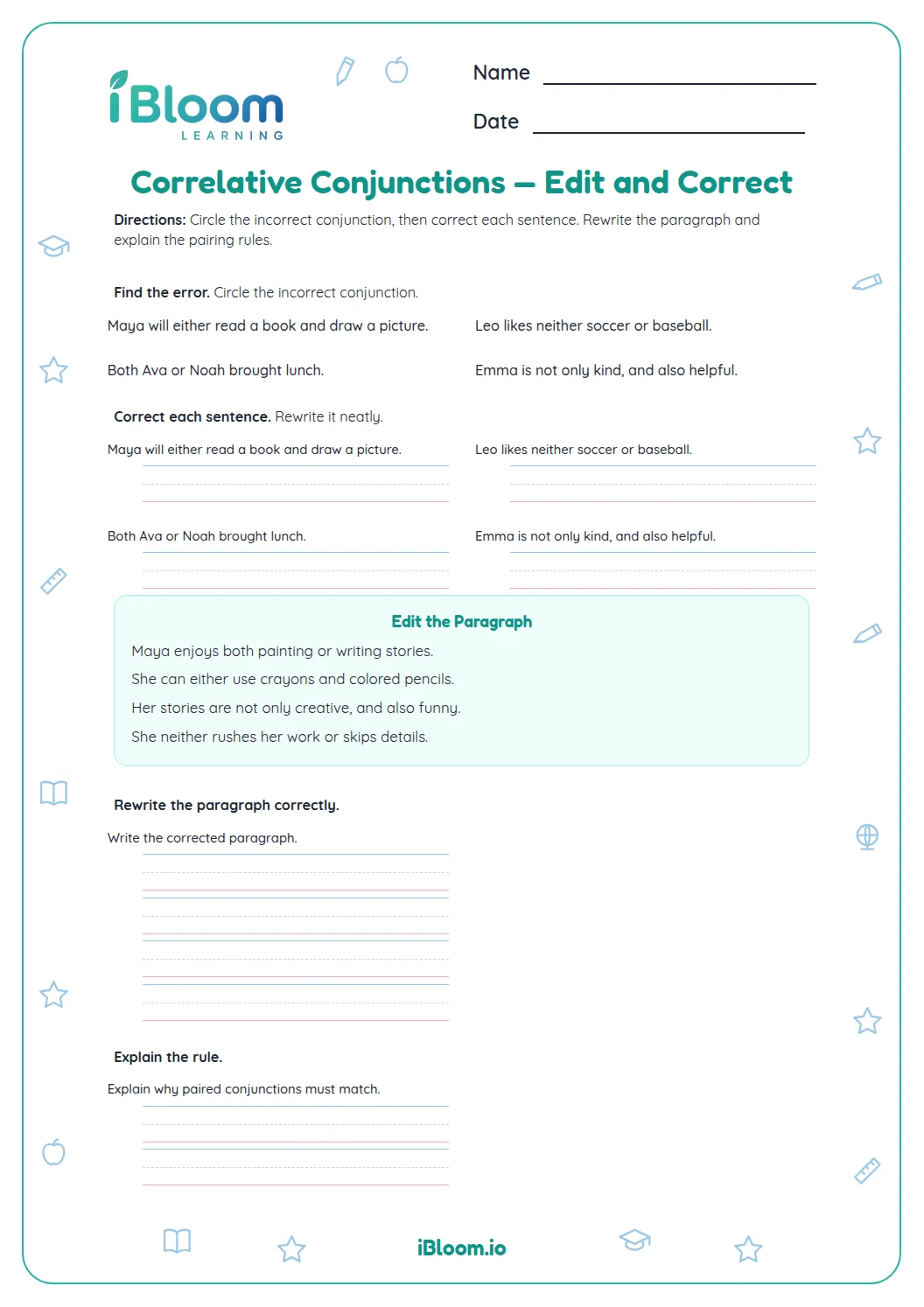
About this worksheet
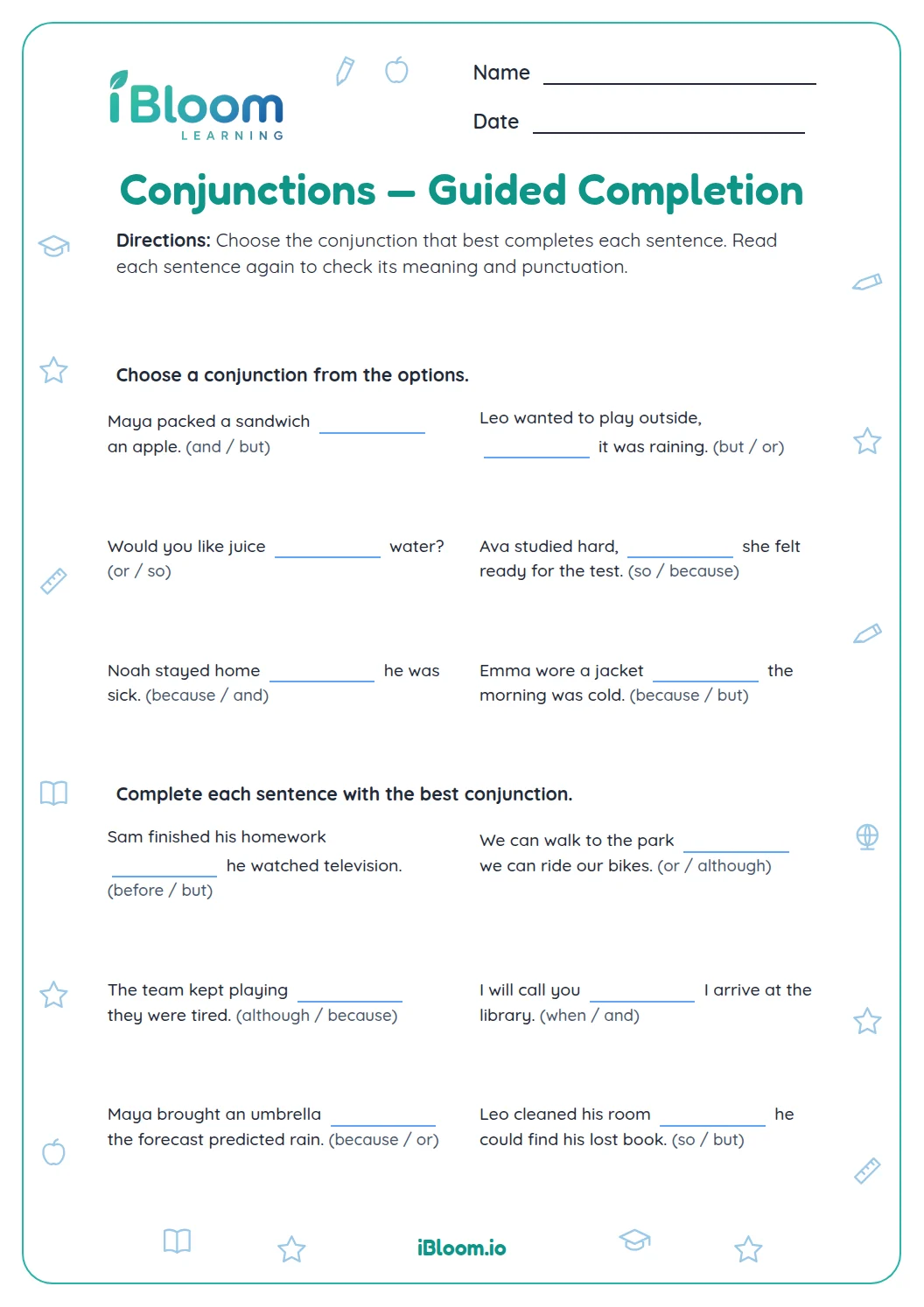
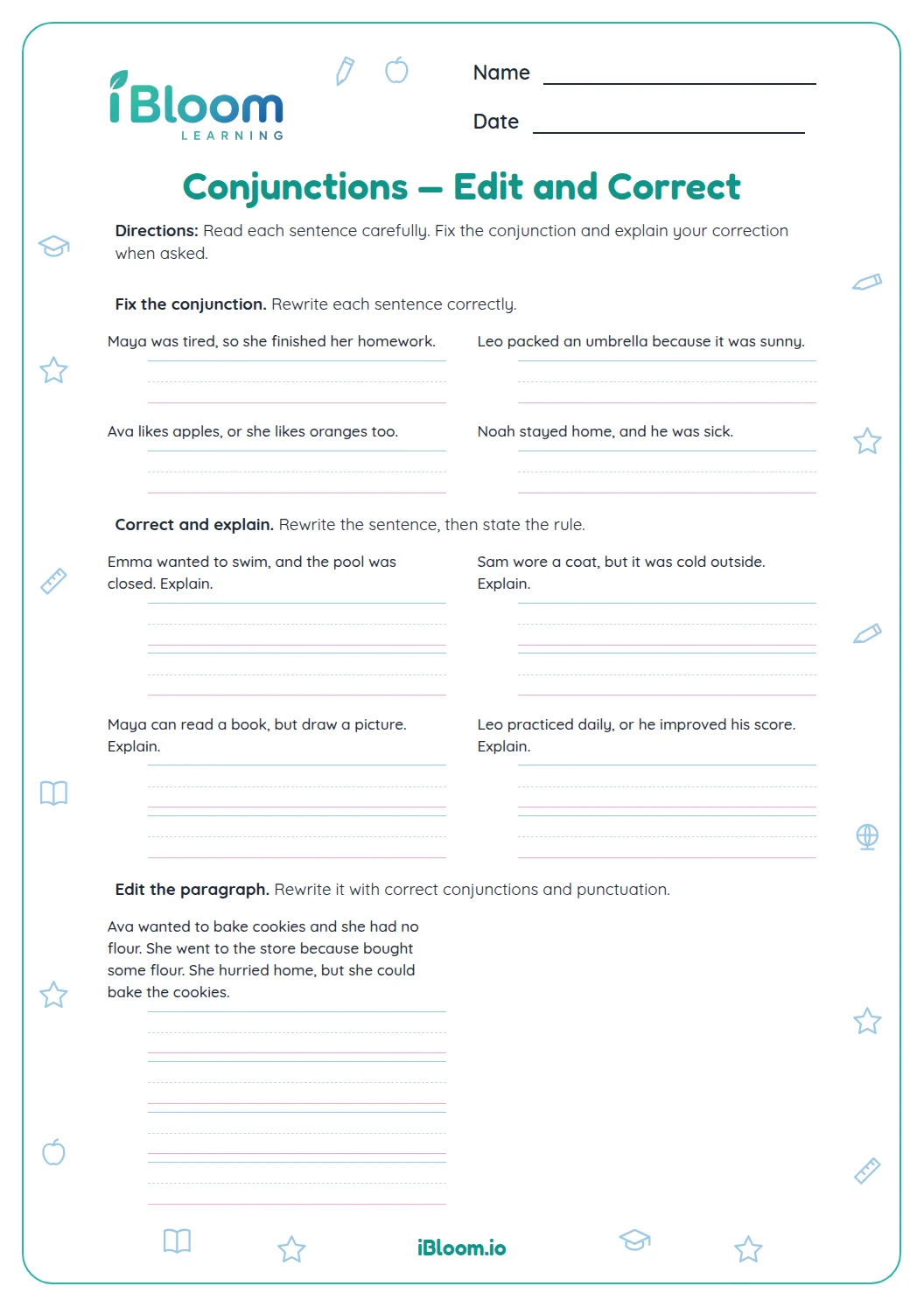
This Grade 5 grammar worksheet focuses on conjunctions in sentences. Children choose a connector that shows addition, choice, time, reason, result, or contrast, then write and explain sentence connections. The 14 questions use complete sentence contexts, with a mix of selected responses and written practice. A separate key provides the choices and sample sentences. It aligns with CCSS L.5.1.a, which asks students to explain conjunctions’ function in particular sentences.
Aligned to L.5.1.a
How does a conjunction connect ideas?
A conjunction links words, phrases, or clauses. The best choice depends on the relationship: and adds, or offers a choice, because gives a reason, and so can introduce a result.
- 1The trail was muddy, ___ we wore boots.
- 2The second idea is a result.
- 3“So” connects the muddy trail to wearing boots.
How can you choose between conjunctions?
Read both sides of the blank, then name their relationship. For contrast, although may fit; for a reason, because may fit. Check that the complete sentence makes sense.
What will students practice?
The 14 items include 12 multiple-choice sentence completions and two written responses: one to join ideas and one to explain the role of because.
How to use this worksheet
- 1Read both clauses before looking at the options.
- 2Name the relationship: addition, choice, time, reason, result, or contrast.
- 3Try the conjunction and reread the full sentence.
- 4For written answers, include both ideas and check punctuation.
Common mistakes and quick fixes
The mistake
Choosing by habit instead of meaning.
The fix
Name the relationship between the two clauses first.
The mistake
Using a connector that changes the intended relationship.
The fix
Reread the whole sentence and confirm its meaning.
The mistake
Writing only one clause for the sentence task.
The fix
Include both ideas and connect them with a conjunction.
Curriculum alignment
Explain how conjunctions connect words, phrases, or clauses in sentences.
On this sheet: The questions directly practice this skill.
Show the official wordingHide the official wording
Explain the function of conjunctions, prepositions, and interjections in general and their function in particular sentences.
What to practice next
Further reading
Questions parents and teachers ask
What kinds of relationships do conjunctions show here?
The worksheet practices addition, choice, time, reason, result, and contrast. Signal words such as and, or, before, because, so, and although help a reader understand how two ideas relate. Read the entire sentence aloud to hear whether the connection is clear.
Why can more than one conjunction sometimes fit?
Some connectors can make a sentence grammatical while changing its meaning. Read both clauses and choose the option that matches the intended relationship, such as a reason, result, time order, or contrast. Read the entire sentence aloud to hear whether the connection is clear.
What should a complete response include?
For the sentence task, include both ideas and a conjunction that connects them clearly. Check punctuation, capitalization, and whether the finished sentence communicates the intended relationship. The final explanation item should name the reason that because introduces, linking it to the main idea.
How many questions are included?
There are 14 items: 12 sentence-completion choices and two written responses. The first group practices selecting connectors in context; the final items ask children to create and explain a connection. Read the entire sentence aloud to hear whether the connection is clear.
How can a child explain the word “because”?
Because introduces a reason. In “I stayed home because it snowed,” the snow explains why the speaker stayed home. The question asks children to state that relationship in their own words. Read the entire sentence aloud to hear whether the connection is clear.