



About this worksheet
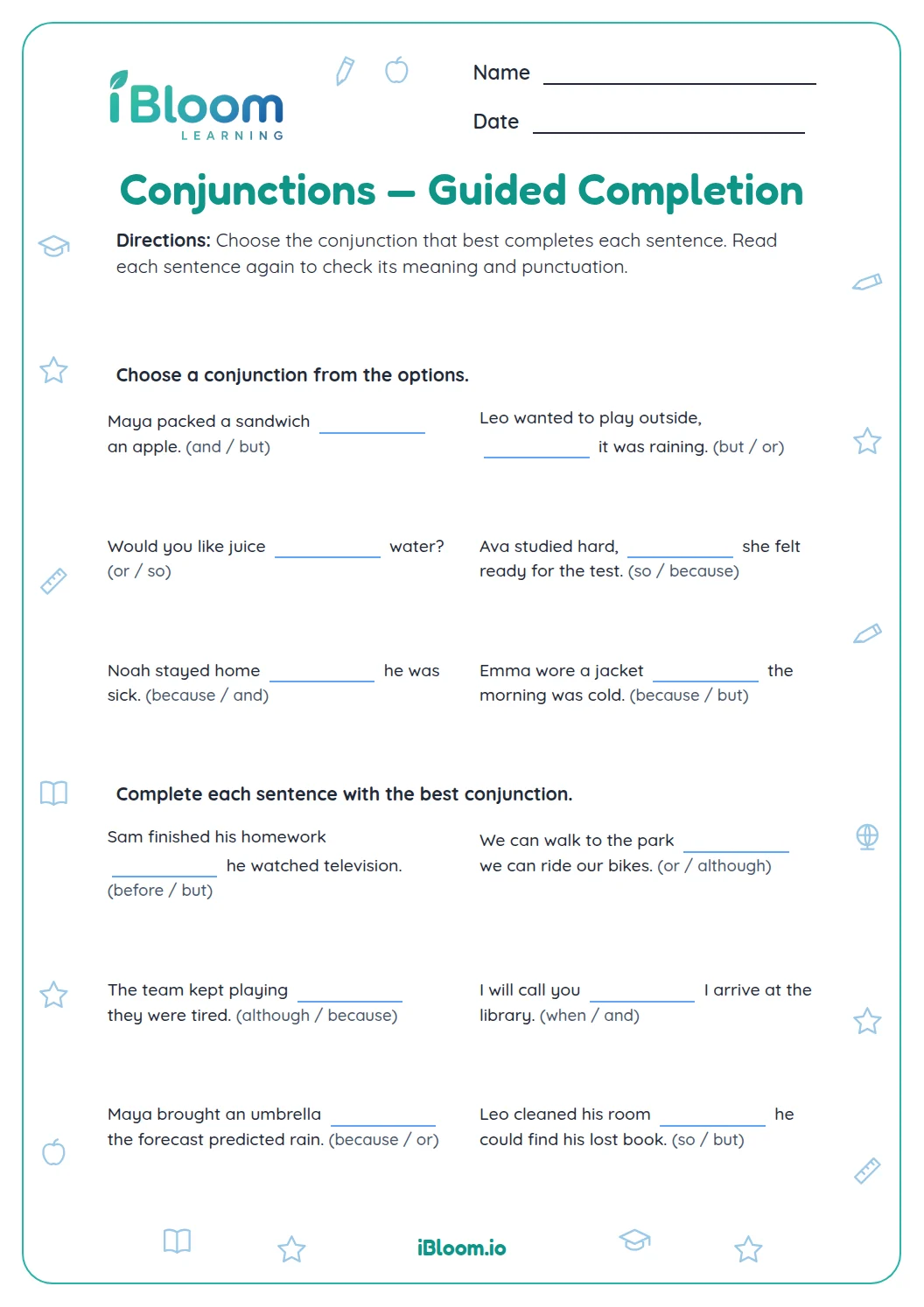
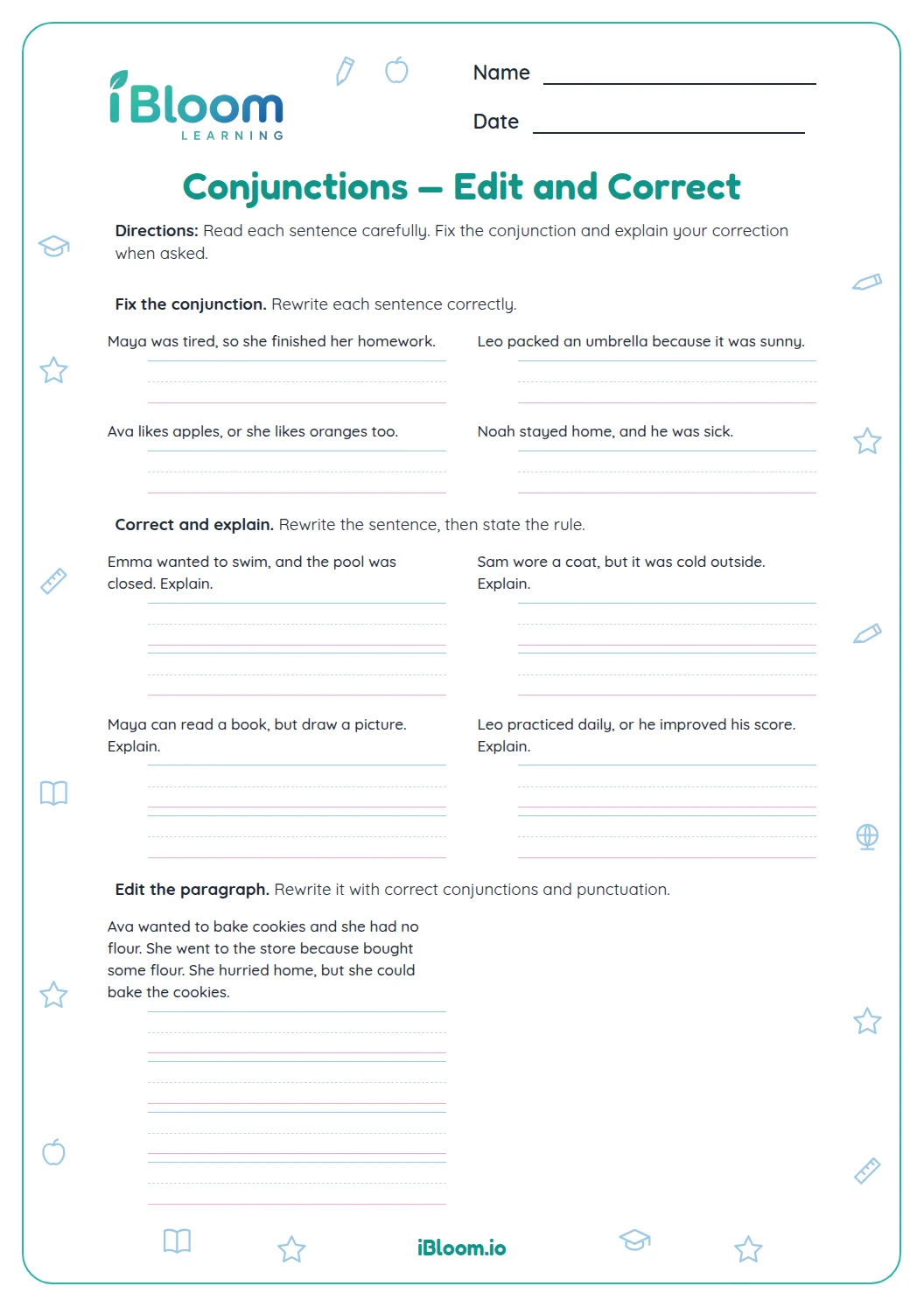
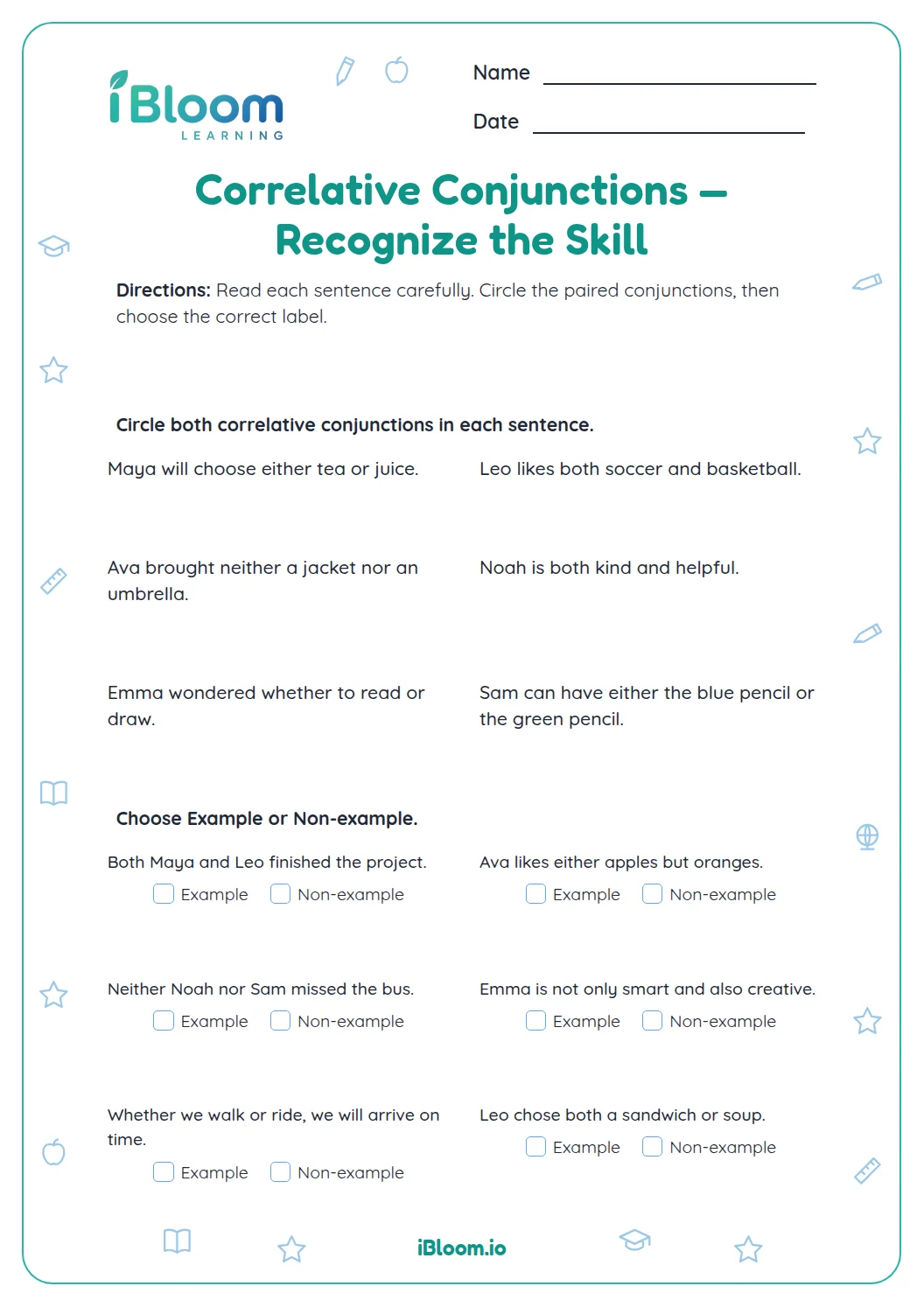
This Grade 5 worksheet practices recognizing conjunctions in complete sentences. Students circle conjunctions, decide whether a sentence contains one, and choose the joining word in a sentence. The questions include coordinating and subordinating conjunctions such as and, but, because, until, and when. It supports CCSS L.5.1.a by focusing attention on how conjunctions connect words and ideas. The separate answer key marks the conjunction or classification for each item.
Aligned to L.5.1.a
How do students spot a conjunction?
Part A presents short sentences and asks students to circle the conjunction. Words such as and, because, or, and but connect words or ideas.
How can a reader tell if a sentence has one?
Part B asks whether each complete sentence contains a conjunction. Comparing sentences with and without a joining word helps students notice the role the word plays.
- 1Rain fell, and puddles formed.
- 2Answer: Conjunction; and links the two ideas.
Which word joins the ideas?
Part C gives a sentence and asks students to identify its conjunction. Reading the whole sentence helps distinguish the joining word from the nouns and verbs around it.
How to work through the page
- 1Read the entire sentence once.
- 2Look for a word that connects words, phrases, or ideas.
- 3Circle the conjunction in Part A.
- 4In Part B, decide whether the sentence has a connecting word.
- 5In Part C, compare the choices with the sentence and check the key.
Common conjunction mix-ups
The mistake
Choosing a noun or verb instead of the conjunction.
The fix
Ask which word links the other words or ideas.
The mistake
Marking every sentence as having a conjunction.
The fix
Check whether a connecting word is actually present; some sentences contain none.
The mistake
Missing a conjunction at the start of a sentence.
The fix
Scan the whole sentence, including its first word, for connectors such as after or when.
Common Core alignment
The sentence work focuses on the function of conjunctions.
Explain the function of conjunctions within sentences.
On this sheet: Students recognize conjunctions and use the sentence context to identify how they connect ideas.
Show the official wordingHide the official wording
Explain the function of conjunctions, prepositions, and interjections in general and their function in particular sentences.
What to practice next
Make more practice
Further reading
Questions parents and teachers ask
What kinds of conjunctions appear on the page?
A conjunction connects words, phrases, or clauses. Students circle examples such as and and because, classify sentences that contain a conjunction, and identify the connector in a complete sentence. The answer key names the conjunction or gives the sentence classification for every item.
How many questions are included?
The 20 questions use three formats. Part A has four short sentences to mark, Part B has eight sentences to classify, and Part C has eight multiple-choice items asking for the connecting word. The key follows the same order as the worksheet.
What is a conjunction’s job?
A conjunction joins words, phrases, or clauses. In “I was tired, so I rested,” so connects two clauses and shows a result. In “tea or cocoa,” or connects two choices. Reading the complete sentence helps reveal that relationship.
What should a student do when two choices seem possible?
Read the full sentence and look for a word that links words or ideas. In Part B, choose “No conjunction” when there is no joining word. In Part C, compare each choice with the sentence and select the connector.
How can I check the short-answer items?
The key lists the conjunction for each circle or identification item and marks whether each Part B sentence contains a conjunction. For a useful review, ask the student to point to the joined words or ideas in one example.