

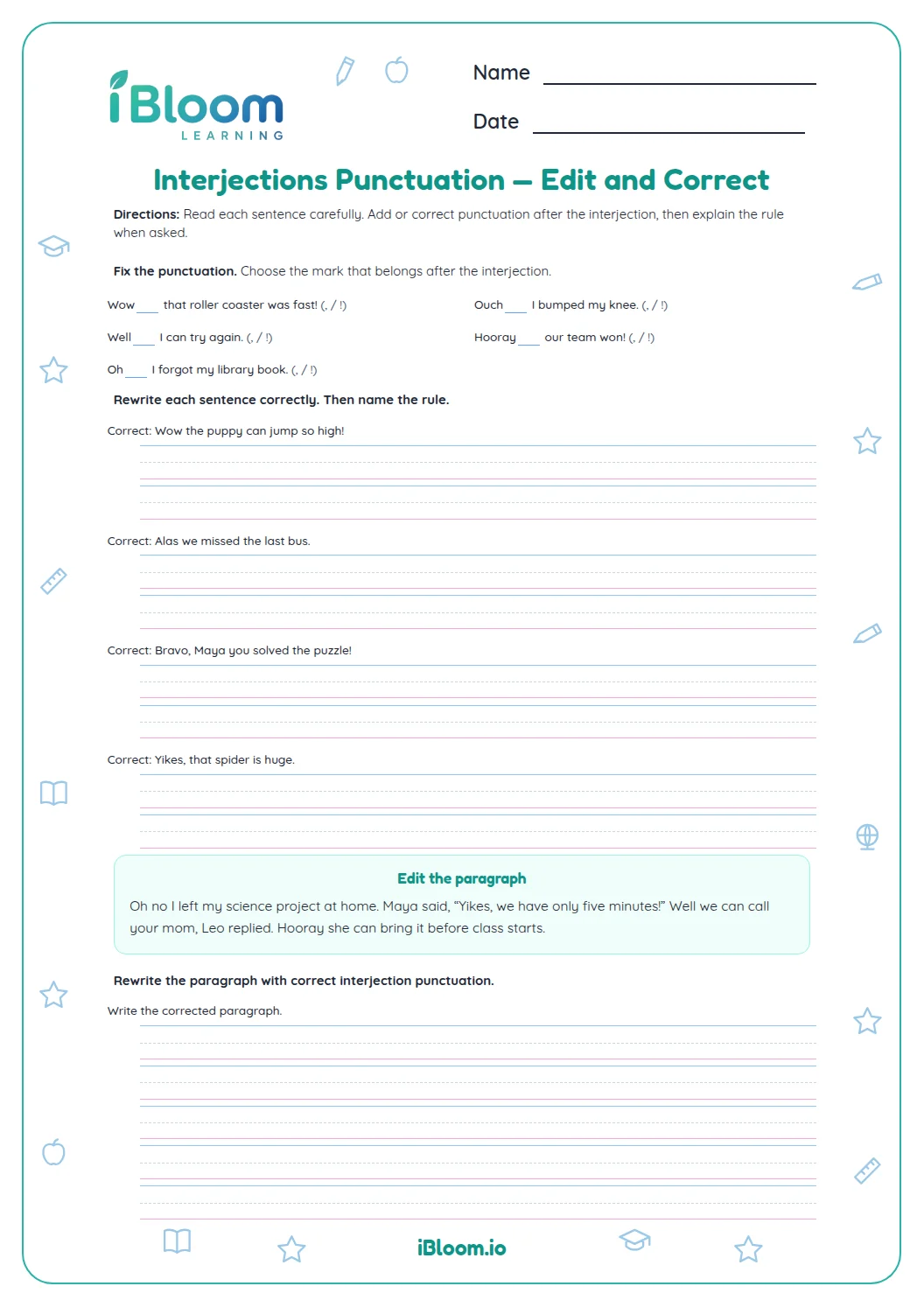

About this worksheet
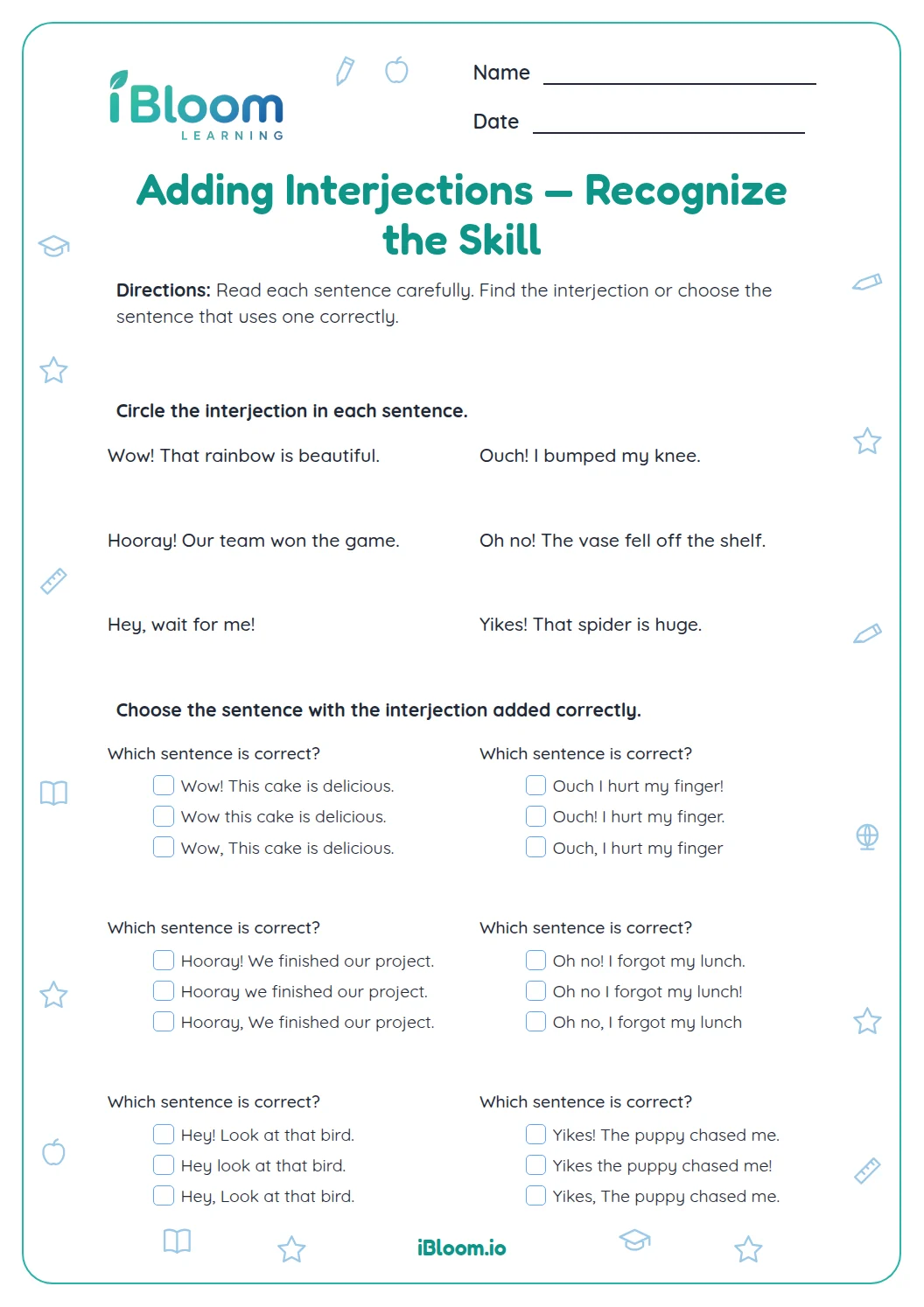
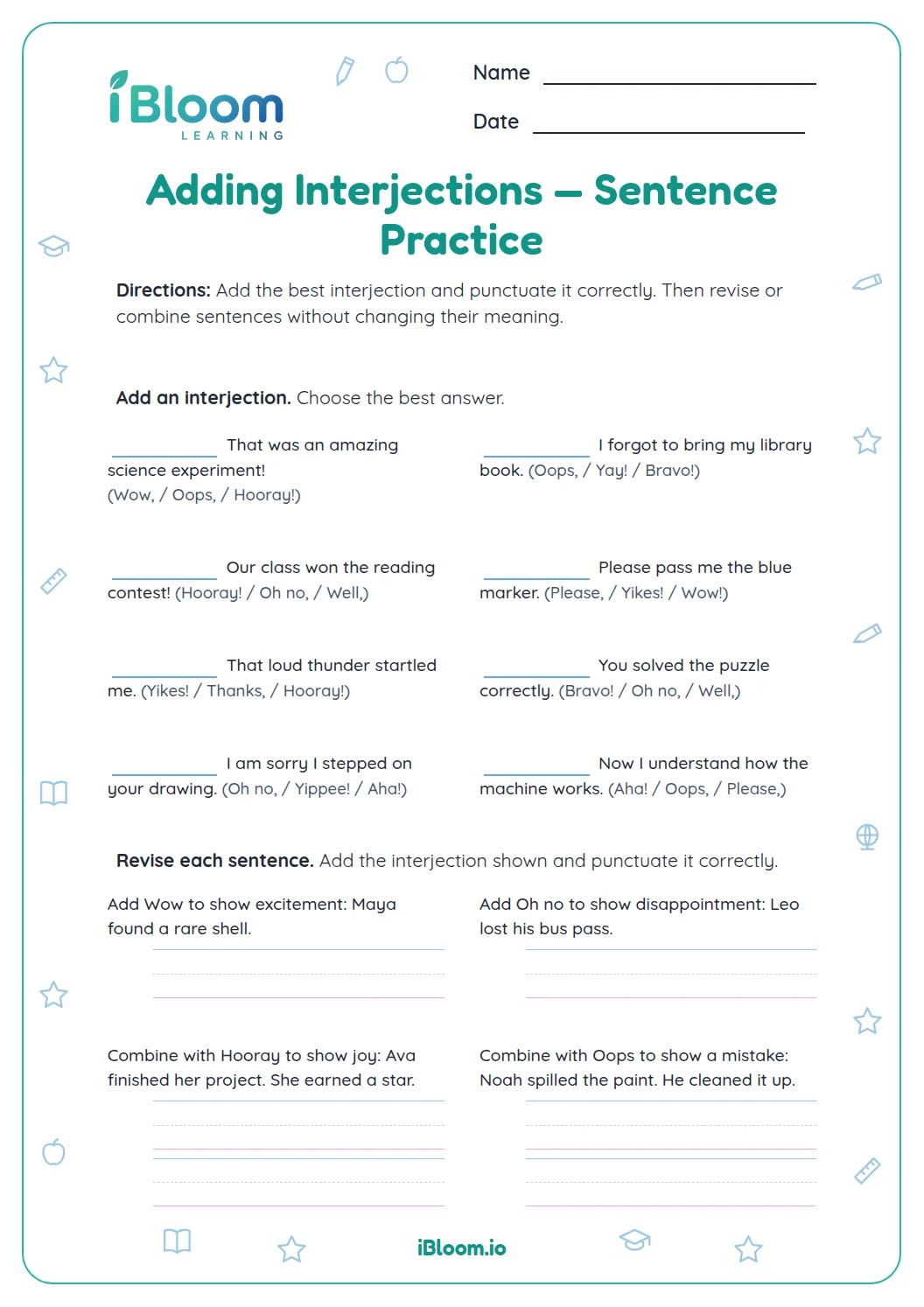
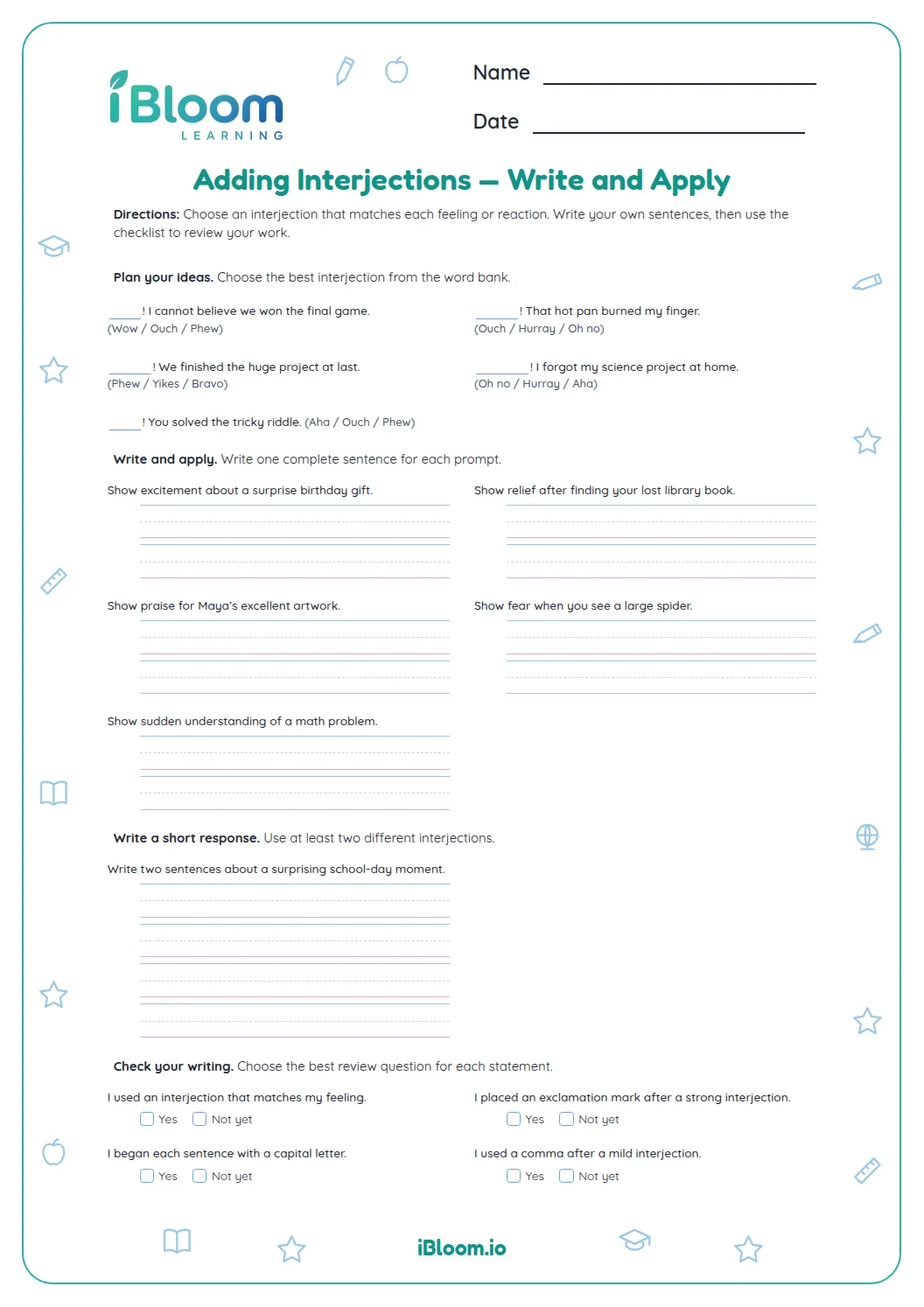
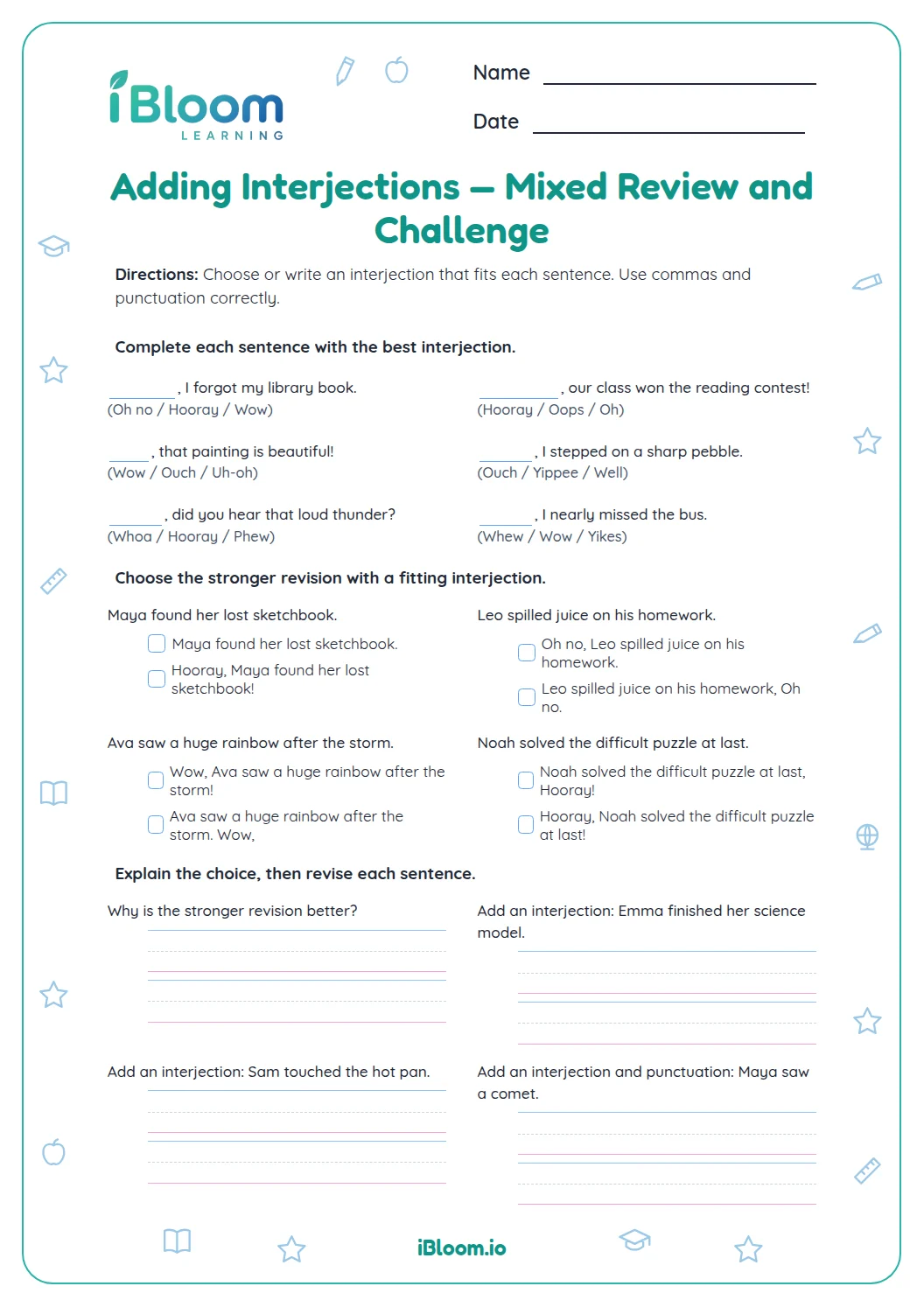
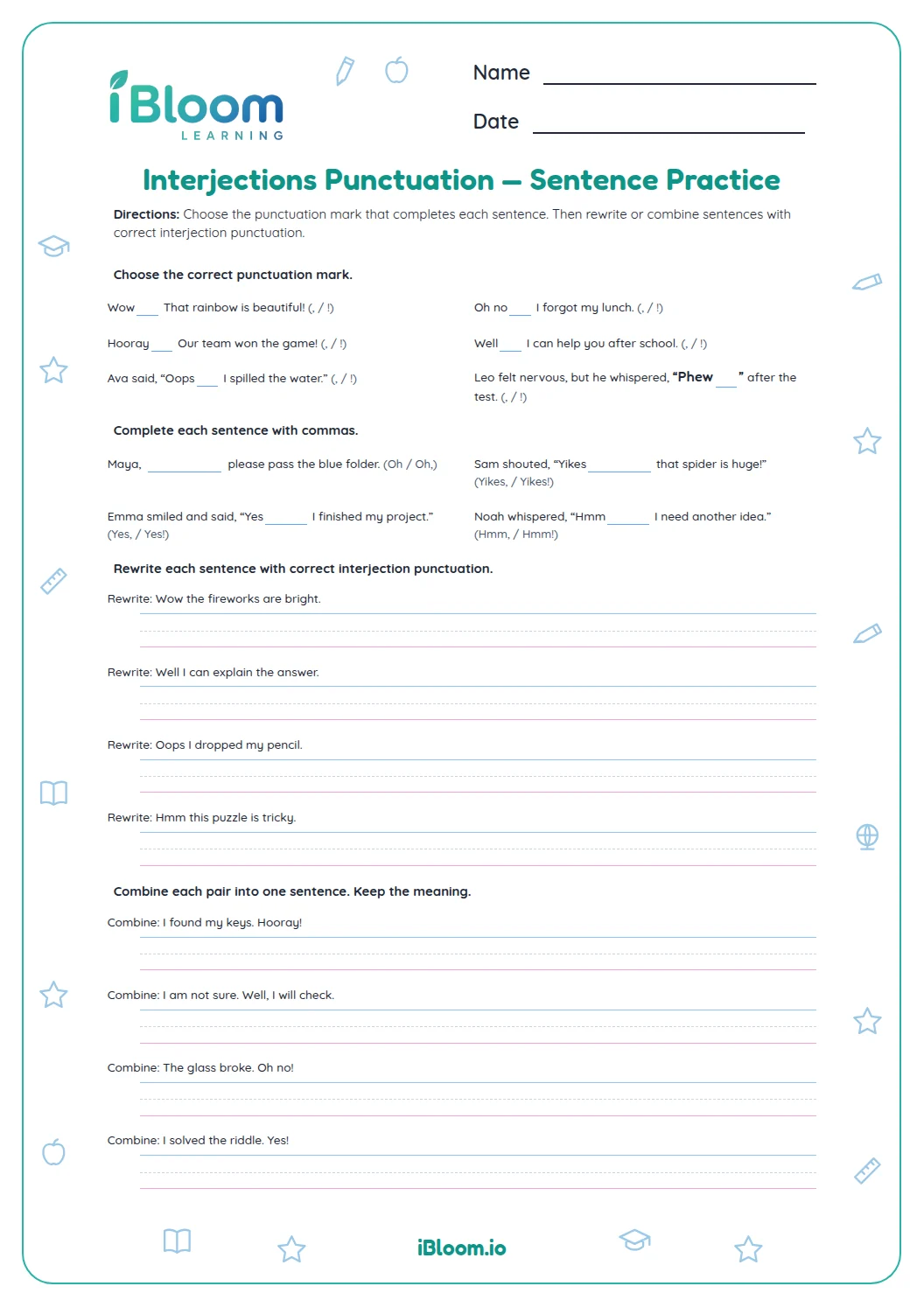
This free Grade 5 printable helps students edit interjections so the reaction and punctuation fit the sentence. Four questions ask students to punctuate mild or strong reactions; six ask them to choose or interpret an interjection; and four edit the reactions in Maya’s science-cupboard paragraph. The examples keep the original plot: Maya finds the model volcano, remembers the missing baking soda, asks Leo, and learns he has an extra box. A separate key lists each corrected choice. The practice connects to Common Core L.5.1a and L.5.2.
Aligned to L.5.1a and L.5.2
What does an interjection add to a sentence?
An interjection shows a reaction such as surprise, relief, pain, or excitement. The surrounding sentence gives clues to the feeling: a forgotten lunch calls for a different reaction than a winning game. Questions 5–10 practice choosing a fitting word and naming what it suggests.
When does an interjection take a comma or an exclamation point?
A mild interjection is commonly followed by a comma; a strong outburst takes an exclamation point. Capitalize the reaction at the start of the sentence, then capitalize the next word after a period or exclamation point.
- 1“Hmm, she could ask Leo for some.” → mild thought, comma
- 2“Hooray! Leo had an extra box.” → strong excitement, exclamation point
How does the paragraph give clues to each reaction?
Maya’s paragraph follows one small problem: the model volcano is ready, but the baking soda is missing. Her surprise, mistake, thought, and relief guide the punctuation. Read the event first, then decide whether the reaction is mild or strong.
How to use this worksheet
- 1Read the whole sentence before choosing an interjection.
- 2Decide whether the reaction is mild or strong.
- 3Check the requested mark: comma for a mild reaction or exclamation point for a strong one.
- 4Capitalize the reaction and the next sentence when needed.
- 5Use the answer key to explain how the context supports each choice.
Common interjection mistakes and quick fixes
The mistake
Choosing a reaction by sound alone, without checking the sentence.
The fix
Use the event as a clue: a thorn points to pain, while finding a key points to relief.
The mistake
Using an exclamation point for every interjection.
The fix
Keep a mild thought such as “Hmm” with a comma; save the exclamation for a strong reaction.
The mistake
Leaving the next word lowercase after an exclamation point.
The fix
An exclamation point ends the sentence, so capitalize the next word.
Common Core alignment
These Grade 5 language standards connect interjection meaning with conventional sentence punctuation.
Explain what interjections do in general and in particular sentences.
On this sheet: Students select reactions and explain the feeling each interjection conveys.
Show the official wordingHide the official wording
Explain the function of conjunctions, prepositions, and interjections in general and their function in particular sentences.
Use standard capitalization, punctuation, and spelling when writing.
On this sheet: Questions edit capitalization and punctuation around interjections.
Show the official wordingHide the official wording
Demonstrate command of the conventions of standard English capitalization, punctuation, and spelling when writing.
What to practice next
Make more practice
Further reading
Questions parents and teachers ask
How many questions are on this interjections worksheet?
The worksheet has 14 multiple-choice questions. Four focus on punctuation, six ask students to choose or interpret a reaction, and four edit interjections in Maya’s paragraph about the model volcano. The answer key shows the exact corrected sentence or reaction for each item.
When should students use a comma after an interjection?
A comma follows a mild interjection that blends into the sentence, as in “Hmm, she could ask Leo for some.” The comma gives the reaction a brief pause without making it a strong outburst. Students use the surrounding context to judge the speaker’s feeling.
When should students use an exclamation point?
Use an exclamation point when the interjection expresses a strong reaction, such as “Hooray!” in question 14. It ends that sentence, so the following word, “Leo,” starts with a capital letter. The worksheet contrasts these strong reactions with mild thoughts and acknowledgments.
What happens in Maya’s paragraph?
Maya finds that the model volcano is still in the science cupboard, but she forgot to bring baking soda. She thinks of asking Leo, and he has an extra box. Those events make the four reactions—surprise, a small mistake, thought, and excitement—clear.
Does every interjection show a strong feeling?
No. An interjection can show a mild thought or acknowledgment as well as a strong feeling. “Hmm” suggests that Maya is thinking, so it takes a comma in this paragraph. “Hooray” expresses excitement, so it takes an exclamation point.