


About this worksheet
Sixteen questions ask students to choose and use conjunctions that connect words, phrases and clauses. Conjunctions link ideas and show how those ideas relate. This worksheet aligns with CCSS L.5.1.a.
Aligned to L.5.1.a
How do conjunctions connect ideas?
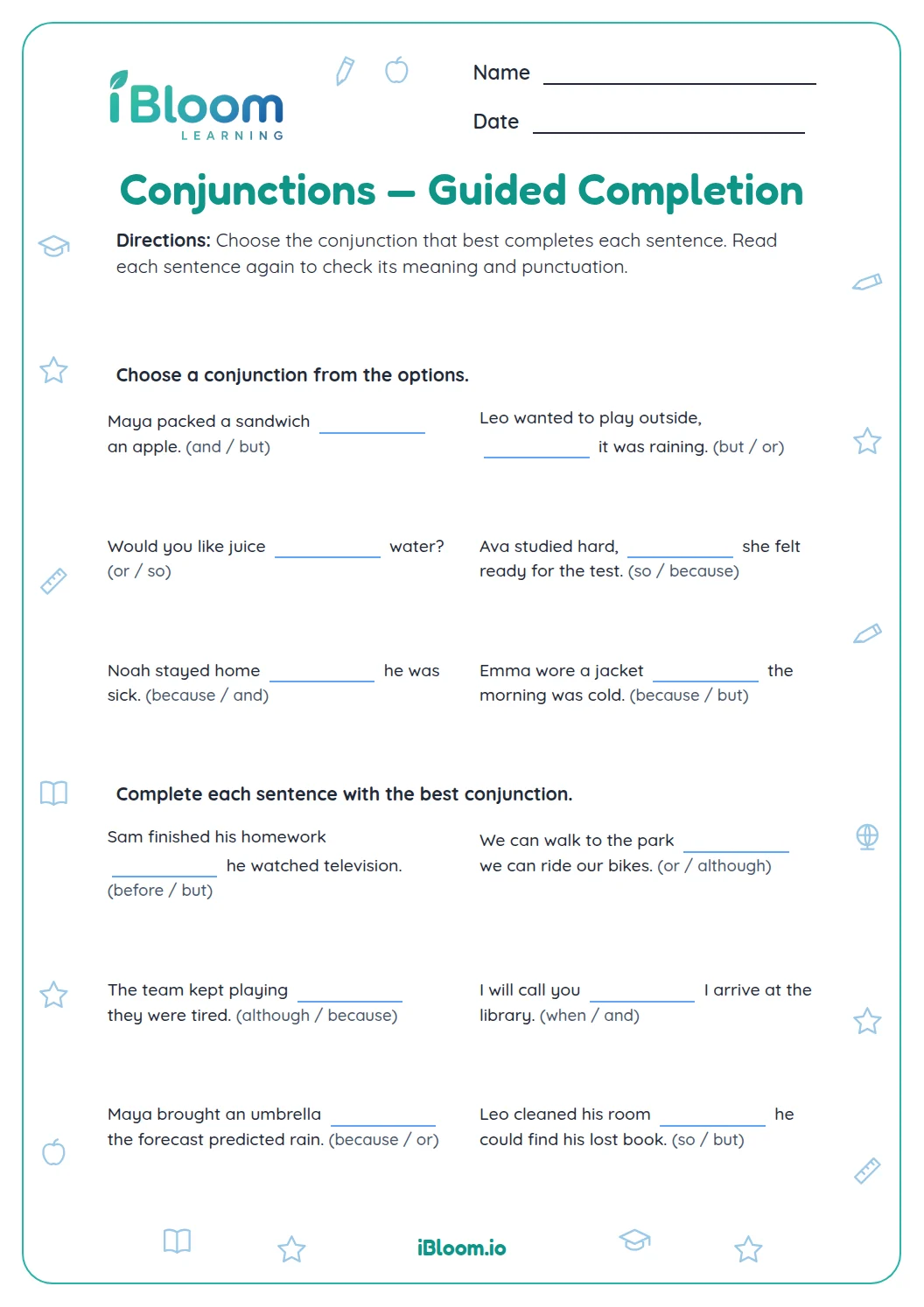
The first section asks students to choose the connector that makes each sentence clear. The choices include addition, contrast, choice, cause, and time relationships.
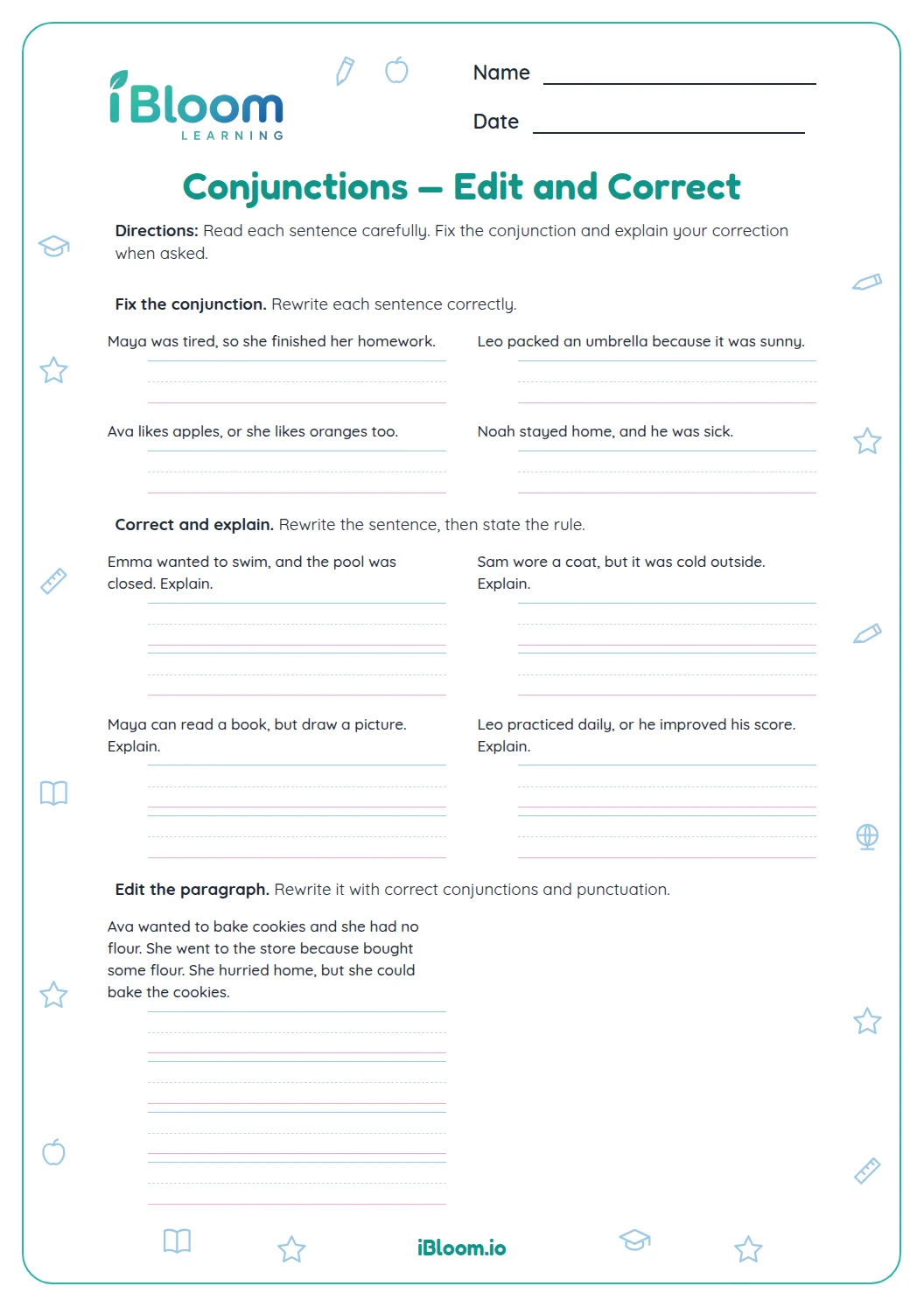
The later questions move from recognizing a conjunction to using one in a complete sentence.
- 1The rain stopped, ___ the team went outside.
- 2so
When should a sentence use a pair?
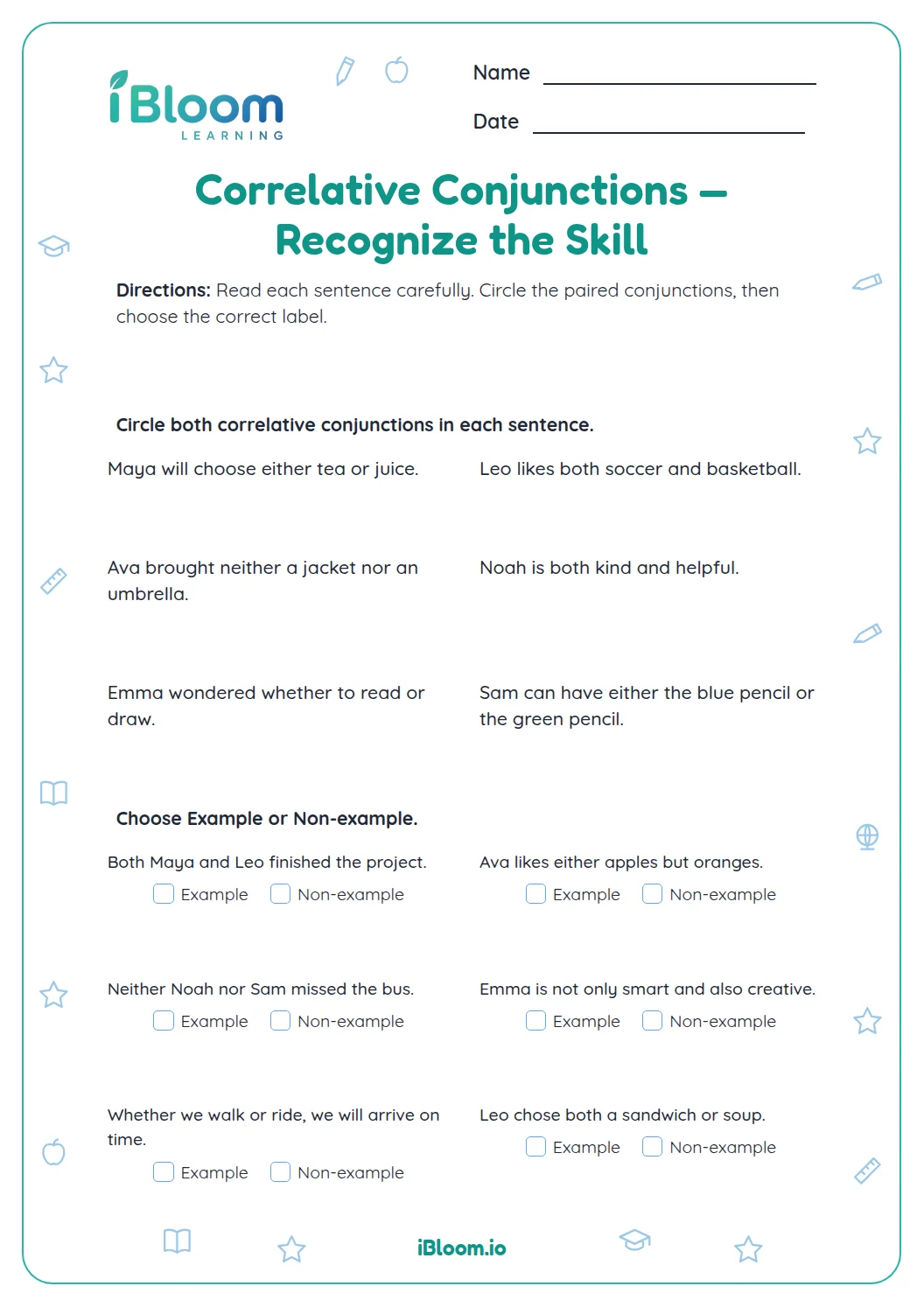
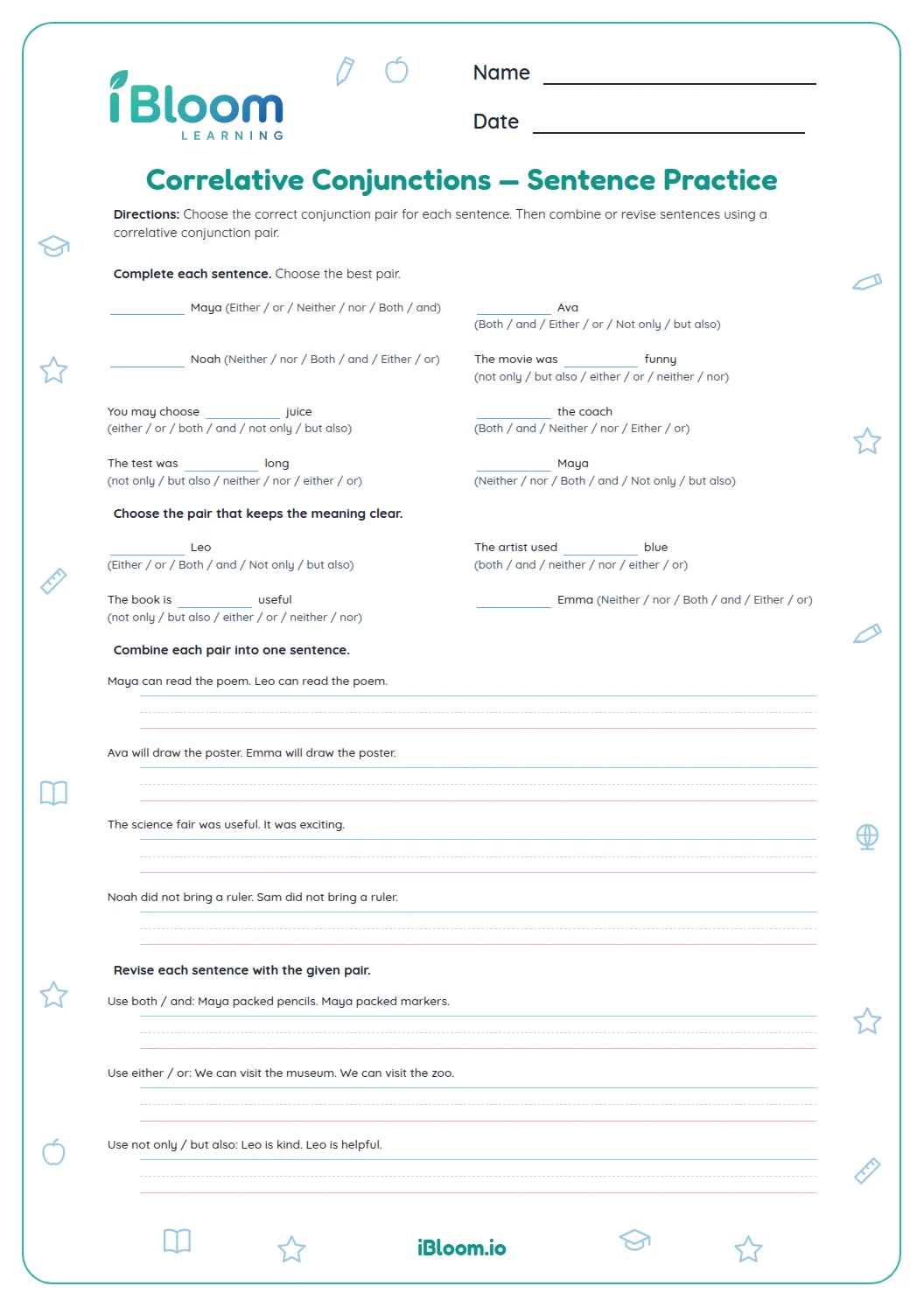
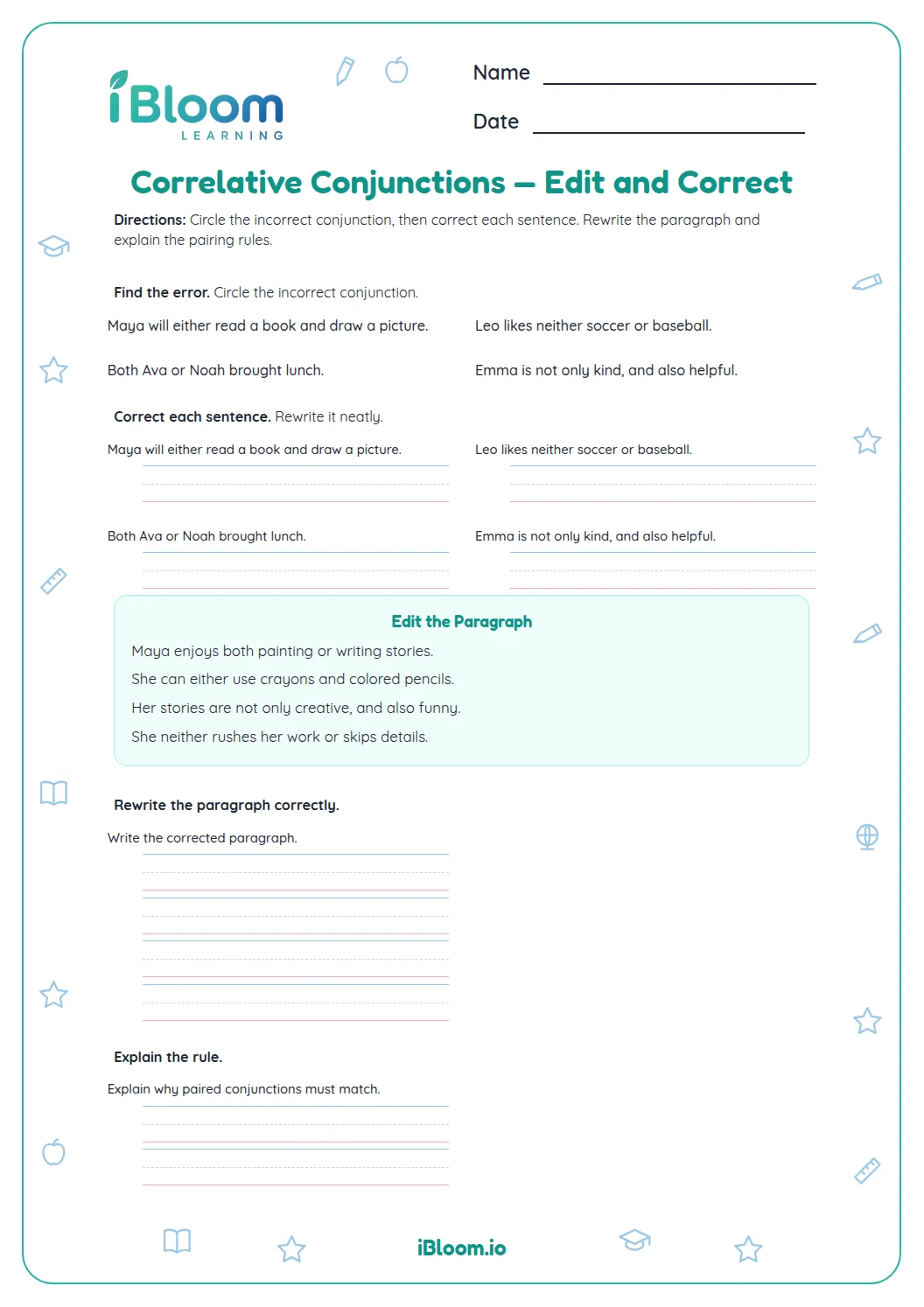
Some sentences use a correlative pair: neither/nor, both/and, or either/or. Keep the paired words together so the sentence’s two subjects or choices stay balanced. The final questions also practice because and after in context.
How can you check a connector?
Read the completed sentence and describe how its two ideas relate. If the connector changes the meaning in a way that does not fit, try another choice. For writing prompts, check that both original ideas remain in the sentence.
How to use this worksheet
- 1Read both clauses before choosing a connector.
- 2Name the relationship: addition, contrast, choice, cause, or time.
- 3Complete the paired conjunctions together, such as neither/nor.
- 4Write a full sentence for each requested conjunction.
- 5Read each result aloud and check whether its ideas still make sense.
Common mistakes and quick fixes
The mistake
Choosing and when the second idea contrasts with the first.
The fix
Ask whether the ideas add information or disagree; use but for the contrast in the trail sentence.
The mistake
Using because where the sentence needs a result.
The fix
Read the clauses in cause-to-effect order and choose so when the second clause is the result.
The mistake
Writing only a conjunction for a sentence-joining prompt.
The fix
Copy both ideas into one complete sentence and include the requested connector.
Common Core alignment
This worksheet practices the listed Common Core skill in short, focused examples.
Students choose conjunctions and write sentences that show their function.
On this sheet: Students choose conjunctions and write sentences that show their function.
Show the official wordingHide the official wording
Explain the function of conjunctions, prepositions, and interjections in general and their function in particular sentences.
What to practice next
Make more practice
Further reading
Questions parents and teachers ask
What kinds of conjunctions appear on this worksheet?
Students choose coordinating conjunctions such as and, but, or, and so, and subordinating conjunctions such as although, when, because, if, and after. They also complete correlative pairs such as neither/nor, both/and, and either/or. The examples contrast connectors that join equal ideas with those that introduce a dependent idea.
How can a child choose between but and so?
Read the two ideas and decide how they relate. “But” signals a contrast, as in a steep trail and continuing to walk. “So” connects a reason to its result, as when a team goes outside after the rain stops.
What does a conjunction do in a sentence?
A conjunction links words, phrases, or clauses and shows how their ideas connect. On this page, students choose a connector that shows addition, choice, contrast, cause, or time, then complete correlative pairs such as neither/nor and either/or. They can explain how each choice changes the sentence meaning.
Why are there sentence-writing questions as well as choices?
The first part asks students to choose a conjunction from three options. The second part uses more connector choices, including correlative pairs such as neither/nor, both/and, and either/or. Comparing the options helps students notice how conjunctions show different relationships between words and ideas.
How can I check the conjunction answers?
Use the answer key, then reread each completed sentence aloud. A correct connector should preserve the intended relationship: addition, choice, contrast, cause, or time. For the correlative pairs, check that both words match the sentence pattern, such as neither/nor or either/or. Each question has one best choice.