

About this worksheet
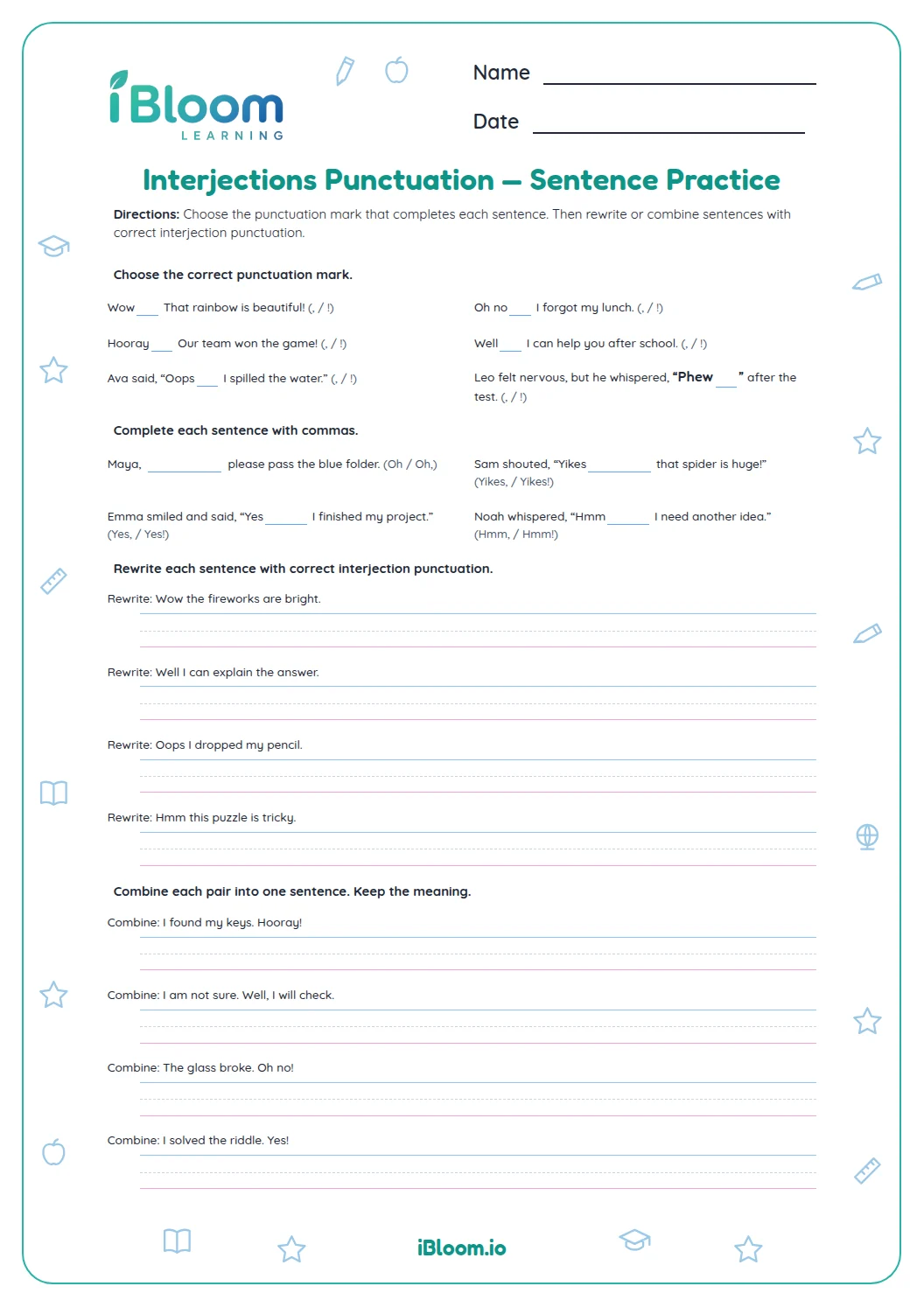
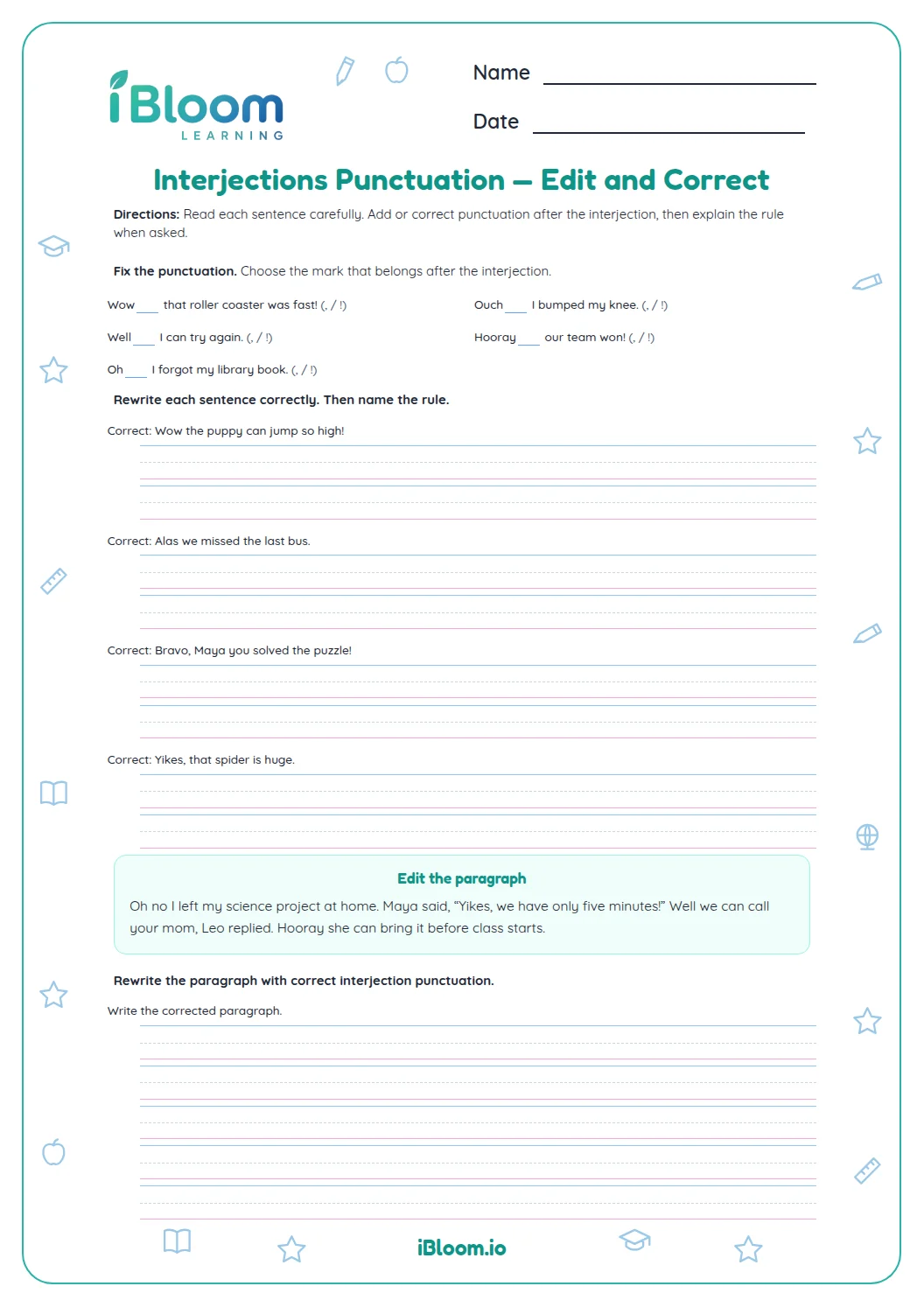
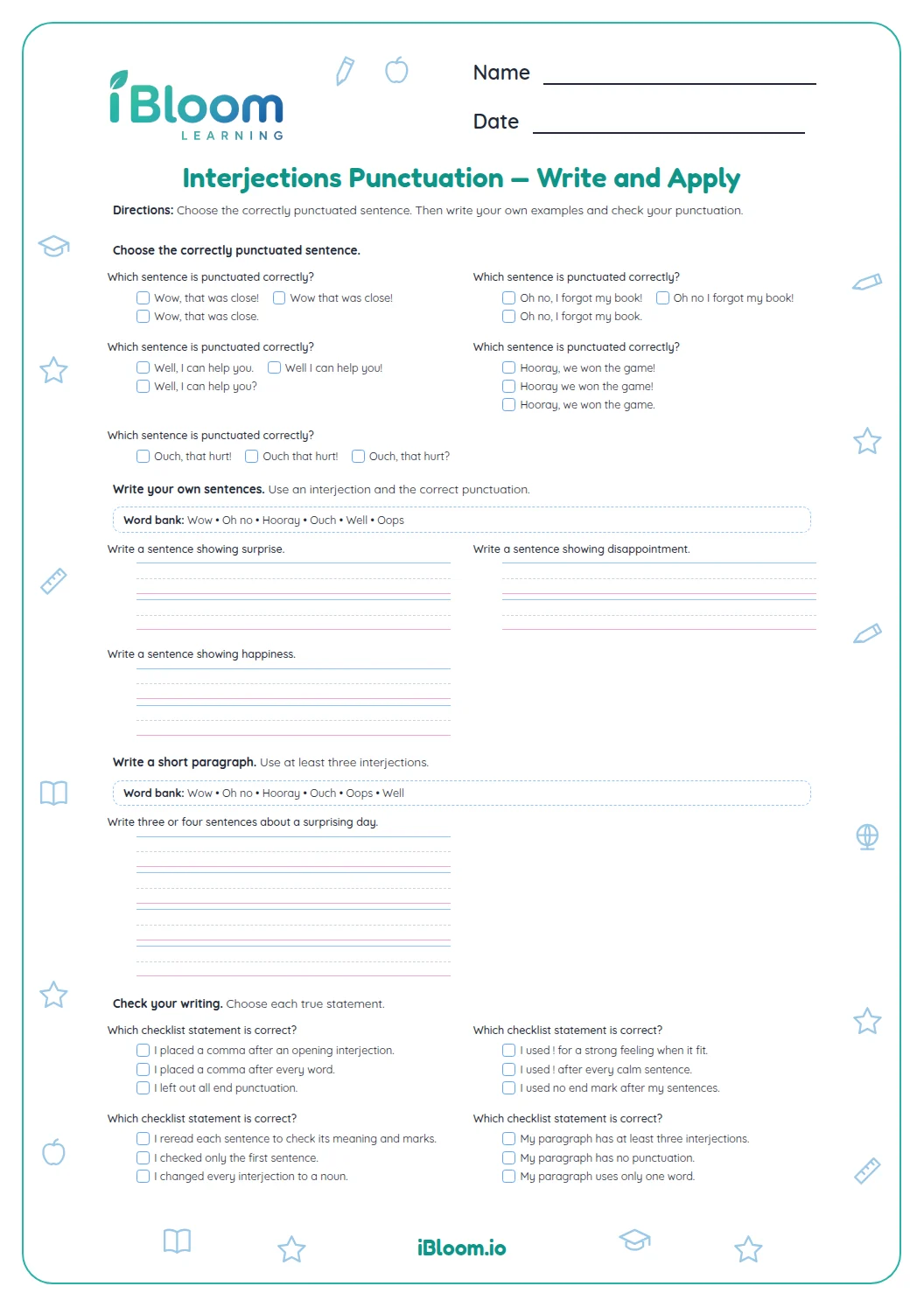
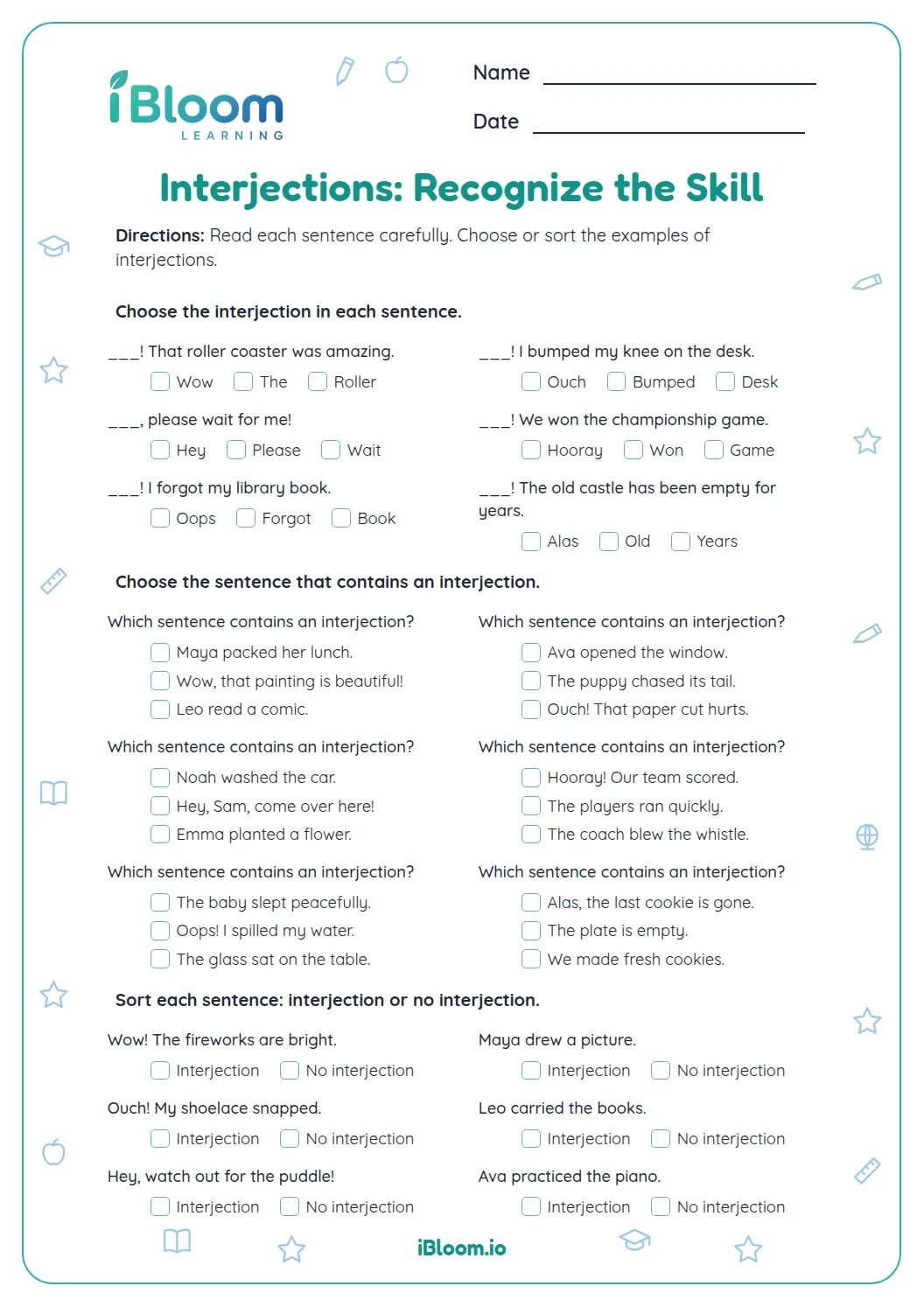
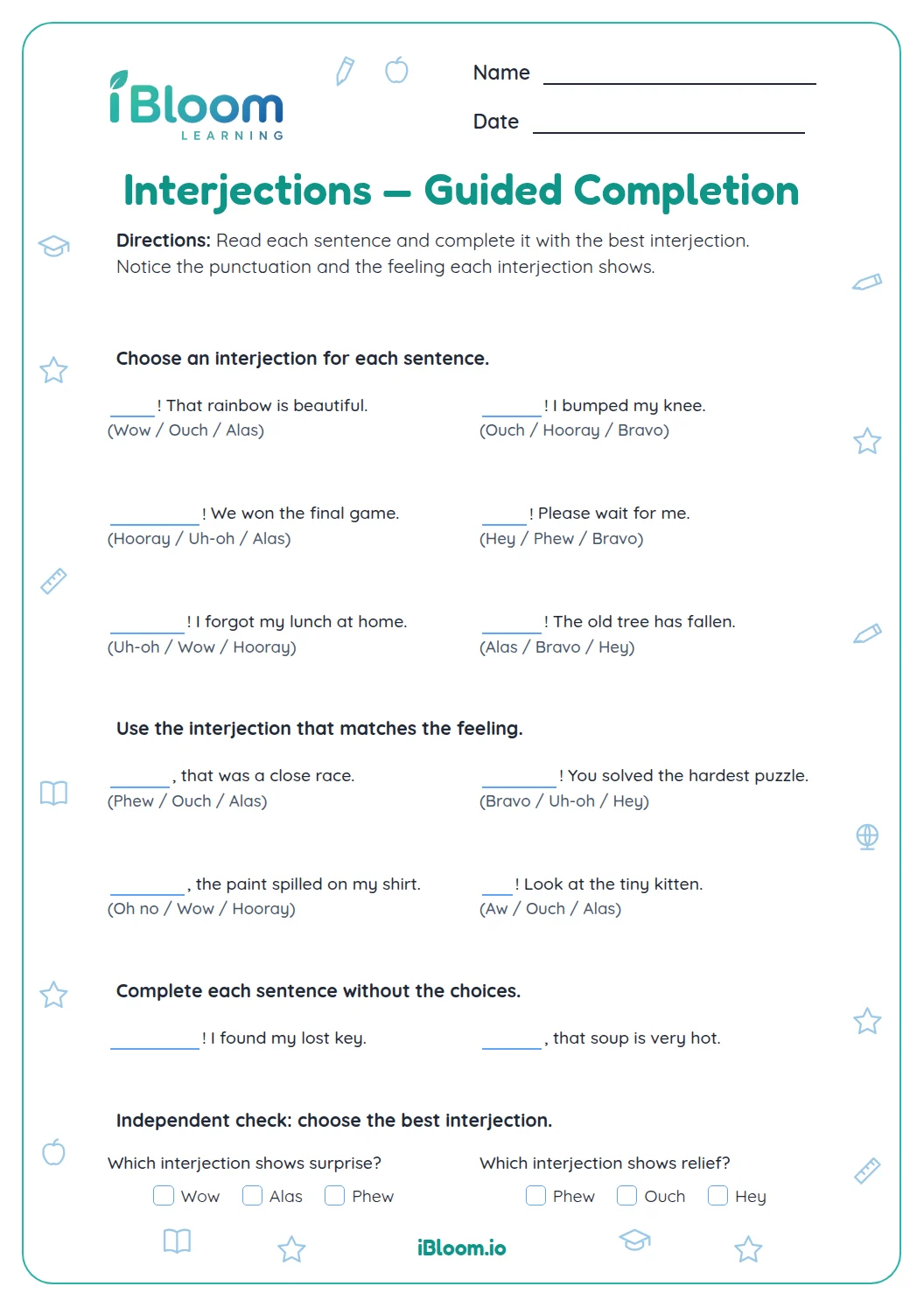
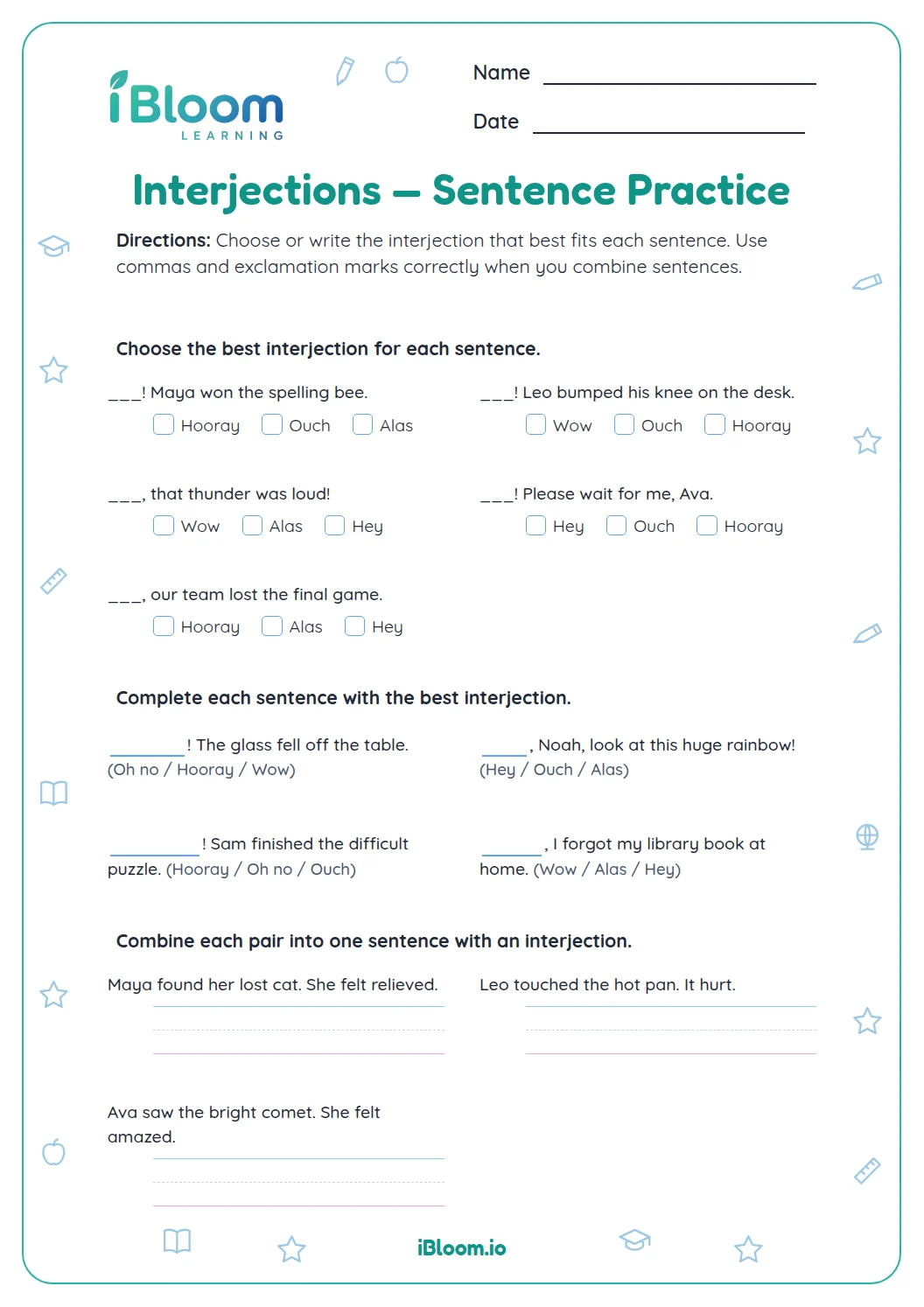
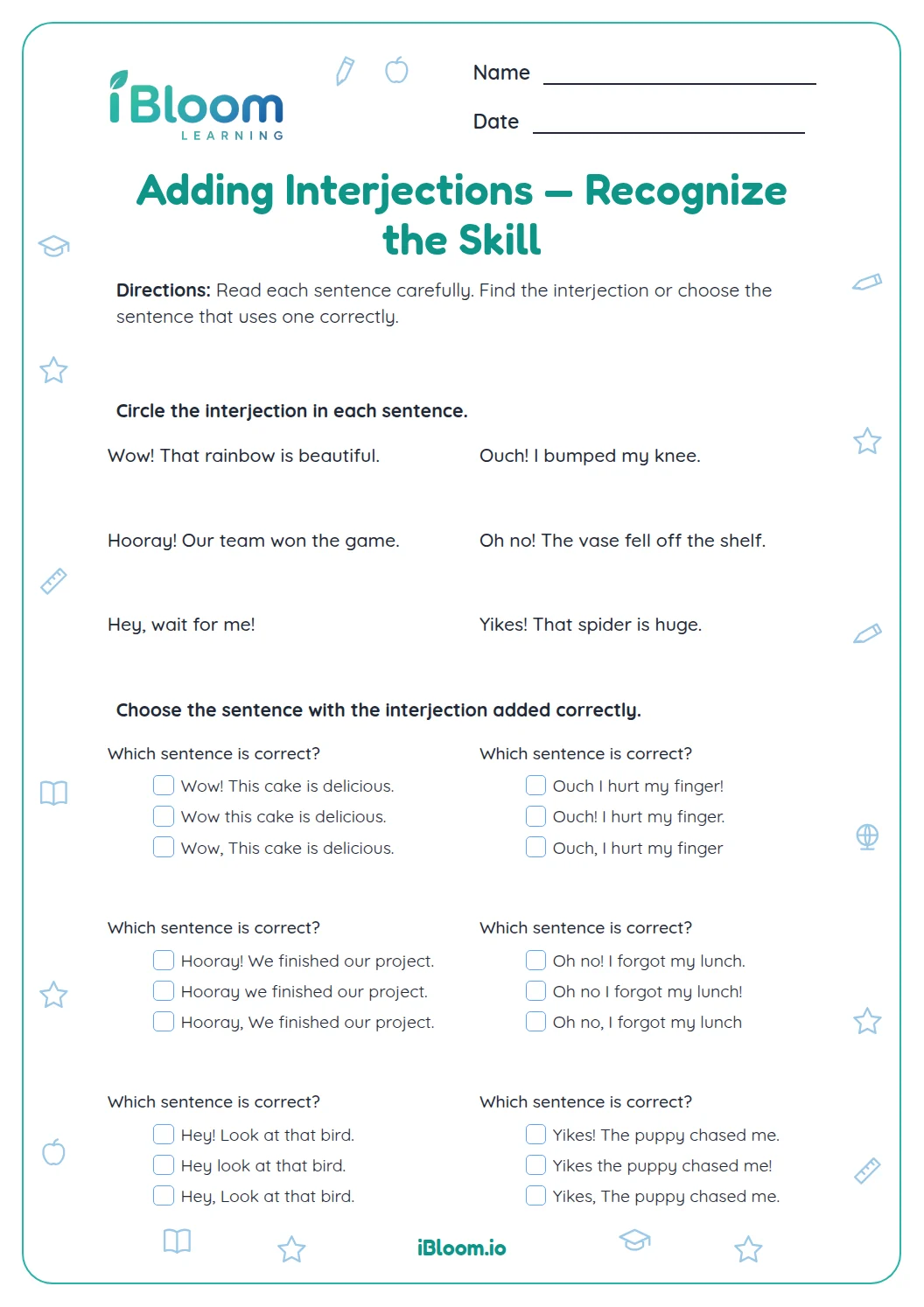
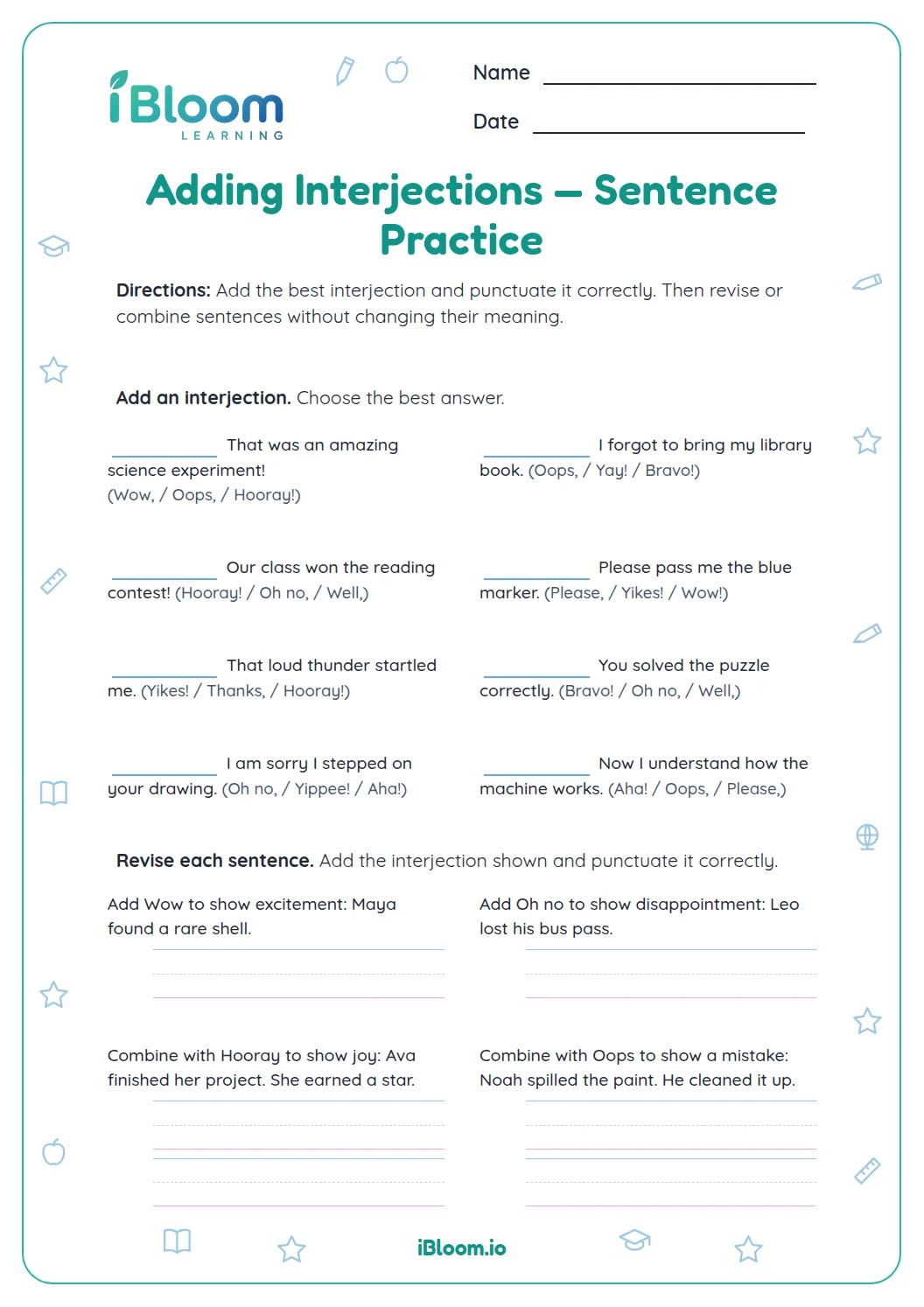
This Grade 5 printable reviews interjections and the punctuation that helps show how they sound. Students recognize interjections, choose correct punctuation, revise sentences, and write examples using mild and strong expressions. The key gives model answers where student wording can vary.
Aligned to L.5.2
What is an interjection?
An interjection is a word or short expression that shows a reaction or feeling. Examples include “Wow,” “Oops,” and “Hooray.” It may stand alone or appear at the beginning of a sentence.
- 1“Wow” expresses a reaction, so it is the interjection.
- 2“Because” connects ideas; “under” tells where.
When should an interjection take a comma or exclamation mark?
A mild interjection often takes a comma before the sentence continues. A strong reaction may use an exclamation mark. Capitalize the next word when the exclamation mark ends the sentence.
How can you check punctuation in a sentence?
Read the sentence with the intended feeling. Decide whether the expression is mild or strong, then choose punctuation and capitalization that match. The sentence should still read smoothly afterward.
How can students work through the page?
- 1Find the word showing a reaction.
- 2Read the full sentence for tone.
- 3Choose a comma or exclamation mark.
- 4Capitalize the next word after a sentence-ending mark.
- 5Read the revised sentence again.
Common mistakes and quick fixes
The mistake
Using an exclamation mark for every interjection.
The fix
Use a comma when the expression is mild and flows into the sentence.
The mistake
Leaving out the comma after a mild opener.
The fix
Place a comma after words such as “Well” when the sentence continues.
The mistake
Leaving the next word lowercase after an exclamation mark.
The fix
Start a new sentence with a capital letter.
Students capitalize and punctuate interjections in sentences.
On this sheet:
Show the official wordingHide the official wording
Demonstrate command of the conventions of standard English capitalization, punctuation, and spelling when writing.
What to practice next
Make more practice
Further reading
Questions parents and teachers ask
What is an interjection?
An interjection is a word or short expression that shows a reaction, such as surprise or relief. This worksheet asks students to identify interjections and punctuate them in context. The answer key gives the expected choice or a model sentence for open responses.
Do all interjections need exclamation marks?
No. A mild interjection can be followed by a comma, as in “Well, we can begin now.” An exclamation mark can show a stronger reaction. Choose punctuation that matches the meaning and tone of the whole sentence. The key follows the same question order as the printable, making it easy to review one answer at a time.
How many questions are included?
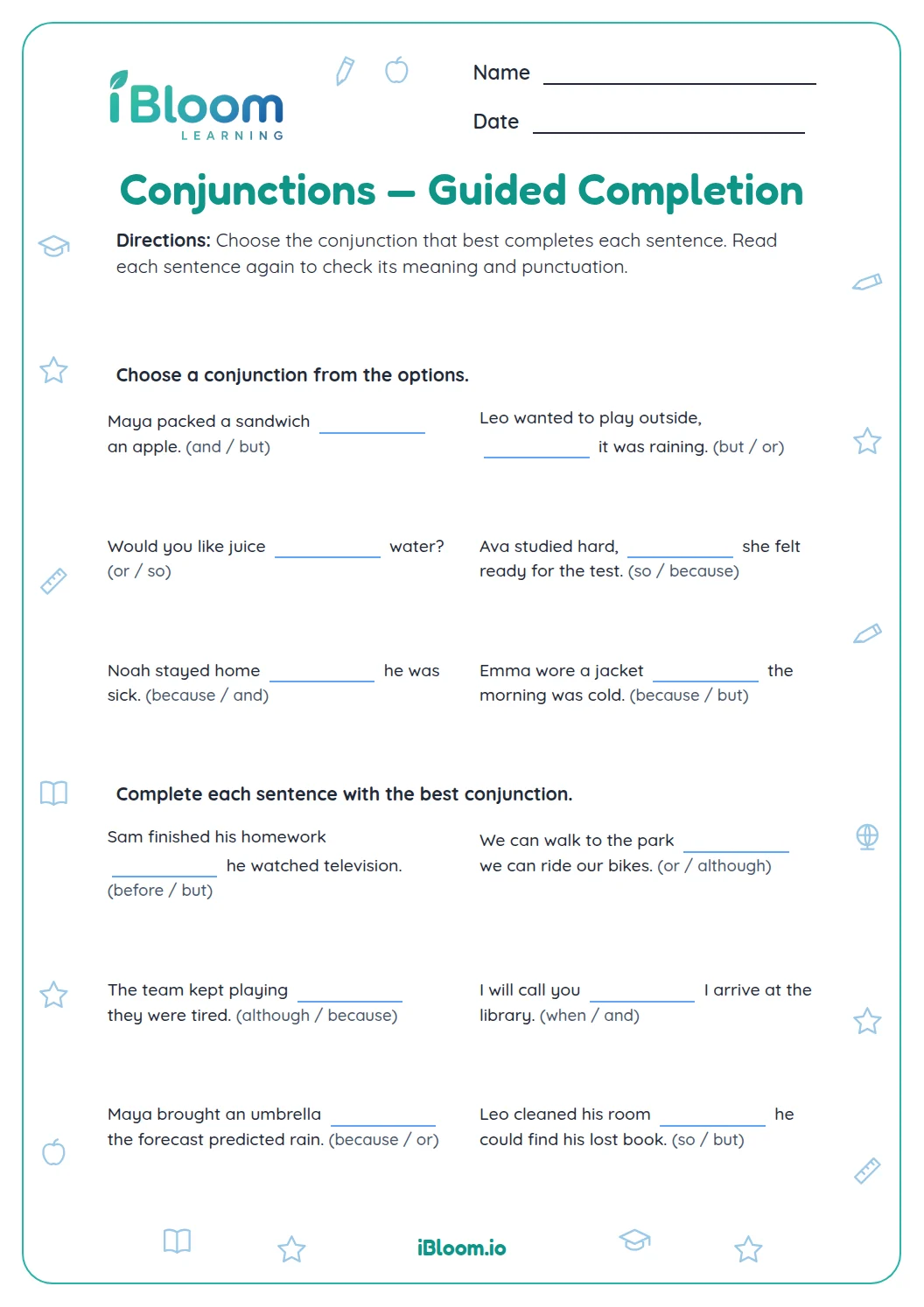
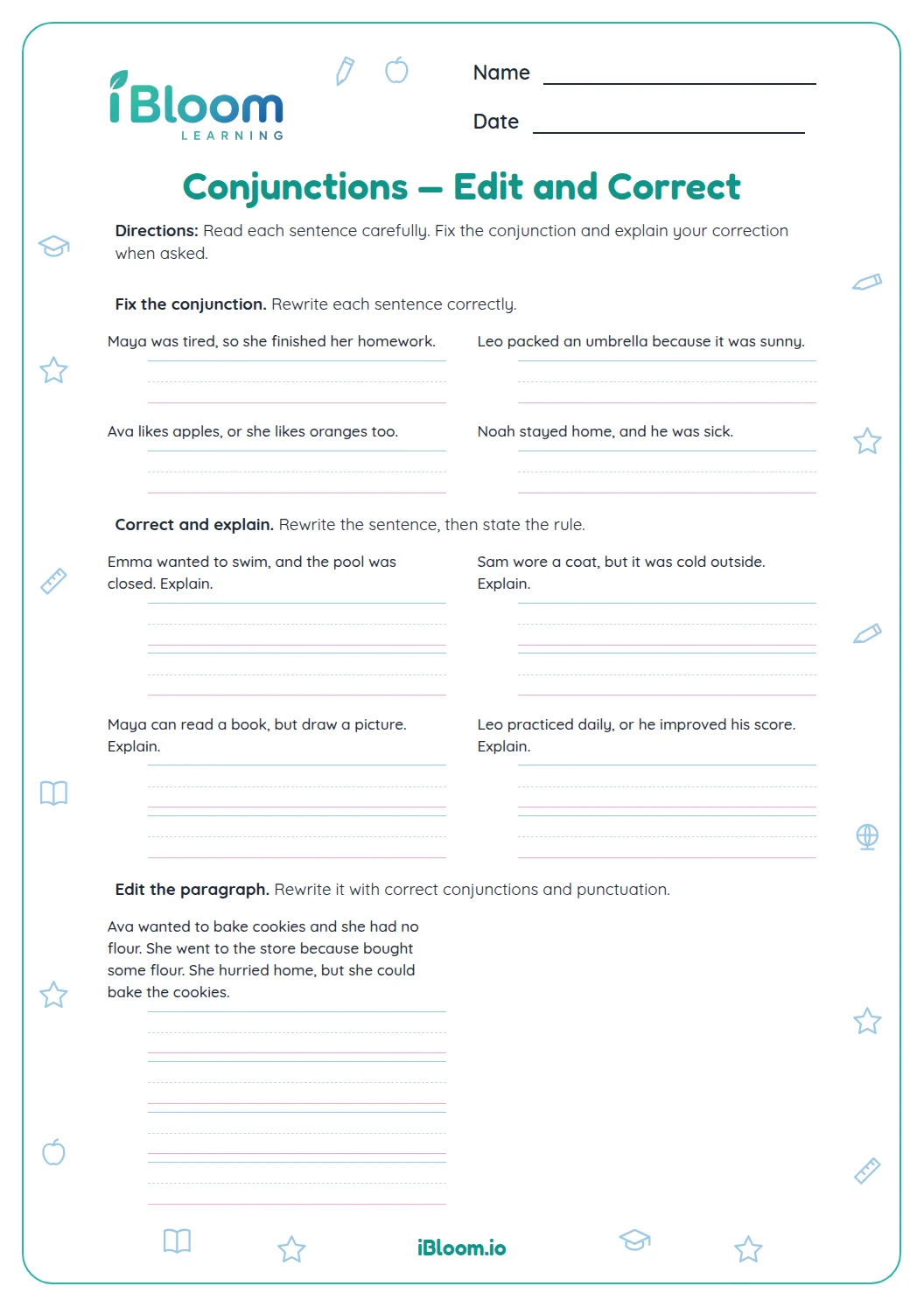
There are 14 questions across three worksheet pages, followed by an answer key. Students identify interjections, choose punctuation, revise sentences, and write examples. The key includes model sentences for open-ended questions, and other correct wording may also work.
Should the word after an exclamation mark be capitalized?
Capitalize it when the exclamation mark ends a sentence. In “Hooray! We finished,” the word “We” begins a new sentence. If an interjection is part of one continuing sentence, punctuation and capitalization depend on how the sentence is written. If an answer is unclear, reread the instructions for that part and compare the worked example on this page.
What is the difference between “Well, we can begin” and “Well! We can begin”?
The comma makes “Well” a mild opener that flows into the sentence. The exclamation mark makes it a stronger standalone reaction and starts a new sentence. Writers choose based on the intended voice. Students can then use the linked related worksheet to build on the same skill with a new set of examples.