


About this worksheet
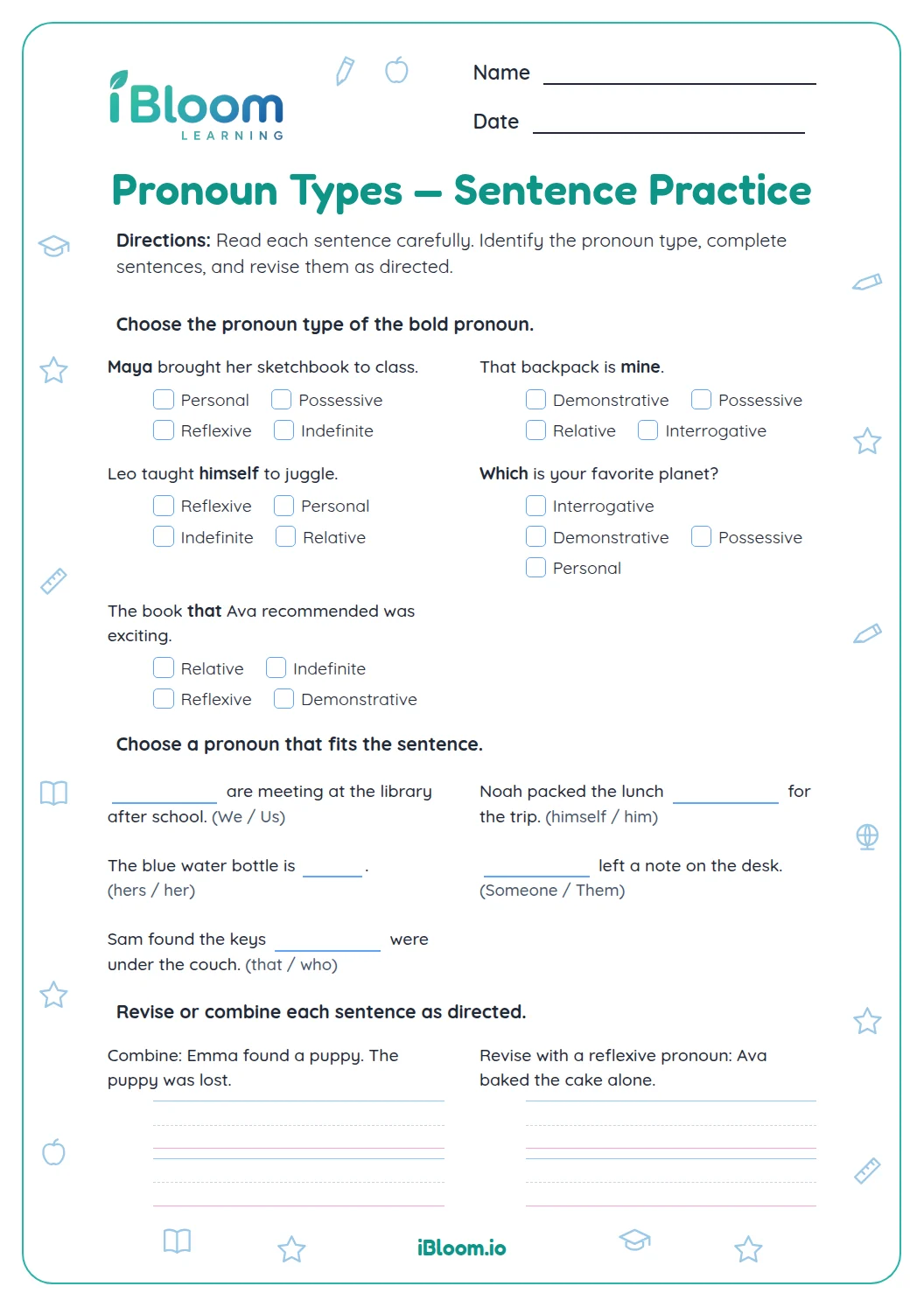
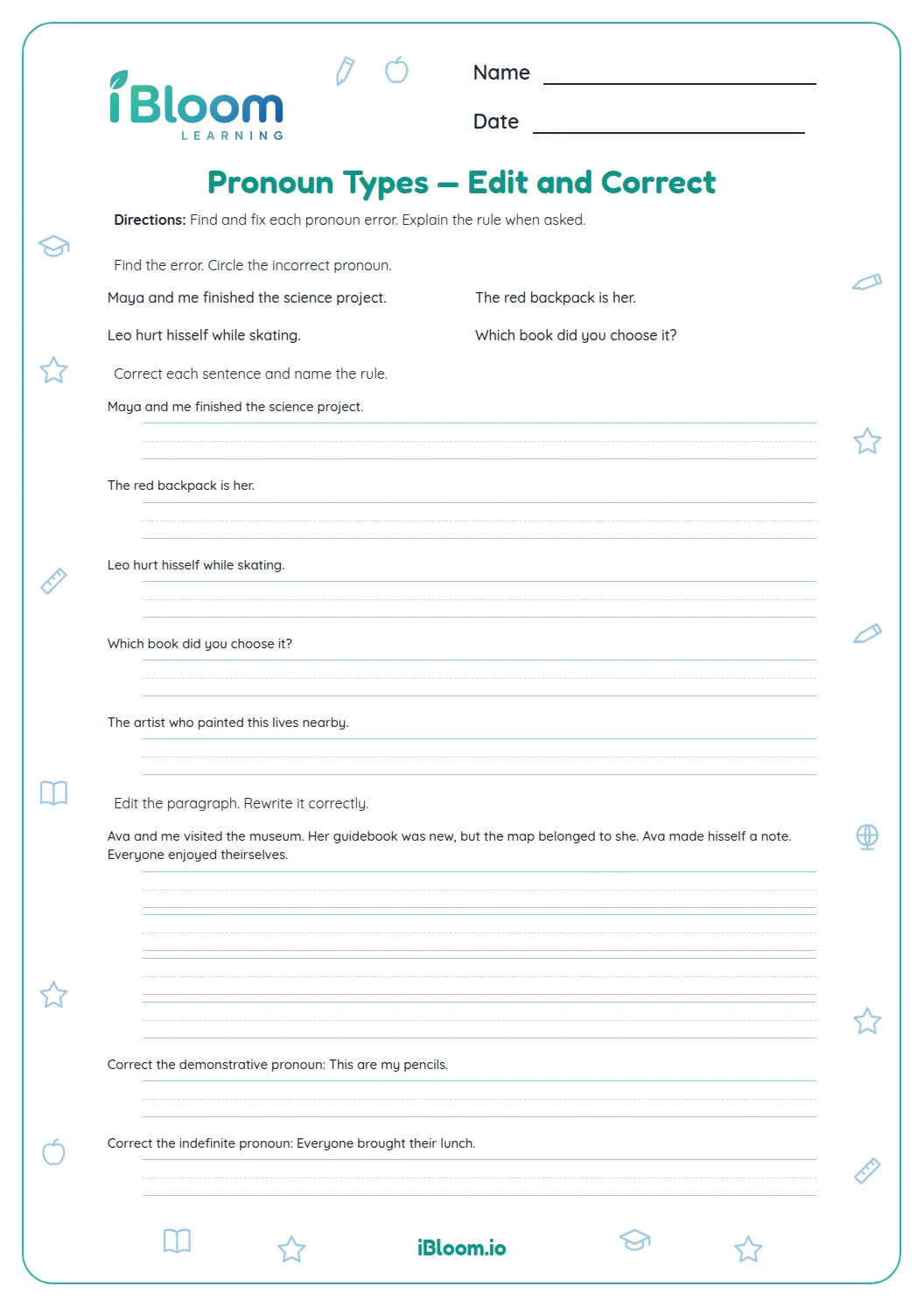
This Grade 5 grammar worksheet practices pronouns in four parts. Students name the type of a pronoun in six sentences, select a pronoun that fits six sentence contexts, revise three sentences to replace a noun or noun phrase, and join two ideas with a relative pronoun. The answer key provides the expected label or revised sentence for each item.
How can you name a pronoun’s type?
Part A asks students to identify the pronoun’s job in its sentence. In “The coach waved to us,” us receives the action, so it is an object pronoun. The sentence gives context; read the pronoun with the words around it.
- 1Part A asks students to identify the pronoun’s job in its sentence.
Which pronoun form fits the sentence?
Part B offers two choices. Check whether the sentence needs a subject, an object, or a word showing ownership. “The librarian helped us find a book” needs an object pronoun after helped.
- 1Part B offers two choices.
How do pronouns help revise a sentence?
Part C asks students to replace a named person or thing, then combine two related ideas with a relative pronoun. “I met a pilot who flies rescue planes” uses who to connect the pilot to the added detail.
- 1Part C asks students to replace a named person or thing, then combine two related ideas with a relative pronoun.
How to work through the page
- 1Read the whole sentence before labeling its pronoun.
- 2Ask what job the pronoun does: subject, object, ownership, connection, or an unnamed person.
- 3For choices, check how the pronoun fits with the verb or preposition.
- 4Replace only the words named in each revision direction.
- 5Read the new sentence aloud to check its meaning and grammar.
Common errors to check
The mistake
Mistake: choosing I or we after an action verb.
The fix
Use me or us when the pronoun receives the action.
The mistake
Mistake: confusing a possessive pronoun with a subject pronoun.
The fix
Ask whether it shows ownership.
The mistake
Mistake: changing extra words during a replacement.
The fix
Replace the named noun phrase and keep the sentence meaning.
What to practice next
Make more practice
Questions parents and teachers ask
Which pronoun types appear in Part A?
Students label subject, object, possessive, relative, and indefinite pronouns. The sentence context helps identify the role. For example, us in “The coach waved to us” is an object pronoun because it receives the action. Ask the student to explain one answer using the sentence or number relationship that supports it.
Does the worksheet include an answer key?
Yes. A separate key follows the worksheet with the pronoun type, selected form, or revised sentence for each item. The revision questions have a specific model answer, though equivalent wording may work when it follows the direction and keeps the sentence clear.
How many items are included?
There are 16 questions in three parts: six pronoun labels, six sentence choices, and four sentence revisions. The sequence moves from recognizing a pronoun’s role to selecting and using a suitable form. Ask the student to explain one answer using the sentence or number relationship that supports it.
What should students check when choosing between pronouns?
Students should check the pronoun’s job in the sentence. A subject performs the action, an object receives it or follows a preposition, and a possessive form shows ownership. Reading the complete sentence helps reveal which form fits. Ask the student to explain one answer using the sentence or number relationship that supports it.
How does the worksheet use relative pronouns?
One identification item includes who, and the final revision asks students to join two sentences with a relative pronoun. Students connect a noun to information about it, as in “I met a pilot who flies rescue planes.” Ask the student to explain one answer using the sentence or number relationship that supports it.