



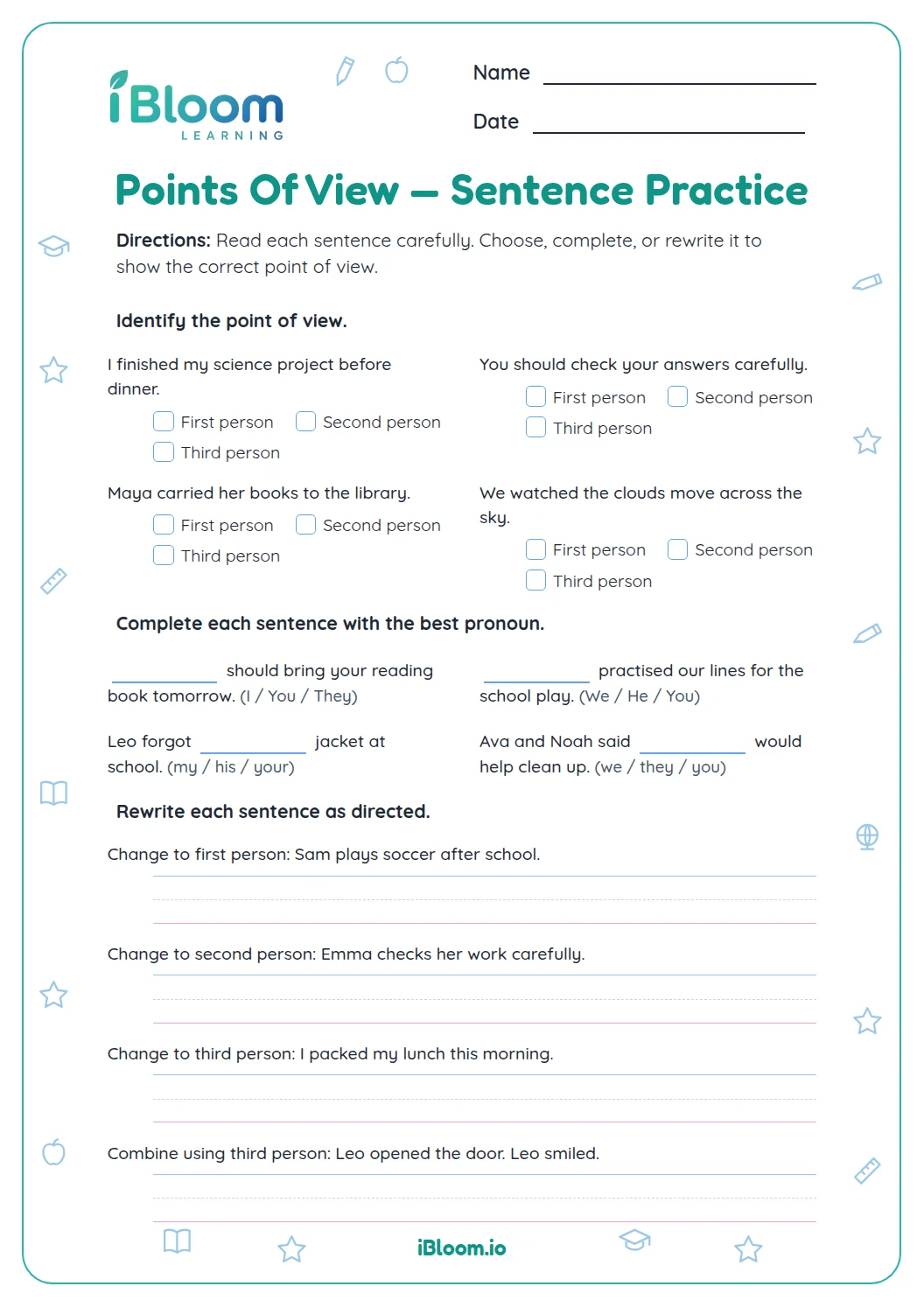
About this worksheet
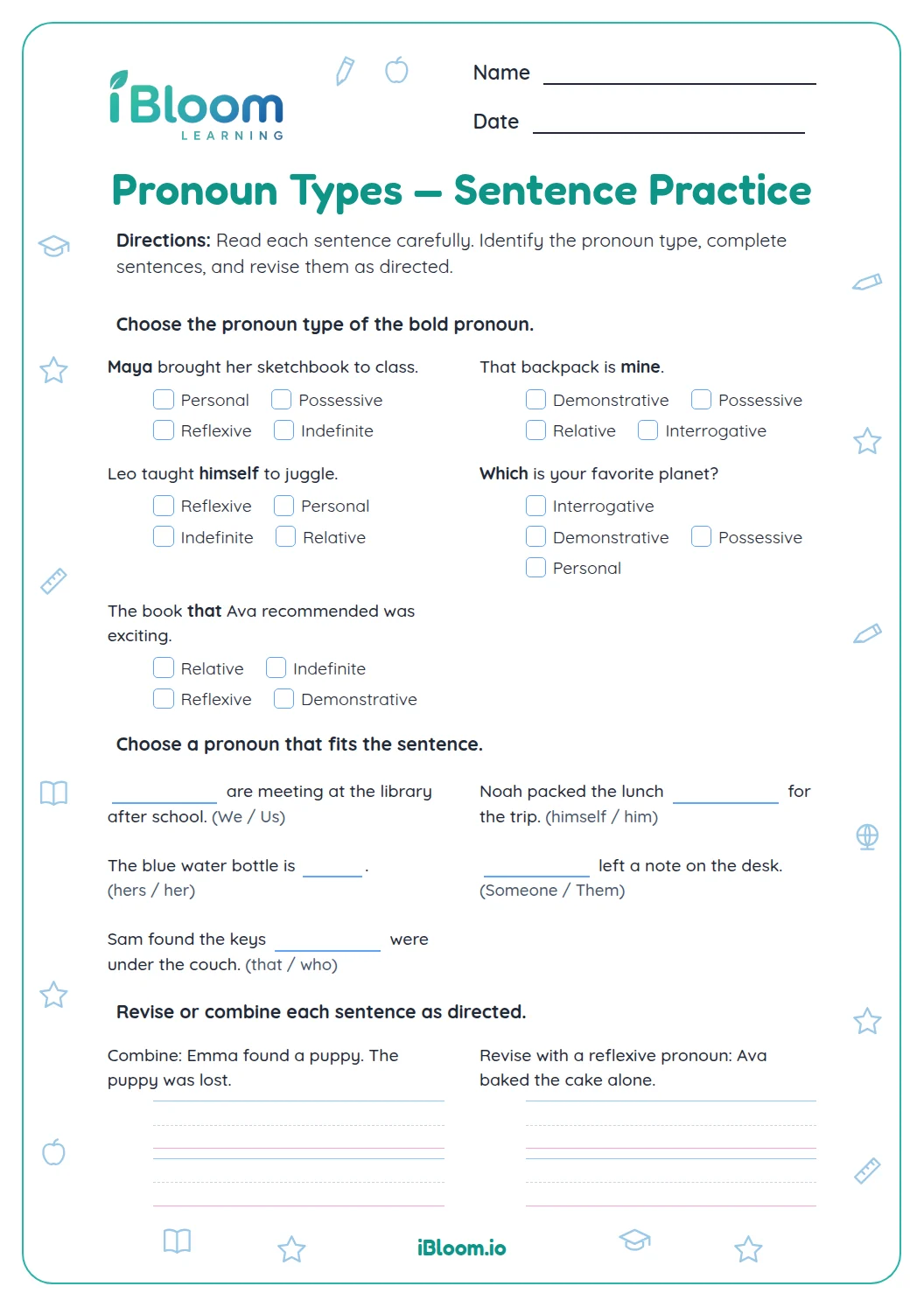
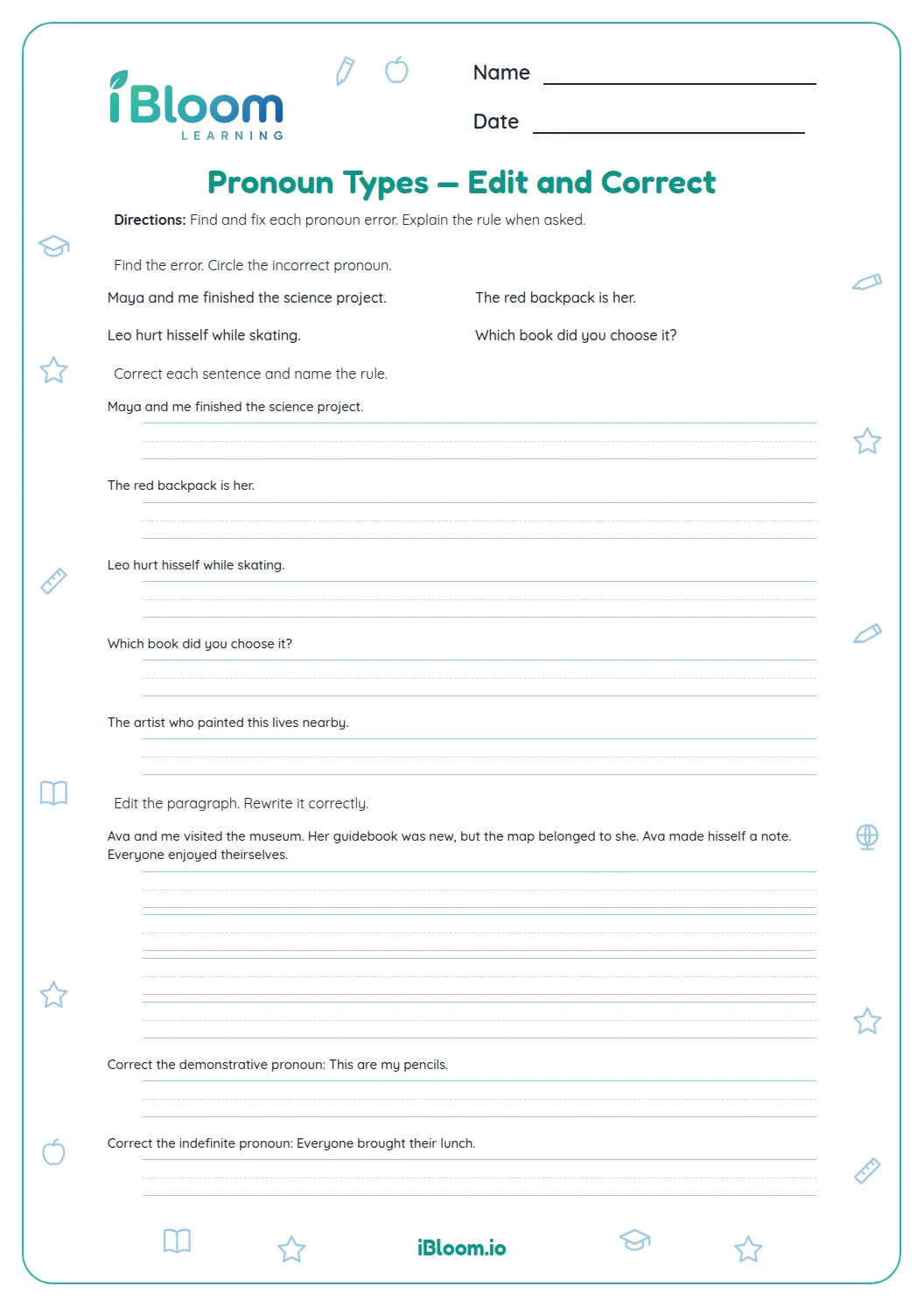
This free Grade 5 printable uses short sentences to help children recognize pronouns and tell several pronoun types apart. Students identify a pronoun in context, classify words such as hers, ourselves, who, everyone, and these, then choose forms that agree with the people or things they refer to. The final questions ask children to identify pronouns in full sentences and revise a sentence with a subject pronoun. This is focused practice with pronoun use as part of the grammar conventions in CCSS L.5.1.
Aligned to L.5.1
How can children recognize a pronoun type?
First find the word that stands for a person, place, thing, or idea. Then use its job in the sentence: a possessive pronoun shows ownership, a reflexive pronoun points back to its subject, and a relative pronoun connects a describing clause.
- 1Question: What type is ourselves in “We taught ourselves”?
- 2The subject is We.
- 3Ourselves points back to We.
- 4So ourselves is a reflexive pronoun.
How does the sentence help choose a pronoun?
Look at the noun or people the pronoun replaces. A single puppy takes itself; plural students take themselves. Read the sentence aloud after choosing to check that the pronoun fits.
What types appear on the worksheet?
The 14 questions progress from spotting a pronoun to classifying types, matching pronouns to their antecedents, and revising a sentence.
- Part A: recognize and classify pronouns
- Part B: choose pronouns that fit sentence context
How to use this worksheet at home or in class
- 1Read each whole sentence before naming the pronoun.
- 2For a type question, ask what the pronoun is doing in that sentence.
- 3For questions 9–11, identify what the pronoun refers to before selecting a form.
- 4Have the child explain one classification aloud, such as why who is relative in its sentence.
- 5Use the key to review both the word and its type.
Common mistakes and quick fixes
The mistake
Calling every word that comes before a noun a pronoun, as in choosing your in “your jacket.”
The fix
Ask whether the word stands alone for a noun. In that sentence, which asks a question and is the interrogative pronoun.
The mistake
Using themselves for one puppy.
The fix
Match the reflexive pronoun to the singular antecedent: the puppy shook itself.
The mistake
Calling any pronoun that shows ownership a possessive adjective.
The fix
In “The backpack is hers,” hers stands alone for the backpack, so it is a possessive pronoun.
Common Core alignment
This page practices the listed Common Core skill with examples drawn from the worksheet.
Demonstrate command of standard English grammar and usage.
On this sheet: This is broad grammar practice: children identify pronoun forms and use them in sentence context.
Show the official wordingHide the official wording
Demonstrate command of the conventions of standard English grammar and usage when writing or speaking.
What to practice next
Make more practice
Further reading
Questions parents and teachers ask
What is a reflexive pronoun?
A reflexive pronoun points back to the subject of the sentence. In “We taught ourselves the song,” ourselves refers back to we. Children can find the subject first, then check whether the reflexive form names that same person or group.
How is a possessive pronoun different from a personal pronoun?
A personal pronoun stands for a person or thing, such as they or him. A possessive pronoun shows ownership and can stand alone, as mine does in “The blue backpack is mine.” The sentence helps determine the pronoun’s job. That distinction depends on how the word works in context.
Which pronoun types does the worksheet include?
It includes personal, possessive, reflexive, interrogative, relative, indefinite, and demonstrative pronouns. Children first identify a word in a sentence, then classify it or choose a pronoun that matches its antecedent. Each type appears in a complete sentence for children to practice.
Does the printable come with an answer key?
Yes. The separate answer key marks the correct option for each of the 14 questions. It shows which words are pronouns, names their types, and identifies the best pronoun forms for the sentence choices, so an adult can review the grammar with the child.
How can children tell what a pronoun refers to?
Look for the person or thing the pronoun stands for, often earlier in the sentence. In “The puppy shook itself,” puppy is the singular noun that itself refers to. Matching the pronoun to that noun helps a reader choose a form that fits.