


About this worksheet
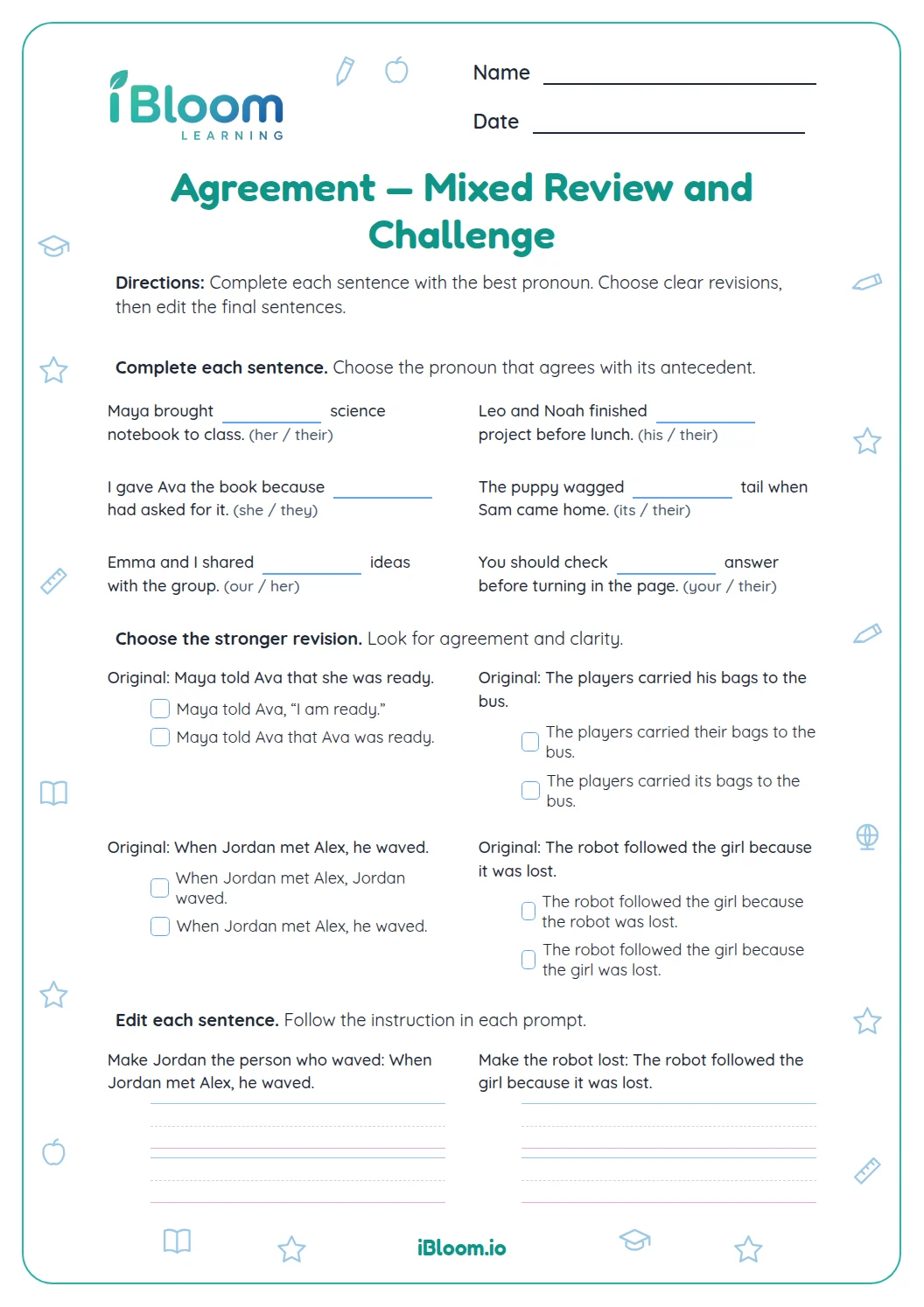
This Grade 5 printable gives students 15 opportunities to match pronouns with their antecedents. The first items practice singular and plural nouns, followed by choices about collective and compound antecedents. The final items ask students to revise sentences so the pronouns agree. A separate answer key includes sample revisions. The page practices standard English grammar conventions in CCSS L.5.1.
Aligned to L.5.1
What does this pronoun worksheet practice?
Students fill in pronouns for singular and plural antecedents, choose a pronoun for a collective or compound antecedent, and revise two sentences. The examples include class, twins, and a compound subject, so students must identify the noun or group the pronoun refers to.
How can a student check a pronoun?
In “The class finished its project,” class names one group, so its matches the singular collective noun. Students should find the antecedent first, then check whether the chosen pronoun fits its number and meaning.
- 1The class finished its project. Class names one group, so its agrees with the antecedent.
What changes in the revision part?
The last two prompts ask students to rewrite a sentence while keeping its meaning. The key gives a sample correction; other grammatically correct revisions can also work when the pronoun clearly agrees with the antecedent.
How can families review the key?
For each missed item, underline the antecedent and say whether it names one person or thing, more than one, or a group. Then reread the sentence with the pronoun. This makes the agreement decision visible instead of relying on the word that sounds familiar.
How to use this worksheet
- 1Read the antecedent before choosing a pronoun.
- 2Decide whether the antecedent is singular or plural.
- 3Check for a compound subject joined by and or nor.
- 4Complete the selection items before revising the sentences.
- 5Use the key to explain each agreement choice.
Common mistakes and quick fixes
The mistake
Treat every group noun as plural.
The fix
Ask whether the noun names one group acting together. Choose its for class or team.
The mistake
Match a pronoun to the nearest noun only.
The fix
Find the full antecedent; in “Maya and cousins,” the compound antecedent is plural.
The mistake
Use their with every singular indefinite pronoun.
The fix
For formal agreement in these items, use his or her with each or everyone.
Match a pronoun to the exact noun or group it replaces.
On this sheet: The questions directly practice pronoun-antecedent agreement.
Show the official wordingHide the official wording
Demonstrate command of the conventions of standard English grammar and usage when writing or speaking.
What to practice next
Make more practice
Further reading
Questions parents and teachers ask
What does this worksheet practice?
It contains 15 questions about pronoun-antecedent agreement. Students choose or supply pronouns for singular, plural, compound, and collective antecedents, then revise two sentences. The answer key includes sample sentence revisions, so use it to compare the agreement and meaning rather than requiring identical wording.
How do students find the antecedent?
Read the sentence and locate the noun or noun group that the pronoun replaces. For “The twins packed their own snacks,” twins is plural, so their fits. If a sentence has two nouns joined by and, treat the full compound subject as the antecedent.
Why does the key use “his or her” with each and everyone?
The worksheet follows the traditional singular agreement convention for each and everyone. Some current style guides accept singular they in these contexts. If a student uses singular they consistently and the sentence stays clear, discuss the classroom convention with the teacher.
How should students handle a collective noun?
A collective noun such as class or team can be treated as one group when its members act together. The worksheet uses that meaning in its examples, so a singular pronoun such as its matches. Reread the sentence to see whether it describes the group as one unit.
How long does the worksheet take?
The 15 questions span two printed pages including the answer key. About 15 minutes is a reasonable estimate for completing the selection items and revising two sentences; allow more time if students explain each choice or check corrections together.
What if a sentence revision differs from the key?
Compare the pronoun with its antecedent and make sure the revision preserves the intended meaning. The key marks sample revisions, not the only possible wording. A response is sound when the antecedent is clear and the pronoun agrees with it under the convention being practiced.