


About this worksheet
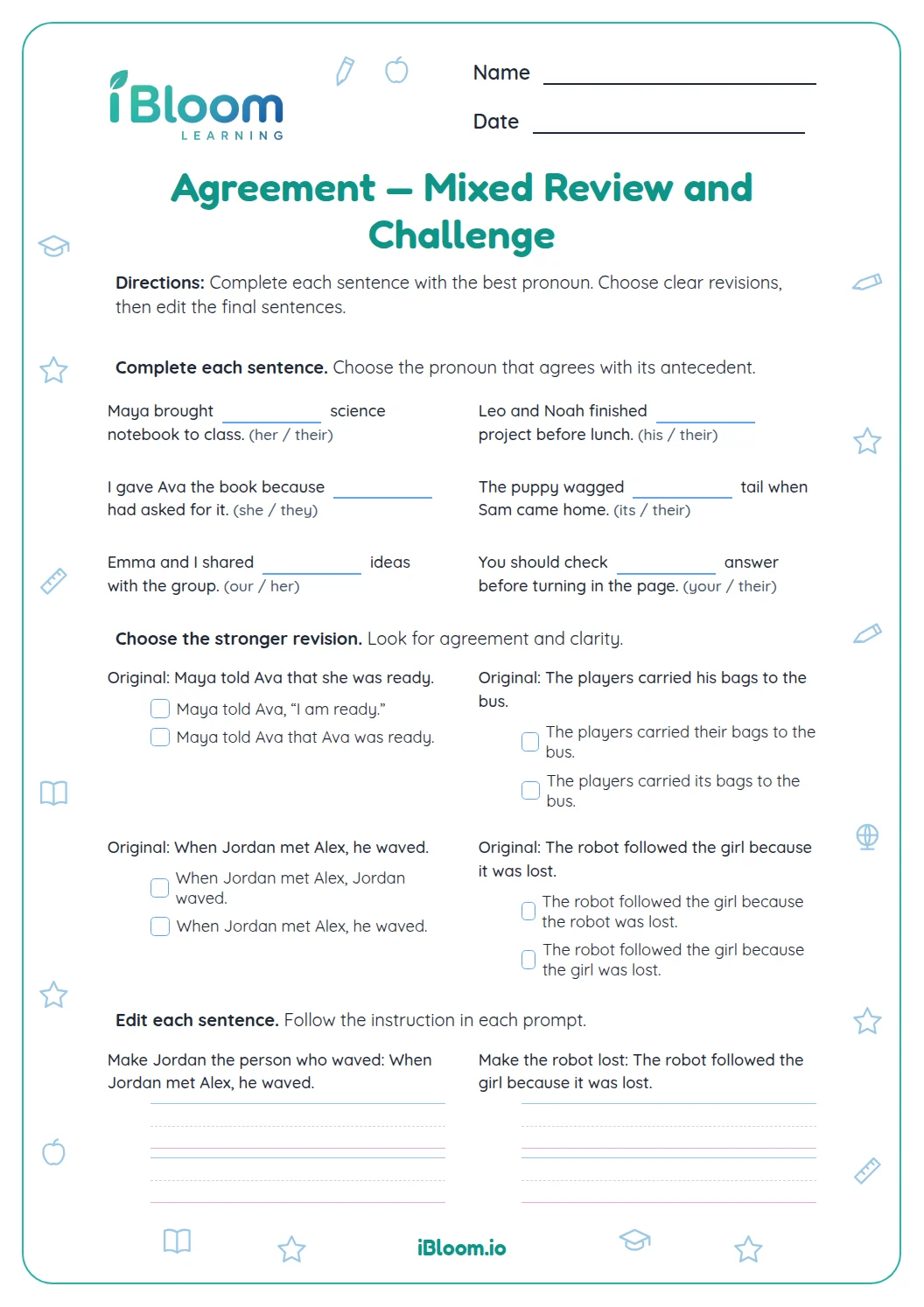
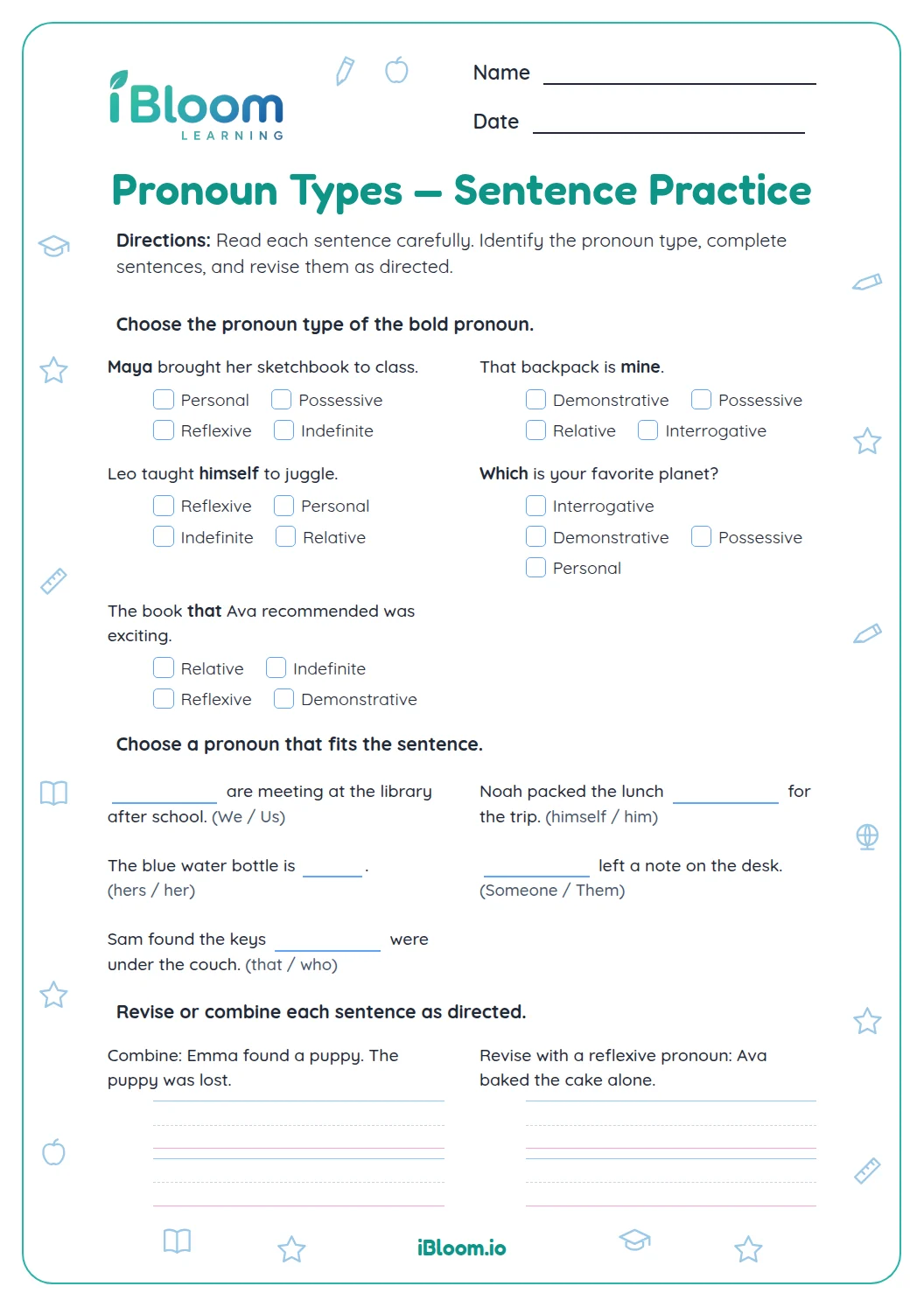
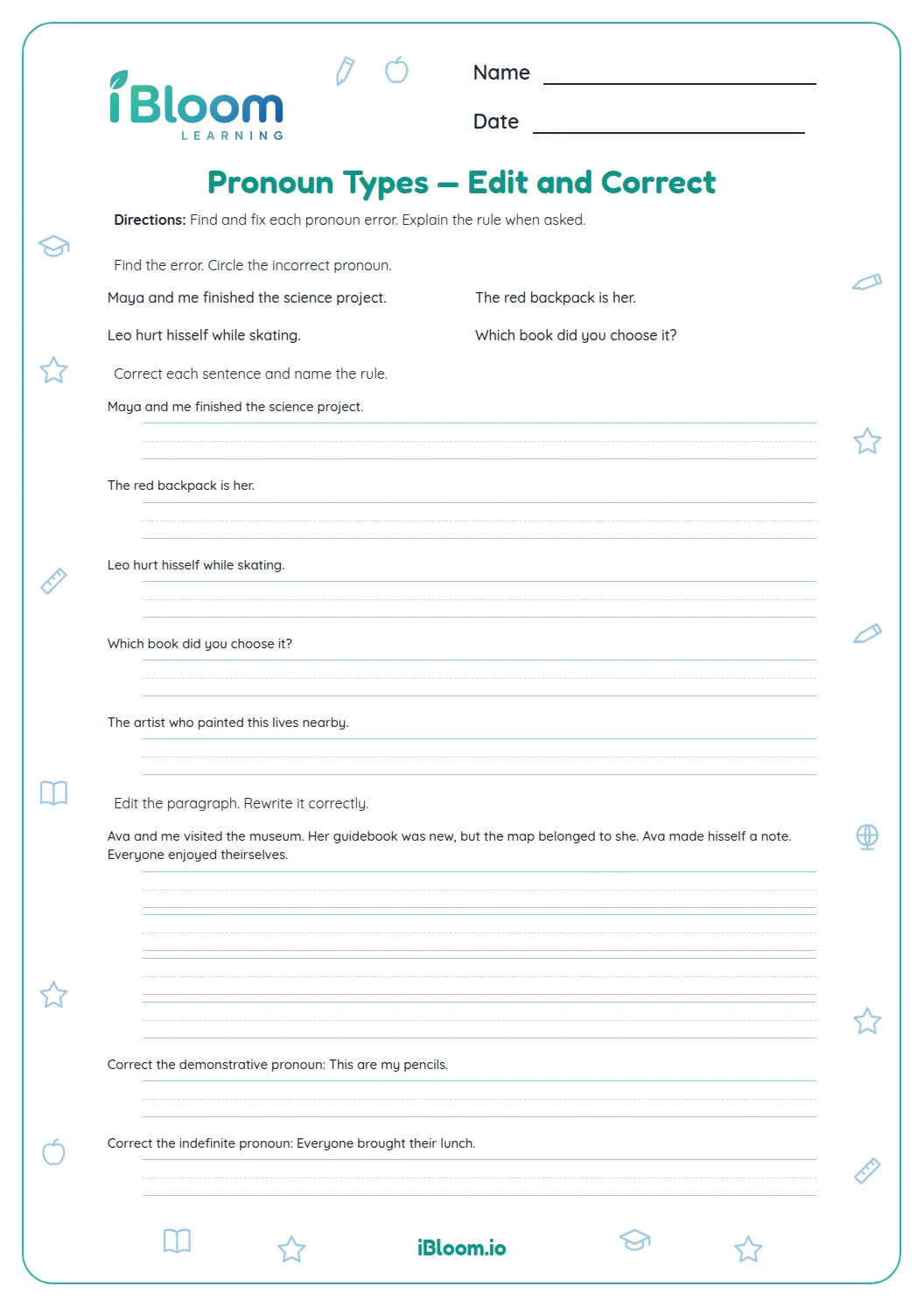
This Grade 5 worksheet helps students match a pronoun to the noun or noun phrase it refers to. The 16 items move from choosing a pronoun in a sentence to supplying one, with singular and plural antecedents including group nouns. A separate answer key supports checking. The practice connects to CCSS L.5.1, command of standard English grammar and usage.
Aligned to L.5.1
What noun does the pronoun replace?
The antecedent is the noun or noun phrase a pronoun refers to. Find it before choosing a pronoun, then check whether it names one person or thing or more than one.
How do group nouns work here?
A collective noun such as flock or committee names a group. When the sentence treats that group as one unit, a singular pronoun such as it fits. Plural nouns such as bicycles take they.
How do you solve question 2?
Maya and Luis names two people, so the matching possessive pronoun is their: “Maya and Luis packed their lunches.” Check the antecedent before looking at the choices.
How to use this worksheet
- 1Locate the noun or noun phrase the pronoun refers to.
- 2Decide whether that antecedent is singular or plural in the sentence.
- 3Choose or write a pronoun that agrees in number and makes sense.
- 4Read the completed sentence aloud and check it with the key.
Check agreement
The mistake
Mistake: matching a pronoun to the closest noun automatically.
The fix
Identify the full antecedent first.
The mistake
Mistake: treating a collective noun as plural when it acts as one unit.
The fix
Check whether the sentence describes the group together.
The mistake
Mistake: using they for a plural noun in one sentence and it for the same noun later.
The fix
Keep the reference consistent.
Demonstrate command of the conventions of standard English grammar and usage when writing or speaking.
On this sheet: The questions provide direct practice with this skill.
Show the official wordingHide the official wording
Demonstrate command of the conventions of standard English grammar and usage when writing or speaking.
What to practice next
Make more practice
Further reading
Questions parents and teachers ask
What is an antecedent?
An antecedent is the noun or noun phrase that a pronoun refers to. In “Maya and Luis packed their lunches,” Maya and Luis is the antecedent and their is the pronoun. Finding that noun first helps students choose a pronoun that agrees.
How do students check pronoun agreement?
Find the antecedent first, decide whether it is singular or plural in the sentence, and select a pronoun that matches. Then read the whole sentence to make sure the reference is clear. The worksheet includes both multiple-choice and write-in items.
How does a collective noun affect pronoun choice?
A collective noun names a group. When it describes the group acting as one unit, as flock does in the sentence about returning to a nest, a singular pronoun such as its agrees. Students should use the sentence meaning to check the reference.
What is on this worksheet?
There are 16 questions in two parts. Part A asks students to choose a pronoun from options, and Part B asks them to supply a pronoun that agrees with the sentence antecedent. The answer key provides the intended choice or pronoun for every item.
Can “they” refer to one person?
Yes. Singular they is widely used when a person’s gender is unknown or when that person uses they. This worksheet uses wording and choices intended to make each answer clear, while the larger rule remains that the pronoun should refer clearly to its antecedent.