


About this worksheet
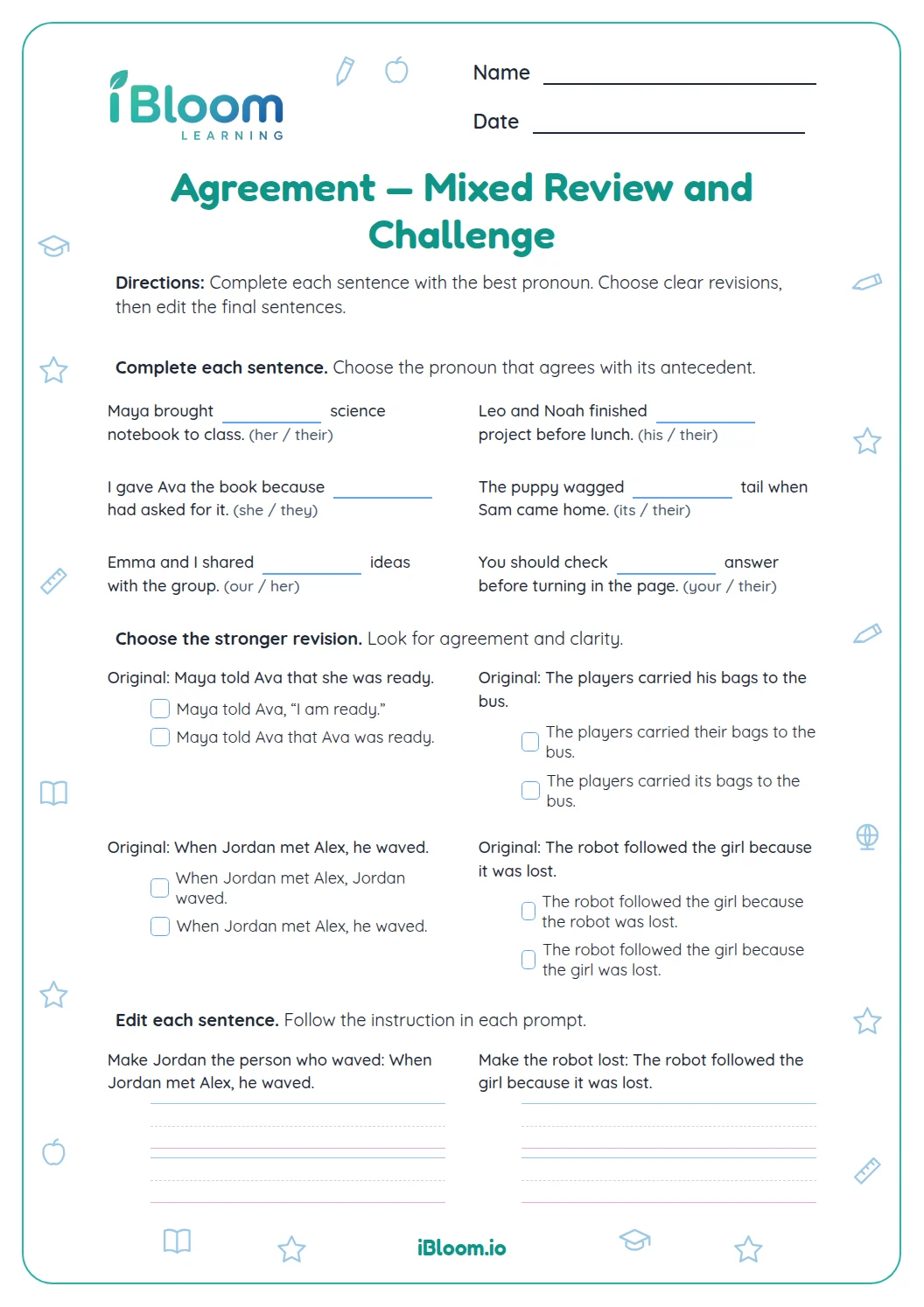
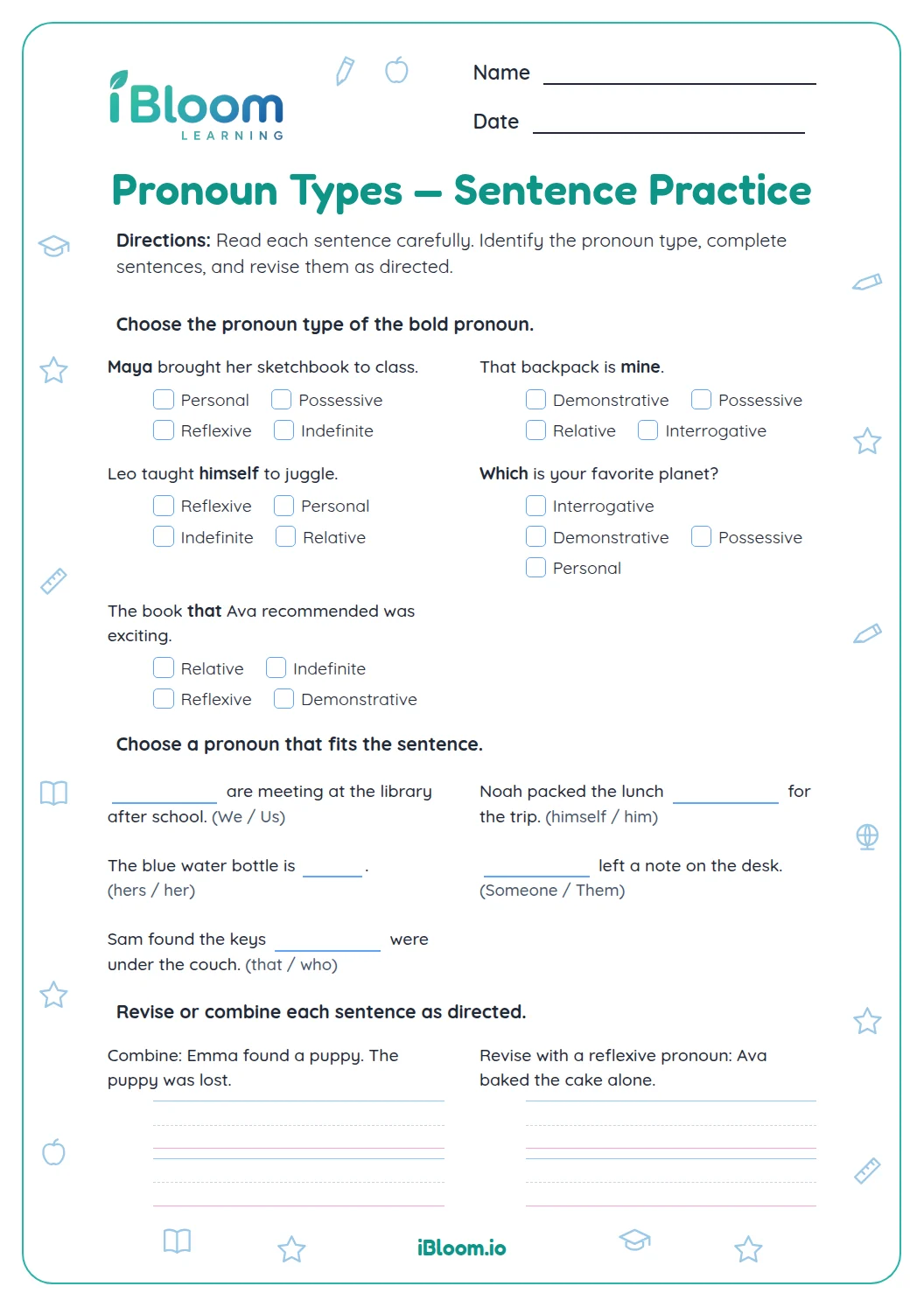
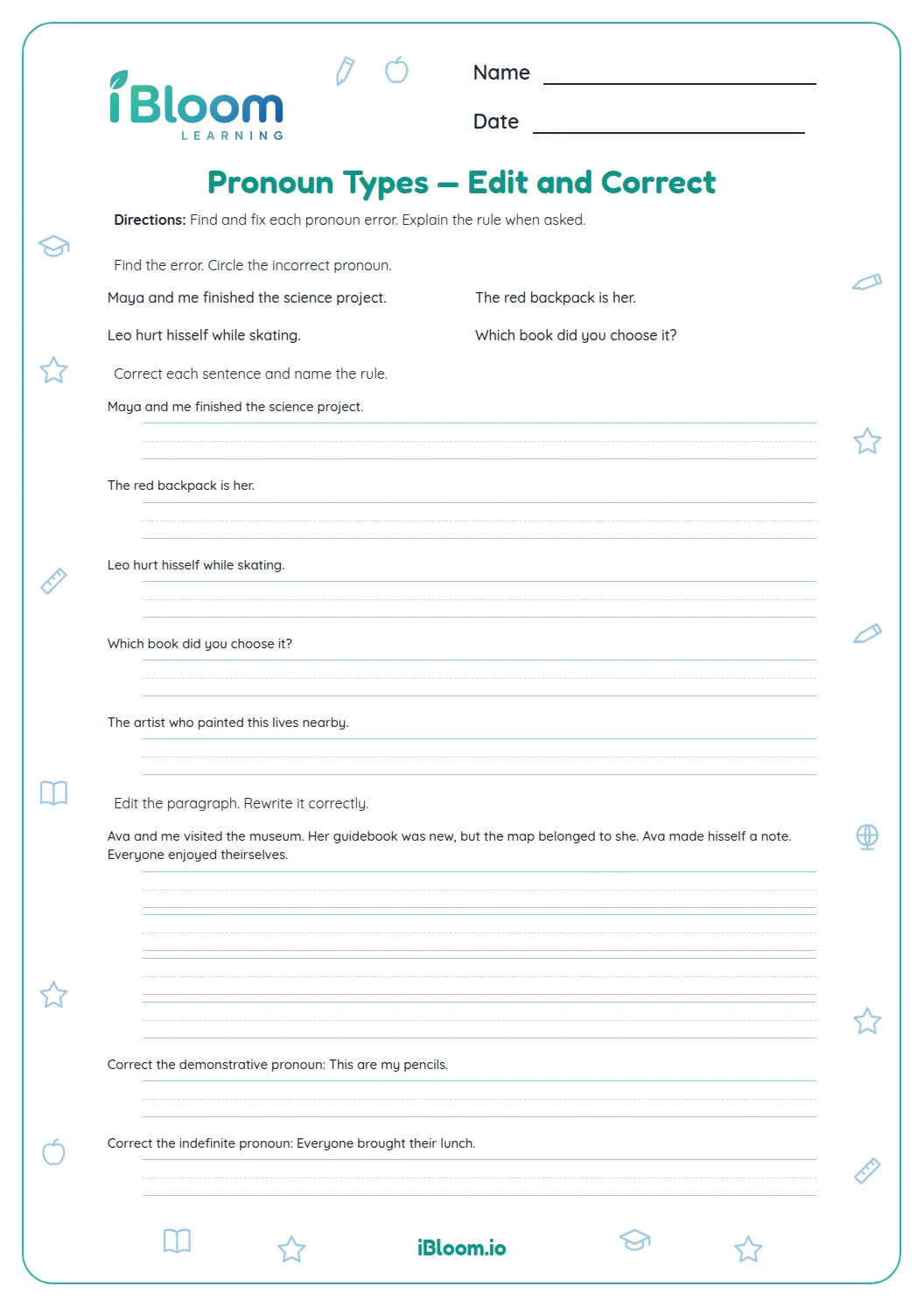
This free printable gives Grade 5 students practice matching pronouns to their antecedents. Part A asks students to choose a pronoun that agrees with a singular or plural noun. Part B shifts to writing the missing pronoun, and Part C asks students to check complete sentences. The examples include named people, animals and groups. The skill aligns with CCSS L.3.1.f, which names pronoun-antecedent agreement. A separate answer key supports quick review.
Aligned to L.3.1.f
How do you find the antecedent?
The antecedent is the noun that a pronoun refers to. In “The players packed their water bottles,” players is the antecedent and their points back to it. First identify that noun; then decide whether it names one or more than one.
Part A gives choices so students can focus on matching the noun and pronoun. Part B removes the choices and asks students to supply the pronoun.
- 1The players packed ___ water bottles.
- 2Players is plural, so the matching pronoun is “their.”
What changes when the antecedent is plural?
A plural antecedent usually takes a plural pronoun: cousins/their, musicians/their, or geese/their. A singular noun such as kitten takes a singular pronoun such as it or its. Read the whole sentence to check that the chosen word makes sense.
A singular noun such as lamp takes a singular pronoun such as it or its. Read the whole sentence to check that the chosen word makes sense. Plural antecedents such as students take plural pronouns such as they or their.
How do you choose a pronoun for a person?
When a sentence names a person, use a pronoun that matches that person and the sentence. For example, Maya takes she or her; Mr. Chen takes he or his. An antecedent can be a person, an animal, or a thing.
A compound antecedent joined by and is plural: Maya and Luis takes they. For one named person, use a pronoun that matches the person, as in Ava/her or Marcus/his.
How can you check your answer?
Read the sentence again and replace the pronoun with its antecedent. If the sentence still makes sense and the number matches, the agreement is sound. Then check that the pronoun points to the intended noun, rather than to another nearby noun.
How to use this worksheet
- 1Read the full sentence before choosing a pronoun.
- 2Circle or underline the antecedent first.
- 3Decide whether the antecedent is singular or plural.
- 4Choose a pronoun that matches and makes sense in the sentence.
- 5In Part B, write only the missing pronoun.
- 6Use the key to review any answer that did not match.
Common mistakes and quick fixes
The mistake
Choosing “their” because a sentence mentions several people, even though its antecedent is each or everyone.
The fix
Locate the exact noun the pronoun replaces; each and everyone are singular here.
The mistake
Matching a pronoun to the closest noun instead of the noun it refers to.
The fix
Replace the pronoun with the antecedent and reread the sentence.
The mistake
Using “it” for a plural antecedent such as puppies.
The fix
Check whether the antecedent names one or more than one.
This practice focuses on matching pronouns to their antecedents.
Match each pronoun to the noun it refers to.
On this sheet: Every part asks students to select or supply pronouns that agree with their antecedents.
Show the official wordingHide the official wording
Ensure subject-verb and pronoun-antecedent agreement.*
What to practice next
Make more practice
Further reading
Questions parents and teachers ask
What is an antecedent?
An antecedent is the noun a pronoun refers to. In “Maya and Luis said they would lead the tour,” the names Maya and Luis are the antecedents for they. Finding the antecedent first makes it easier to choose a pronoun that matches the sentence.
Why does “everyone” take a singular pronoun here?
Some indefinite pronouns, such as everyone, are grammatically singular in formal school grammar, even though they refer to people considered one at a time. A traditional agreement form is “Everyone brought his or her own pencil.” Singular “they” is also widely used in everyday writing; a style guide can set the preference.
When should a student use “their”?
Use their when the antecedent is plural, such as players, puppies or musicians. The plural noun and plural pronoun agree. On this worksheet, students also see singular indefinite pronouns, which take a singular form in the expected answers.
What is the difference between “its” and “it’s”?
Its shows possession, as in “The club displayed its model.” It’s is a contraction meaning “it is” or “it has.” The worksheet uses its to show that something belongs to a club, lamp or animal. Students can say the sentence aloud as “it is” to test whether it’s would fit.
How many questions are on the printable?
There are 16 questions across three parts. Students choose matching pronouns in Part A, complete sentences in Part B, and identify a correctly matched sentence in Part C. The separate answer key lists an answer for each item.
What should students practice next?
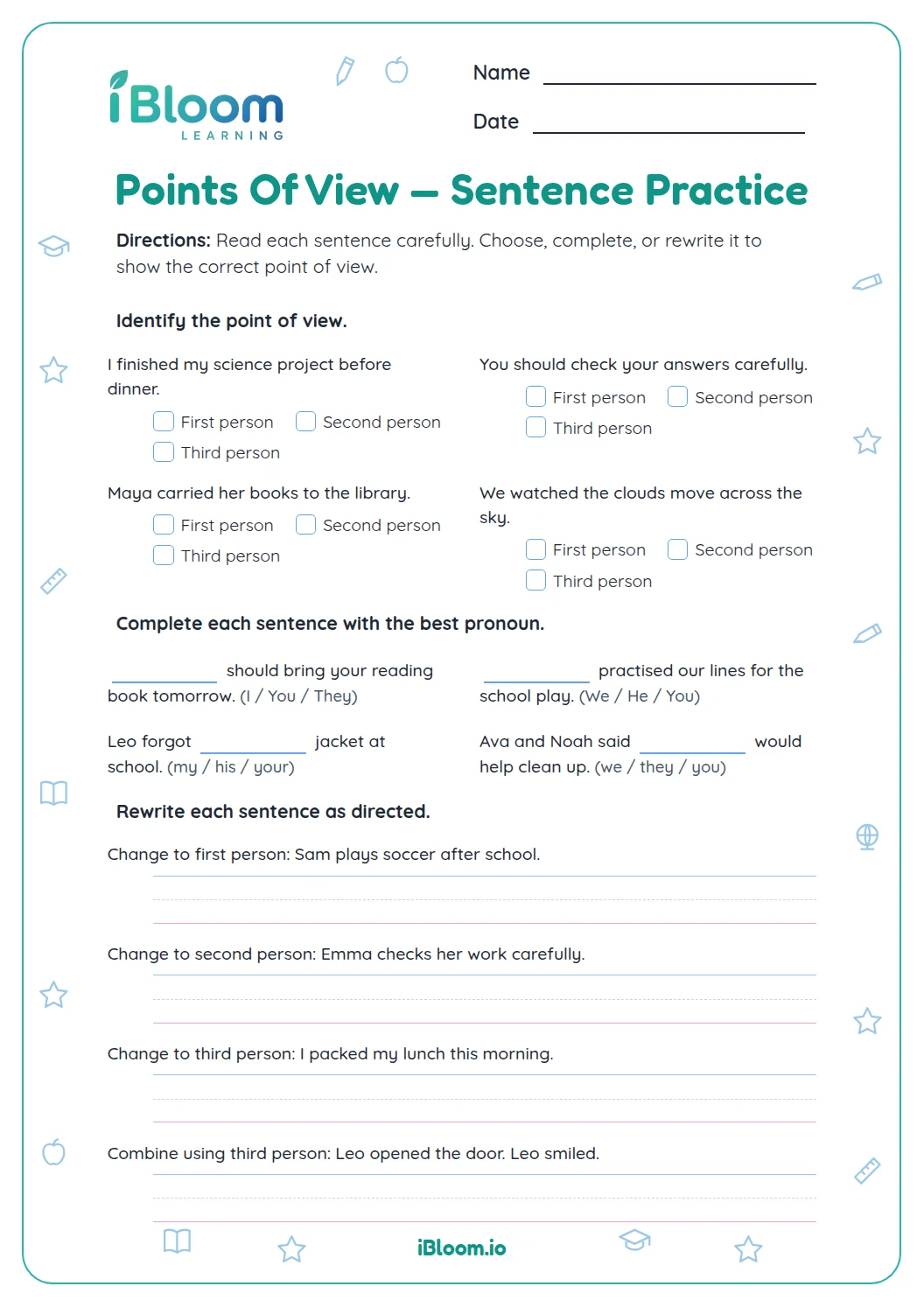
After matching pronouns to antecedents, students can practice pronoun types and point of view. The linked Grade 5 worksheets build on this work by asking students to recognize how pronouns function in a sentence and how they affect a reader’s point of view.