



About this worksheet
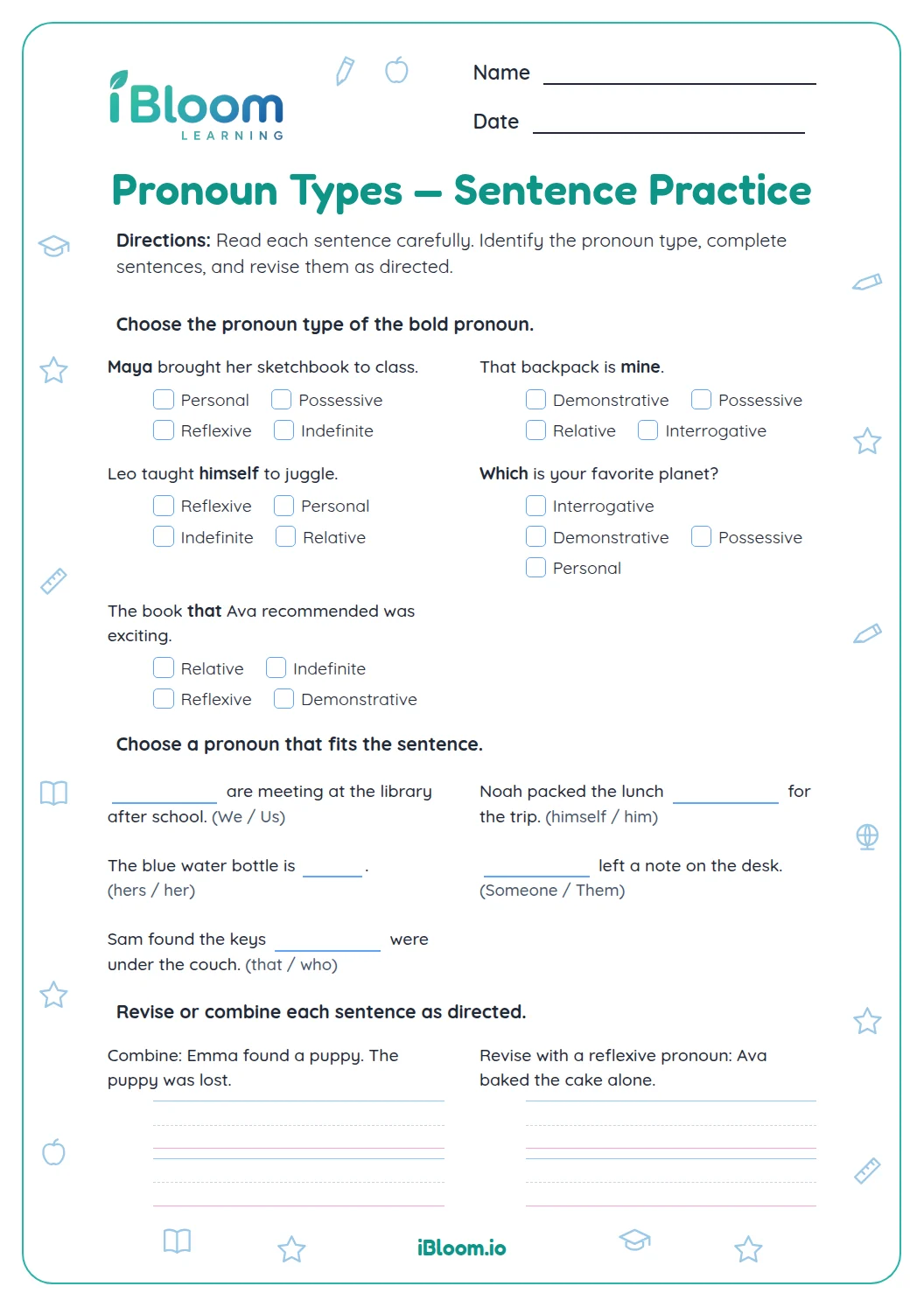
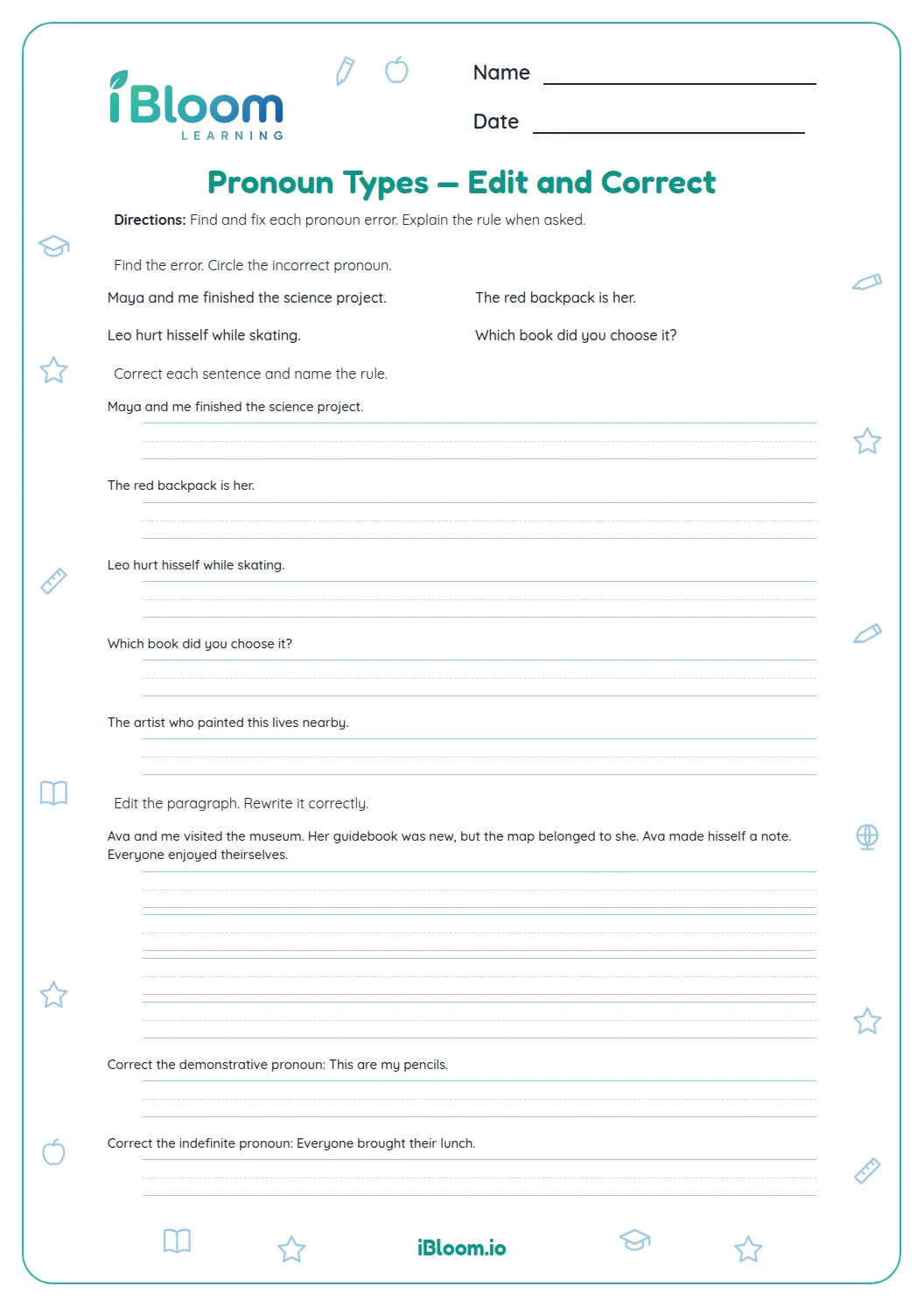
This Grade 5 grammar worksheet practices personal, possessive, and relative pronouns in complete sentences. Students identify forms, choose pronouns that fit a sentence, and use relative pronouns to connect details; the separate answer key lists answers and a sample revision.
Aligned to L.5.1
What does this page help students practice?
Students identify personal and possessive pronouns, complete sentences with the right form, and use relative pronouns to connect a noun with more information. The examples keep pronoun choices tied to sentence meaning.
Work through the parts in order, then use the answer key to review the reasoning behind each response.
How does a pronoun fit its sentence?
For “The markers belong to Leo and ___,” the phrase “belong to” needs an object pronoun after Leo and. “Me” completes the sentence; “I” is used as a subject and “mine” stands alone to show ownership.
- 1The markers belong to Leo and ___.
- 2Answer: me
What can students do after checking the page?
Ask the learner to explain one answer aloud and point to the words or numbers that support it. Then try the next related worksheet linked below.
How to use this worksheet
- 1Read the full sentence, including the words before and after the blank.
- 2Check whether the pronoun names a subject, object, owner, or clause connector.
- 3Choose the form that fits both grammar and meaning.
- 4Reread the completed sentence aloud.
- 5Check all fifteen items with the answer key.
Common mistakes and quick fixes
The mistake
Rushing and answering from one word or number alone.
The fix
Read the entire prompt and use all the clues it gives.
The mistake
Changing an answer without checking the evidence in the item.
The fix
Point to the clue, number relationship or grammar pattern that supports the choice.
The mistake
Copying a key response without understanding it.
The fix
Explain the answer in your own words before moving on.
Common Core alignment
This page gives focused practice with the listed Common Core skill.
Use pronouns and standard English grammar in writing.
On this sheet: Students select and use pronouns in complete sentences.
Show the official wordingHide the official wording
Demonstrate command of the conventions of standard English grammar and usage when writing or speaking.
What to practice next
Make more practice
Further reading
Questions parents and teachers ask
Which pronouns appear on the page?
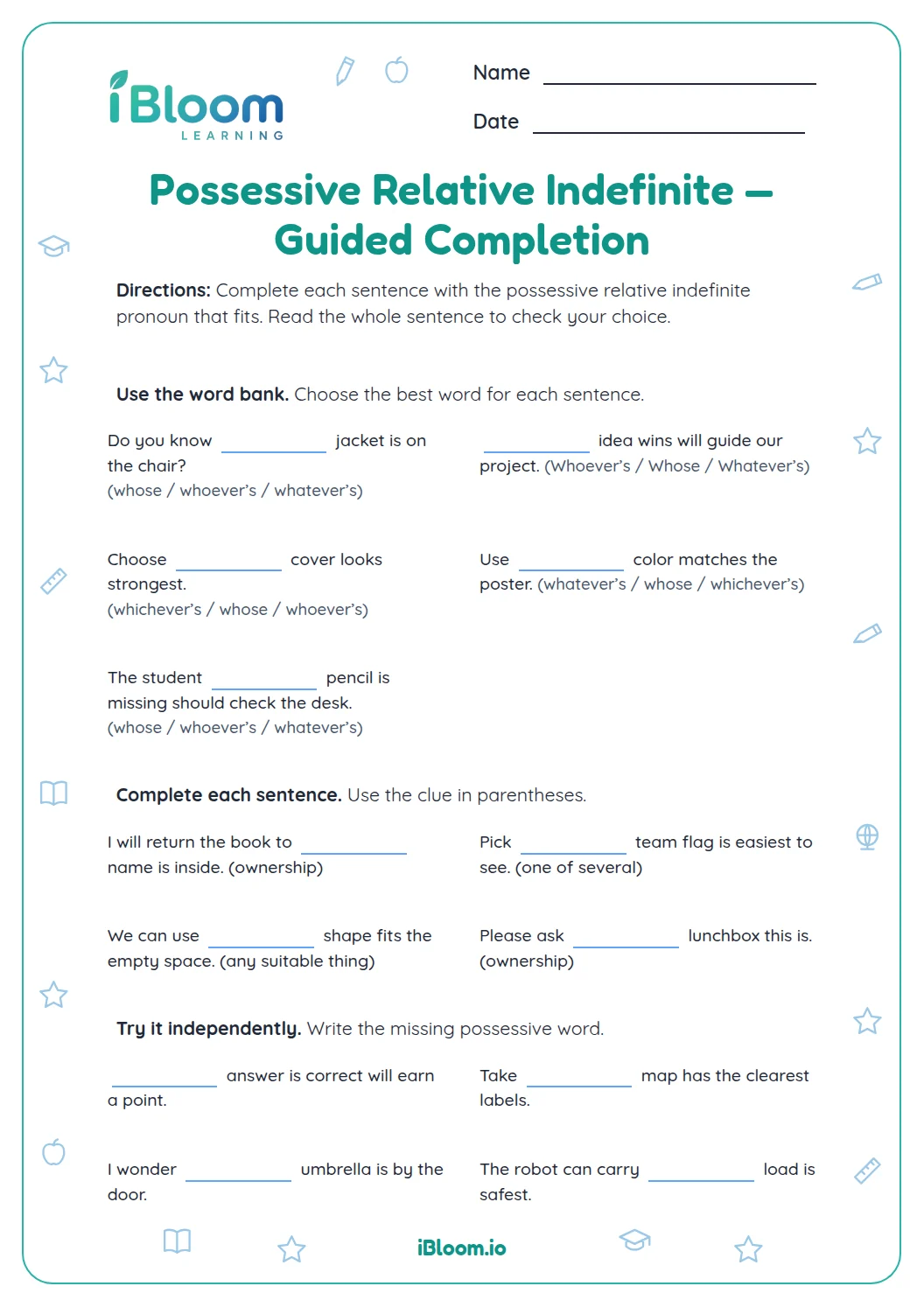
The page practices personal, possessive, and relative pronouns in 15 sentence-based questions. Examples include me as an object pronoun, ours as a possessive pronoun, and that or whose as a relative pronoun. Students also choose a pronoun that completes a sentence and revise repeated wording.
What is a possessive pronoun?
A possessive pronoun shows ownership without naming the owner again. In “The backpack is mine,” mine tells who owns the backpack; in “their folder,” their comes before a noun. Ask the learner to point to the exact words in the prompt that support the response, then restate the idea in a complete sentence.
Why do pronouns need clear meaning?
A pronoun should point clearly to the person or thing it replaces. Clear references help readers follow who acted, who owns an item and how ideas in a sentence connect. Ask the learner to point to the exact words in the prompt that support the response, then restate the idea in a complete sentence.
Can written answers differ from the key?
Yes. A few prompts ask students to write their own sentence or revise repeated wording. The key gives a sample; another response is correct when it uses a suitable pronoun and keeps the meaning clear. Ask the learner to point to the exact words in the prompt that support the response, then restate the idea in a complete sentence.
What should students practice next?
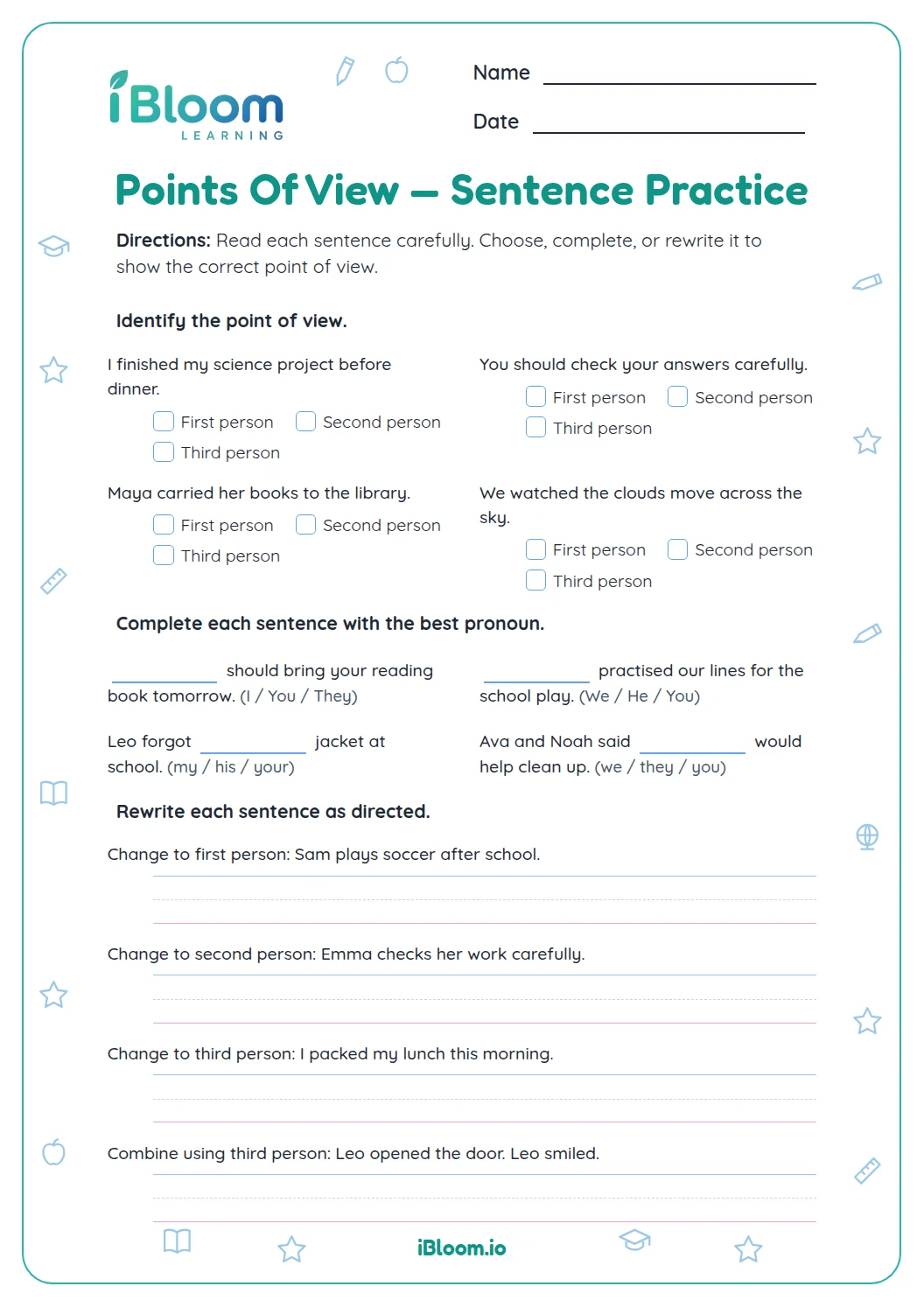
Pronoun Agreement is a useful next step because students connect pronouns to the nouns they replace. Points of View then shows how pronouns shape who tells a story. Ask the learner to point to the exact words in the prompt that support the response, then restate the idea in a complete sentence.