


About this worksheet
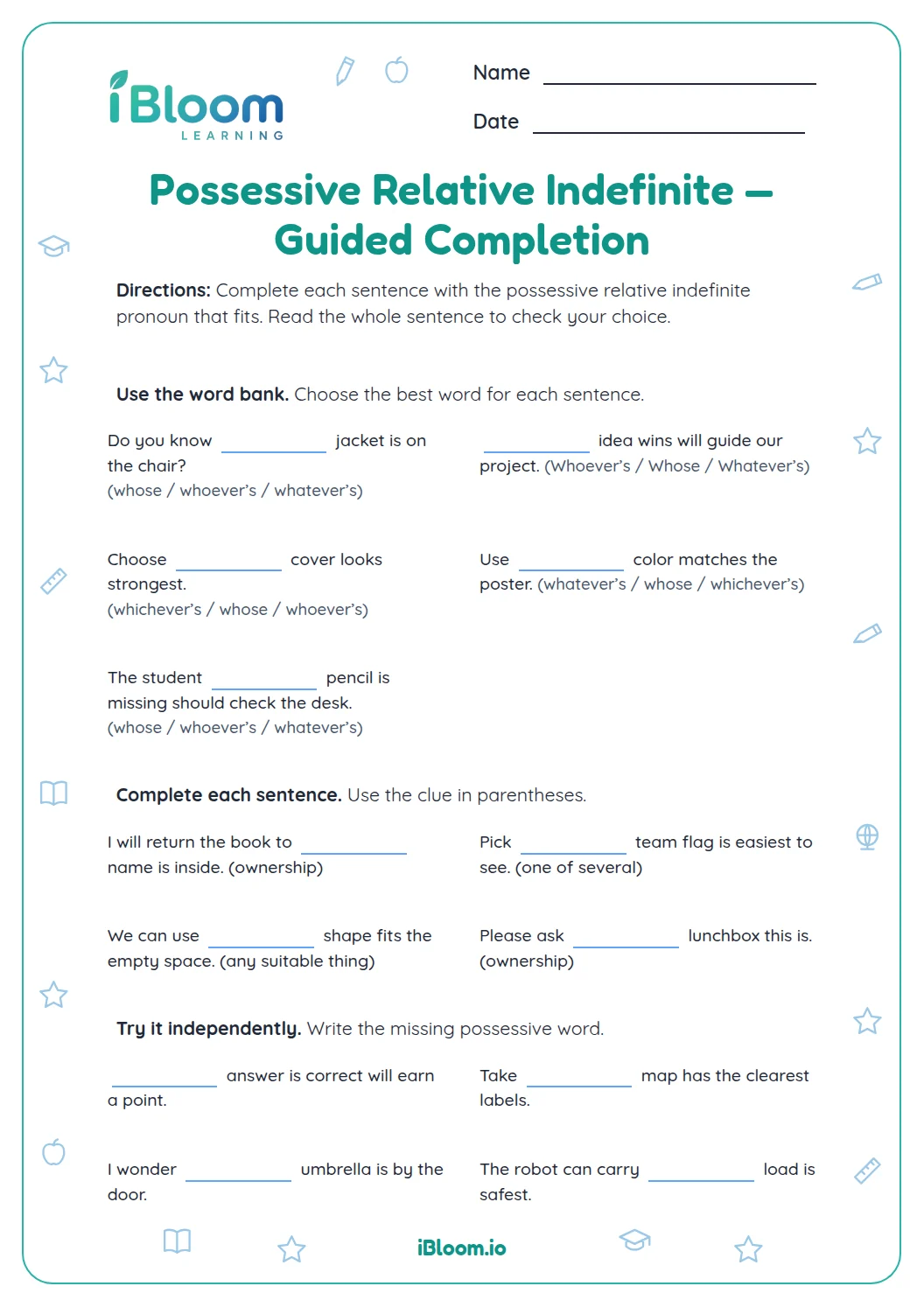
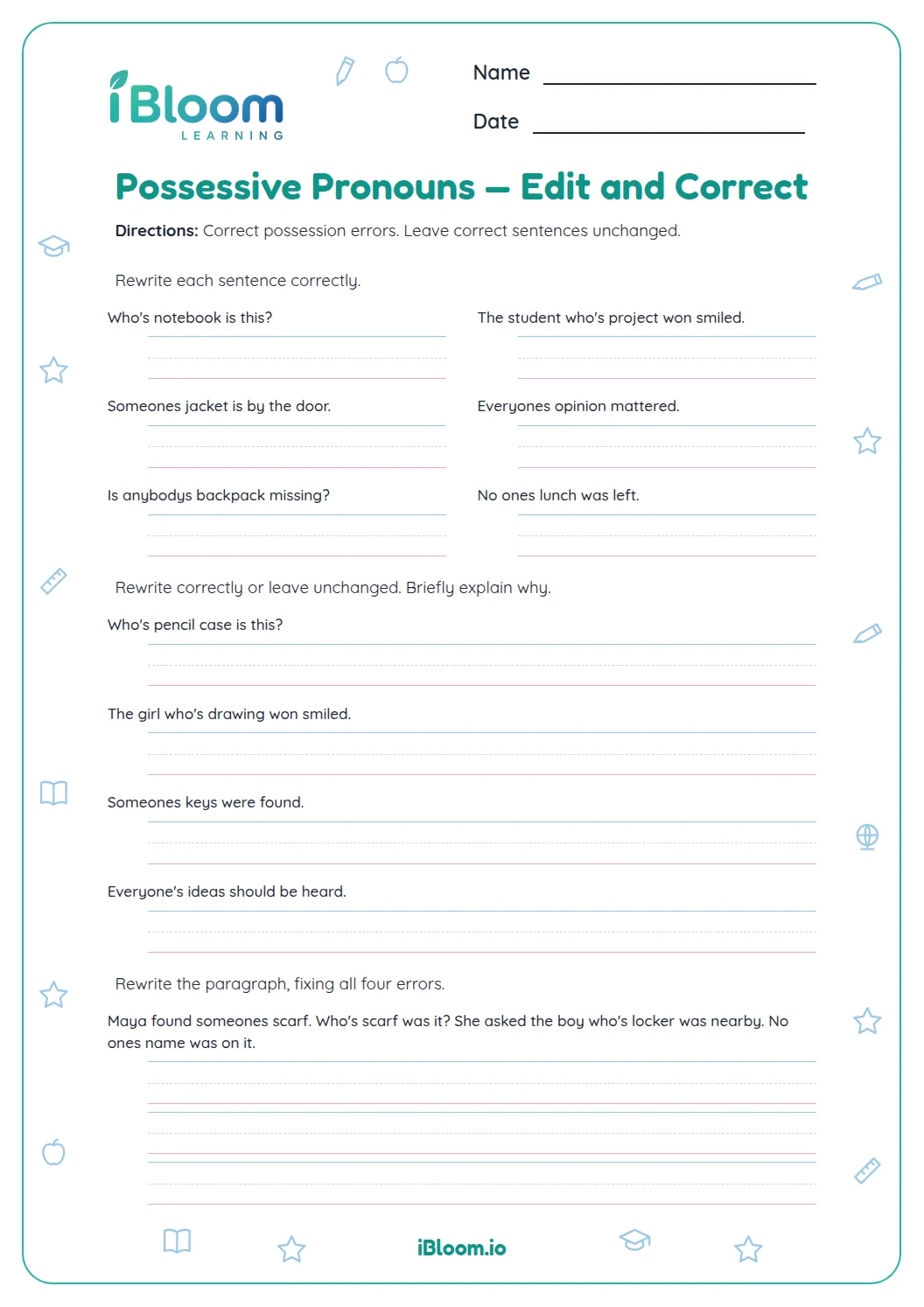
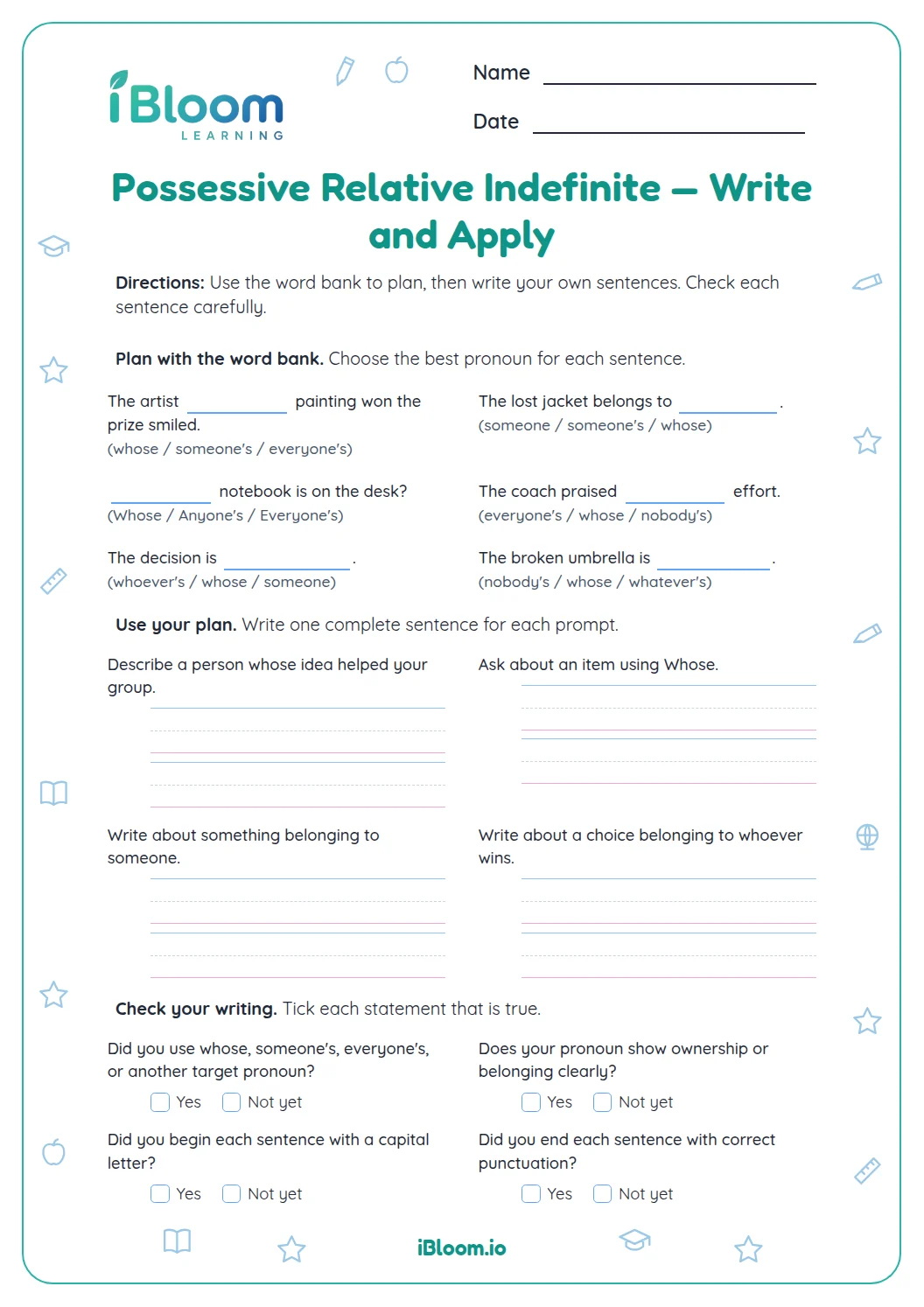
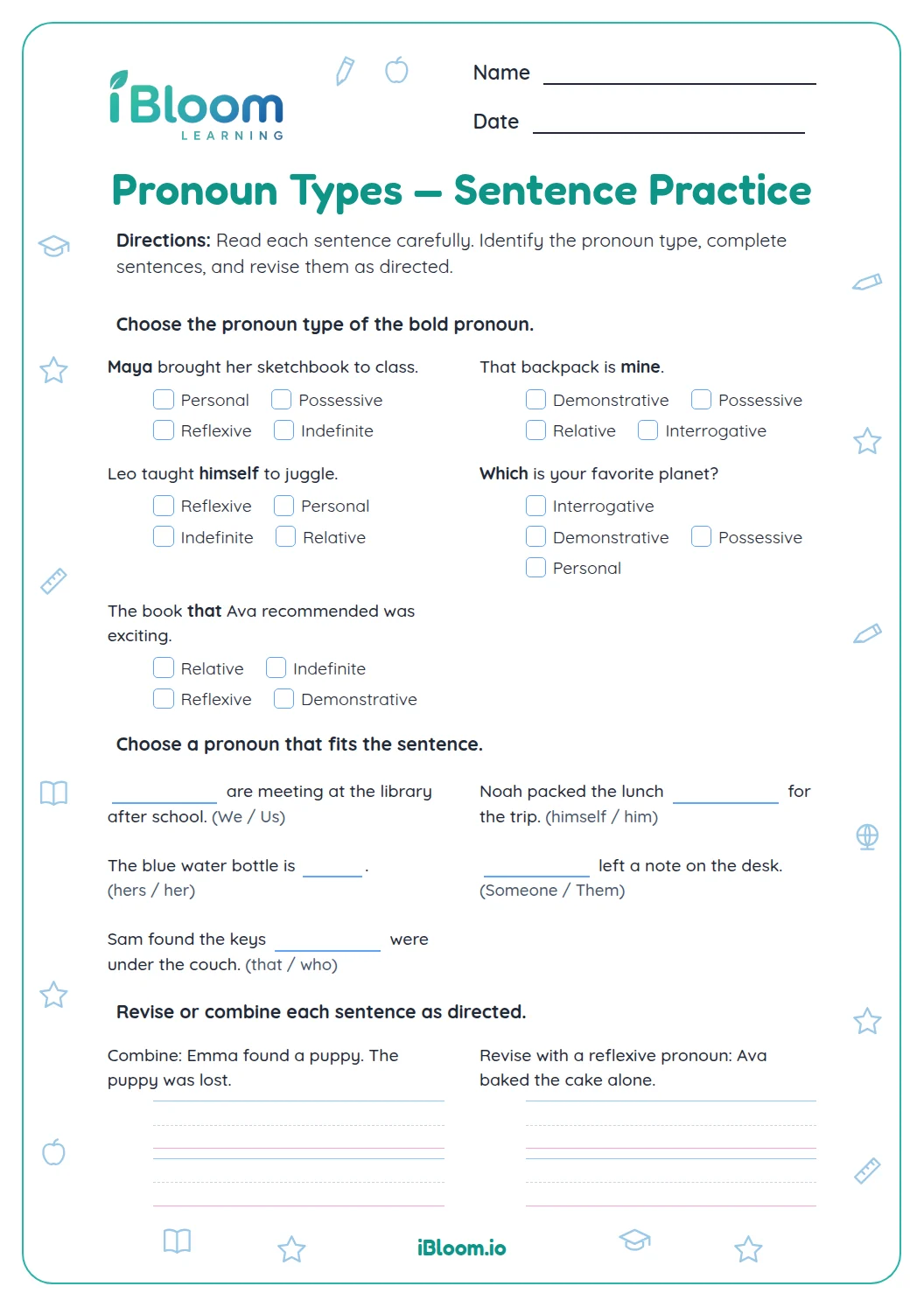
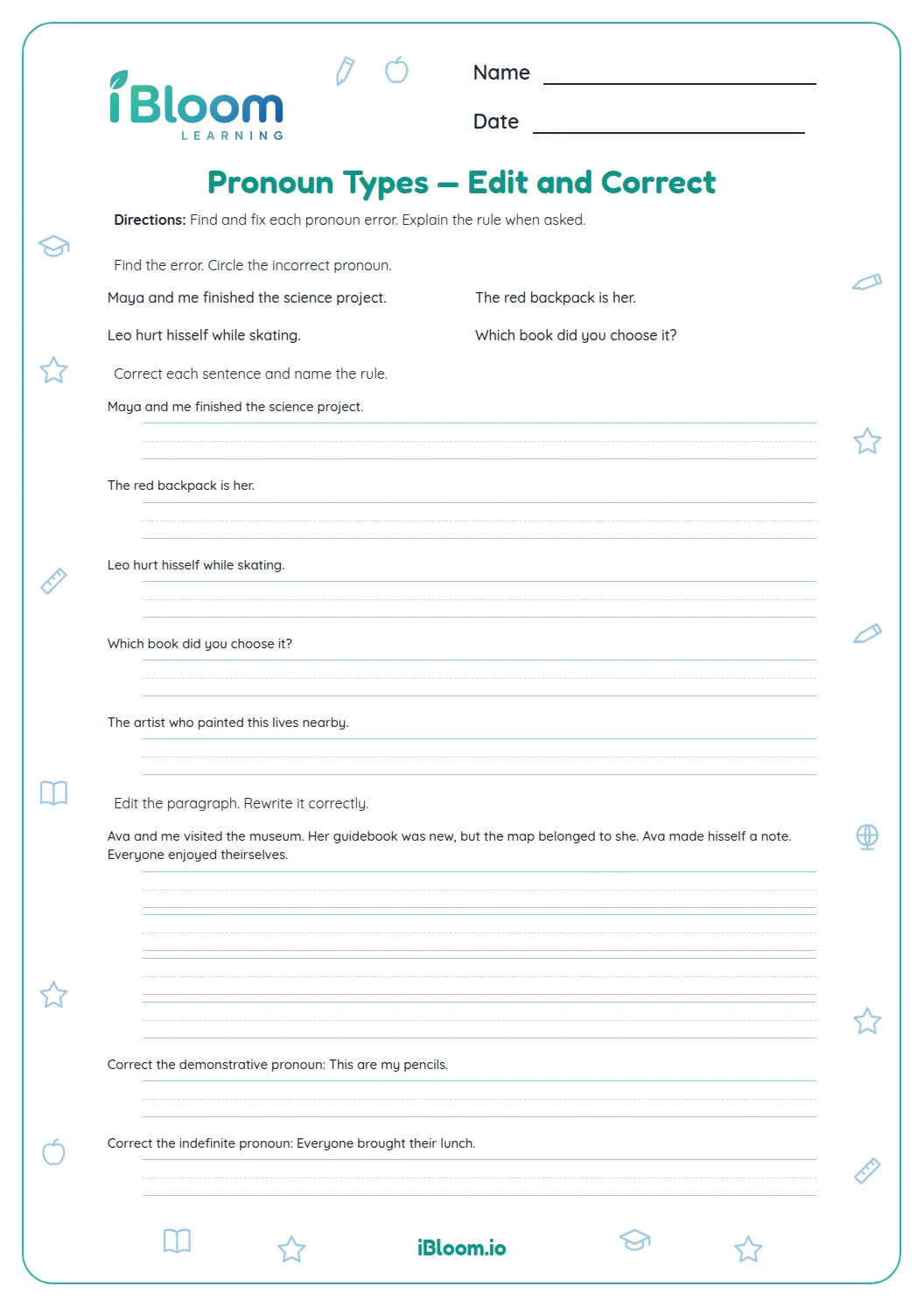
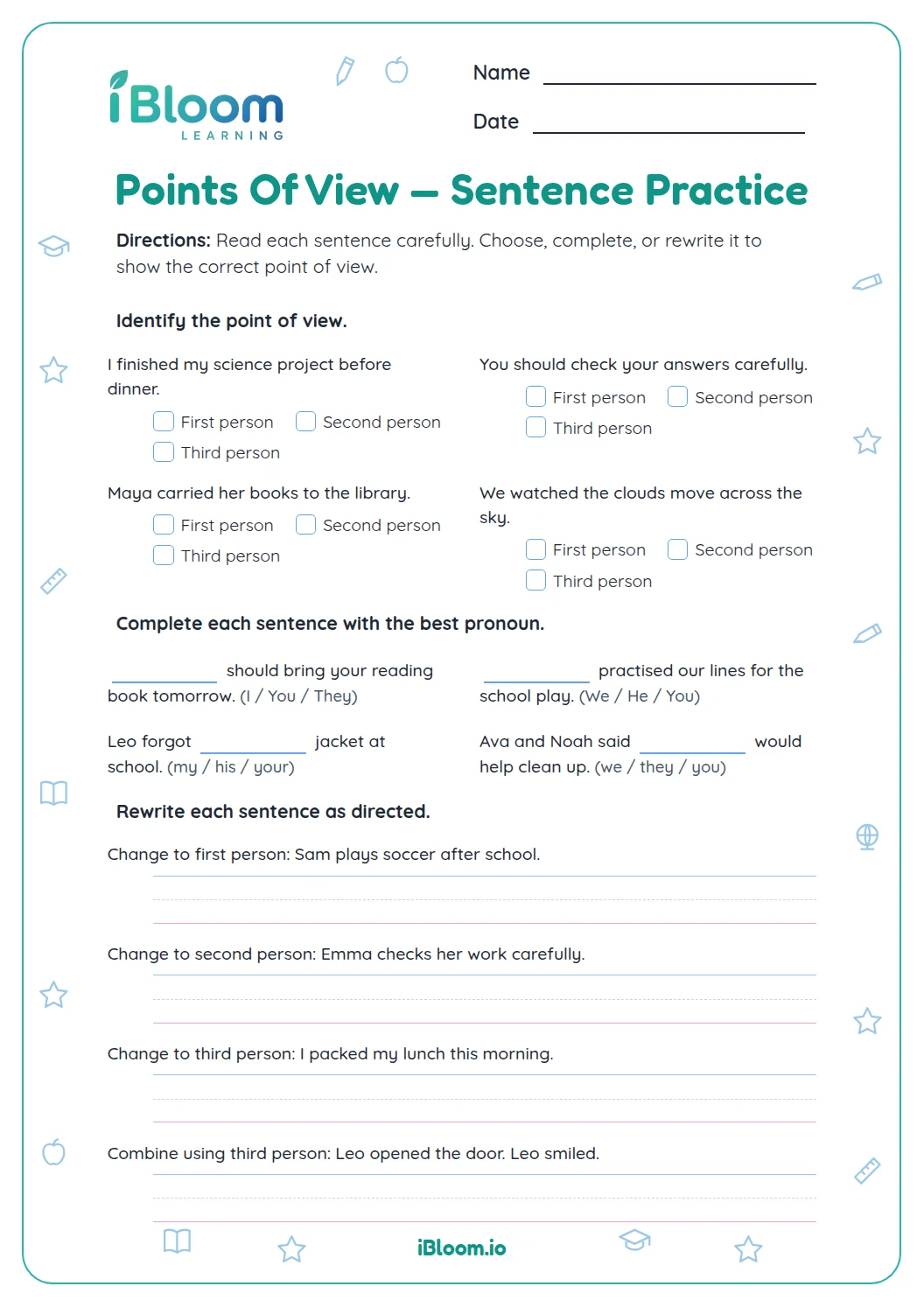
This Grade 5 worksheet focuses on possessive, relative, and indefinite pronouns. Students first select a pronoun that fits a sentence, then name the type of a pronoun in context. Examples distinguish ownership words such as theirs, clause-connecting words such as who, and general references such as everyone.
How can students recognize these pronoun types??
Students choose possessive, relative, and indefinite pronouns in context, then classify pronouns in complete sentences. Examples include theirs and yours, relative words that connect clauses, and indefinite words such as someone and neither.
- The sheet has 14 questions in two parts.
- The answer key follows the practice pages.
How can a sentence help identify a pronoun type?
In question 1, “The blue backpack is mine,” mine stands alone in place of the owner’s name, so it is possessive. Sentence context also helps distinguish relative and indefinite pronouns.
How can students check a relative pronoun?
Read the words around it and ask whether the pronoun begins a clause describing a noun. In question 9, that begins “that I borrowed,” which describes the book.
How to use this worksheet
- 1Read the directions at the top of the page.
- 2Work through each part in order.
- 3Reread a sentence or example before choosing an answer.
- 4Check the separate answer key and revisit any missed item.
Common mix-ups
The mistake
Calling “their” a pronoun when it comes before a noun.
The fix
“Their coats” uses a possessive determiner; “the coats are theirs” uses a pronoun.
The mistake
Calling “everyone” a relative pronoun because it refers to people.
The fix
It refers to people generally; it does not connect a describing clause to a noun.
The mistake
Classifying “whose” without reading the whole sentence.
The fix
Check whether it connects a clause and asks who owns something in that clause.
What to practice next
Make more practice
Questions parents and teachers ask
What is a possessive pronoun?
A possessive pronoun shows ownership and stands in for a noun phrase. In “The gloves are theirs,” theirs replaces the name of the owners. The worksheet uses forms such as mine, ours, hers, and yours in complete sentences. The worksheet pairs these descriptions with examples so students can practice identifying the idea in context.
What does a relative pronoun do?
A relative pronoun introduces a clause that describes a noun. In “the artist who painted the mural,” who begins the clause that tells which artist. Students use the entire sentence to recognize that connecting job. Pointing to a clue in the complete sentence helps explain why the answer fits.
What is an indefinite pronoun?
An indefinite pronoun refers to a person or thing without naming exactly who or what. Someone, everyone, each, and neither are examples. The worksheet asks students to notice that general reference in a sentence. Pointing to a clue in the complete sentence helps explain why the answer fits.
How many questions are included?
The worksheet has 14 questions on two practice pages. The first eight ask students to choose a pronoun by type, and the remaining six ask them to classify a pronoun in a sentence. An answer key follows. The key gives students a way to review each item after completing both parts.
Is “whose” always a relative pronoun?
No. Its job depends on the sentence. In “the student whose notebook is missing,” whose connects a describing clause and shows possession within it. Read the whole sentence before labeling the word. The worksheet pairs these descriptions with examples so students can practice identifying the idea in context.