


About this worksheet
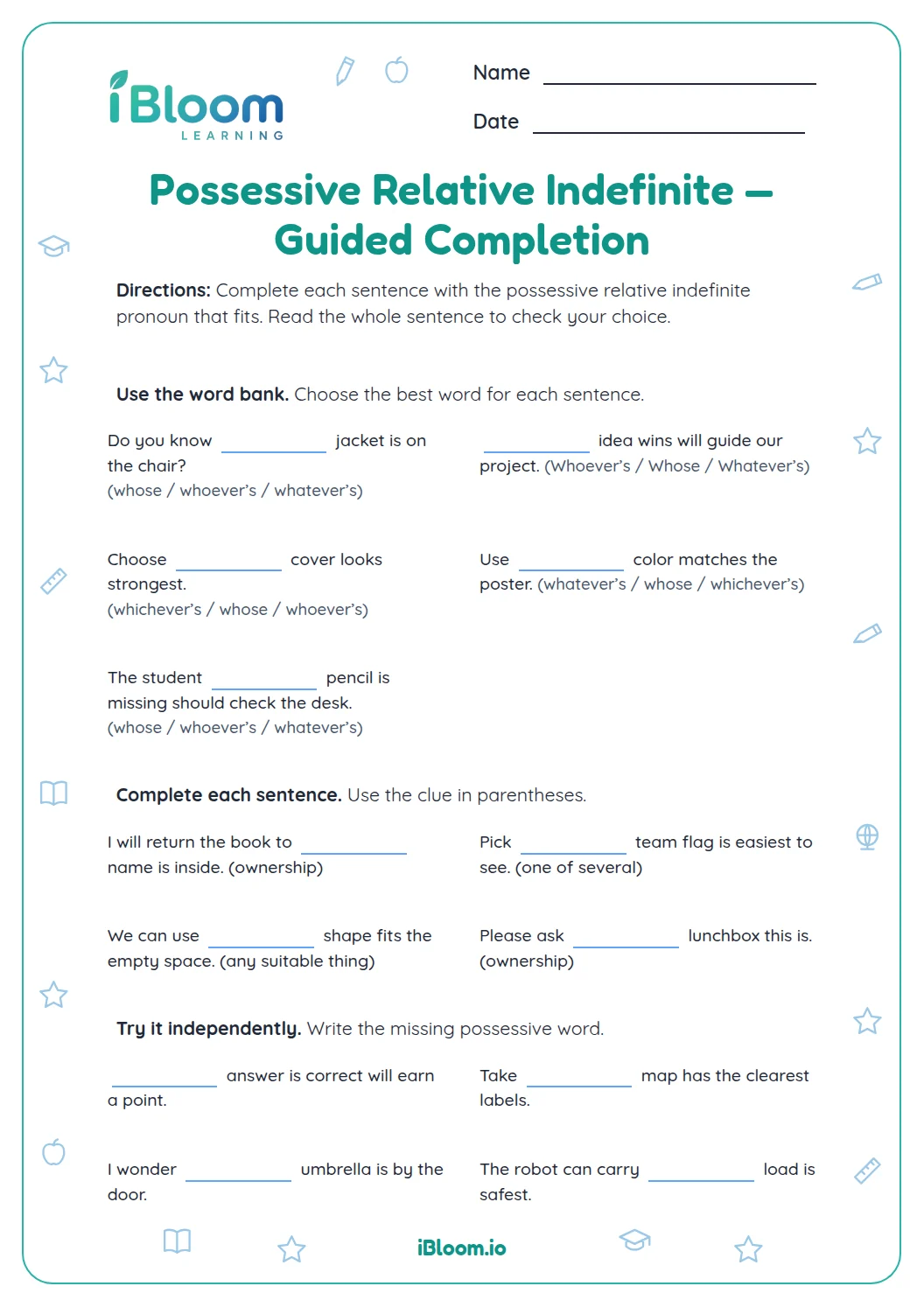
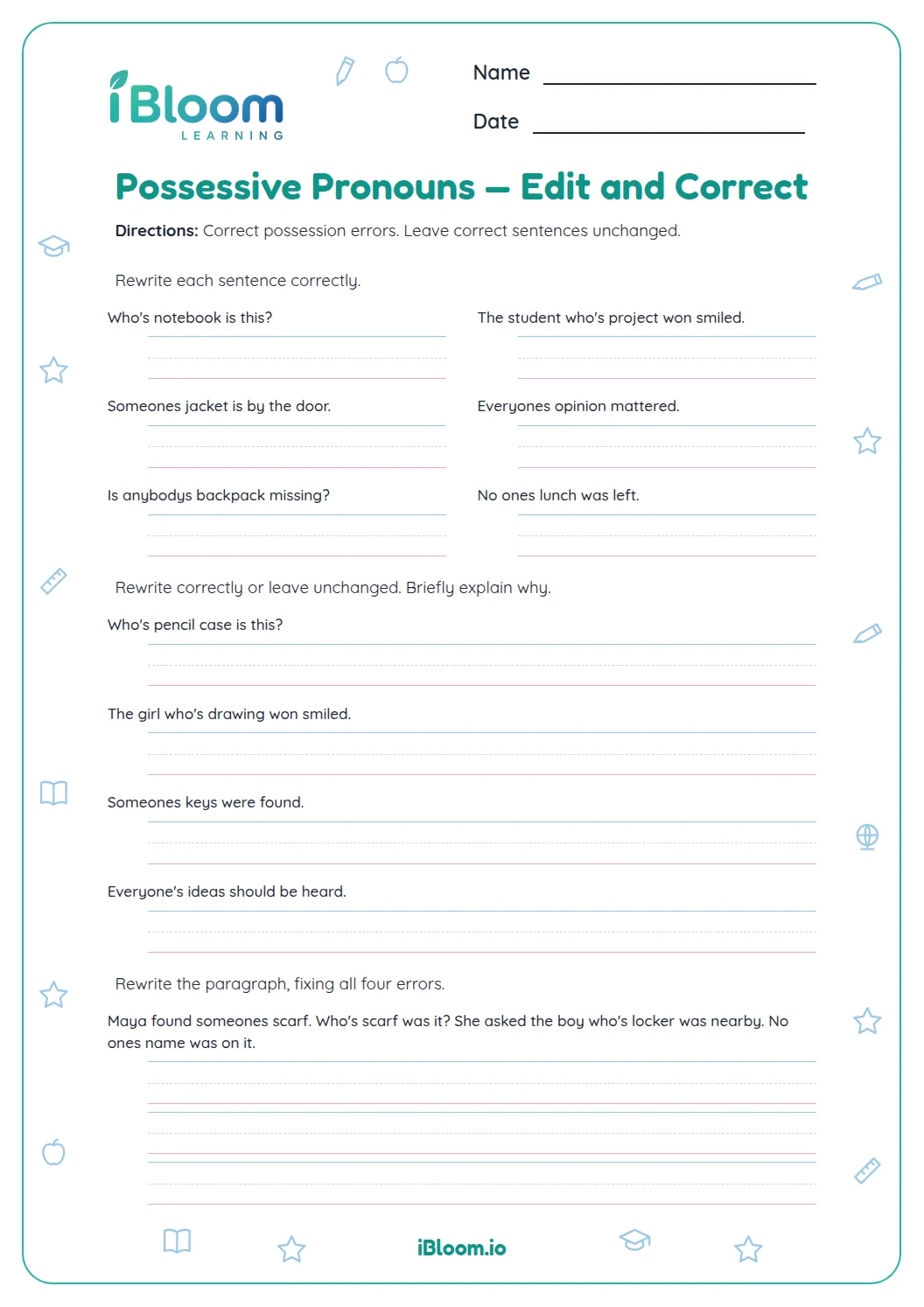
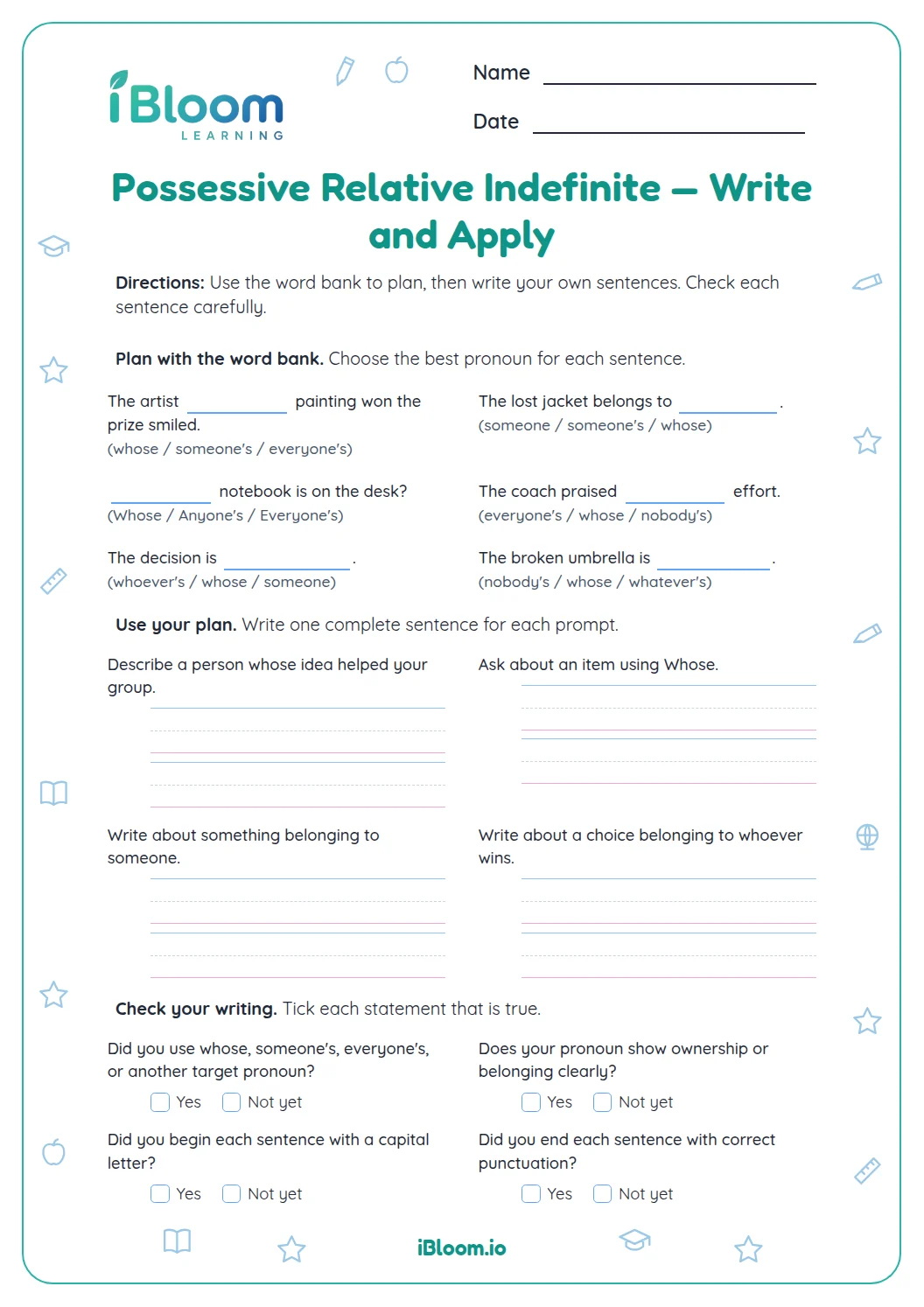
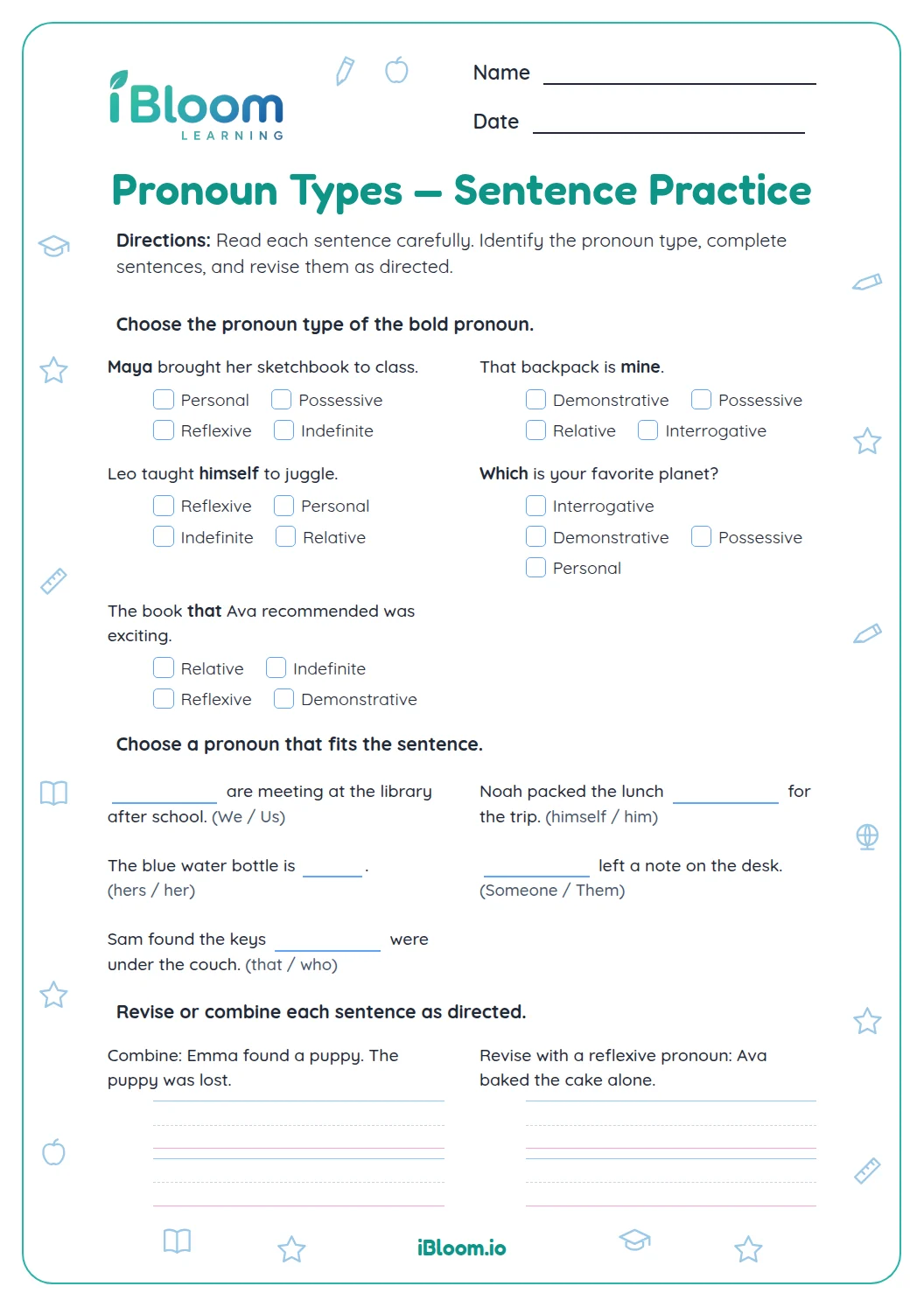
This free printable Grade 5 worksheet mixes possessive, relative and indefinite pronouns in sixteen questions. Students label six capitalized pronouns, choose words to complete seven sentences, and finish with two corrections and a sentence-writing challenge. The examples distinguish ownership, connections between clauses and references to unspecified people or things. This practices Common Core L.5.1 grammar and usage and L.4.1a relative pronouns. The separate answer key includes the labels and choices, corrected sentences, and one possible challenge sentence.
Aligned to L.5.1 and L.4.1a
What does each pronoun type do?
Possessive pronouns such as mine, ours and theirs can stand in place of a noun phrase that shows ownership. In “The blue notebooks are ours,” ours means our notebooks.
Relative pronouns introduce a clause that describes a noun: the artist who painted this mural. Indefinite pronouns such as someone and nothing refer to people or things without identifying a particular one.
Why is “yours” the right answer in question 7?
The sentence already names the jacket, so the completion needs a pronoun that can stand alone. Yours replaces your jacket. Your needs a noun after it, while you names the person rather than showing ownership.
- 1That jacket belongs to you. It is ___.
- 2Try “It is your”: the ownership phrase is unfinished.
- 3Try “It is yours”: yours replaces your jacket.
- 4Answer: yours
What makes the last part a challenge?
Part C asks students to use pronouns in their own writing. They repair her to hers, change have to has after everyone, then combine all three pronoun types in one sentence.
For the final response, check for someone, a who clause describing someone, and a possessive pronoun such as mine. “Someone who lost a pencil may borrow mine” meets all three requirements and is a complete sentence.
How to use this worksheet
- 1Read the P, R and I labels before starting Part A.
- 2For each capitalized word, describe its job before writing the label.
- 3In Part B, read the whole completed sentence aloud to check grammar.
- 4In Part C, rewrite the pencil example and the ticket sentence with the requested corrections.
- 5Check that the final sentence uses someone, a relative who clause, and a possessive pronoun.
Mistakes to notice and repair
The mistake
Labeling whose as possessive in “the runner whose lace broke.”
The fix
Here whose introduces a clause describing the runner, so classify it as a relative pronoun.
The mistake
Writing “It is her” when the sentence means the pencil belongs to her.
The fix
Use hers to replace her pencil. The possessive pronoun stands alone.
The mistake
Keeping have after everyone because a group has many people.
The fix
Everyone takes a singular verb in this sentence: everyone has a ticket.
Common Core alignment
Choose, edit and use possessive, relative and indefinite pronouns in sentences.
On this sheet: Students classify pronouns, complete sentences, repair agreement and write a sentence using all three types.
Show the official wordingHide the official wording
Demonstrate command of the conventions of standard English grammar and usage when writing or speaking.
Use who, whose and which to add details about people or things.
On this sheet: Students choose relative pronouns and use who in their own sentence.
Show the official wordingHide the official wording
Use relative pronouns (who, whose, whom, which, that) and relative adverbs (where, when, why).
What to practice next
Make more practice
Further reading
Questions parents and teachers ask
Which three types of pronouns does the sheet review?
It reviews possessive, relative and indefinite pronouns. Part A includes ours and mine for ownership, who and whose for connecting details, and someone and nothing for unspecified people or things. Students then choose pronouns in complete sentences before editing and writing in the final part.
Why is “whose” labeled relative in question 5?
Whose introduces the clause “whose lace broke,” which describes the runner. Although that clause also expresses ownership of a lace, the word is functioning as a relative pronoun here. Ask students to read the whole clause and identify the person it tells them more about.
What is the difference between “their” and “theirs”?
Their comes before a noun, as in their gloves. Theirs can replace the whole phrase, as in “The gloves are theirs.” Question 11 uses that second pattern. Have students substitute the complete phrase their gloves to hear why theirs can finish the sentence by itself.
Why does “everyone” take “has” instead of “have”?
Everyone is treated as singular in the sentence “Everyone has a ticket.” It refers to each person in the group. Students correct this verb in question 15, after choosing Everyone for another sentence in Part B. Reading each finished sentence aloud helps reinforce the agreement pattern.
Does the writing challenge have only one correct answer?
The final sentence can vary, but it must use all three pronoun types. The key offers “Someone who lost a pencil may borrow mine.” Someone is indefinite, who introduces the describing clause, and mine shows possession. Accept another complete sentence that meets those same three requirements.