






About this worksheet
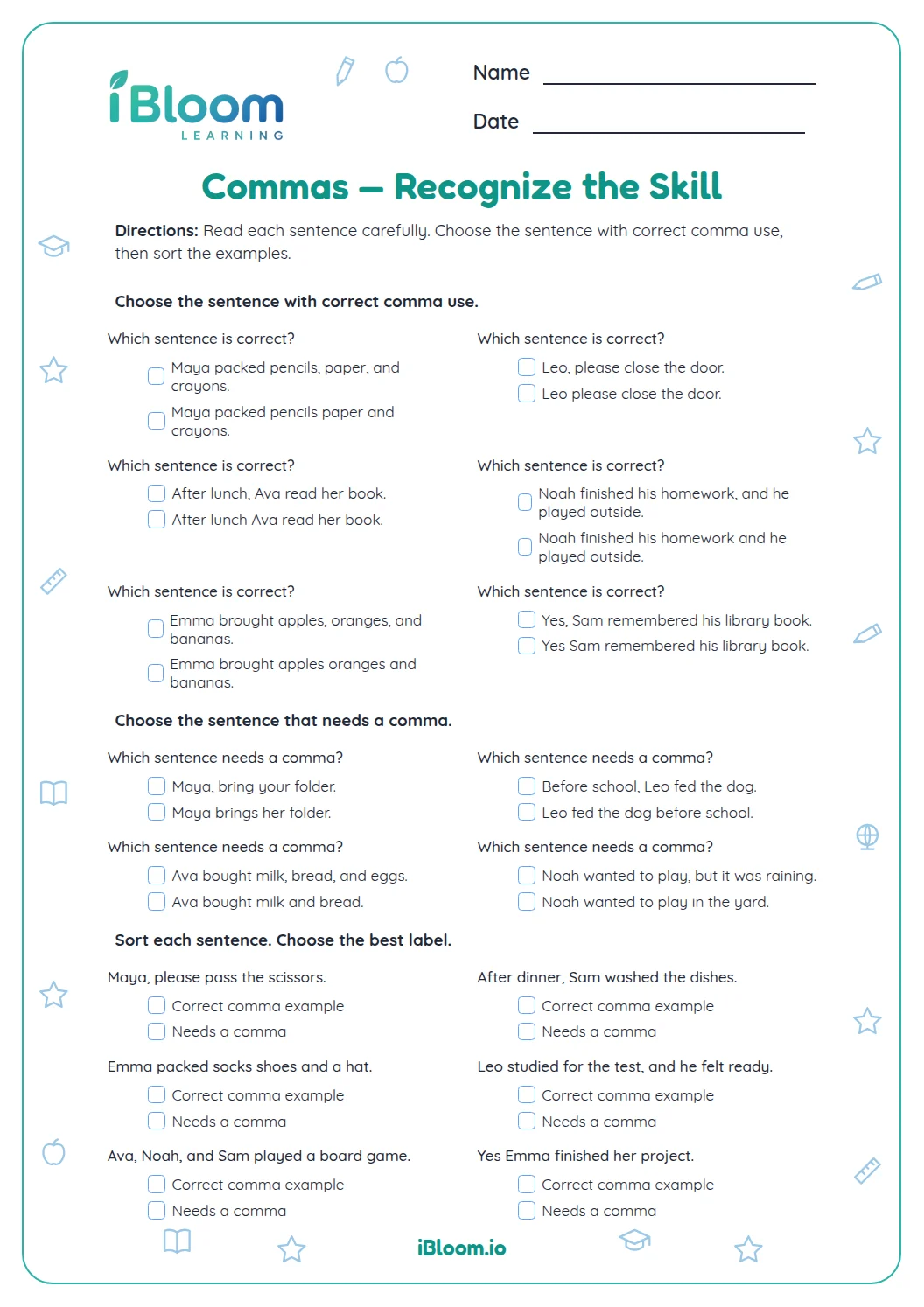
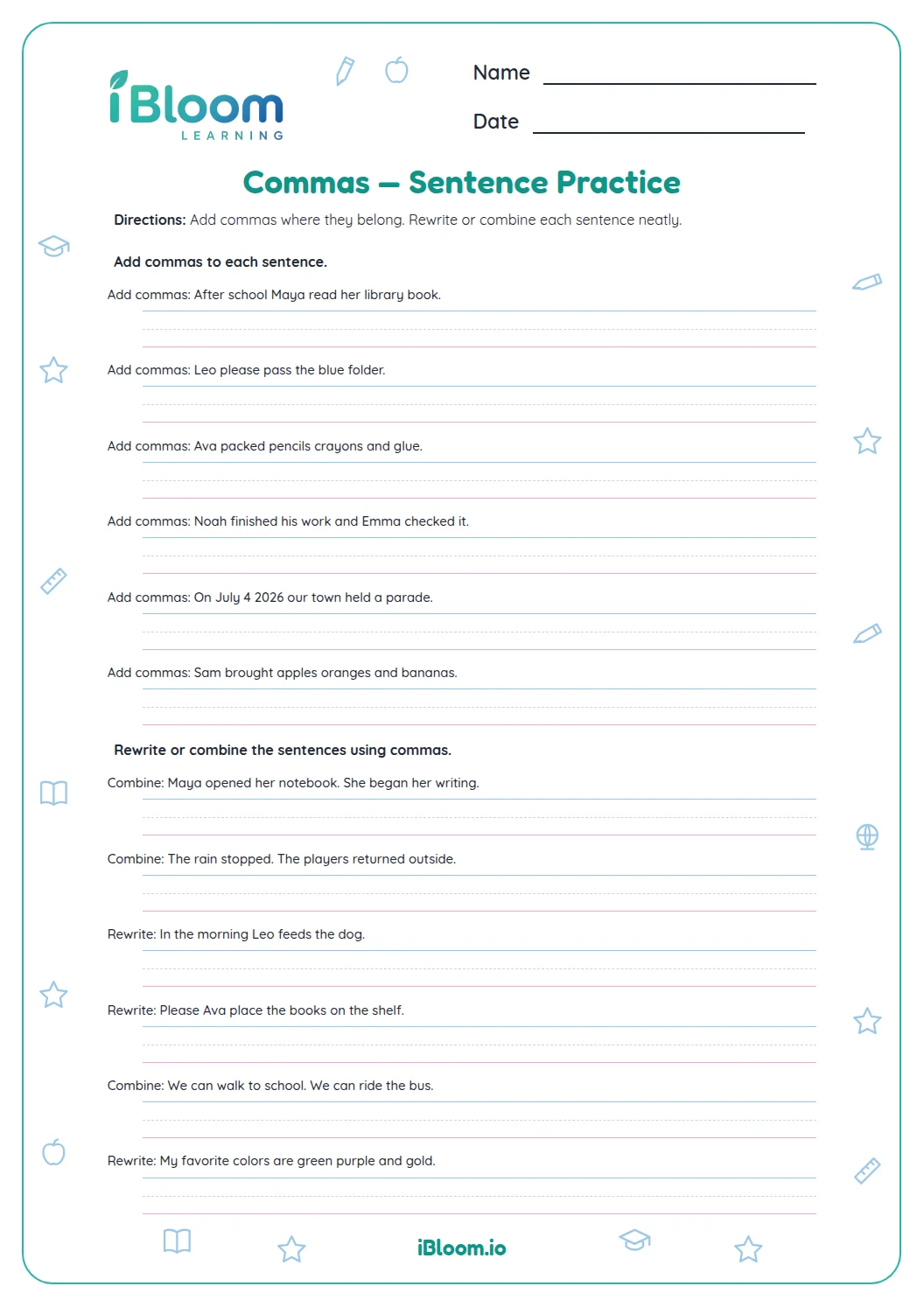
This two-page Grade 5 worksheet practices commas in direct address. Children choose the correctly punctuated version of six sentences, identify whether the name or group appears at the beginning or end in four more, then complete four sentences with a person or group. The examples include names, a teacher title, classmates, and a team. The separate key shows the selected punctuation and sample names for the completion items. It supports CCSS L.5.2, applying punctuation conventions when writing.
Aligned to L.5.2
What does this worksheet ask students to do?
The 14 questions move from recognizing the comma to using direct address in a sentence. Part A has six punctuation choices, Part B has four position checks, and Part C has four sentence completions.
The first two parts help students notice that direct address can appear at the start or end. The last part lets them apply the comma while completing a request, question, greeting, or sentence.
- Part A: choose correct punctuation in six sentences
- Part B: identify beginning or end in four sentences
- Part C: complete four sentences with an addressed person or group
How do commas set off direct address?
A name used to speak directly to someone is separated from the rest of the sentence with a comma. Place it after a name at the beginning, before a name at the end, or on both sides when the name appears in the middle.
- 1Please listen Leo.
- 2The name Leo is addressed directly.
- 3Write: Please listen, Leo.
Can direct address appear in different places?
Yes. A sentence can begin with the person’s name (“Ava, could you close the door?”), end with it (“We will see you, Coach”), or place it in the middle (“Please bring the ball, Jordan, before lunch”). Commas mark off the name in each position.
How to work through the worksheet
- 1Read the whole sentence aloud.
- 2Find the person or group being spoken to.
- 3Add a comma after direct address at the beginning or before it at the end.
- 4For a blank, choose a person or group that fits the sentence.
- 5Reread the sentence and check that the comma separates the addressed words.
Common mistakes and quick fixes
The mistake
Leaving out the comma before a name at the end.
The fix
Read the sentence and pause where the name is spoken to: “Please listen, Leo.”
The mistake
Putting the comma after the rest of the sentence when the name comes first.
The fix
Set off the opening name: “Ava, could you help?”
The mistake
Treating every name as direct address even when it names the subject.
The fix
Ask whether the speaker is talking to the person. In “Jordan, we saved your seat,” Jordan is addressed; in “Jordan saved our seat,” Jordan is the subject.
Common Core alignment
This worksheet practices skills described in these grade-level language or reading standards.
Use punctuation correctly when writing.
On this sheet: Students edit sentences and write their own examples using punctuation conventions.
Show the official wordingHide the official wording
Demonstrate command of the conventions of standard English capitalization, punctuation, and spelling when writing.
What to practice next
Make more practice
Questions parents and teachers ask
What is direct address?
Direct address happens when a speaker names the person or group they are speaking to. In “Please listen, Leo,” Leo is the person being addressed. This worksheet has students spot direct address, place the comma, and complete sentences with a suitable name or group.
Does a name always need a comma?
A name needs a comma when it is used to speak directly to someone. Compare “Jordan, we saved your seat” with “Jordan saved our seat.” In the first sentence, Jordan is being spoken to; in the second, Jordan is doing the action.
Can direct address go at the beginning or end?
Yes. A name at the beginning is followed by a comma, as in “Ava, could you close the door?” A name at the end is preceded by one, and a name in the middle is set off on both sides. Part B practices all three positions.
What does the answer key show?
The separate key marks the correct punctuation choices, identifies whether each addressed person appears at the beginning or end, and supplies a fitting name or group for each completion. Students may use another suitable name in Part C if it makes a complete sentence and keeps the comma in place.
How can students check a direct-address comma?
Have students read the sentence aloud and identify the person or group they are speaking to. Then check that a comma separates that name from the rest of the sentence. This quick reread works for both “Maya, please pass the glue” and “Please listen, Leo.”