





About this worksheet
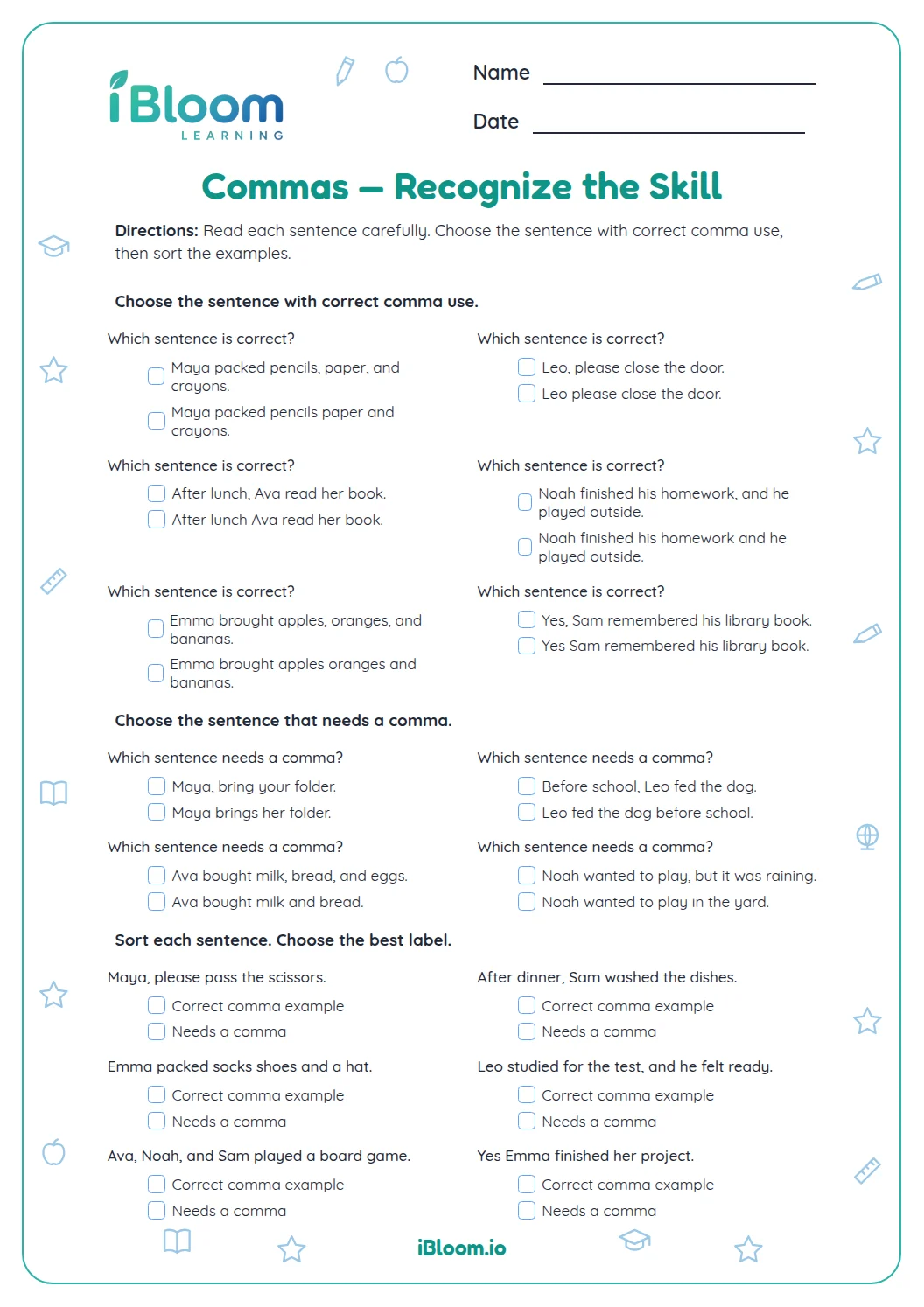
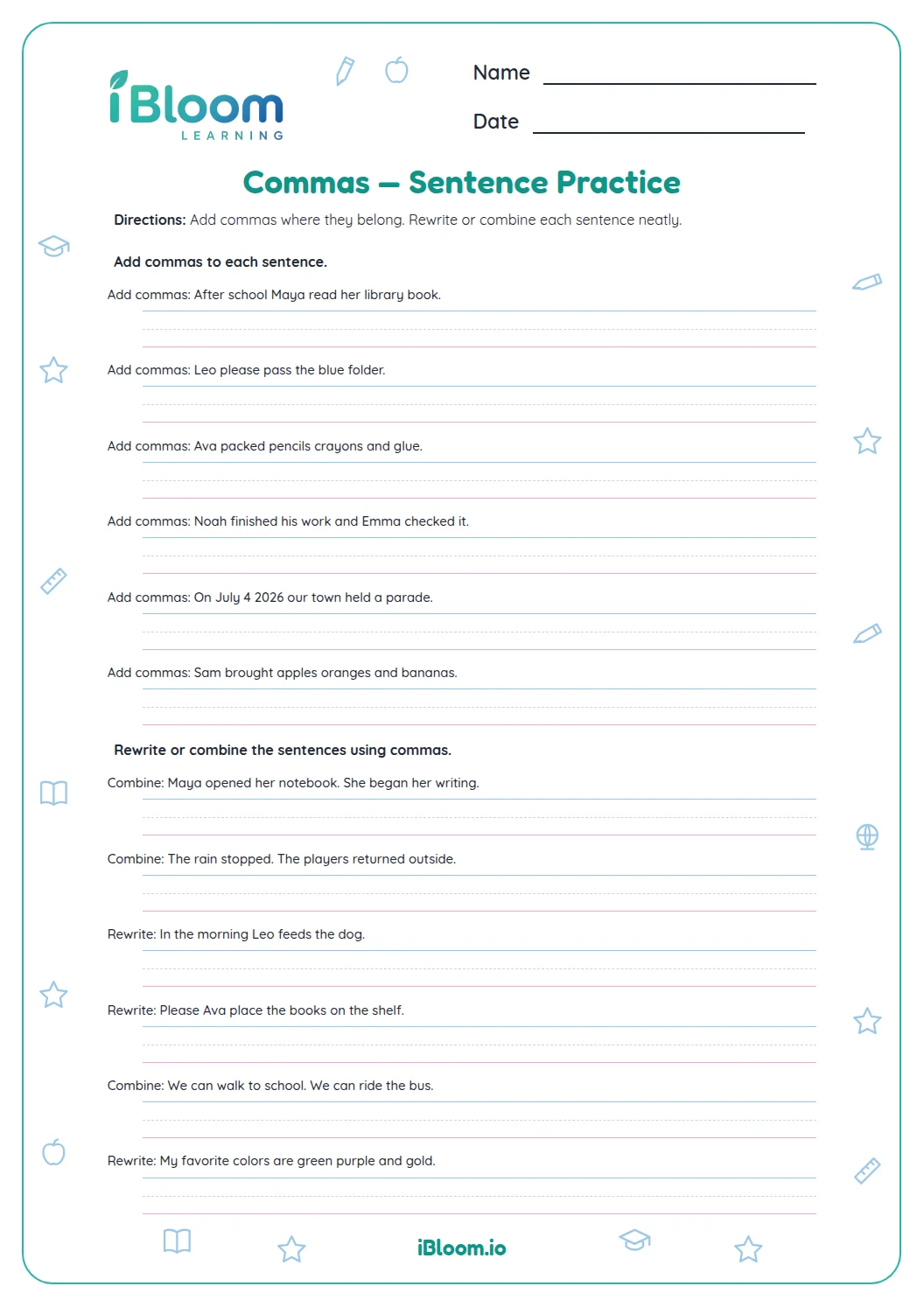
Six sentence choices, six comma edits, and two short sentence corrections provide compact practice. The key includes an item that needs no comma.
Aligned to L.5.2.a
Which comma skills appear on the worksheet?
Part A asks students to choose sentences with correct punctuation, including lists, openers, direct address, appositives and a date. Part B asks where commas belong; Part C asks students to revise two complete sentences.
For each comma, identify its job: separating a series, marking an opener, setting off a name or extra information, or punctuating a date.
Where does the comma go after an opener?
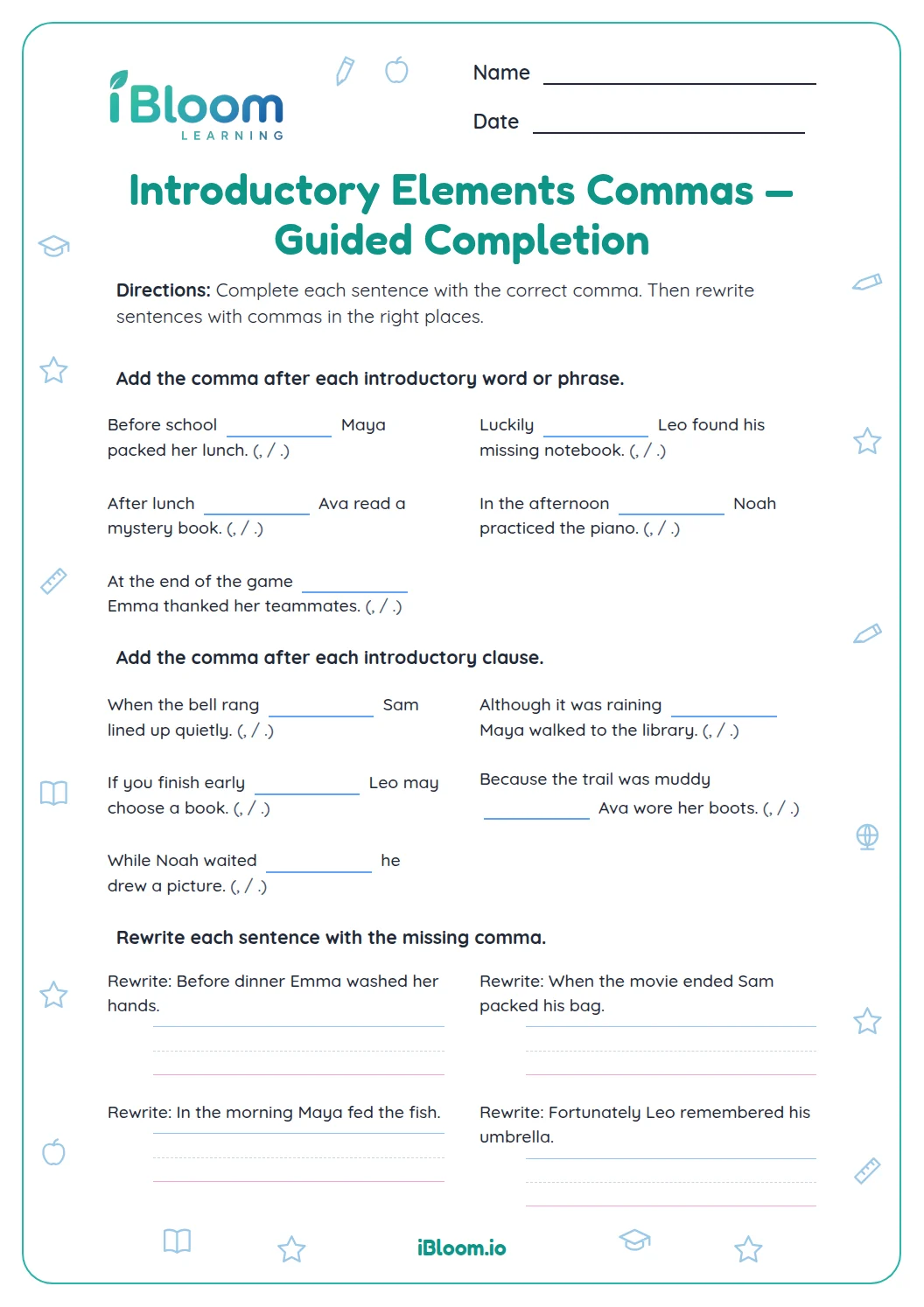
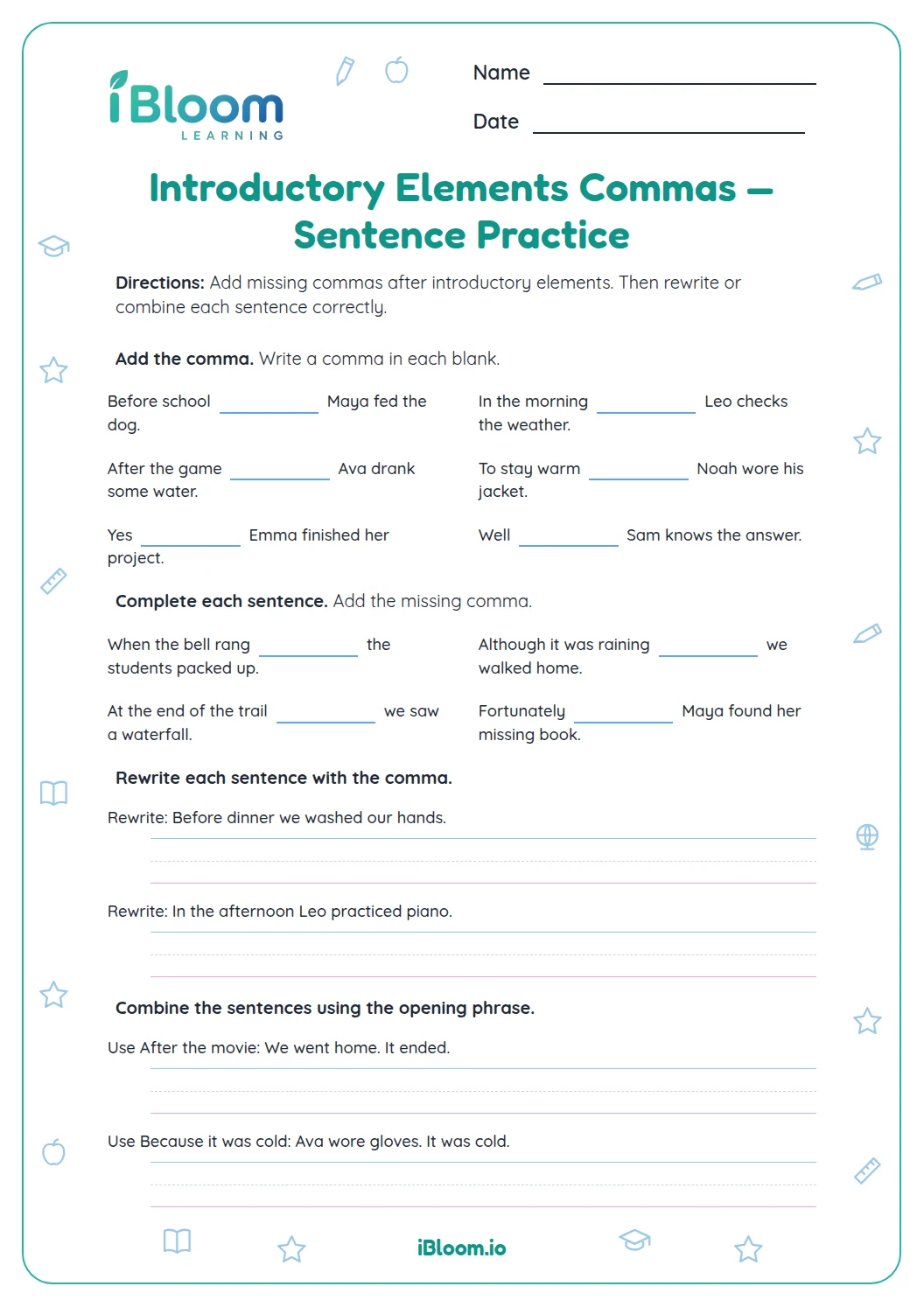
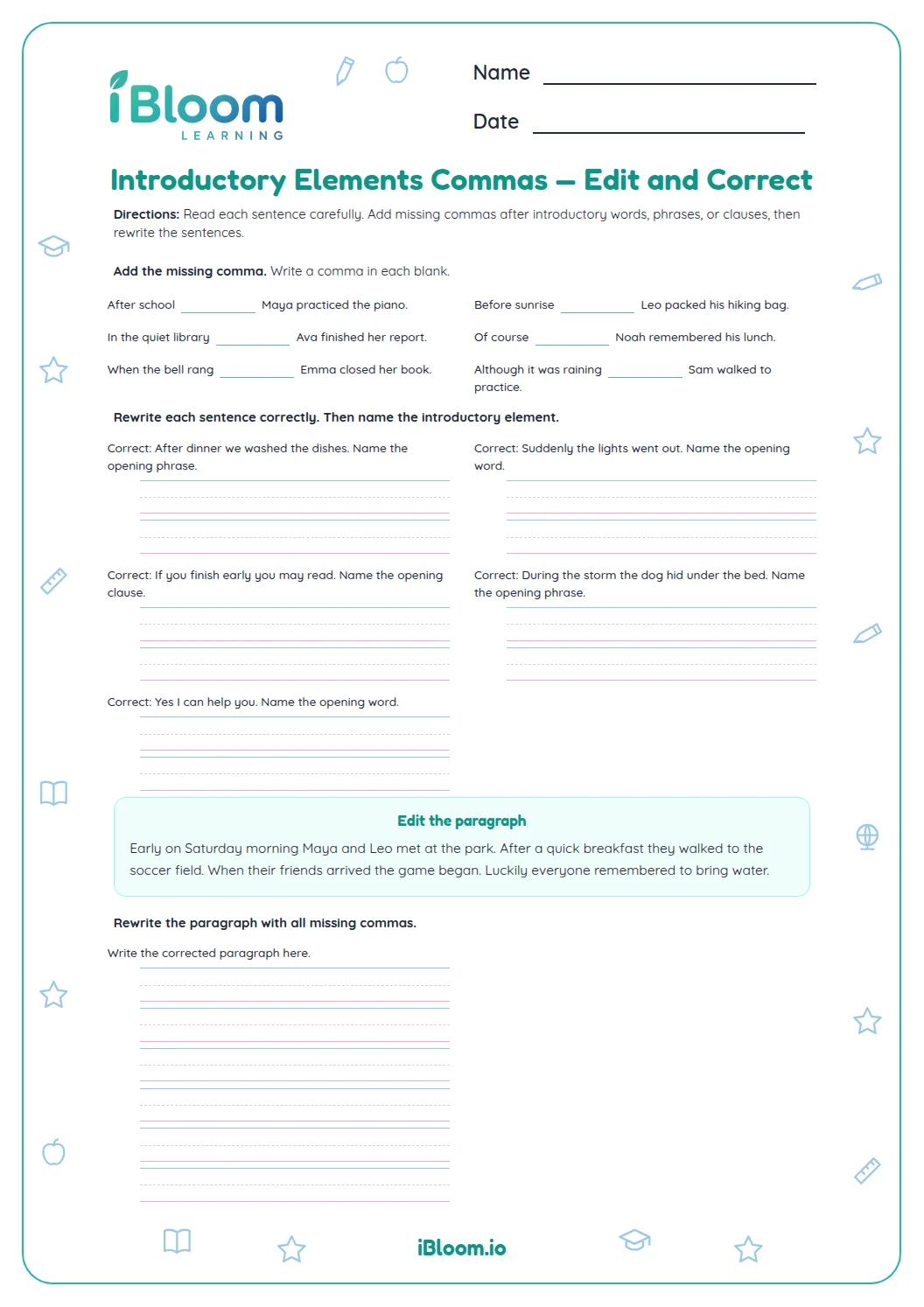
A comma separates an introductory phrase from the main clause. In question 7, “After lunch” introduces the sentence, so the comma goes before “the class.”
- 1After lunch ___ the class planted seeds.
- 2After lunch, the class planted seeds.
How do commas work in a series?
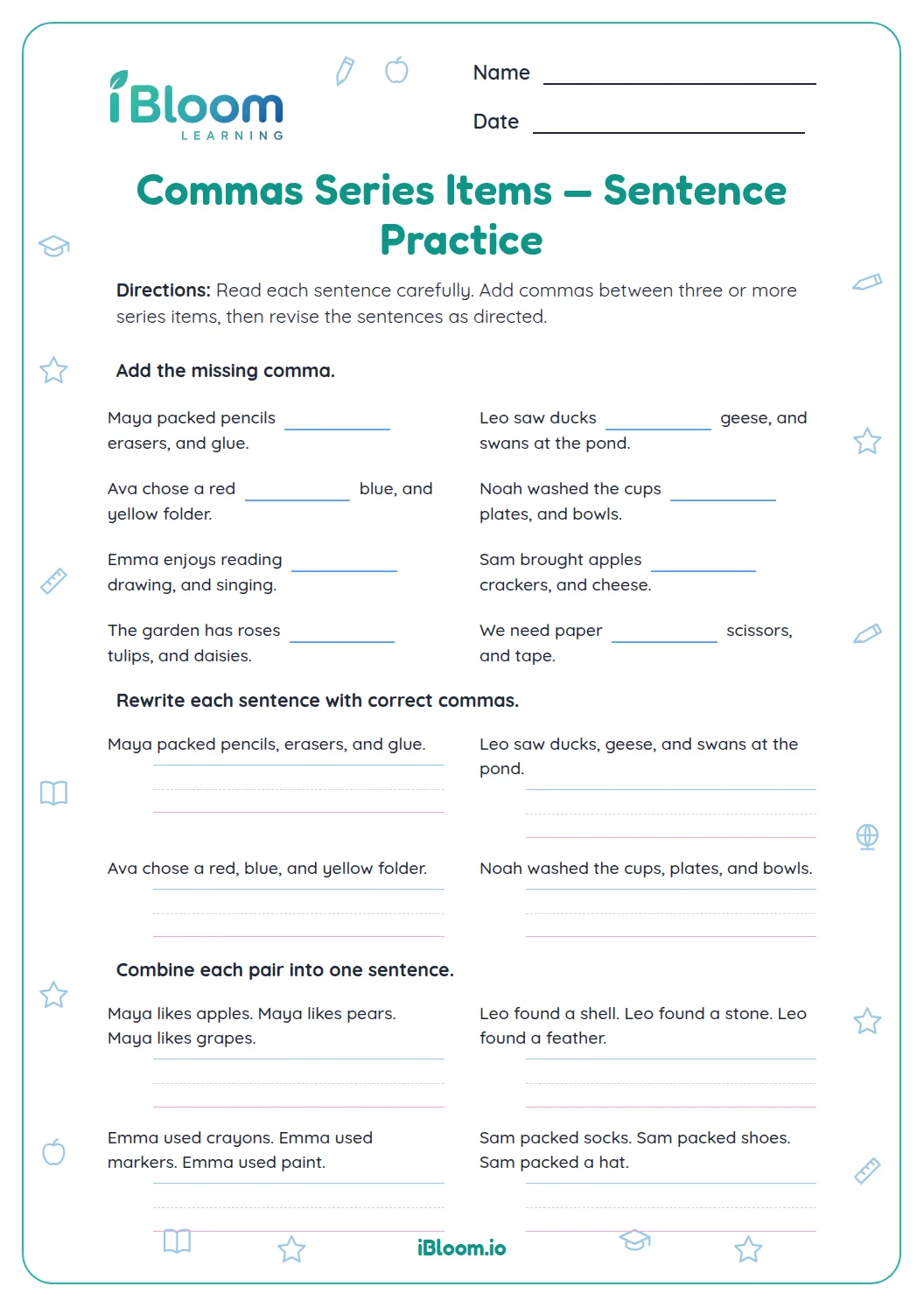
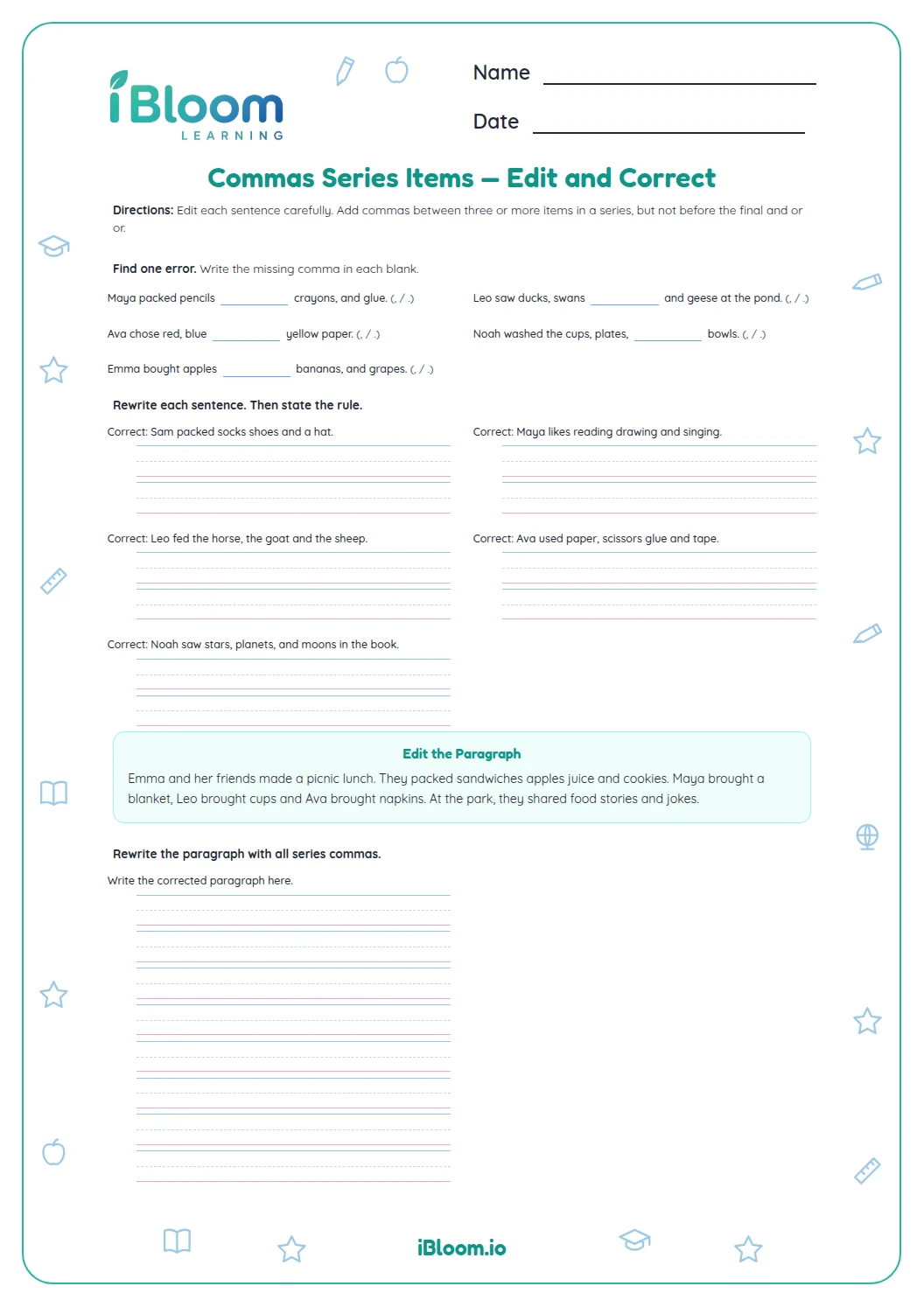
Use commas to separate three or more items in a series. This worksheet uses a comma before the conjunction in its series examples, as in “apples, crackers, and cheese.”
How should students check an edited sentence?
Read the whole sentence after adding punctuation. Check each comma against a reason: opener, items in a series, direct address, date, or extra information. Remove any comma that does not have a clear job.
How to use this worksheet
- 1Read the full sentence before changing punctuation.
- 2Mark introductory words or phrases that come before the main clause.
- 3Separate each item in a series with commas.
- 4Use paired commas around direct address or extra information inside a sentence.
- 5Reread the edited sentence aloud, then compare it with the answer key.
Common mistakes and quick fixes
The mistake
Putting a comma between the subject and its verb, as in “Our class, planted seeds.”
The fix
Keep the subject and verb together unless extra information interrupts them.
The mistake
Using only one comma around an appositive in the middle of a sentence.
The fix
Use a pair to open and close the extra information.
The mistake
Forgetting the comma after an introductory phrase.
The fix
Find the main clause and place a comma where the opener ends.
Curriculum alignment
Use punctuation to separate items in a series.
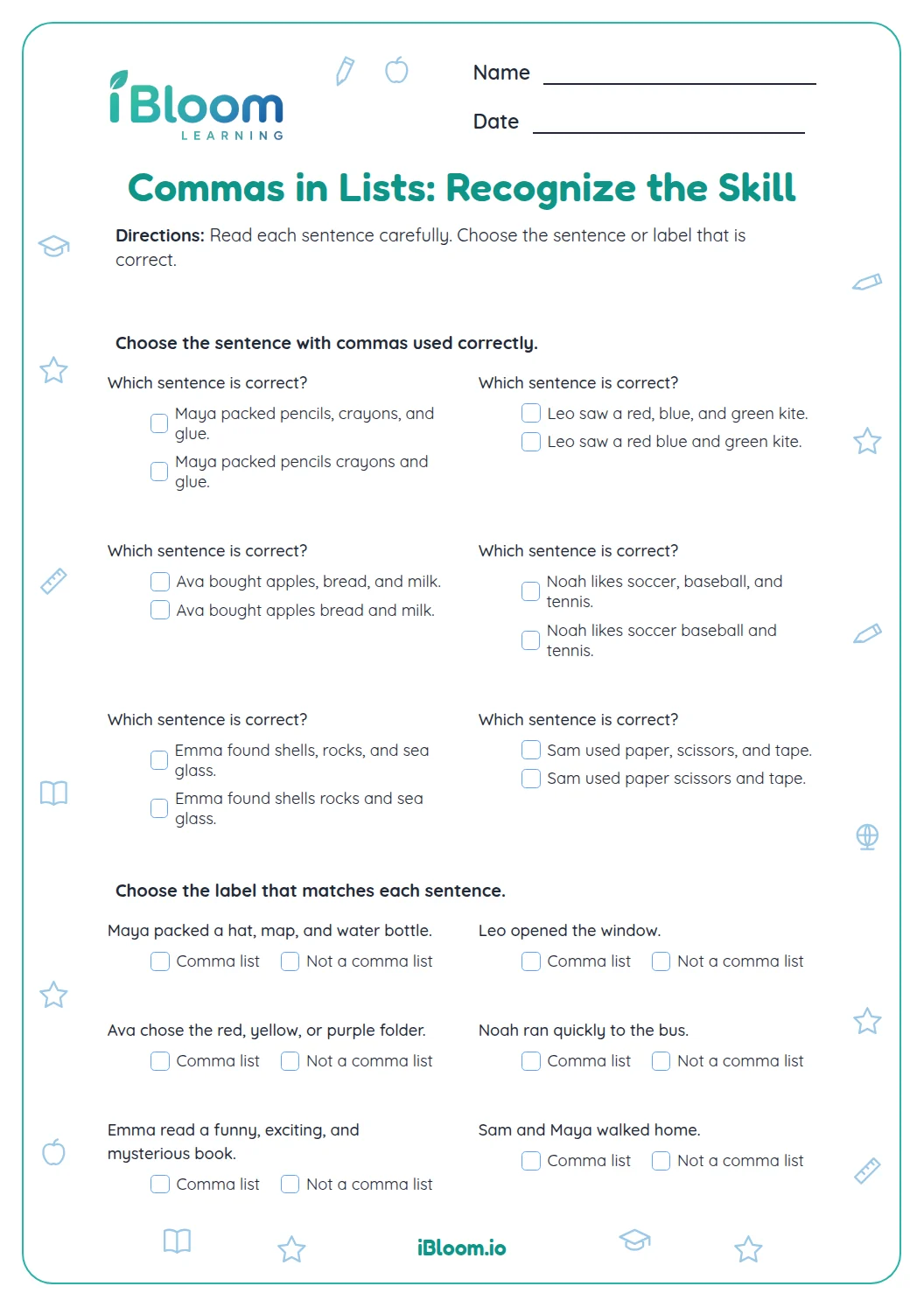
On this sheet: Students edit commas separating items in a series.
Show the official wordingHide the official wording
Use punctuation to separate items in a series.
What to practice next
Make more practice
Further reading
Questions parents and teachers ask
Does this worksheet use the serial comma?
Yes. The series examples place a comma before the final “and,” as in “apples, crackers, and cheese.” Students add a comma at each marked place, then check that all three items are separated clearly in the sentence. This is the serial comma.
What is direct address?
Direct address names the person being spoken to. In “Maya, please pass the folder,” Maya is the person addressed, so a comma separates the name from the request. Question 16 also asks students to set off extra information.
Why does an appositive need two commas here?
An appositive renames a nearby noun. When it appears in the middle of a sentence as extra information, commas mark both ends. In “Our guide, a park ranger, showed us the nest,” the phrase “a park ranger” renames the guide.
How much time should I plan?
Plan about 18 minutes for the 16 questions, with extra time if students explain each comma choice. They can finish Part A, check the comma jobs in Part B, and then revise the two sentences in Part C before using the answer key.
What if a sentence needs no comma?
Read the sentence and look for a specific reason to add punctuation. Question 12 has no introductory element, series, direct address or appositive, so it stays as written. Naming the comma rule first helps prevent inserting a comma between a subject and its verb.