






About this worksheet
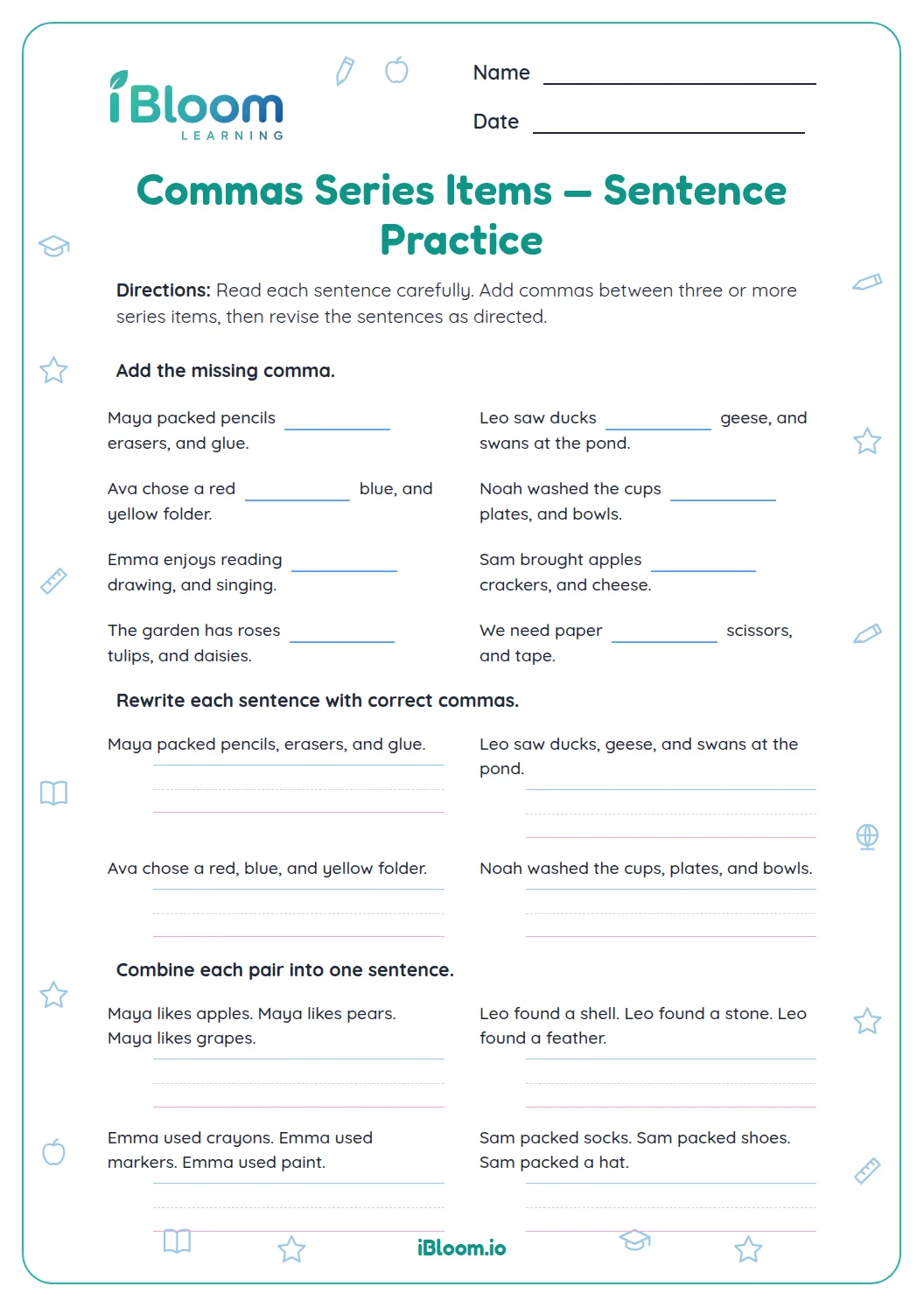
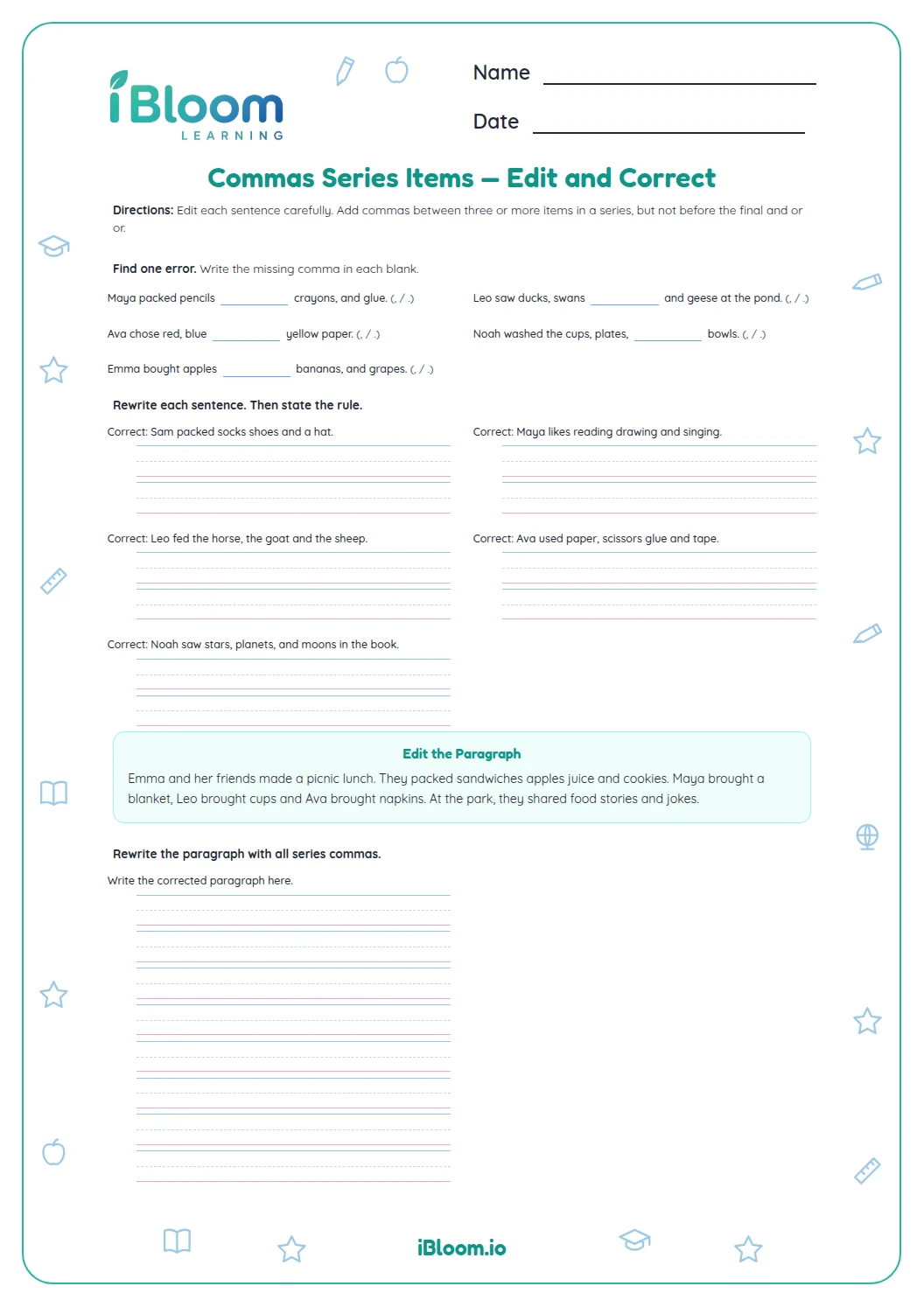
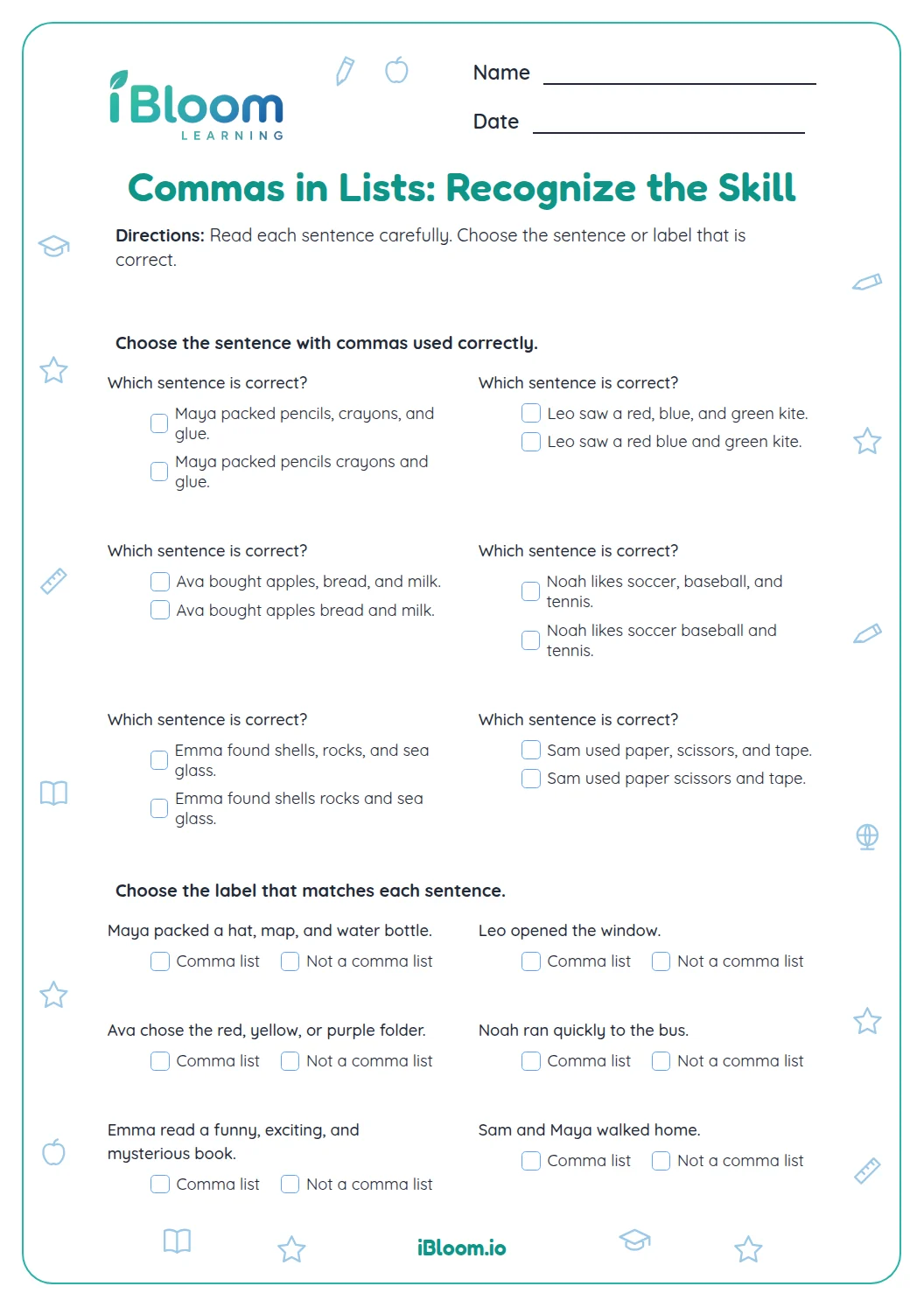
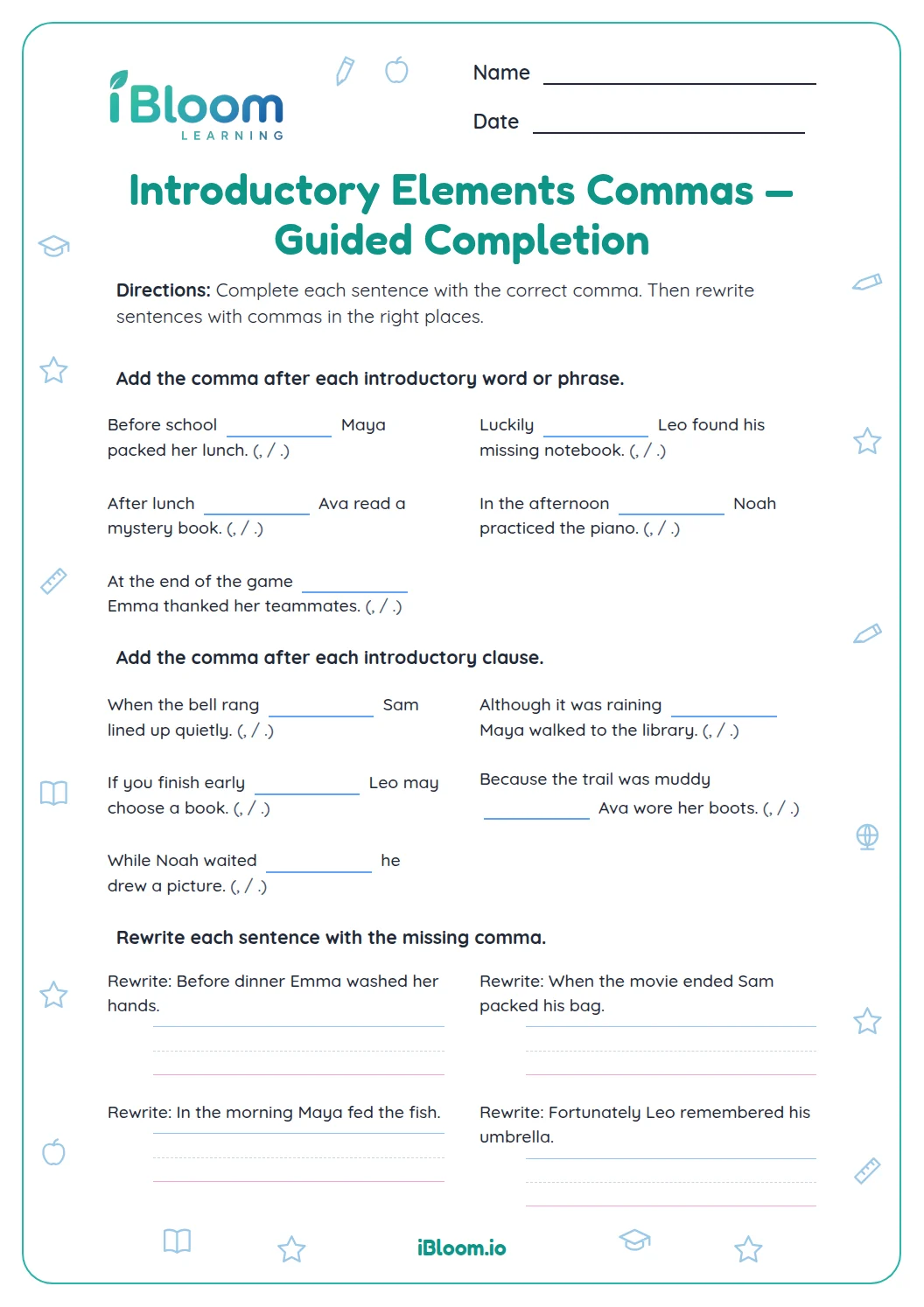
This free Grade 5 worksheet turns comma rules into writing practice. Students identify comma positions in four sentences, combine three sets of ideas into single sentences, and write four original sentences with lists. The lists include objects, actions, and longer phrases, so students must find where each whole item ends. All 11 tasks practice CCSS L.5.2a, using punctuation to separate items in a series. The sheet uses a comma before the final and or or. A separate answer key gives comma locations and sample responses for the open writing prompts.
Aligned to L.5.2a
What counts as one item in a series?
An item can be one word or a whole phrase. In “by Sam, near Jo, and behind Ben,” each location is one item. A comma belongs between those locations, not between every word.
Part A begins with familiar objects and then moves to actions and phrases. Students write the two words that need commas after them. Naming those words makes them locate the boundary between complete list items.
- 1Original: I packed a pen a notebook and a ruler.
- 2Items: a pen | a notebook | a ruler
- 3Write: pen, notebook (the words that need commas after them)
- 4Revised: I packed a pen, a notebook, and a ruler.
How do students combine ideas into a list?
Part B gives a sentence starter and three items. Students write one complete sentence using all three. For “We can ...” and “read a poem / solve a puzzle / play a game,” they keep each action together and join the final action with and.
The slashes in the prompts separate the planning notes. Students replace them with commas and a final joining word when writing the sentence.
How can I check an original list sentence?
Part C asks for school supplies, weekend actions, places to read, and snack choices. Each response must be a complete sentence and contain the requested number of items. The snack sentence uses or to present choices.
Read the response once for meaning and once for punctuation. The model answers are examples; a different sensible list can meet the same requirements.
How to use this worksheet
- 1Read the sheet’s instruction about the comma before and or or.
- 2Identify the three items in question 1, then write the two words that need commas after them.
- 3Finish Part A, checking the end of each whole item rather than every word.
- 4In Part B, use the given starter and all three items in one sentence.
- 5Write Part C, then count the items and compare punctuation with the key.
Mistakes to notice and fix
The mistake
Putting a comma inside “a notebook.”
The fix
Treat the article and noun as one item; the comma comes after notebook.
The mistake
Writing “We read, and write.” as a three-item list.
The fix
Count the items first. Two items joined by and do not need a series comma.
The mistake
Leaving out the comma before the final and.
The fix
This worksheet uses a final series comma. Add it after the next-to-last item.
Common Core alignment
Use commas to separate words and phrases in a list.
On this sheet: Students locate commas in lists and punctuate combined and original sentences.
Show the official wordingHide the official wording
Use punctuation to separate items in a series.*
What to practice next
Make more practice
Further reading
Questions parents and teachers ask
Does this worksheet use the Oxford comma?
Yes, it uses a comma before the final and or or in every series of three or more items. The instruction makes that convention explicit. When checking responses, look for the comma after the next-to-last item as well as the earlier separators.
Do students write their own sentences?
Yes, students combine supplied ideas and write original sentences. Part A has four comma-location questions, Part B has three sentence combinations, and Part C has four original writing prompts. This sequence lets students apply the same punctuation rule with gradually less wording supplied for them.
How should I mark the four original sentences?
Accept any complete, sensible sentence that follows its prompt and punctuates the series correctly. Check the requested number of items, then check the commas between them. Question 11 also asks for or before the final snack choice. The key provides examples, not required personal choices.
Why do some list items contain several words?
Longer items help students see that a comma separates complete ideas within a series. In question 3, by Sam is one location, just like near Jo and behind Ben. Ask students to name each location aloud before deciding where the commas belong.
Can this be used for independent writing practice?
Yes, after a brief review of the first sentence, students can complete the remaining tasks independently. The 11 responses take about 20 to 25 minutes, depending on writing speed. Use the answer key afterward to discuss one correction and one original sentence rather than only counting errors.