



About this worksheet
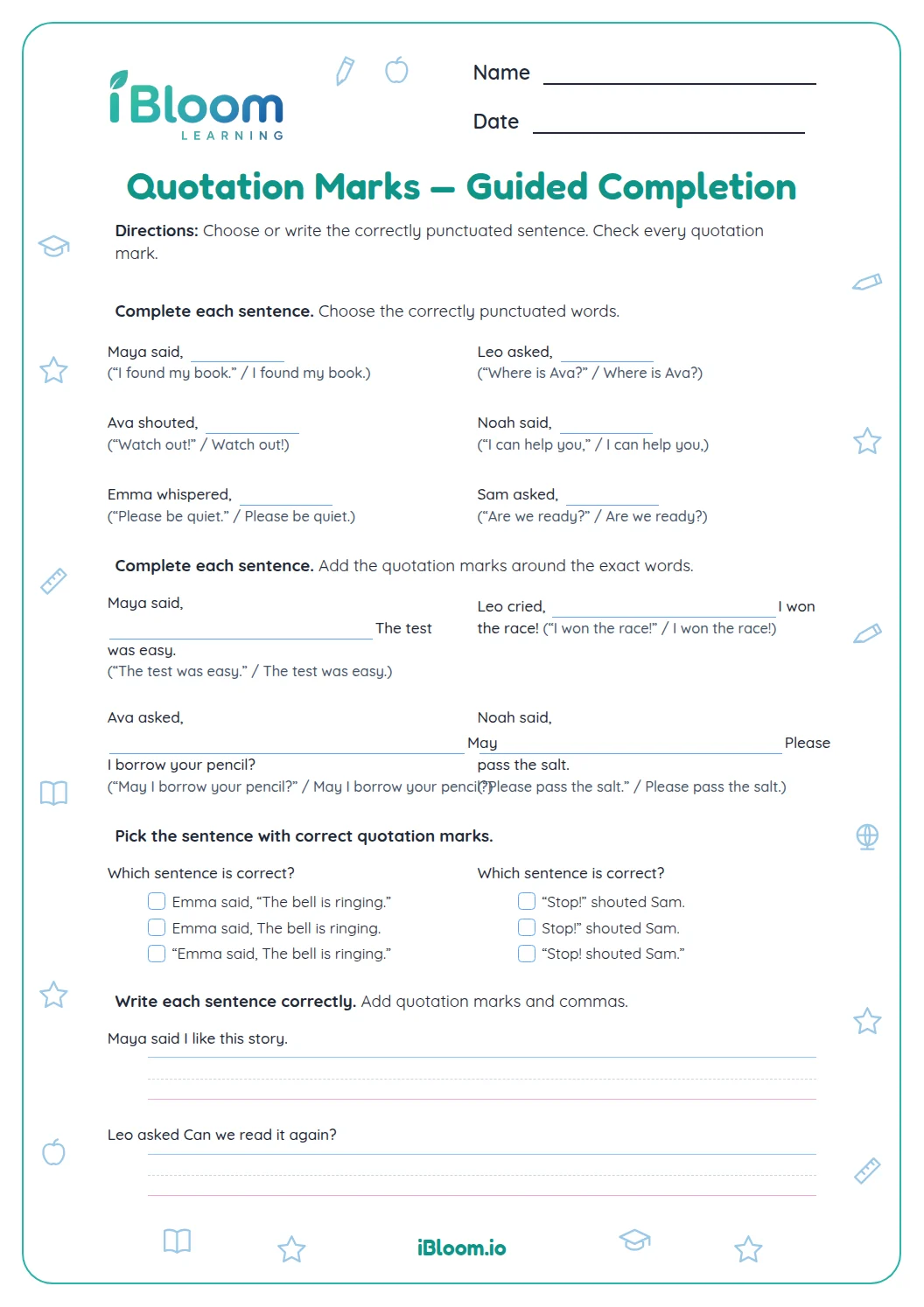
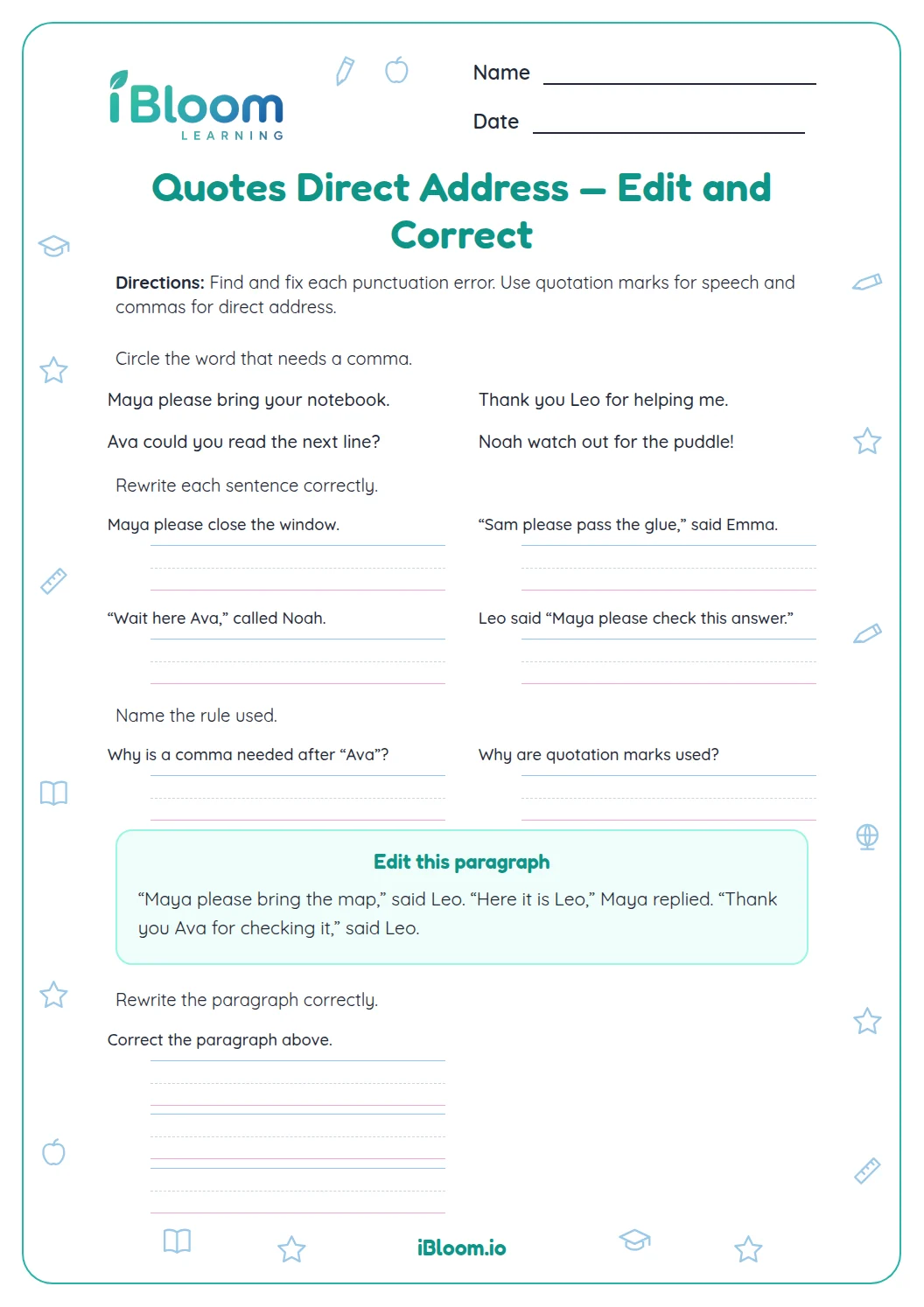
This Grade 5 punctuation worksheet gives students 12 sentence-level quotation mark and comma completions, followed by two dialogue rewrites. Students add opening and closing quotation marks, place commas around spoken words and keep the punctuation inside a quotation with the quoted sentence. The separate key models each mark and rewrite.
Aligned to L.5.2
Where do quotation marks go in dialogue?
The first 12 items ask students to supply one missing quotation mark or comma. The sentences include statements, questions and exclamations, so the closing punctuation must match the spoken words.
For “We can help___” Omar said, the missing mark is a comma before the closing quotation mark.
- 1Maya said, “We found the trail.”
- 2The comma introduces the words; the period closes the spoken sentence.
How does punctuation change around a speaker tag?
When the speaker tag follows a statement, use a comma inside the closing quotation mark: “Bring your map,” said Nia. When the spoken words are a question, keep the question mark inside: “Are you ready?” asked Leo.
Questions 1–8 ask students to add marks in examples with tags before and after the spoken words.
How can students edit a whole dialogue sentence?
The final four items ask students to rewrite a speaker’s exact words with quotation marks and punctuation. A new paragraph can help when a different person speaks.
Look at both the quotation marks and the words such as said, asked and shouted.
How to use this worksheet
- 1Read the sentence and identify the exact spoken words.
- 2Add the opening and closing quotation marks around those words.
- 3Check the comma between spoken words and a speaker tag.
- 4Keep a question mark or exclamation point inside if it belongs to the quote.
- 5Rewrite the last four sentences and compare with the key.
Common mistakes and quick fixes
The mistake
Putting every comma outside the closing quotation mark.
The fix
In these US dialogue examples, place the comma inside the closing quotation mark.
The mistake
Moving the question mark outside the quote.
The fix
If the spoken words are a question, put the question mark before the closing quotation mark.
The mistake
Forgetting the capital at the start of spoken words.
The fix
Capitalize the first word inside the opening quotation mark.
Common Core alignment
The questions ask students to edit punctuation and capitalization in dialogue.
Use standard punctuation and capitalization when editing dialogue.
On this sheet: Students add punctuation and rewrite correctly punctuated sentences.
Show the official wordingHide the official wording
Demonstrate command of the conventions of standard English capitalization, punctuation, and spelling when writing.
What to practice next
Make more practice
Further reading
Questions parents and teachers ask
Does punctuation go inside quotation marks in these examples?
The worksheet has 14 questions. The first 12 ask students to add a missing quotation mark or comma; the last two ask them to rewrite dialogue sentences with the needed punctuation. The key shows each completed sentence, including its comma and final mark.
Why does dialogue use a comma before a speaker tag?
A comma can connect a speaker’s words to a tag such as “said Nia.” For example, “Bring your map,” said Nia. The comma remains inside the quotation marks. Students add missing marks and rewrite dialogue with a tag before or after the quoted words. The answer key shows each completed sentence for checking.
Should a new speaker start a new paragraph?
Yes, beginning a new paragraph when the speaker changes helps readers follow who is talking. The worksheet focuses on adding dialogue marks and rewriting a speaker’s words. In longer stories, a new line also helps distinguish one speaker from another.
How can a student tell where quotation marks should close?
Find the exact spoken words and close the quotation marks when those words end. Then check whether a speaker tag follows. In “The bus is here,” called Rae, the comma closes the quoted statement before the tag. The key shows the expected closing mark in each item, so students can compare the punctuation boundary carefully.
What is on the answer key?
The answer key gives the missing mark for each of the 12 completion items and sample full sentences for the four rewrites. Comparing the whole sentence helps students check capitalization, commas and end marks as well as quotation marks.
What if a student writes a different correct sentence?
For the rewrite items, wording can vary if the student preserves the spoken words and uses quotation marks and punctuation correctly. The key provides one model version. The first 12 blanks have specific expected marks, so students can check each punctuation choice directly. If a sentence uses a different valid convention, compare it with a trusted classroom model.