






About this worksheet
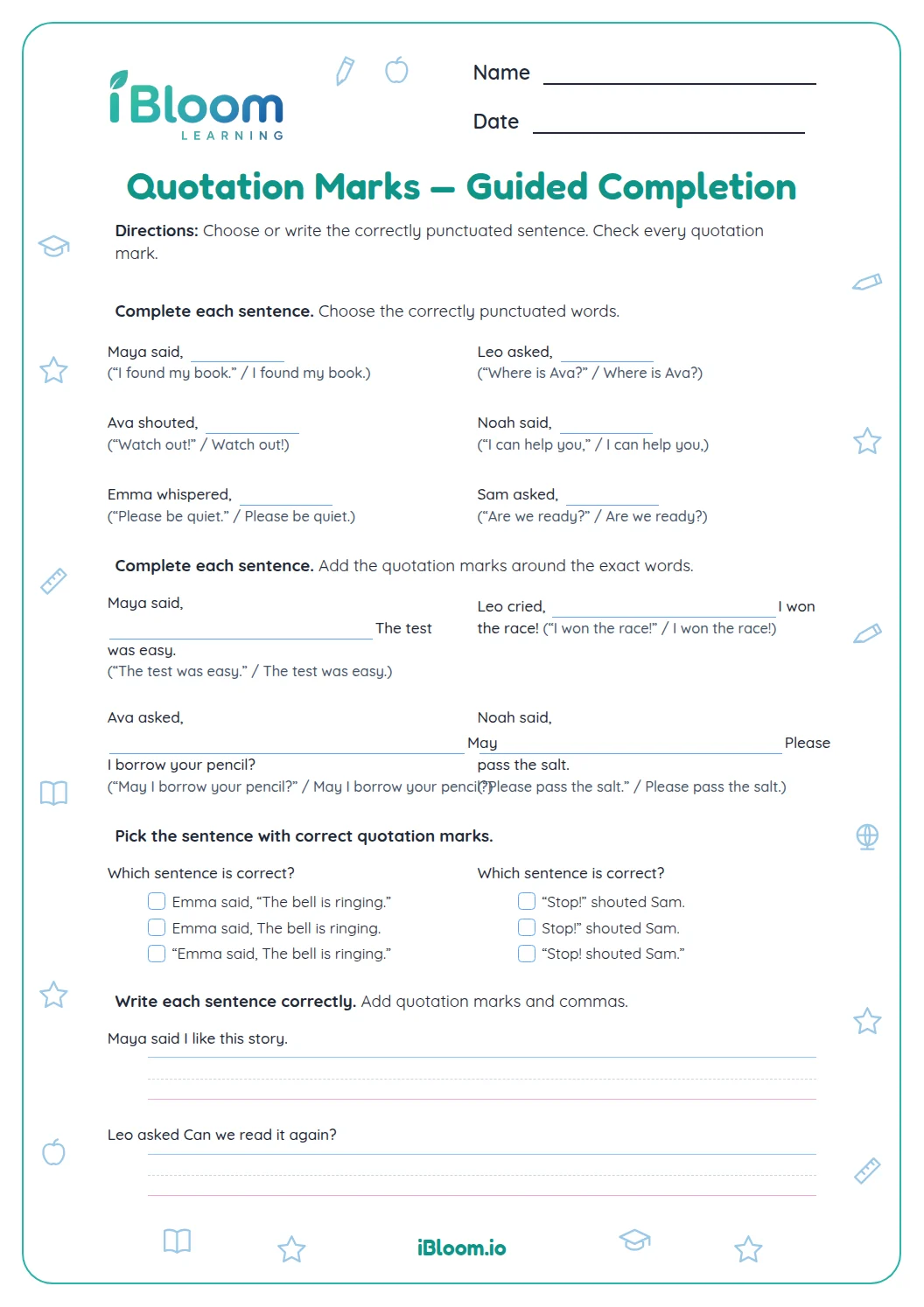
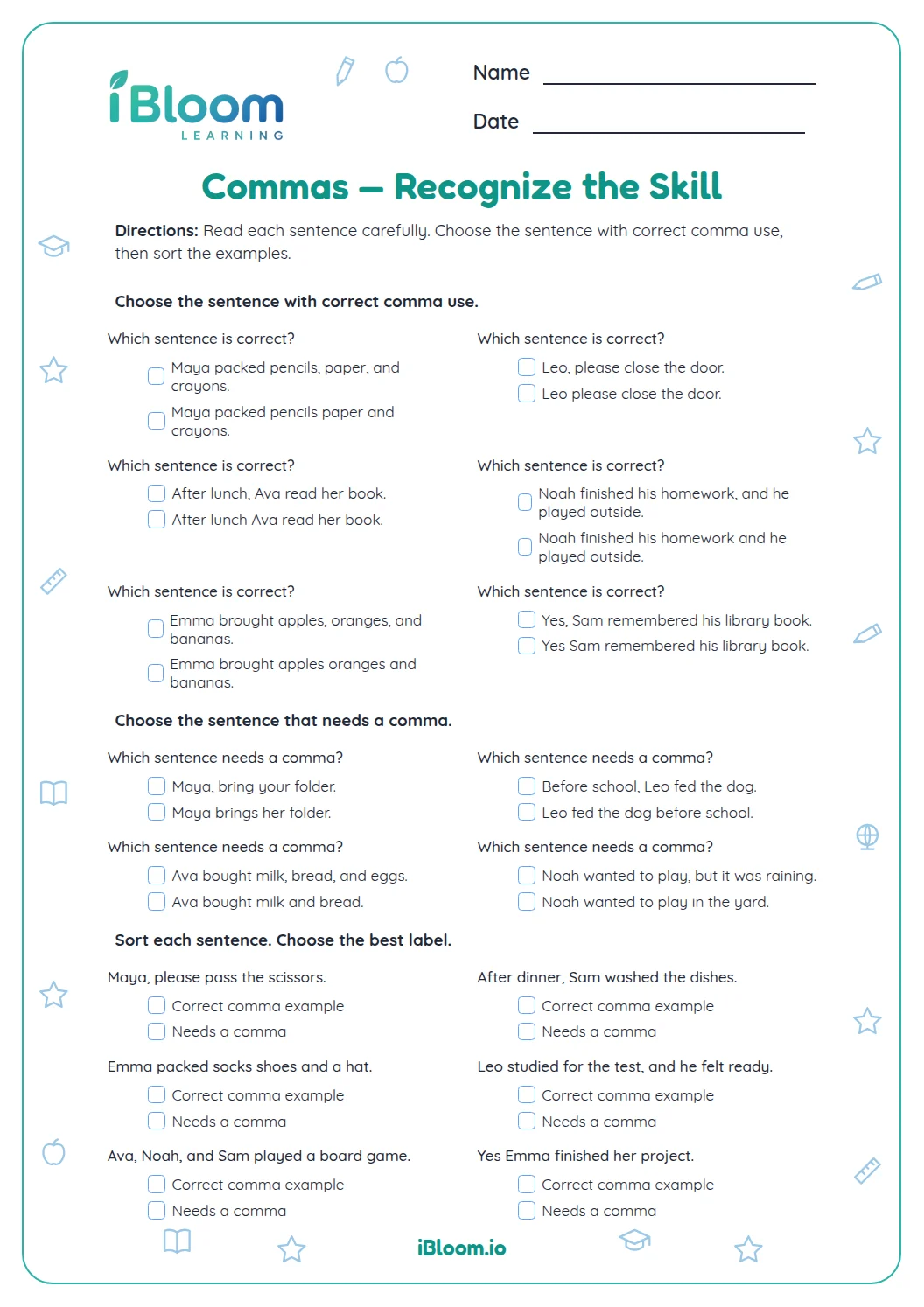
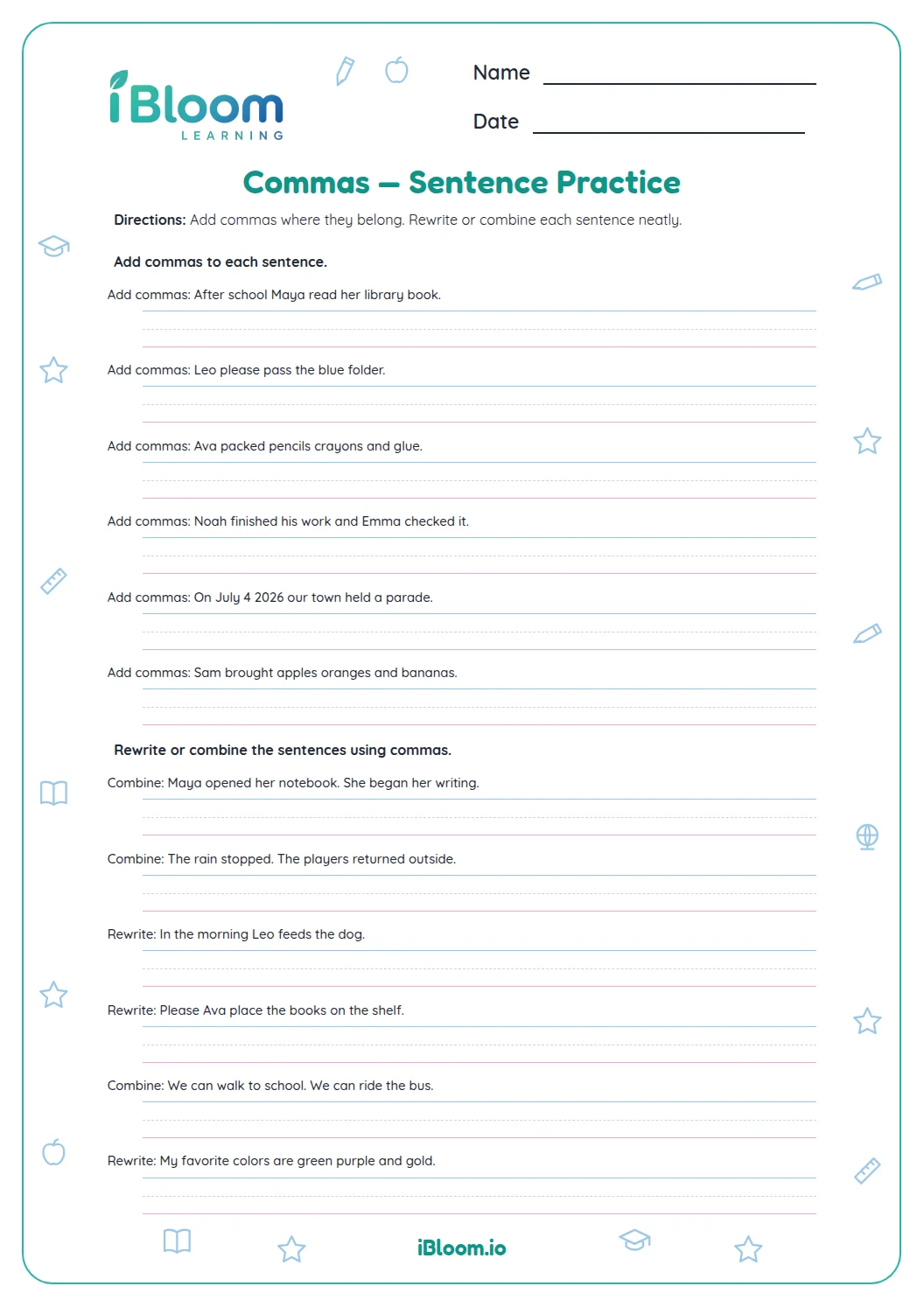
This Grade 5 printable gives students 14 opportunities to punctuate direct speech. They choose correctly punctuated sentences, complete dialogue with quotation marks and commas, and write their own dialogue with speaker tags. The two printed pages include a separate answer key with model responses.
Aligned to L.4.2.b
What punctuation does this worksheet practice?
The 14 questions cover three tasks: choose correct punctuation, add missing quotation marks and commas, and write dialogue. The examples include statements, questions, and exclamations with a speaker tag before or after the spoken words.
How can you check a dialogue sentence?
Question 5 is “Which sentence punctuates the spoken words correctly?” The correct version is “I finished,” said Ava. The comma belongs inside the closing quotation mark because the speaker tag follows the quoted words.
- 1Question 5: punctuate “I finished” before a speaker tag
- 2Correct: “I finished,” said Ava.
- 3Place the comma inside the closing quotation mark.
What writing tasks are included?
The final part asks students to write a sentence with a speaker tag before the quote, write a question with a speaker tag, and create two lines spoken by two people. Each response should make the spoken words clear.
How should the key be used?
Compare selected and completed items with the key. For original dialogue, use the sample to check for quotation marks around the spoken words, a correctly placed comma when needed, and a clear speaker tag.
How to use this worksheet
- 1Identify the exact spoken words in each sentence.
- 2Put quotation marks at the beginning and end of the spoken words.
- 3Place commas inside quotation marks when the speaker tag continues the sentence.
- 4Keep question marks and exclamation points with the spoken words.
- 5Read original dialogue aloud and check that each speaker is clear.
Common mistakes and quick fixes
The mistake
Putting a comma outside the closing quotation mark.
The fix
Move the comma inside the quotation marks.
The mistake
Putting the speaker tag inside the spoken words.
The fix
Keep the speaker tag outside the quotation marks.
The mistake
Using a period after a quote that ends with a question mark.
The fix
Keep the question mark inside the quotation marks and omit an extra period.
Common Core alignment
Students use commas and quotation marks to mark spoken words in dialogue.
Use commas and quotation marks to mark direct speech.
On this sheet: Students use commas and quotation marks to mark direct speech.
Show the official wordingHide the official wording
Use commas and quotation marks to mark direct speech and quotations from a text.
What to practice next
Make more practice
Further reading
Questions parents and teachers ask
What punctuation skill does this worksheet cover?
Students mark direct speech with quotation marks and place commas correctly when a speaker tag introduces or follows the spoken words. They also practice question marks and exclamation points inside the quotation marks, then apply the rules in original dialogue.
How many questions are on the worksheet?
There are 14 questions in three parts: five punctuation choices, six sentence completions, and three dialogue-writing tasks. The two-page worksheet is followed by a separate two-page answer key with correct choices and sample responses for the open writing prompts. Students can work at their own pace.
Where does the comma go in dialogue?
When a speaker tag follows a statement, the comma goes inside the closing quotation mark. For example, “I finished,” said Ava. When the speaker tag comes first, use a comma before the opening quotation mark: Ava said, “I finished.” The comma marks the pause before the tag.
Where do question marks and exclamation points go?
Put the question mark or exclamation point inside the closing quotation mark when it belongs to the spoken words. For example: “Are you coming?” asked Imani. The worksheet includes both question and exclamation examples for students to punctuate. The closing mark belongs to the speaker’s words.
How should I check a student’s original dialogue?
Look for quotation marks around the exact words spoken and a speaker tag that clearly names who said them. Check comma placement when the sentence continues with a speaker tag, and keep question marks or exclamation points with the dialogue they punctuate.