







About this worksheet
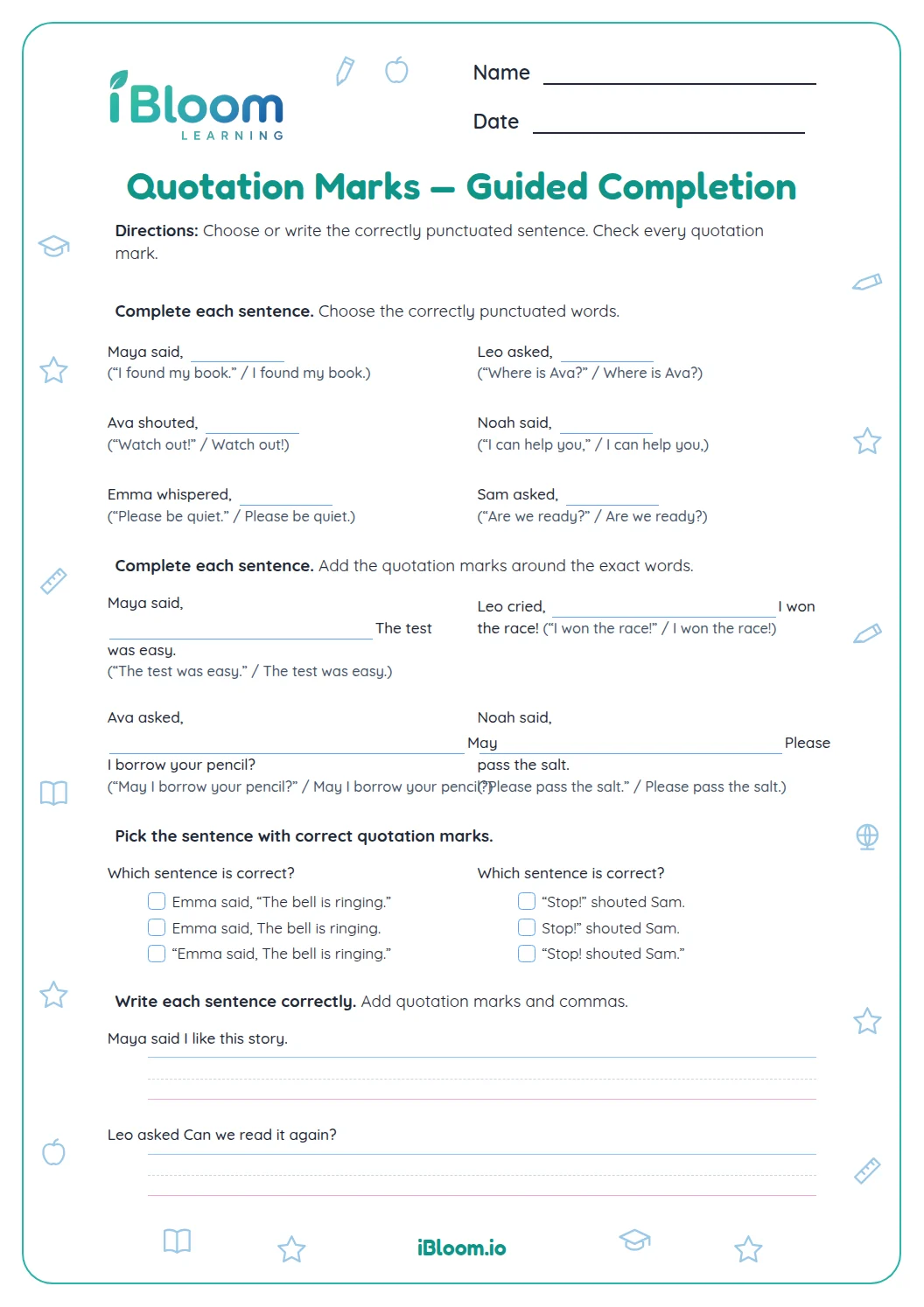
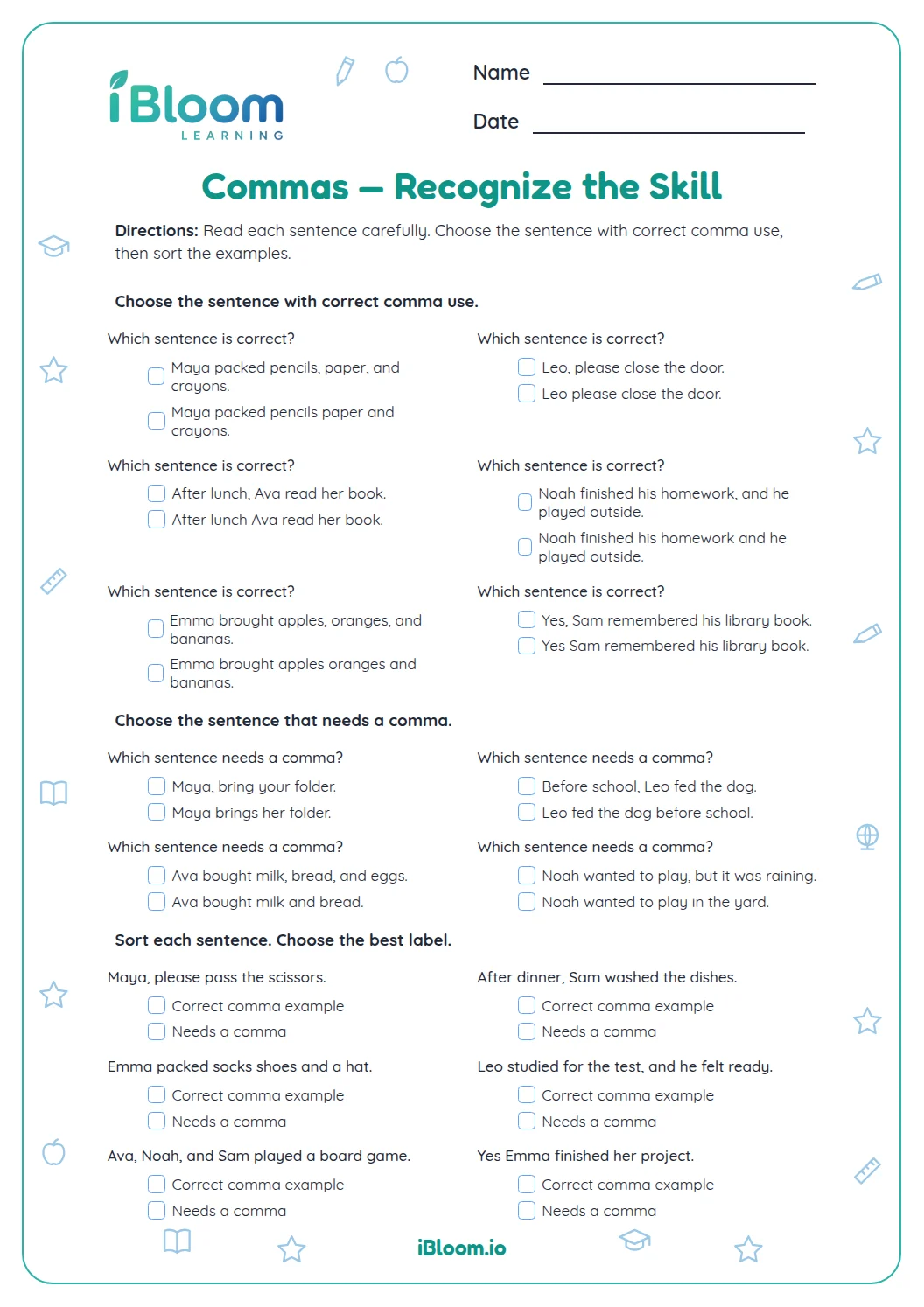
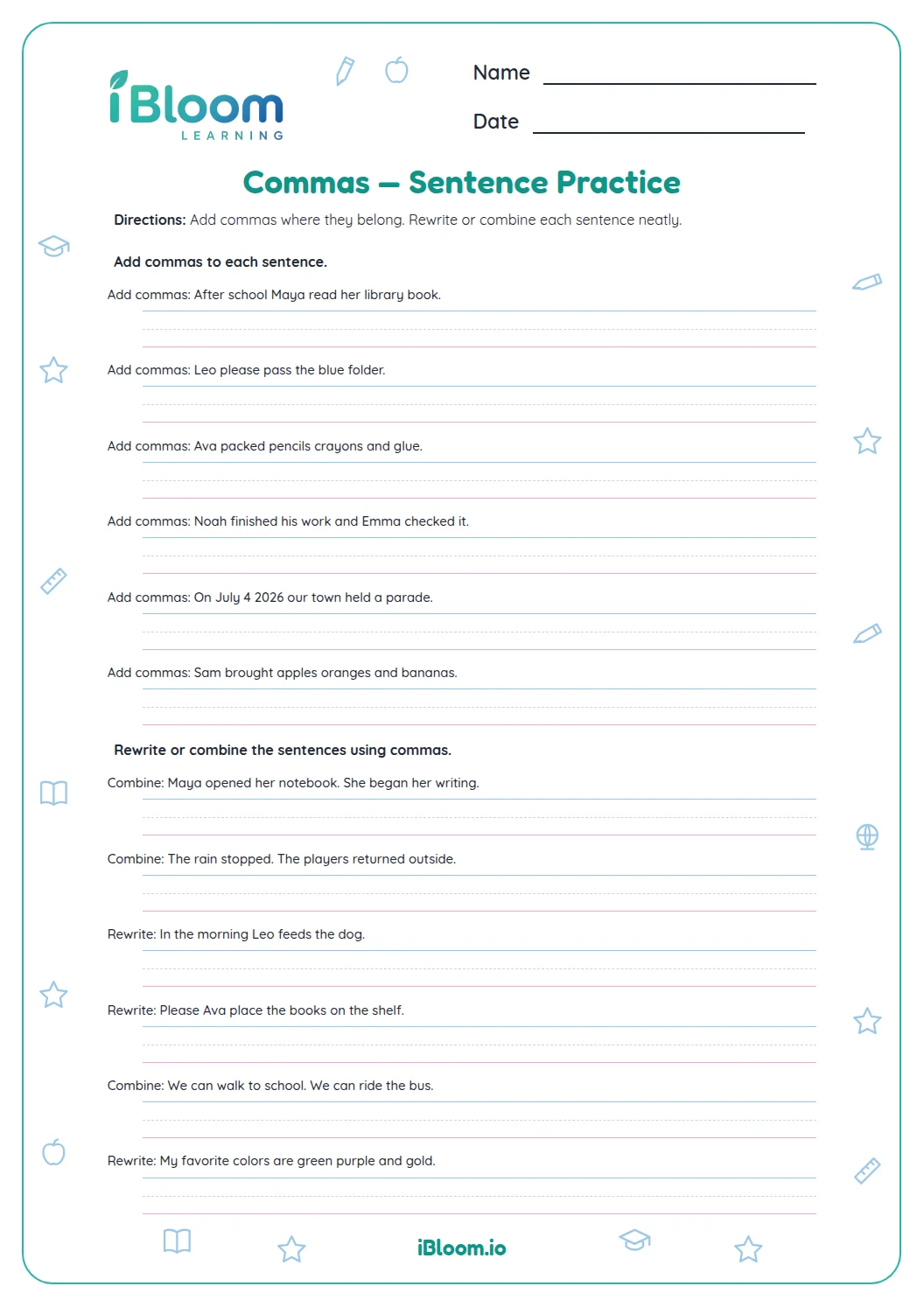
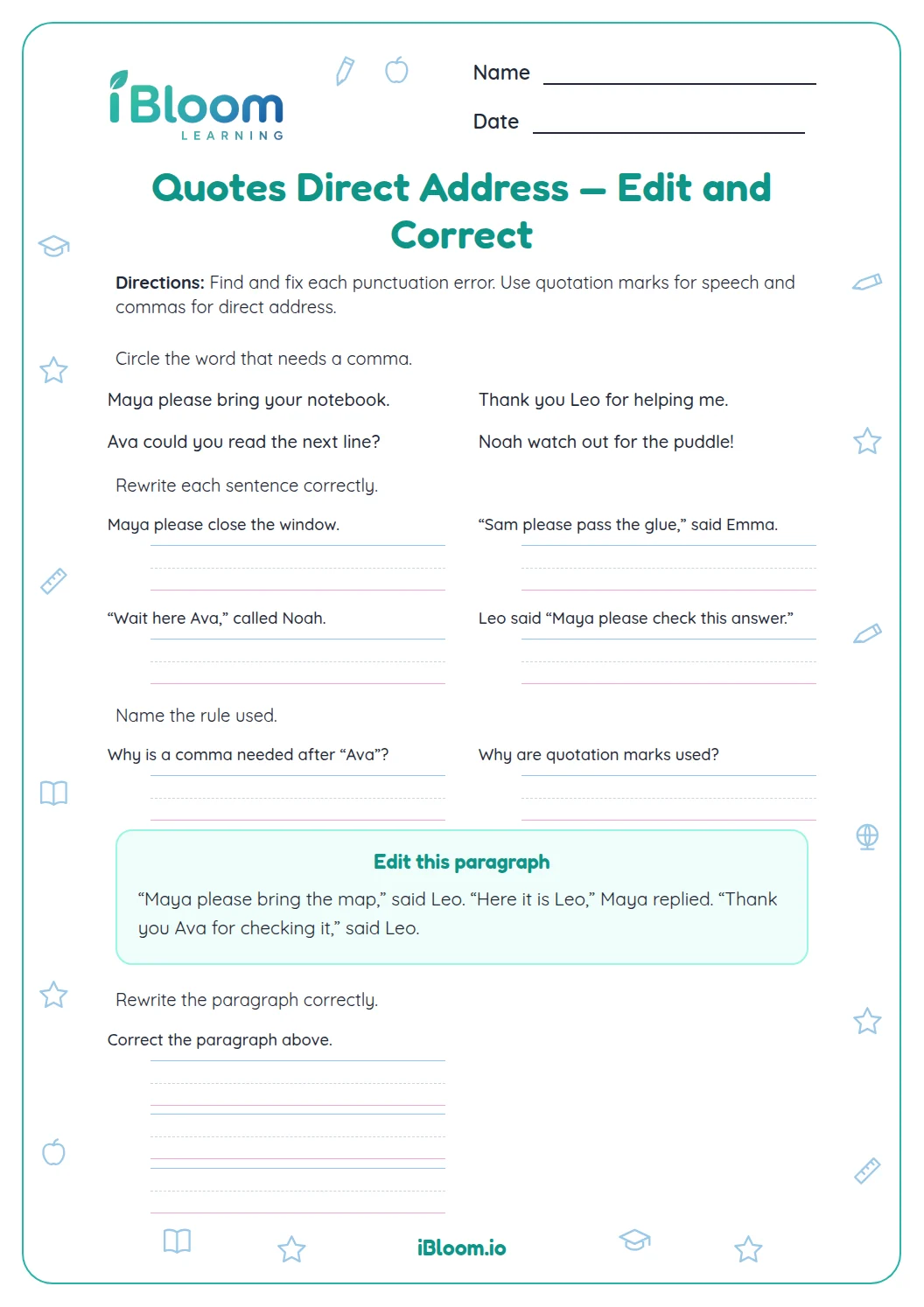
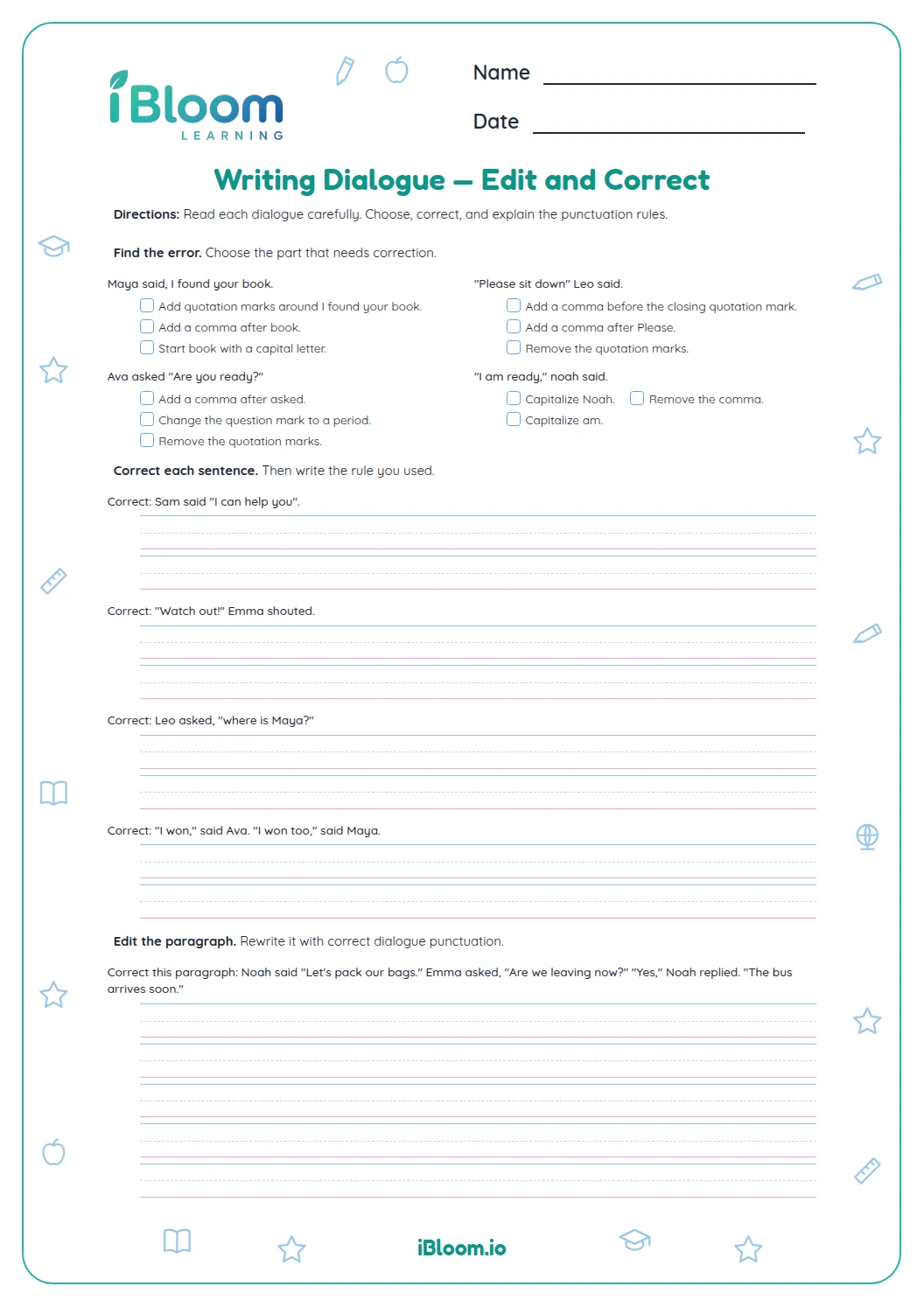
This free Grade 5 worksheet has 14 questions on dialogue punctuation. Students first choose correctly punctuated examples, then correct nine dialogue lines and a short exchange. They add quotation marks, place commas around spoken words and reporting clauses, and keep question marks or exclamation points inside quotation marks. A separate answer key shows corrected versions. The editing practice applies standard English punctuation conventions (CCSS L.5.2).
Aligned to L.5.2
How can students recognize correct dialogue punctuation?
The first four questions compare short dialogue examples. Check that quotation marks surround only the words spoken, and that commas and end marks sit in the right place. For example, the comma in “I’m ready,” said Lee belongs inside the closing quotation mark.
Where do commas and end marks go?
In the editing section, add a comma between spoken words and a following reporting clause. Put a spoken question mark or exclamation point inside the closing quotation mark.
- 1Edit: “Run” said Mia.
- 2Corrected: “Run!” said Mia.
- 3The exclamation point stays inside the closing quotation mark.
How do students edit a short exchange?
Read both sentences and mark exactly what each speaker says. Add commas after the reporting clauses before the quotes, then keep the spoken question mark and period inside their respective quotation marks.
How to edit each dialogue line
- 1Find the exact words spoken aloud.
- 2Put quotation marks around those words.
- 3Decide whether the reporting clause comes before or after the speech.
- 4Add a comma at the boundary when the sentence pattern calls for one.
- 5Keep a spoken question mark or exclamation point inside the quotation marks.
- 6Reread the complete sentence and compare it with the answer key.
Dialogue punctuation mistakes and quick fixes
The mistake
Leaving the comma outside the closing quotation mark.
The fix
In standard US punctuation, place the comma inside the closing quotation mark.
The mistake
Putting a spoken question mark after the quotation marks.
The fix
Keep the question mark inside the quotation marks with the spoken question.
The mistake
Capitalizing “said” after a quoted statement.
The fix
When the reporting clause continues the same sentence, begin it with a lowercase word.
Common Core alignment
Students revise dialogue using standard English punctuation conventions.
Use standard English punctuation when editing written dialogue.
On this sheet: Students correct quotation marks, commas, and end punctuation in written sentences.
Show the official wordingHide the official wording
Demonstrate command of the conventions of standard English capitalization, punctuation, and spelling when writing.
What to practice next
Make more practice
Further reading
Questions parents and teachers ask
How many questions are on the worksheet?
There are 14 questions: four punctuation choices, nine dialogue lines to correct, and one short exchange. The worksheet asks students to recognize correct examples before editing their own lines. A separate key shows expected punctuation for each response. Use the key to check each punctuation choice.
Where does a comma go in dialogue?
In standard US punctuation, a comma that separates spoken words from a following reporting clause goes inside the closing quotation mark: “We found it,” said Nora. Several editing questions ask students to add that comma while correcting the sentence. Read one answer aloud and compare its punctuation with the corrected version in the key.
Where should a question mark go in quoted speech?
When the spoken words form a question, put the question mark inside the quotation marks: “Are you ready?” The reporting clause follows with a lowercase word when it continues the same sentence. The worksheet includes questions with spoken questions and statements.
How does the worksheet handle sentences that begin with the speaker?
When a reporting clause comes first, add a comma to introduce the spoken words: Dad asked, “Are you ready?” Check that the quotation marks surround only the exact words spoken and that the question mark stays inside them. Read one answer aloud and compare its punctuation with the corrected version in the key.
Does the answer key show one possible correction?
The key gives corrected versions for the choices, nine dialogue lines, and the short exchange. Students may make different edits that preserve the spoken words and standard punctuation; compare quotation marks, commas, and end marks with the examples. Use the answer key to check each punctuation choice.