









About this worksheet
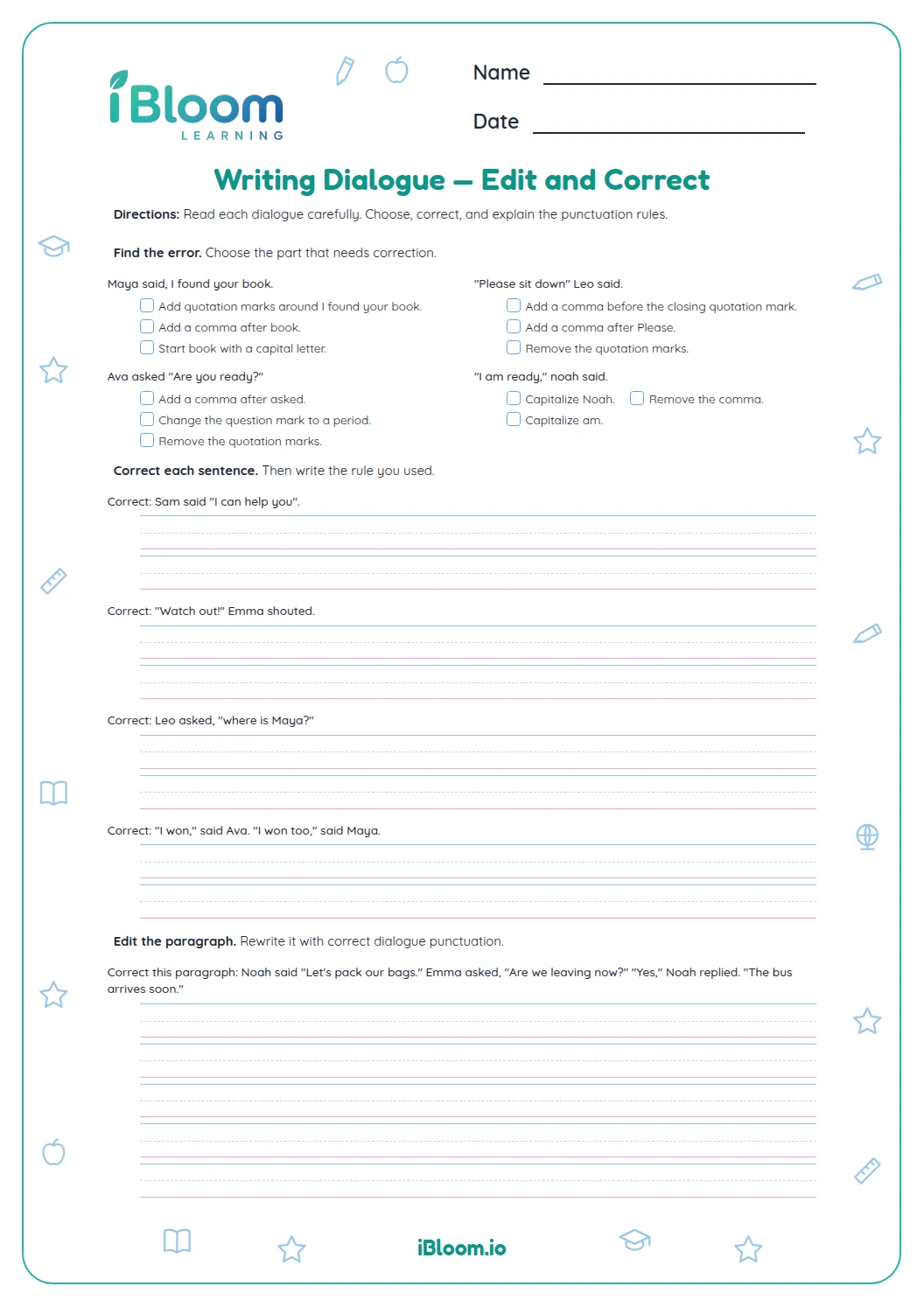
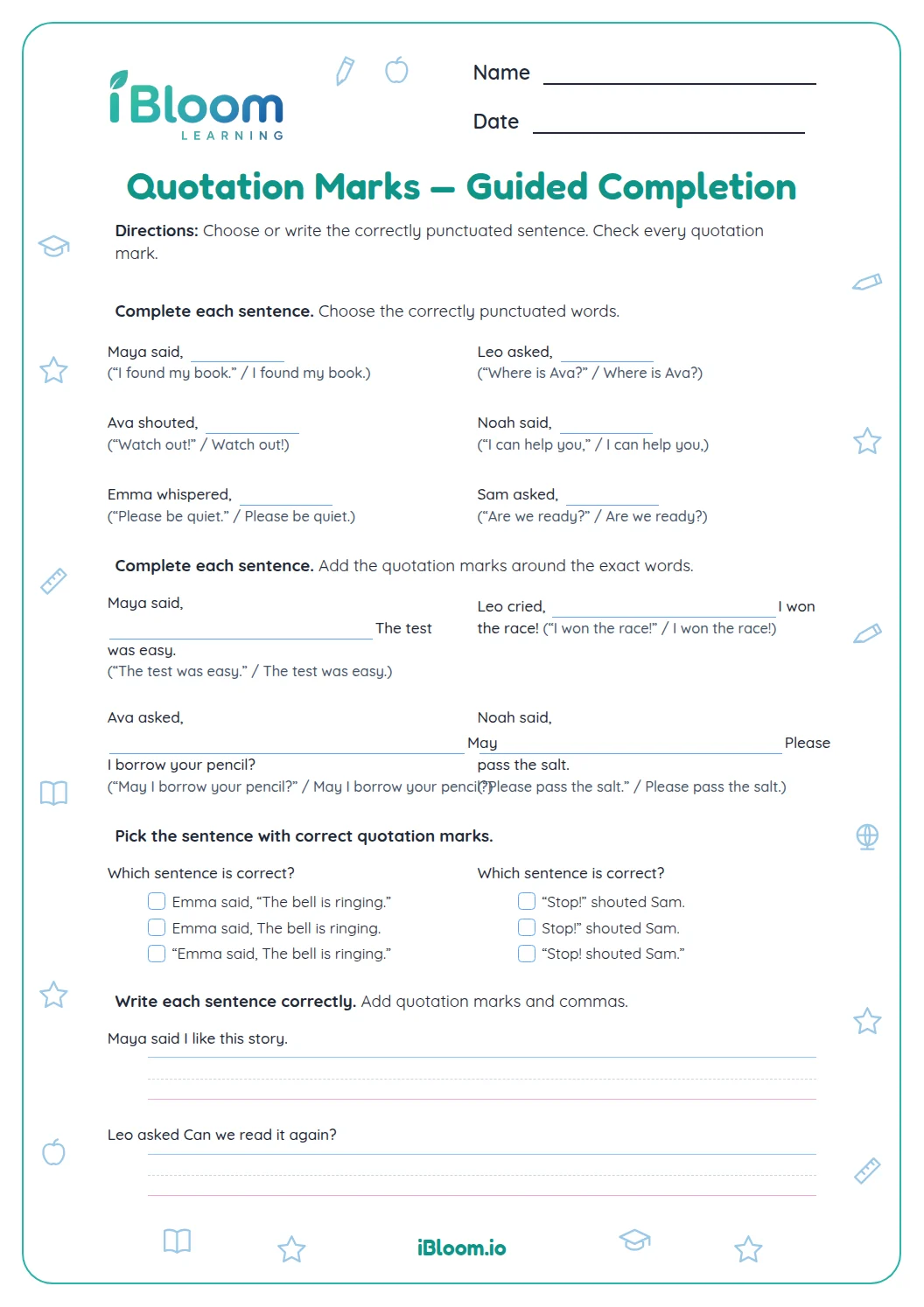
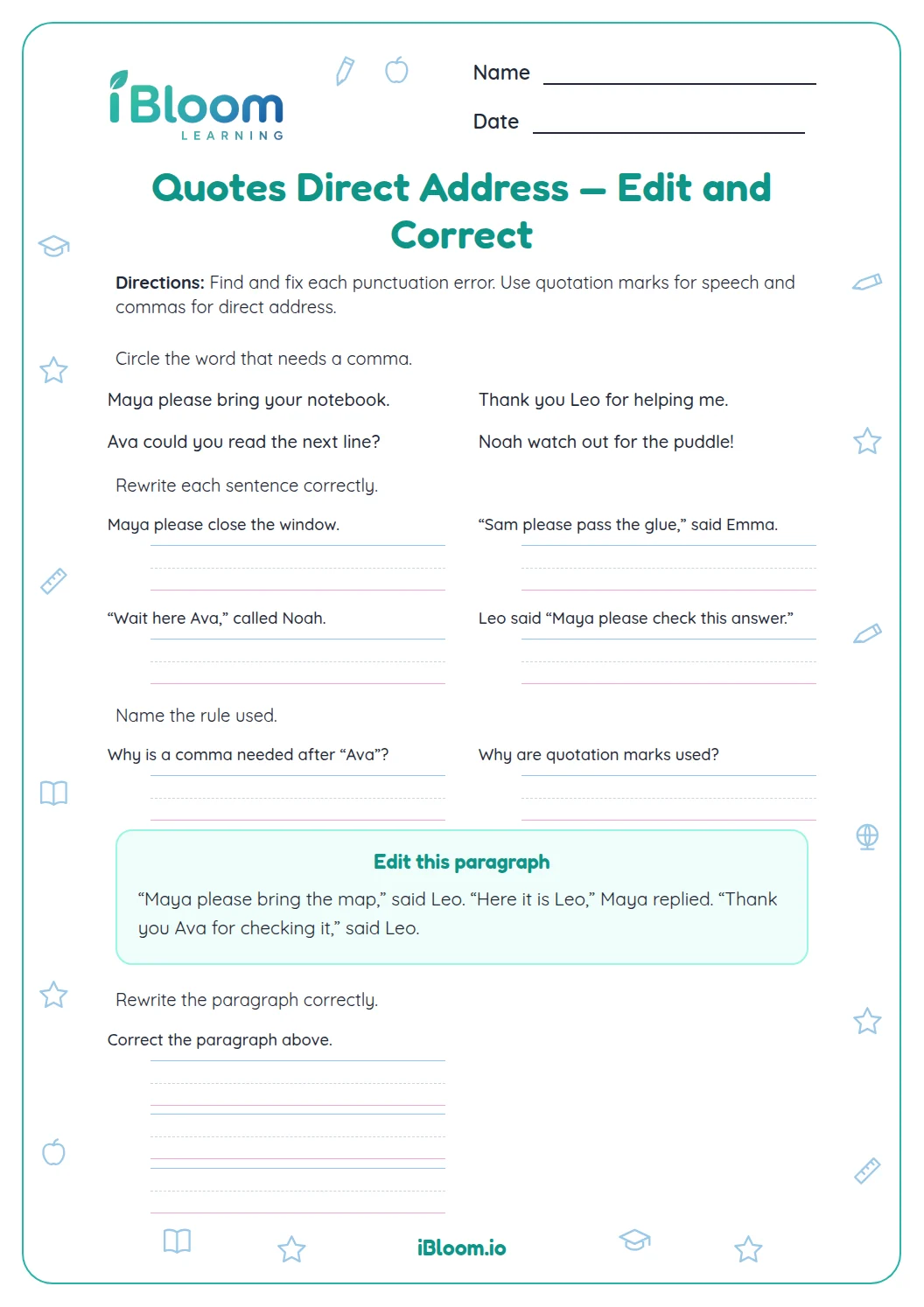
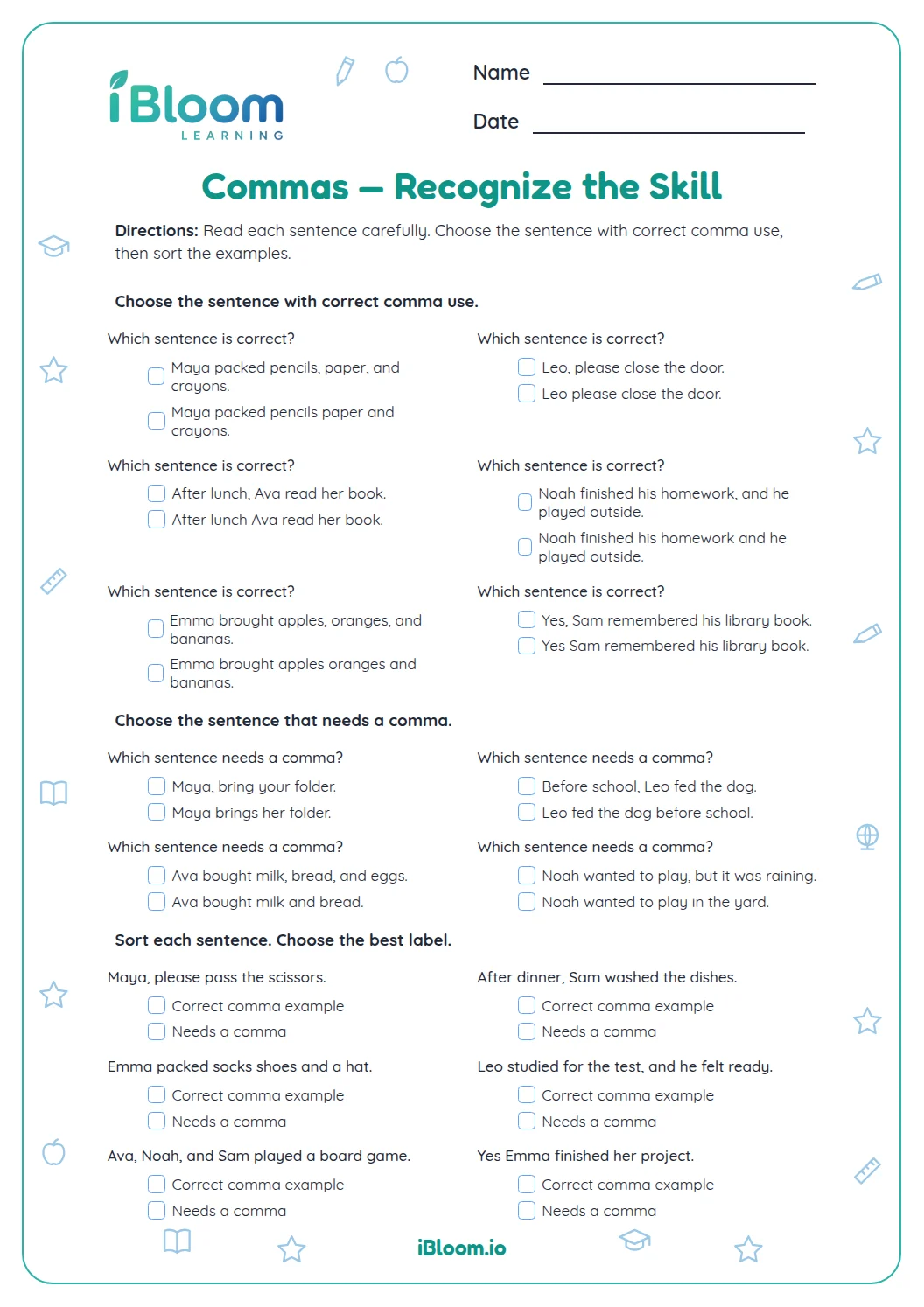
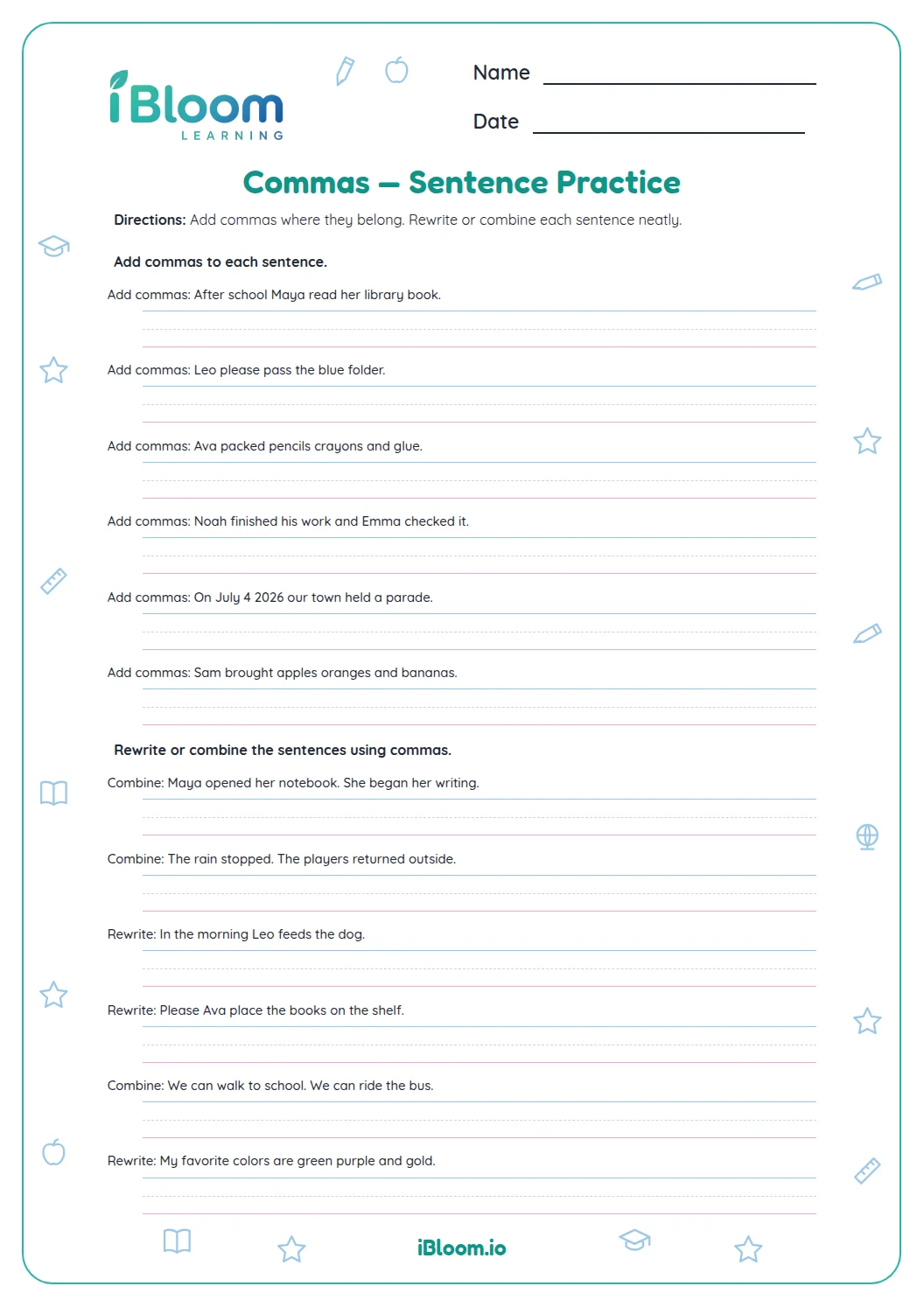
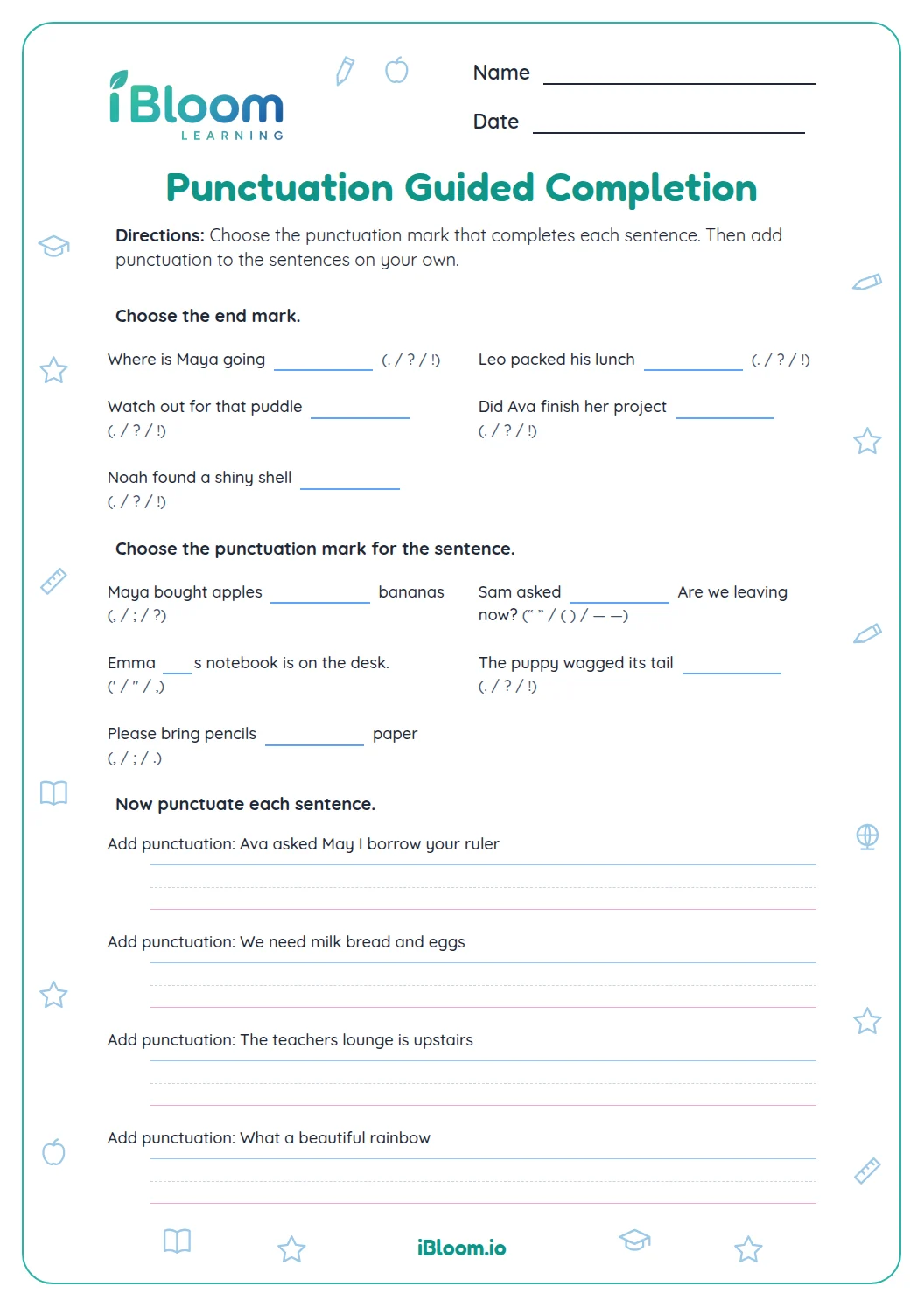
This Grade 5 worksheet helps students punctuate spoken words with quotation marks, commas and end marks. Four questions ask students to choose a correctly punctuated sentence, six provide guided completion, and four invite editing or writing. The task practices the conventions used to mark dialogue; a separate answer key includes model responses for open-ended items.
Aligned to 3.L.2.c
Where do the quotation marks go?
Place an opening quotation mark before the first spoken word and a closing quotation mark after the final spoken word. Keep the sentence’s end punctuation inside the closing mark.
In question 1, the words We can begin are spoken. The comma after said introduces the quotation.
- 1Mia said, “We can begin.”
- 2Comma after the speaker tag
- 3Period inside the closing quotation mark
How does a speaker tag affect the comma?
A speaker tag names who spoke. When it comes before the quoted words, place a comma before the opening quotation mark. When it follows a statement, use a comma before the closing quotation mark and begin the tag with a lowercase letter.
A question mark or exclamation point stays inside the quotation marks when it belongs to the spoken words.
How to use this worksheet
- 1Find the exact words spoken.
- 2Put quotation marks around those words.
- 3Add a comma where the speaker tag joins the quotation.
- 4Put the spoken sentence’s end mark inside its closing quotation mark.
- 5Read the sentence aloud and check who is speaking.
Common mistakes and quick fixes
The mistake
Putting a period outside the quotation marks.
The fix
Place the spoken sentence’s period inside the closing mark.
The mistake
Using a period between a speaker tag and a quotation.
The fix
Use a comma when the tag introduces the spoken words.
The mistake
Capitalizing a speaker tag after a dialogue comma.
The fix
Continue the same sentence with a lowercase tag, such as said Mia.
Common Core alignment
This worksheet practices the Common Core skill described below.
Use commas and quotation marks to mark dialogue.
On this sheet: Children add quotation marks and commas to dialogue in complete sentences.
Show the official wordingHide the official wording
Use commas and quotation marks in dialogue.
What to practice next
Make more practice
Questions parents and teachers ask
What punctuation does this dialogue worksheet practice?
It practices quotation marks around spoken words, commas connecting speech and speaker tags, and periods, question marks or exclamation points inside the closing quotation mark. Students can use the model to check each step and review the skill in a clear, complete response.
How many questions are on the page?
There are 14 items: four multiple-choice questions, six guided punctuation completions and four written responses. The answer key gives the corrected sentences and sample dialogue. Students can use the model to check each step and review the skill in a clear, complete response.
Why does dialogue need quotation marks?
Quotation marks show a reader which words a character or person says aloud. This sheet asks students to add those marks and place commas and end punctuation so the speech is easy to follow. Students can use the model to check each step and review the skill in a clear, complete response.
What is a speaker tag?
A speaker tag tells who said the words, as in Mia said. Students use the tag to decide where a comma belongs before or after a quotation. Students can use the model to check each step and review the skill in a clear, complete response.
Can answers to the writing questions differ?
Yes. The final responses are open-ended, so the key gives examples rather than a single required sentence. Check that the spoken words are inside quotation marks and the punctuation is placed correctly. Students can use the model to check each step and review the skill in a clear, complete response.