








About this worksheet
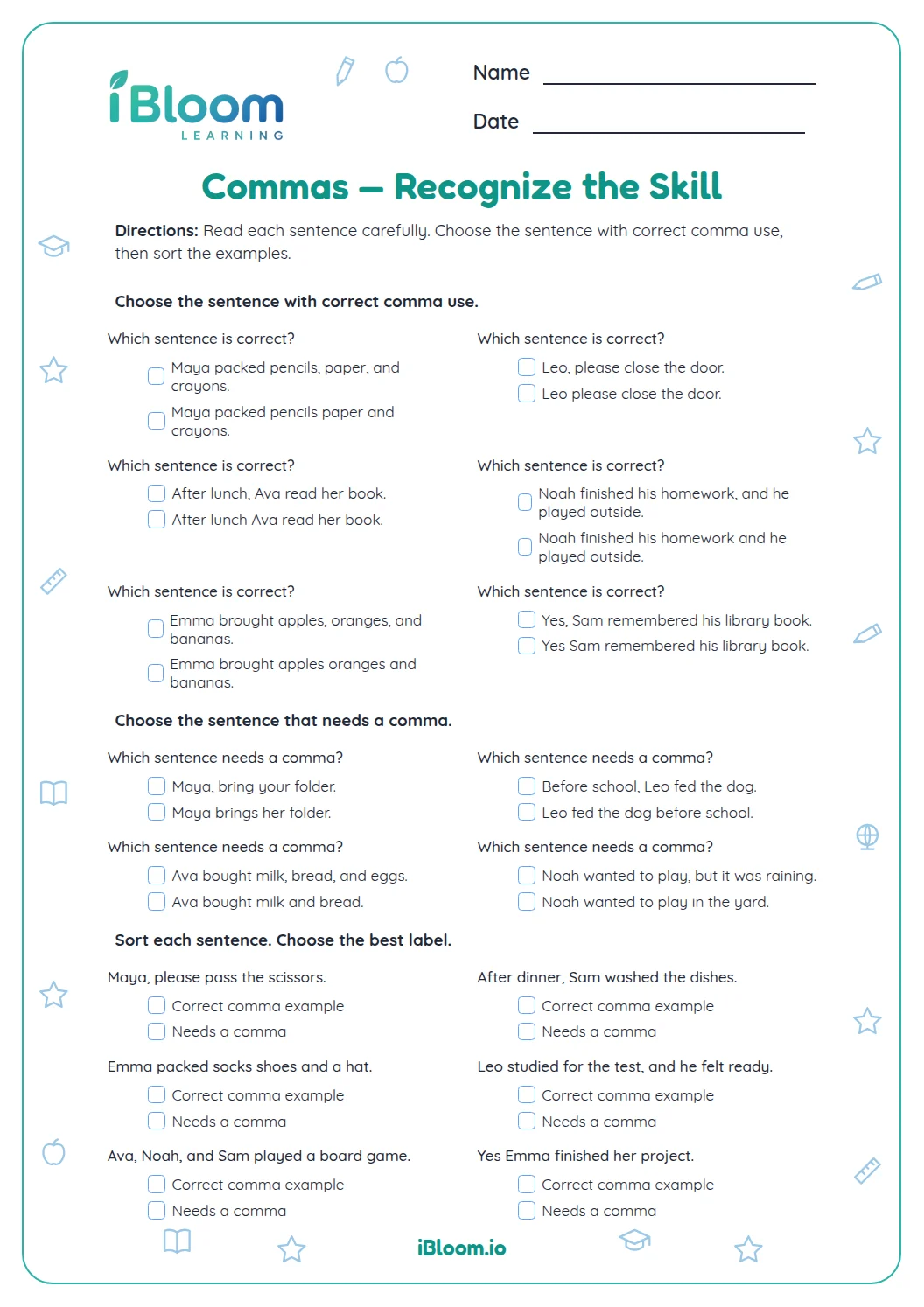
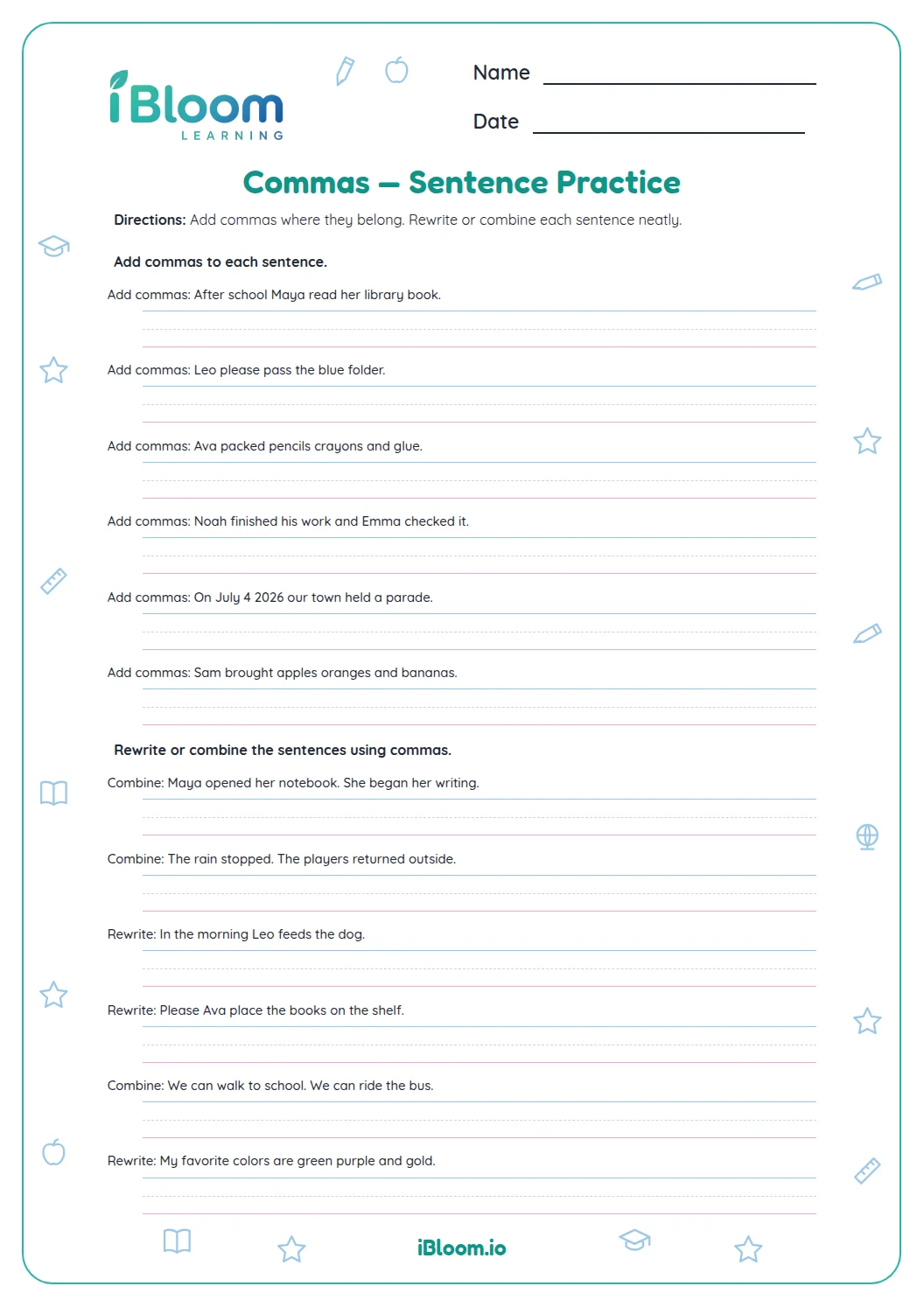
This printable Grade 5 punctuation worksheet gives students 15 questions in three parts. They identify correctly punctuated sentences, supply commas or a colon in context, and finish with punctuation choices in complete sentences. It practices commas in introductory phrases, greetings, direct address and series, quotation marks around a short title, colons before a list, and sentence-ending marks. The answer key shows the selected sentences and missing marks. Its conventions work aligns with CCSS L.5.2.
Aligned to L.5.2
Which punctuation choices appear?
Part A has nine multiple-choice items. Students distinguish questions, statements and exclamations, then check commas in greetings, introductory phrases, series and direct address, plus quotation marks around a title.
- 1For “Which sentence asks for information?”, choose “How many pages are left?” because it is a direct question.
How do students decide which mark is missing?
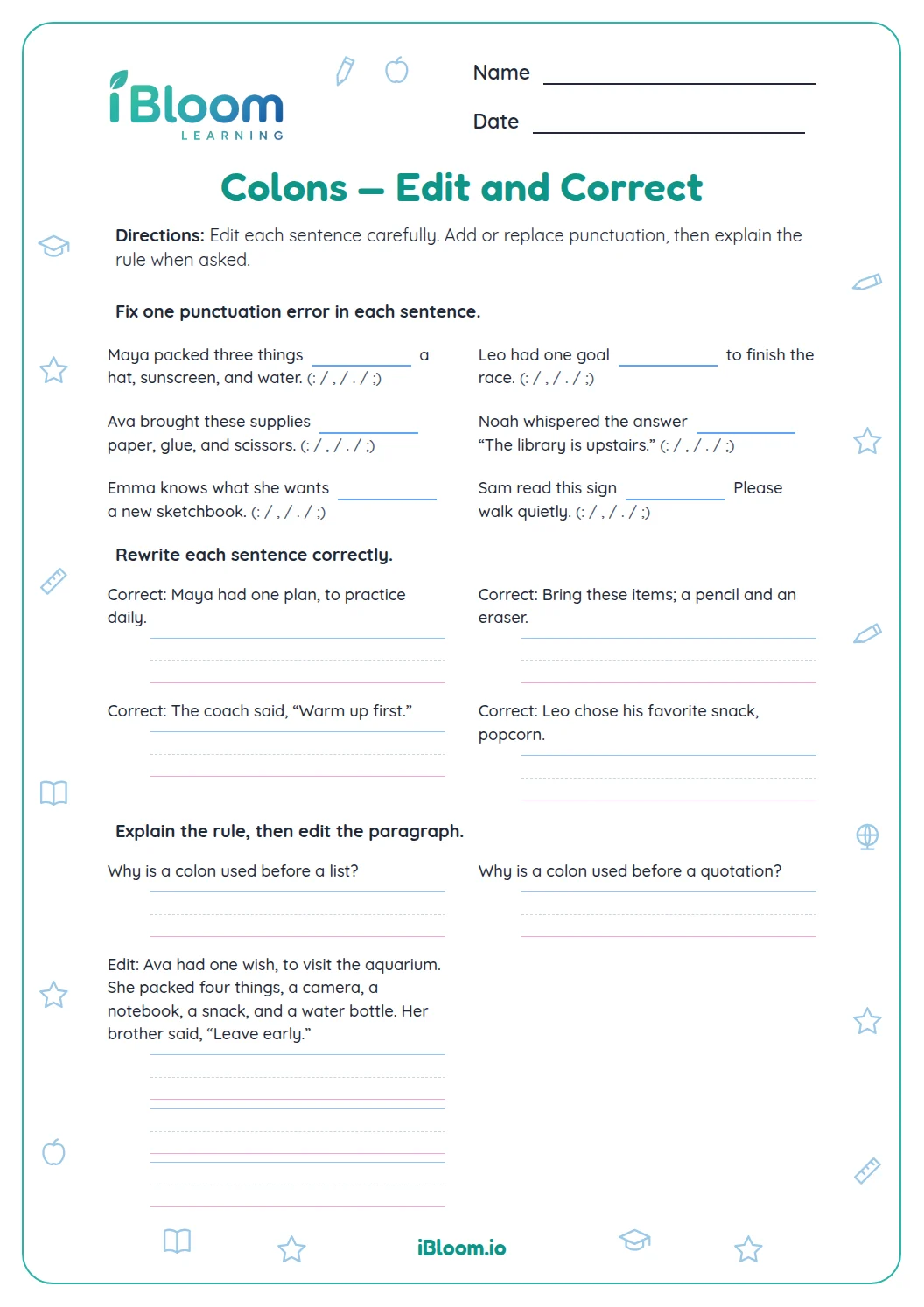
Part B gives a sentence with a blank where a comma or colon belongs. Read the words after the blank: an introductory phrase takes a comma, while a list introduced by a complete clause can take a colon.
- 1“I need three things___ paper, tape, and string.” takes a colon because the words after it name the three things.
How can the key support a review?
Check the mark against the sentence’s job. If a child chose a different end mark, ask them to explain the tone they intended; the recognition choices on this page each have one best answer.
How can I support this practice?
- 1Read the whole sentence before choosing a mark.
- 2In Part A, identify whether the sentence asks, tells, or exclaims.
- 3Check commas around greetings, direct address, introductory phrases, and series.
- 4For Part B, read what follows the blank to decide whether it is a list or an opening phrase.
- 5Compare each choice with the answer key and explain the clue.
What should students check?
The mistake
Using an exclamation mark for every sentence that sounds lively.
The fix
Ask whether the sentence is a question, a statement, or a strong exclamation; punctuation follows its purpose.
The mistake
Leaving out a comma after an introductory phrase.
The fix
Read the opening words as a group, then place a comma before the main clause.
The mistake
Putting a colon before a list without a complete lead-in.
The fix
Check that the words before the colon introduce the list as a complete thought.
Curriculum alignment
This worksheet practices the Common Core skill named below.
Demonstrate command of capitalization, punctuation, and spelling when writing.
On this sheet: Fifteen items move from spotting punctuation in sentences to adding a mark where meaning or sentence structure calls for it.
Show the official wordingHide the official wording
Demonstrate command of the conventions of standard English capitalization, punctuation, and spelling when writing.
What to practice next
Make more practice
Further reading
Questions parents and teachers ask
Does the worksheet include an answer key?
Yes. The key marks the correct sentence choices and supplies the missing punctuation marks. For each answer, ask the student to point to the clue in the sentence, such as a question, a list, a direct address, or an introductory phrase. This turns checking into a short explanation of the convention.
Which punctuation marks appear on the page?
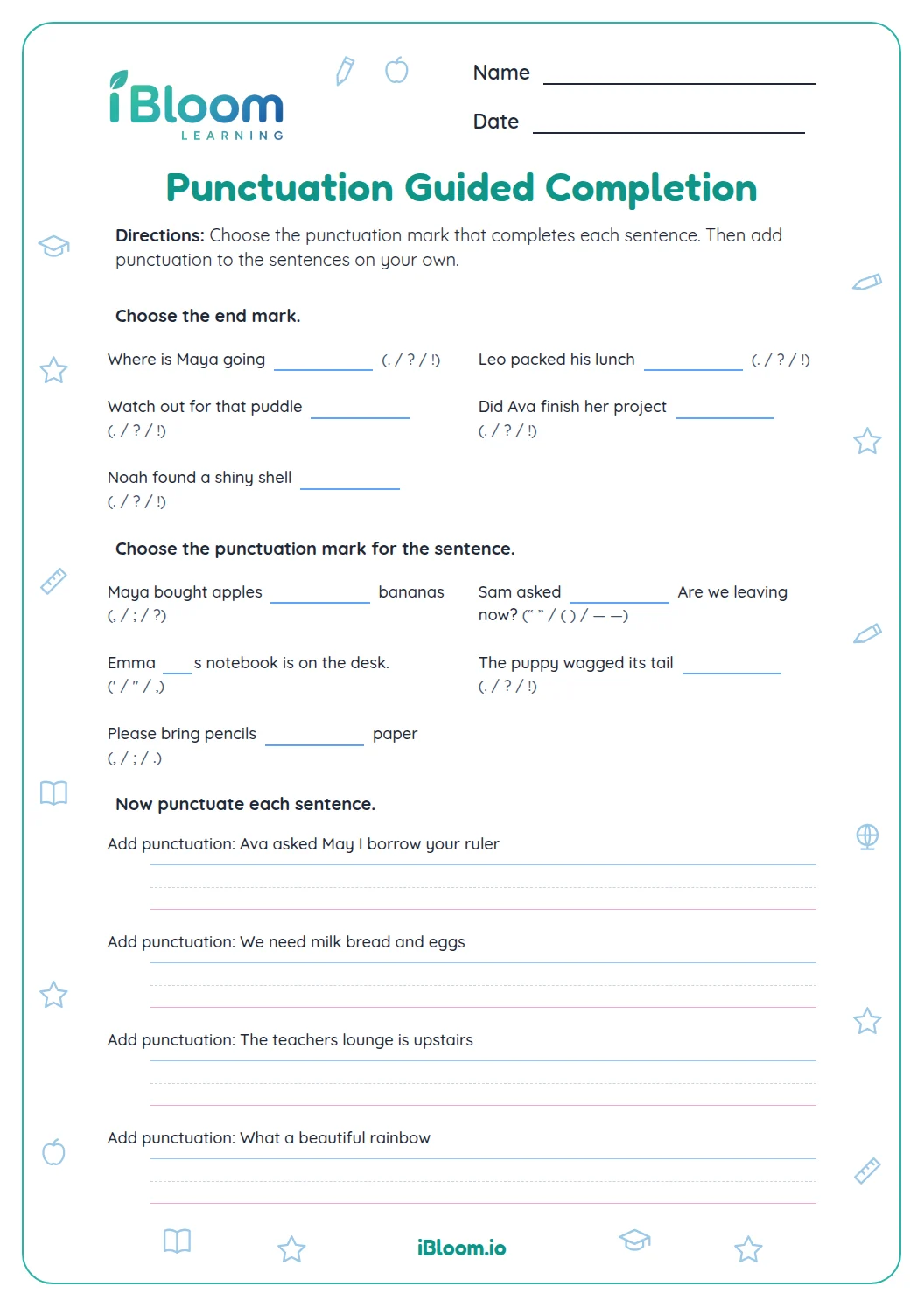
Students work with periods, question marks, exclamation marks, commas, quotation marks, and a colon. The items include end punctuation, commas in a greeting and series, commas after an opener and around a name, and quotation marks around a short title. The final part supplies missing marks.
How can a student choose an end mark?
Read the sentence for its purpose. A direct question asks for information and ends with a question mark; a statement ends with a period; an exclamation mark signals strong feeling. Then read the sentence again with the mark to make sure the meaning still fits.
When does a comma belong in a series?
Use commas to separate three or more items in a series. In “apples, crackers, and water,” each item is distinct, and the final comma comes before and. The worksheet also includes commas after an opener and around direct address, so students should identify the sentence structure first.
What does Part B ask students to do?
Part B gives six sentences with one blank for a punctuation mark. Students use the surrounding words to decide what belongs there, including a comma after an introductory phrase and before a dialogue tag, and a colon before a list. The answer key shows each mark on its own.