








About this worksheet
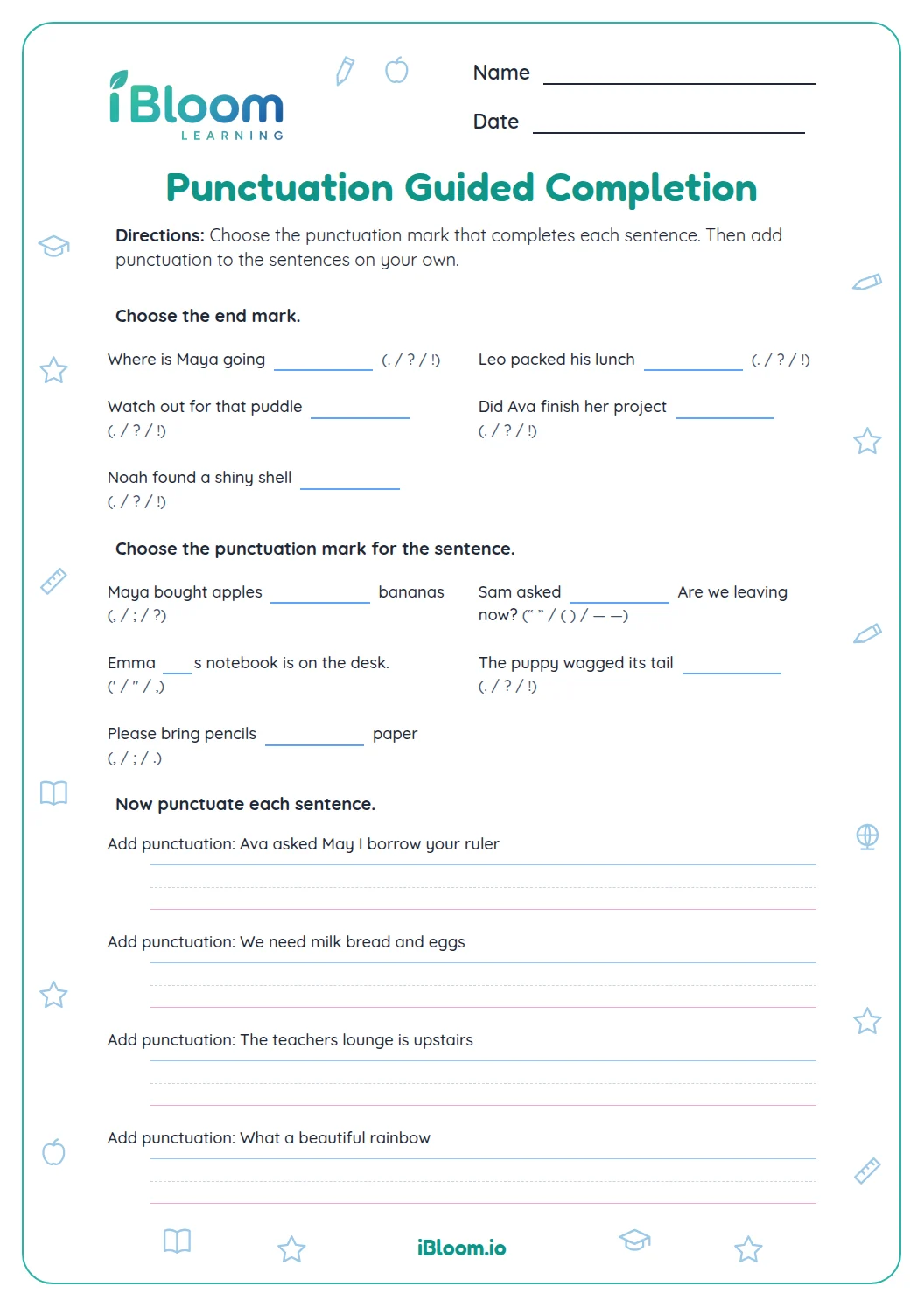
This free printable Grade 5 punctuation worksheet contains 16 fill-in punctuation questions in a mixed review. Students add commas after introductory elements, in a series, for direct address, and in dialogue; they also use colons and semicolons. The answer key gives the missing mark for each sentence. The work practices standard English punctuation conventions in CCSS L.5.2.
Aligned to L.5.2
How do punctuation marks guide a reader?
Punctuation marks organize words and ideas. Commas separate items or set off introductory words. Quotation marks show spoken words, and the comma or question mark belongs with the quoted sentence. Colons can introduce a list; semicolons can join closely related complete thoughts.
- 1Before the trip ___ we packed socks, coats, and hats.
- 2“Before the trip” is an introductory phrase.
- 3Add a comma after it: Before the trip, we packed socks, coats, and hats.
What should you check when editing dialogue?
Capitalize the first word inside the quotation marks. Place punctuation that belongs to the spoken words inside the closing quotation mark. In “We found the trail,” said Noah, the comma is inside the quotation marks because the sentence continues with said Noah.
When do a colon and semicolon fit?
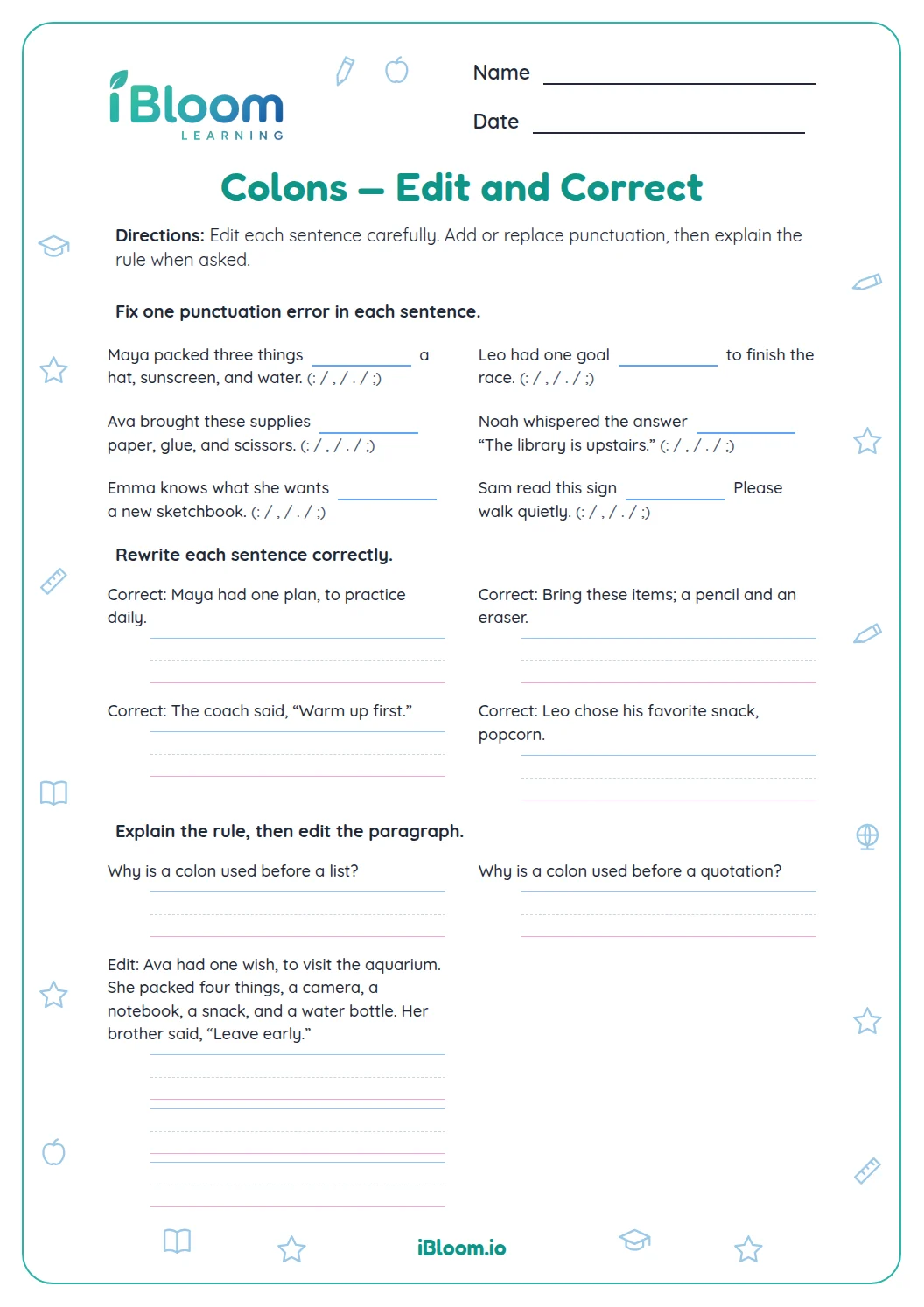
Use a colon after a complete thought to introduce a list, as in We need three things: paper, glue, and scissors. Use a semicolon between two closely related complete sentences, as in The rain stopped; the team went outside.
More Grade 5 punctuation practice at home or in class
- 1Read the entire sentence aloud and notice where a reader needs a pause or boundary.
- 2Check for an introductory phrase, a list, direct address, or spoken words.
- 3For dialogue, capitalize the first quoted word and place its end mark inside the quotation marks.
- 4Use a colon after a complete statement that introduces a list.
- 5Use a semicolon only when both sides can stand as complete sentences.
- 6Rewrite the sentence, then reread it to check meaning and punctuation.
Common mistakes and quick fixes
The mistake
Putting a comma between the subject and verb after an introductory phrase.
The fix
Place the comma after the introductory words: After lunch, we visited the museum.
The mistake
Putting the comma outside the closing quotation mark in dialogue.
The fix
Keep the spoken sentence mark inside the quotation marks: “We are ready,” said Ana.
The mistake
Using a semicolon where one side is not a complete sentence.
The fix
Check that each side could be its own sentence before joining them with a semicolon.
Curriculum alignment
Apply standard English punctuation conventions while editing sentences.
On this sheet: The worksheet directly practices this skill in its questions.
Show the official wordingHide the official wording
Demonstrate command of the conventions of standard English capitalization, punctuation, and spelling when writing.
What to practice next
Make more practice
Further reading
Questions parents and teachers ask
Which comma patterns appear on this page?
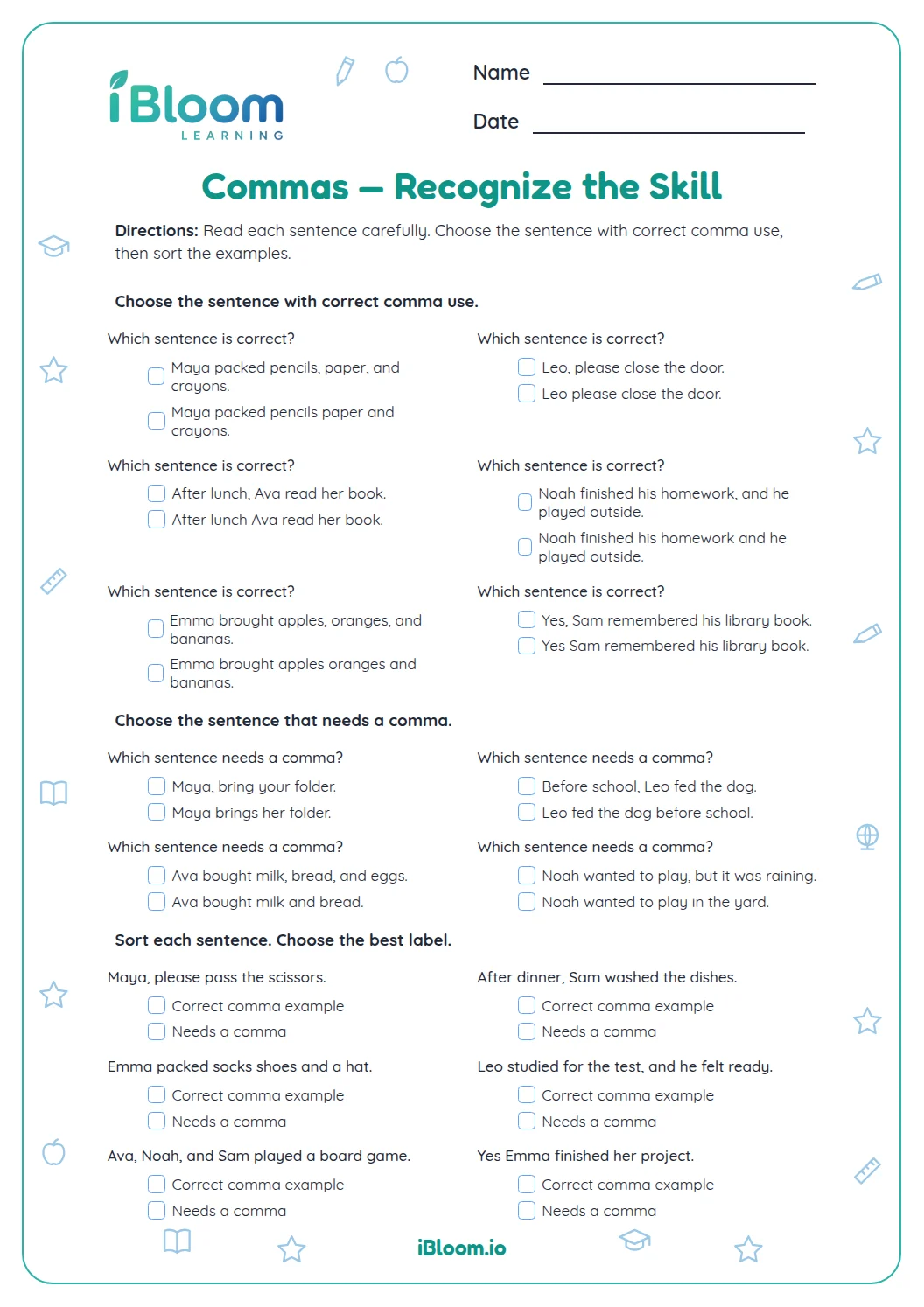
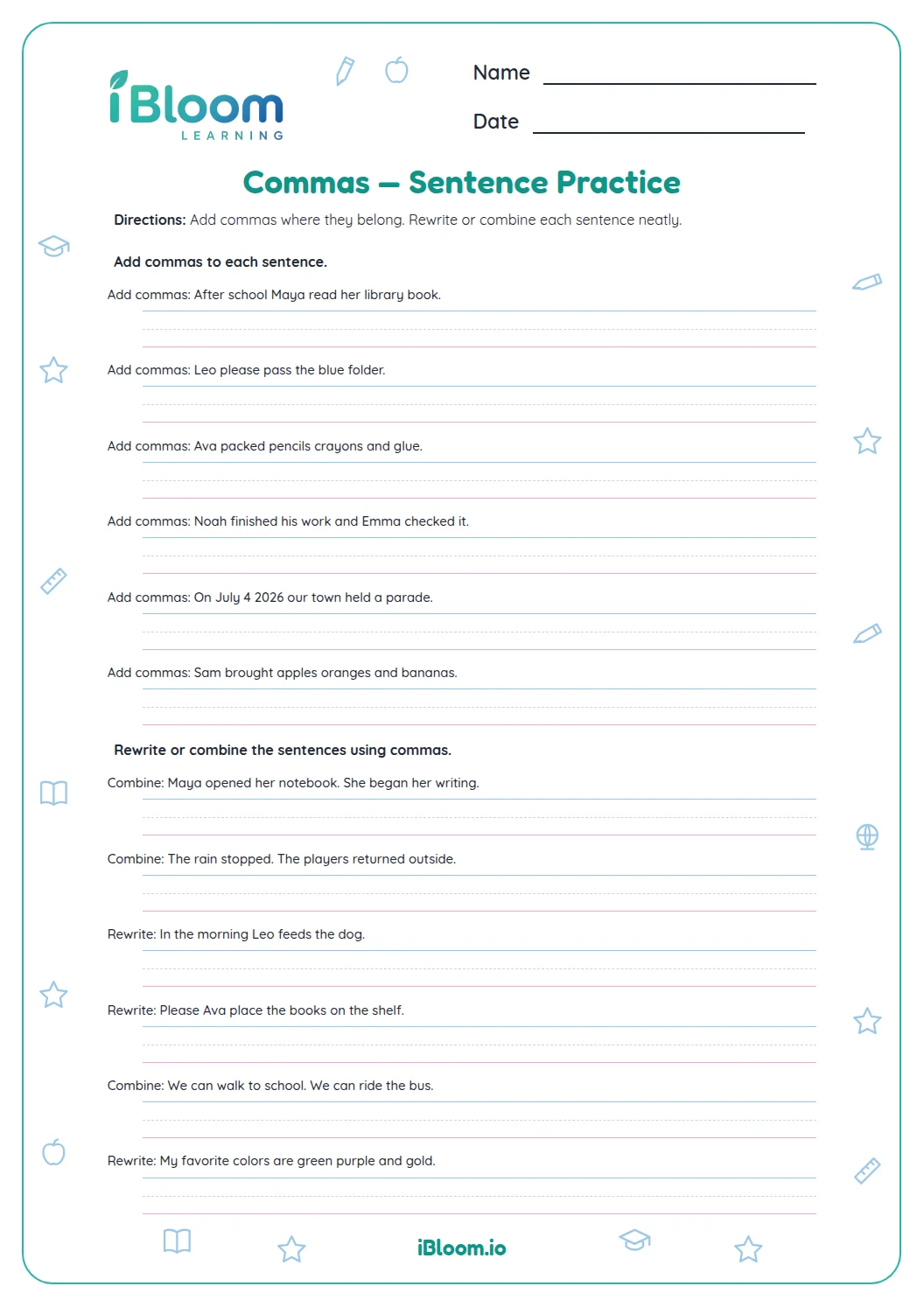
Students practice commas after introductory phrases and words, between items in a series, and around direct address. The prompts include examples such as “Riley, please pass the ruler” and “Before the trip, we packed socks, coats, and hats.” Students can read each side aloud to check whether it is complete.
Where does punctuation go in dialogue?
A comma, period, question mark, or exclamation point that belongs to the quoted words goes inside the closing quotation mark in standard US punctuation. The worksheet gives dialogue examples and asks students to place commas and end marks inside the quotation marks. The key shows one correct version, and careful editing should preserve the sentence meaning.
When should a student use a colon?
A colon can introduce a list after a complete thought. One prompt asks students to complete “We need three things ___ paper, glue, and scissors,” so they must recognize that the words before the blank form a complete statement. Take time to reread the final sentence so each mark supports its meaning.
How is a semicolon different from a comma?
A semicolon can join two closely related independent clauses, and each side can stand as a sentence. A comma alone cannot join two complete sentences. Question 16 uses therefore to connect two related complete thoughts. Read each clause separately before deciding whether the semicolon is correct.
Are the written answers the only possible versions?
The key gives a model correction for each editing prompt. Students may make a different change if it preserves the original meaning and uses correct capitalization and punctuation; compare each sentence mark by mark. The answer key also gives the exact capitalization and punctuation for comparison.
How long does this worksheet take?
Plan for about 25 minutes for the 16 punctuation blanks. Students who need more time can complete the first two parts, then return to the dialogue and review examples. A classroom session can pause after question 10 before the editing section begins.