






About this worksheet
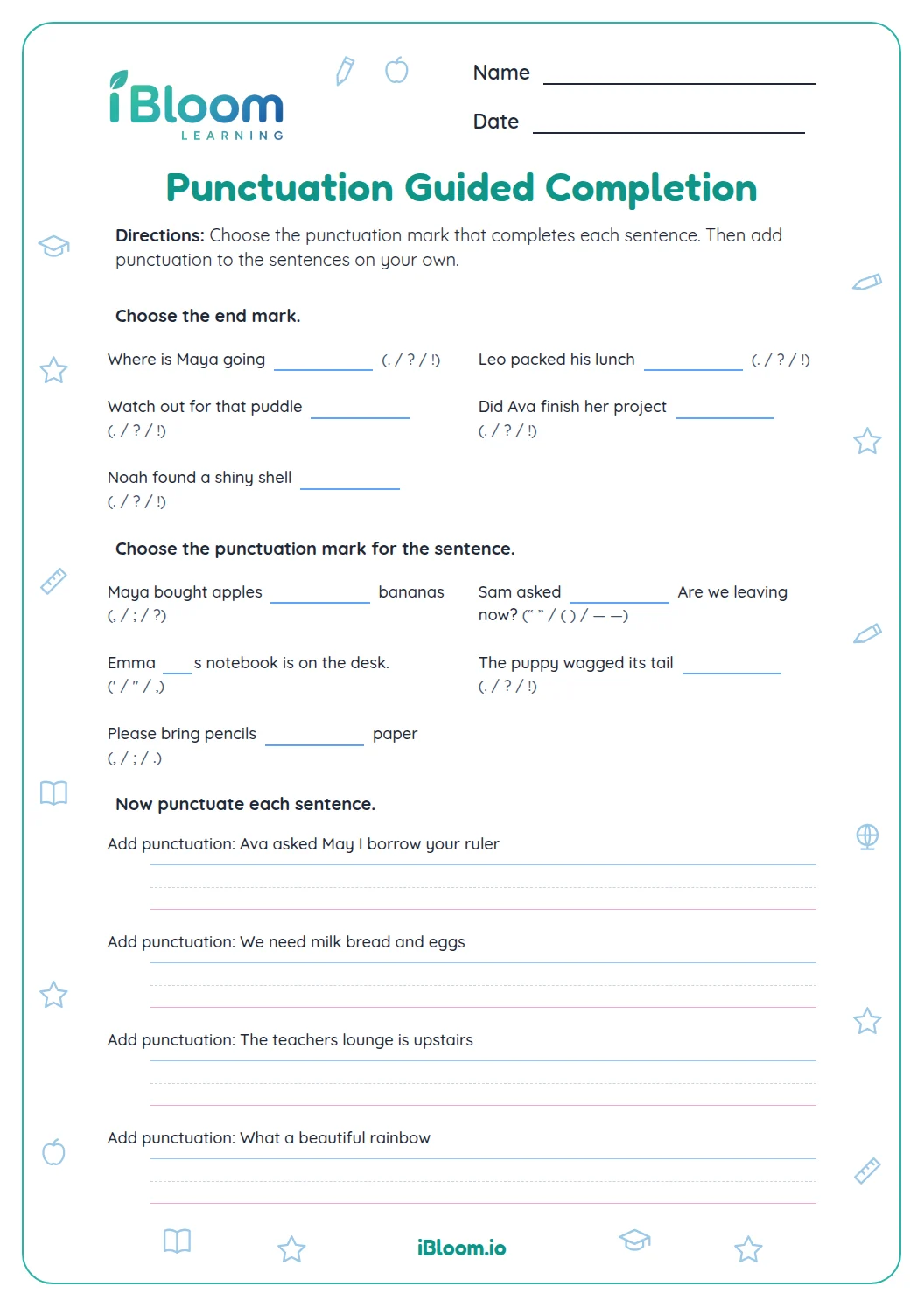
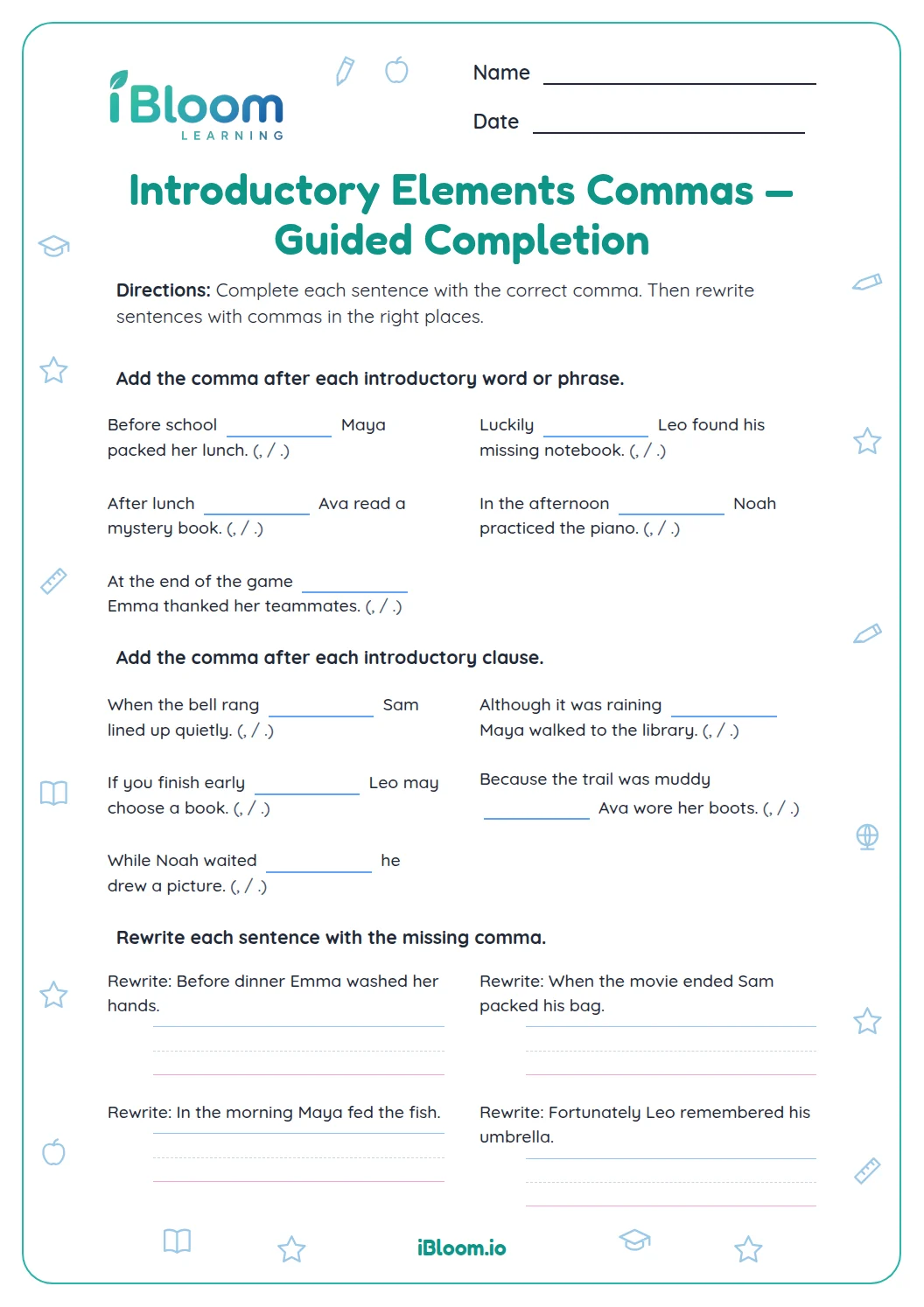
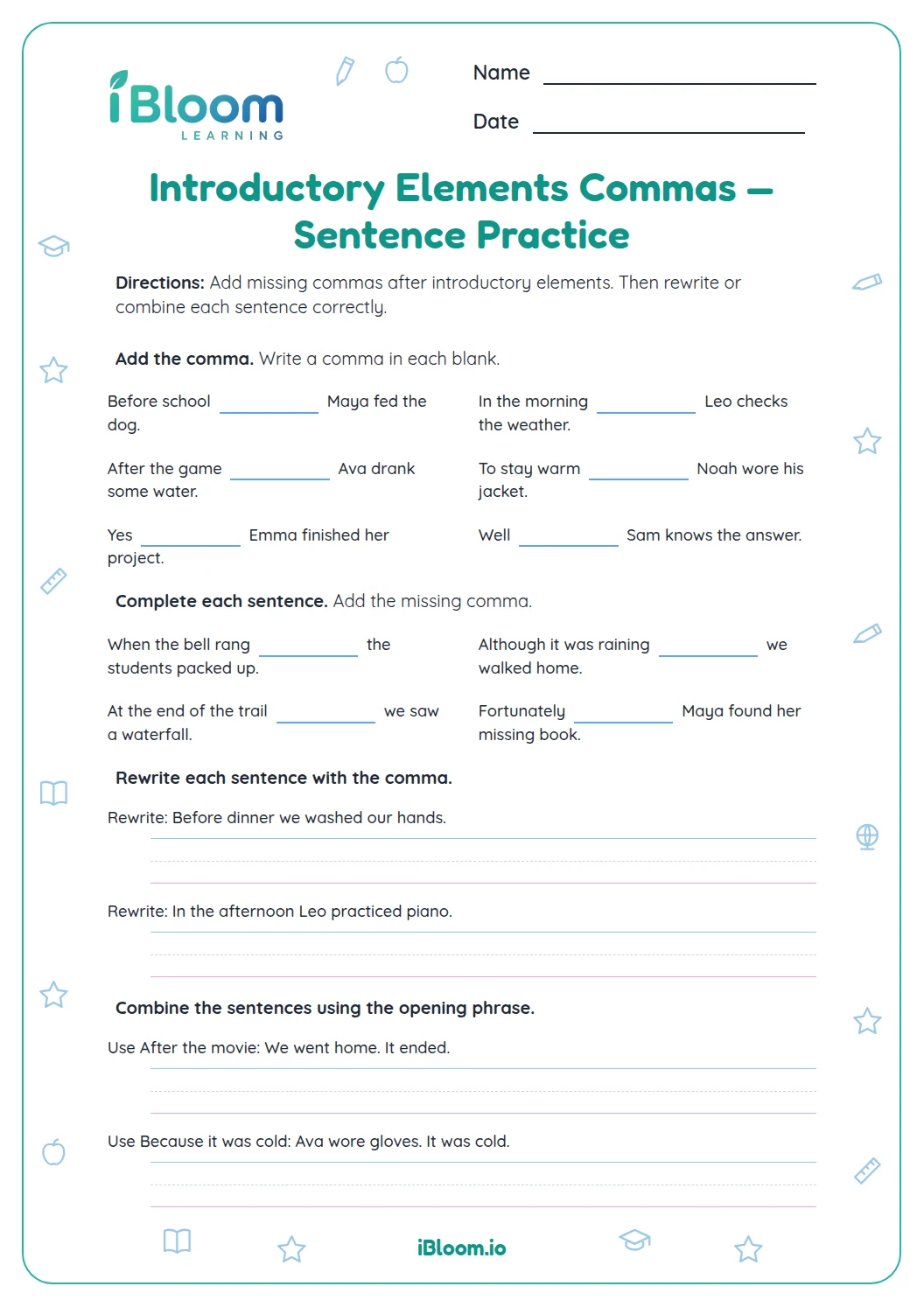
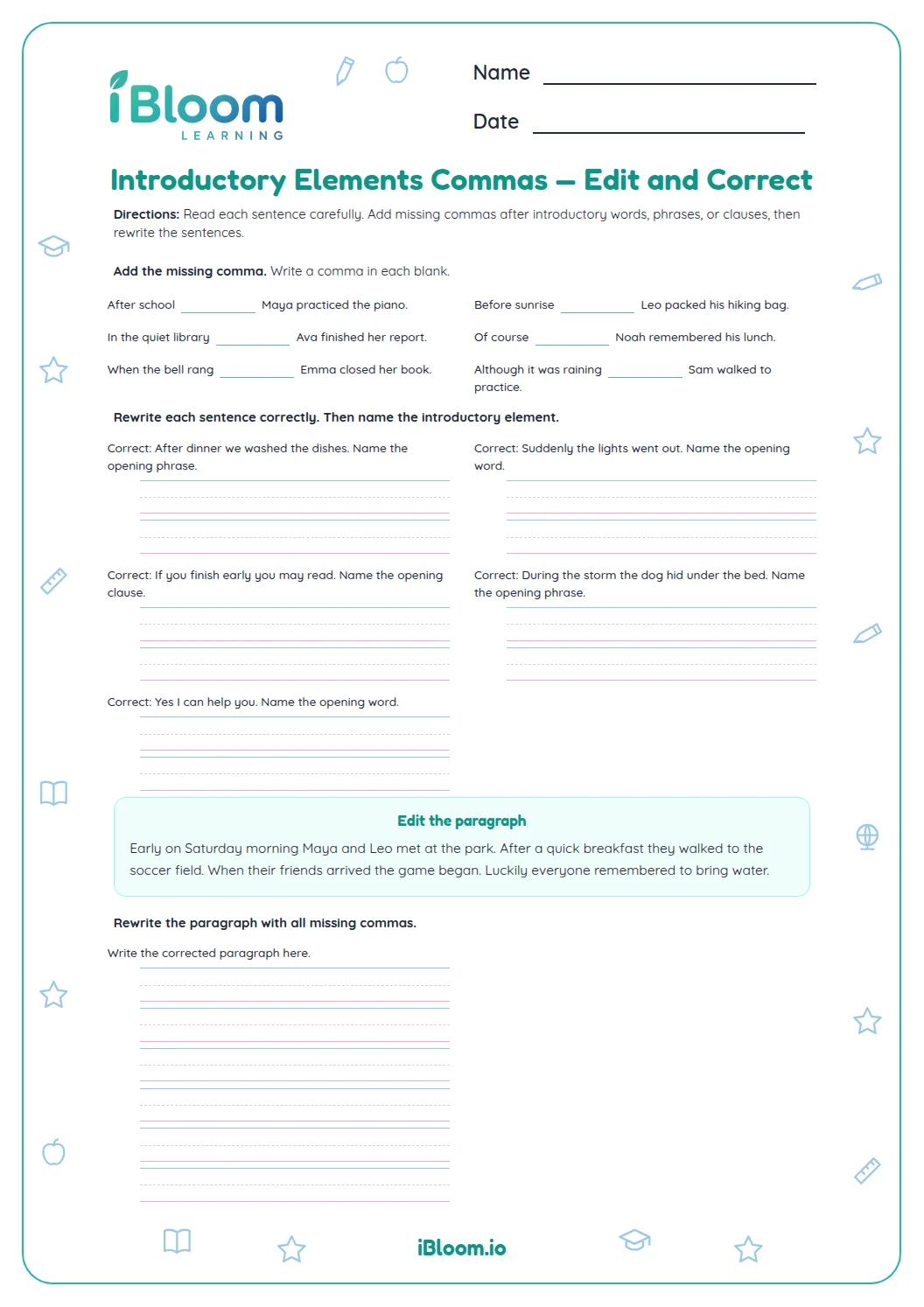
This free printable Grade 5 worksheet reviews end marks, commas, apostrophes, and quotation marks. Thirteen short prompts ask students to supply punctuation in sentence contexts, including lists, direct address, and quoted speech. A final school-morning paragraph brings the conventions together. A separate answer key gives the marks and sample writing for Common Core L.5.2 practice.
Aligned to L.5.2
How do children choose an end mark?
The sentence’s purpose guides the choice. A calm statement ends with a period; a direct question needs a question mark; the excited cheer in question 3 calls for an exclamation point. The prompt specifies the tone where more than one end mark could otherwise work.
The first part also checks list commas, plural possession, and the opening quotation mark for speech.
Where does the possessive apostrophe go?
Part B applies punctuation in context: an introductory comma, direct address, question punctuation inside quotation marks, a list, a singular possessive, and a spoken statement.
For question 9, the spoken words ask a question, so the question mark goes inside the closing quotation mark.
- 1The collars belong to two dogs.
- 2Plural noun: dogs
- 3Possessive form: dogs’
- 4The dogs’ collars are muddy.
How do the last two tasks make a paragraph?
Question 13 asks for a sentence that uses a comma with direct address. Question 14 asks for a four-sentence school-morning paragraph with an introductory comma, quoted question, and excited ending.
- 1Prompt: Write a sentence that addresses someone by name.
- 2Sample: Ava, please bring my book.
- 3The comma separates the name Ava from the request.
How to use this worksheet
- 1Read each sentence aloud to hear whether it states, asks, or exclaims.
- 2Choose end marks and punctuation for the list, owners, and spoken words.
- 3Use commas with an opening phrase and with a person being addressed.
- 4Write a direct-address sentence and the school-morning paragraph.
- 5Check each mark against the key and reread the sentences for meaning.
Mistakes to discuss
The mistake
Choosing dog’s when the collars belong to two dogs.
The fix
Make the plural dogs first, then add the apostrophe: dogs’.
The mistake
Leaving a spoken question without its closing quotation mark.
The fix
Enclose the spoken words and put the question mark before the closing quotation mark.
The mistake
Writing four unrelated sentences for the paragraph.
The fix
Keep the school-morning setting and let the final two sentences continue the first two.
Common Core alignment
Apply capitals and punctuation in original sentences and a short paragraph.
On this sheet: Children apply end marks, commas, possessive apostrophes, and quotation marks while writing and checking sentences.
Show the official wordingHide the official wording
Demonstrate command of the conventions of standard English capitalization, punctuation, and spelling when writing.
What to practice next
Make more practice
Further reading
Questions parents and teachers ask
Which punctuation marks does this worksheet practice?
The worksheet practices periods, question marks, exclamation points, commas, possessive apostrophes, and quotation marks. Thirteen short prompts ask students to supply punctuation in context, and one paragraph brings the conventions together. The separate answer key includes the marks and sample writing.
Why does the apostrophe come after dogs in question 5?
A period ends the calm statement, a question mark ends a direct question, and an exclamation point ends the excited cheer. The worksheet gives the tone in each prompt so children can choose the mark that fits. Read the completed sentence aloud to check the choice.
Do questions 11 and 12 make one paragraph?
The phrase “two dogs” shows that more than one dog owns the collars, so the apostrophe follows the s in dogs’. For the bag owned by one friend, friend’s uses an apostrophe before s. The worksheet contrasts plural and singular ownership in separate questions.
Can my child write different sentences from the key?
Question 14 asks for four connected school-morning sentences. Include an opening phrase followed by a comma, two statements, a spoken question in quotation marks, and an excited ending. The answer key gives one model; accept other clear paragraphs that follow the same punctuation directions.
How should we check the quotation marks?
The key marks all twelve choice questions and offers sample wording for both writing tasks. Check that the direct-address comma separates the name from the rest of the sentence. In the paragraph, verify the opening comma, quotation marks, and end marks while accepting different story details.