



About this worksheet
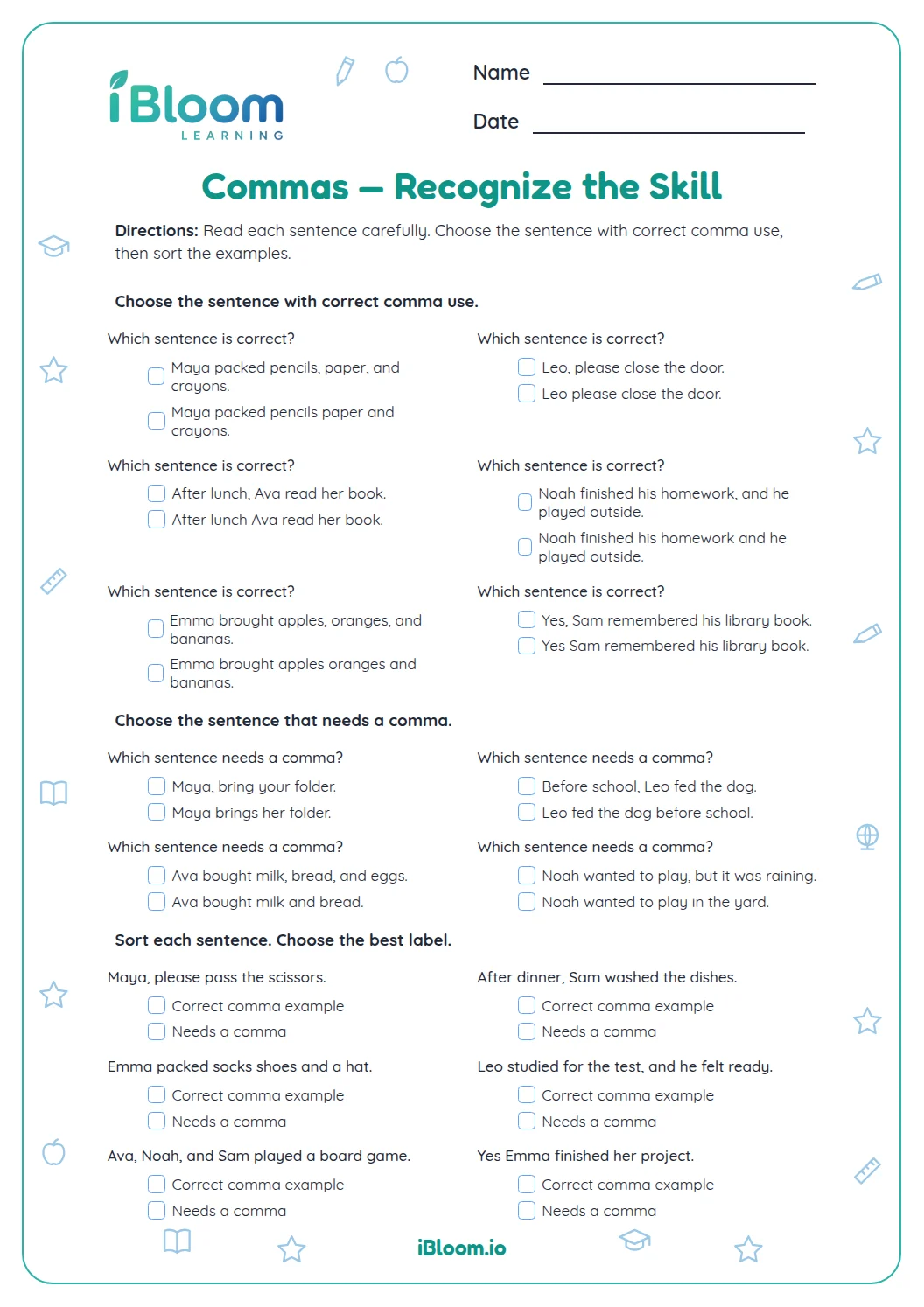
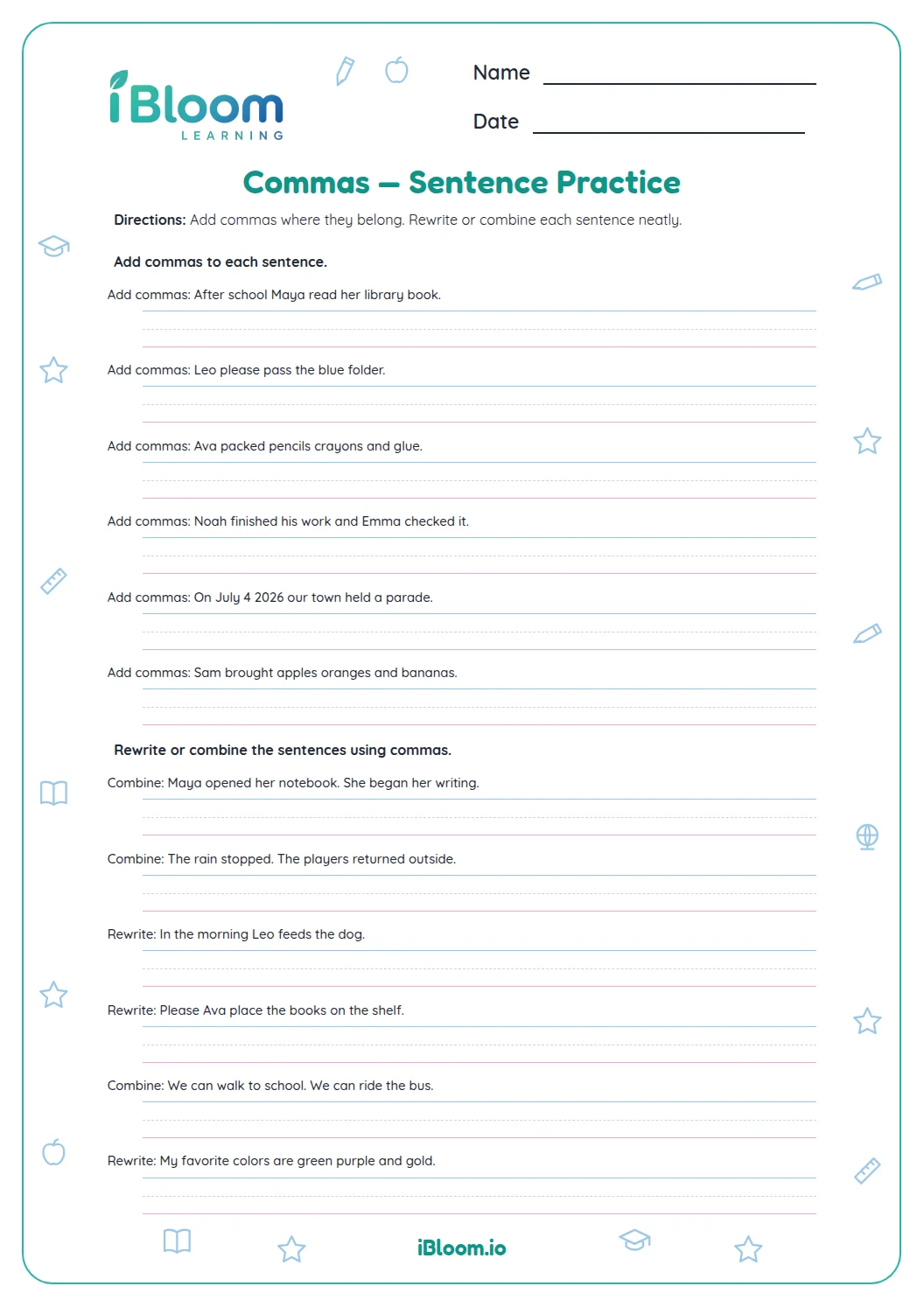
This free Grade 5 worksheet focuses on the boundary between an introductory phrase and the main sentence. Its 12 questions begin with recognizing a phrase at the start, check two comma placements, move to identifying where four missing commas belong, and finish with two short writing tasks. The sentences use time phrases and action phrases that set up the main idea. Students practice CCSS L.5.2.b by separating introductory elements with commas. The answer key provides exact recognition answers and sample sentences for the two open responses.
Aligned to L.5.2.b
How can students find the full opening phrase?
Read to the start of the main sentence, where the subject and its action begin. The introductory phrase sets up that sentence by telling when, why, or under what circumstances the action happens.
In question 1, “Nora packed early” is the main sentence. “To save time” explains why she packed early. The comma marks the boundary between those two parts.
Part A ends with two checks of comma placement. Choose No when the comma splits At the end of the day, and Yes when it follows all of To finish her model.
- 1To save time, Nora packed early.
- 2Opening phrase: To save time
- 3Main sentence: Nora packed early.
- 4Comma boundary: after time
Why ask for the word before the comma?
Part B requires a precise boundary. Students write only the word immediately before the missing comma, so they must read the entire opening phrase. In question 7, the answer is trail: “At the end of the trail, we stopped for water.”
Some openings contain more than one small word group. Stopping after “end” would split the phrase “At the end of the trail.” Read the full introduction before choosing a boundary.
How do the last two tasks use the same skill?
Part C asks students to write two introductory phrases of their own: one tells when a gate was opened, and one begins with To and explains why a towel was grabbed. They rewrite each complete sentence with a comma.
Accept different phrases when they make sense with the main sentence. Keep the original main idea and place the comma after the entire opening. The key labels both responses as samples.
How to use this worksheet
- 1Read question 1 and identify who does the main action.
- 2Separate the opening from “Nora packed early.”
- 3Choose four complete phrases and check two comma placements in Part A.
- 4In Part B, read each sentence with the comma after the proposed word.
- 5Write both Part C sentences and compare their structure with the samples.
Mistakes to check together
The mistake
Choosing only “Before” as the introduction.
The fix
Include all of “Before the final bell”; the phrase gives a complete time setting.
The mistake
Placing a comma after the main subject.
The fix
In question 7, the boundary comes before “we,” not after it.
The mistake
Writing “To dry my hands I grabbed a towel.”
The fix
Insert a comma after hands, where the opening ends and the main sentence begins.
Common Core alignment
Identify introductory phrases and separate them from the main sentence with a comma.
On this sheet: Students identify opening phrases, locate four commas, check two comma placements, and write two openings.
Show the official wordingHide the official wording
Use a comma to separate an introductory element from the rest of the sentence.
What to practice next
Make more practice
Further reading
Questions parents and teachers ask
What counts as an introductory phrase here?
It is a group of words at the beginning that sets up the main sentence. The worksheet includes time settings such as “Before the final bell” and purpose phrases such as “To save time.” Students identify the full group, then locate its boundary with the main sentence.
What should students write for Part B?
Students write the one word that needs a comma immediately after it. For question 7, that word is trail. They can then read the sentence aloud as “At the end of the trail, we stopped for water.” This checks the boundary without requiring four complete sentence rewrites.
Why not put the comma after the first few words?
The comma belongs after the whole introductory phrase, wherever that phrase ends. In “At the end of the trail,” stopping after end would leave “of the trail” disconnected from its opening. Ask students to find the subject and action of the main sentence before choosing the boundary.
Are the two writing answers fixed?
No, the last two answers can vary, and the key gives samples. The first opening should tell when the gate was opened. The second should begin with To and tell why the speaker grabbed a towel. Both complete sentences need a comma after the full introductory phrase.
How can students check their own opening phrases?
They can first read the words after the comma as a complete sentence. Then they can check that the opening makes sense with that sentence and follows the prompt’s direction. For “To dry my hands, I grabbed a towel,” the purpose fits the action and the comma marks the boundary.