




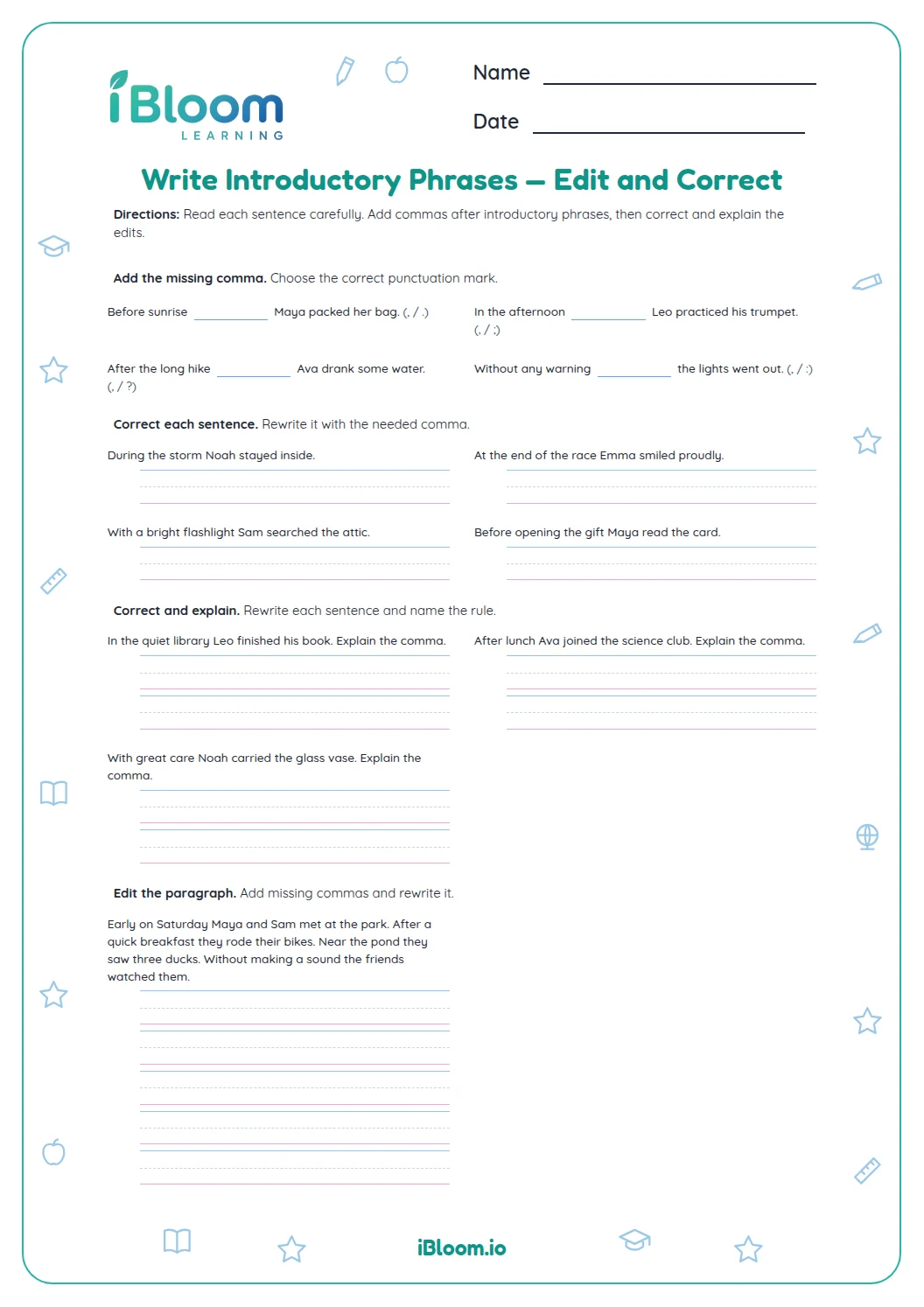
About this worksheet
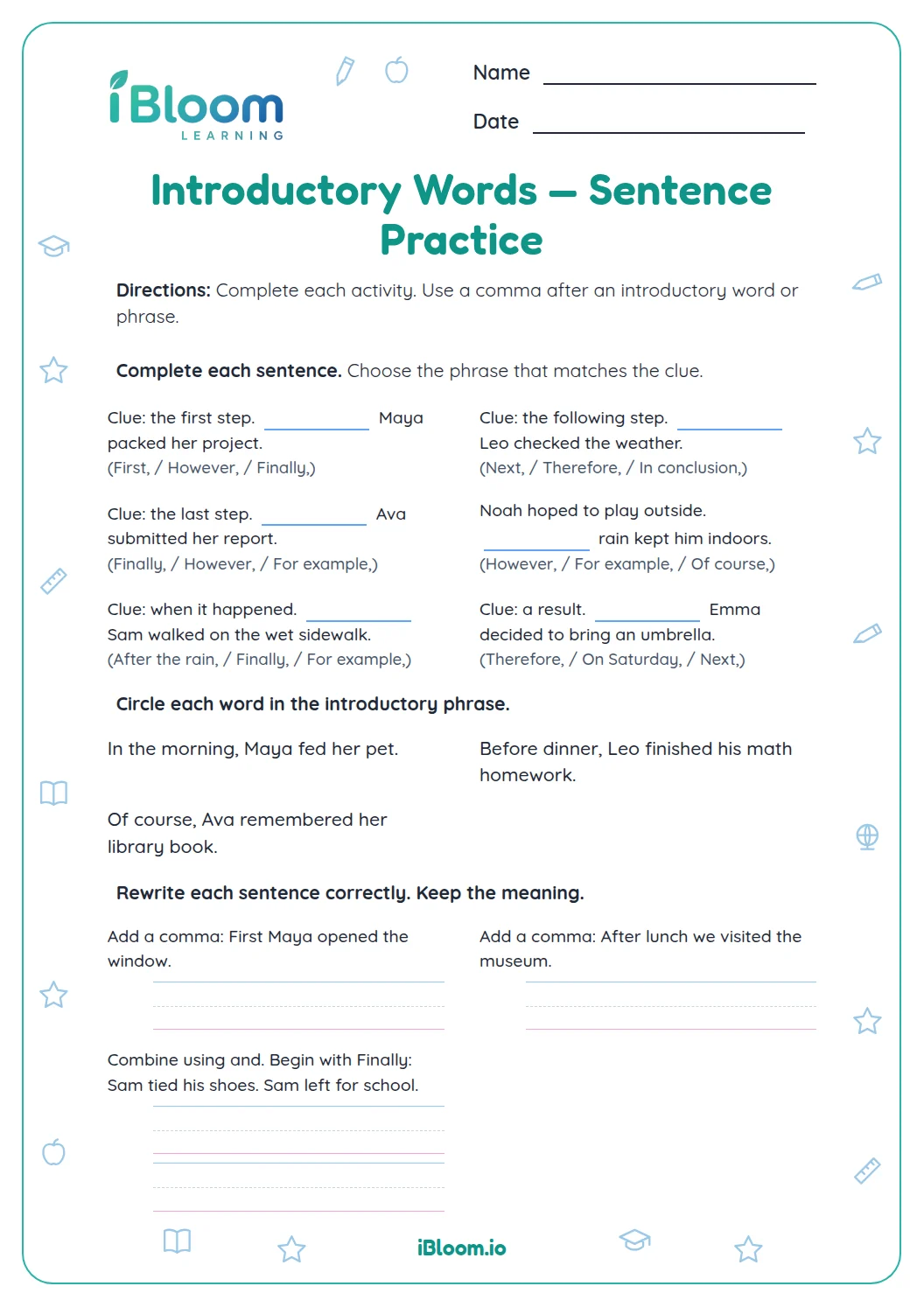
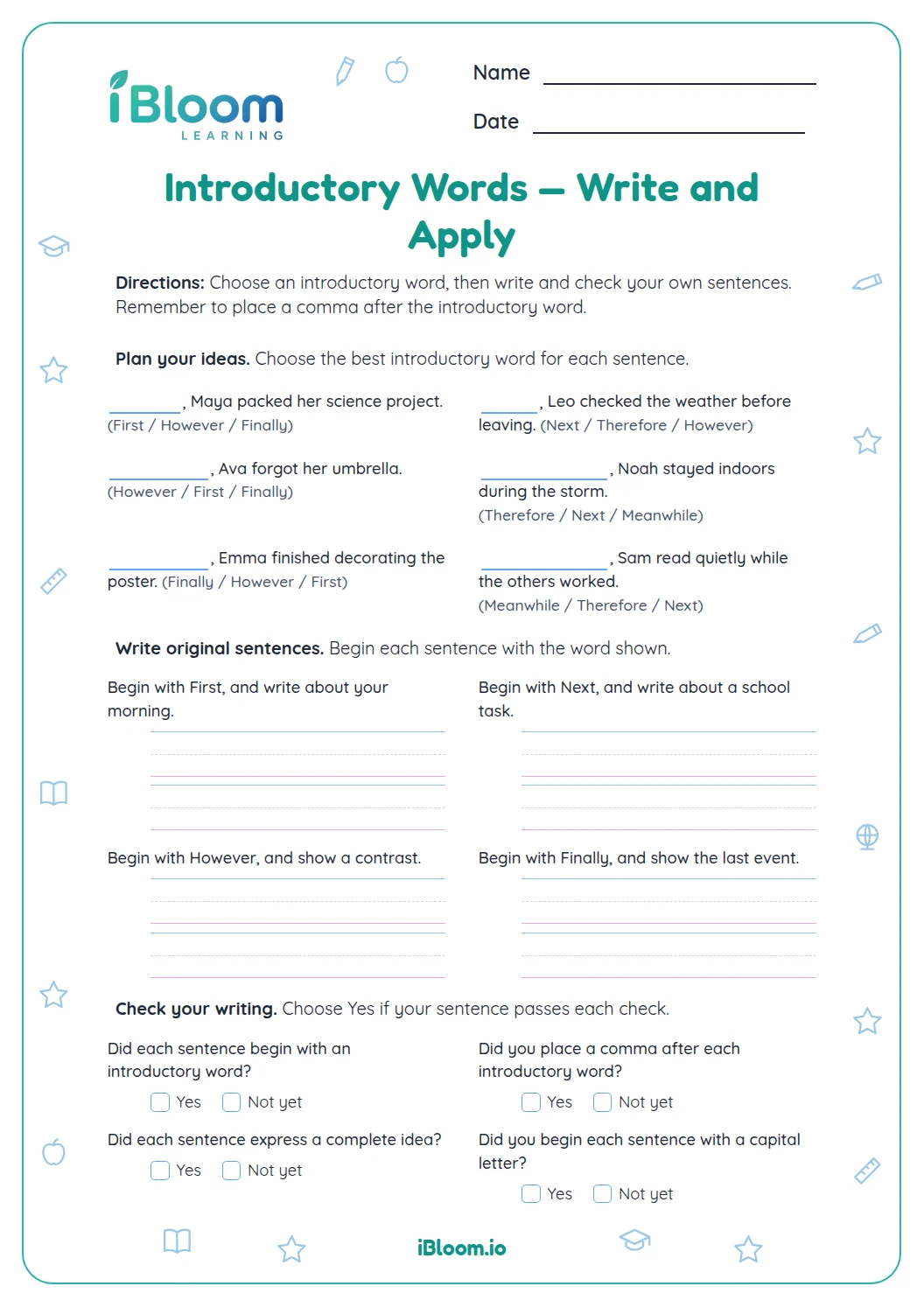
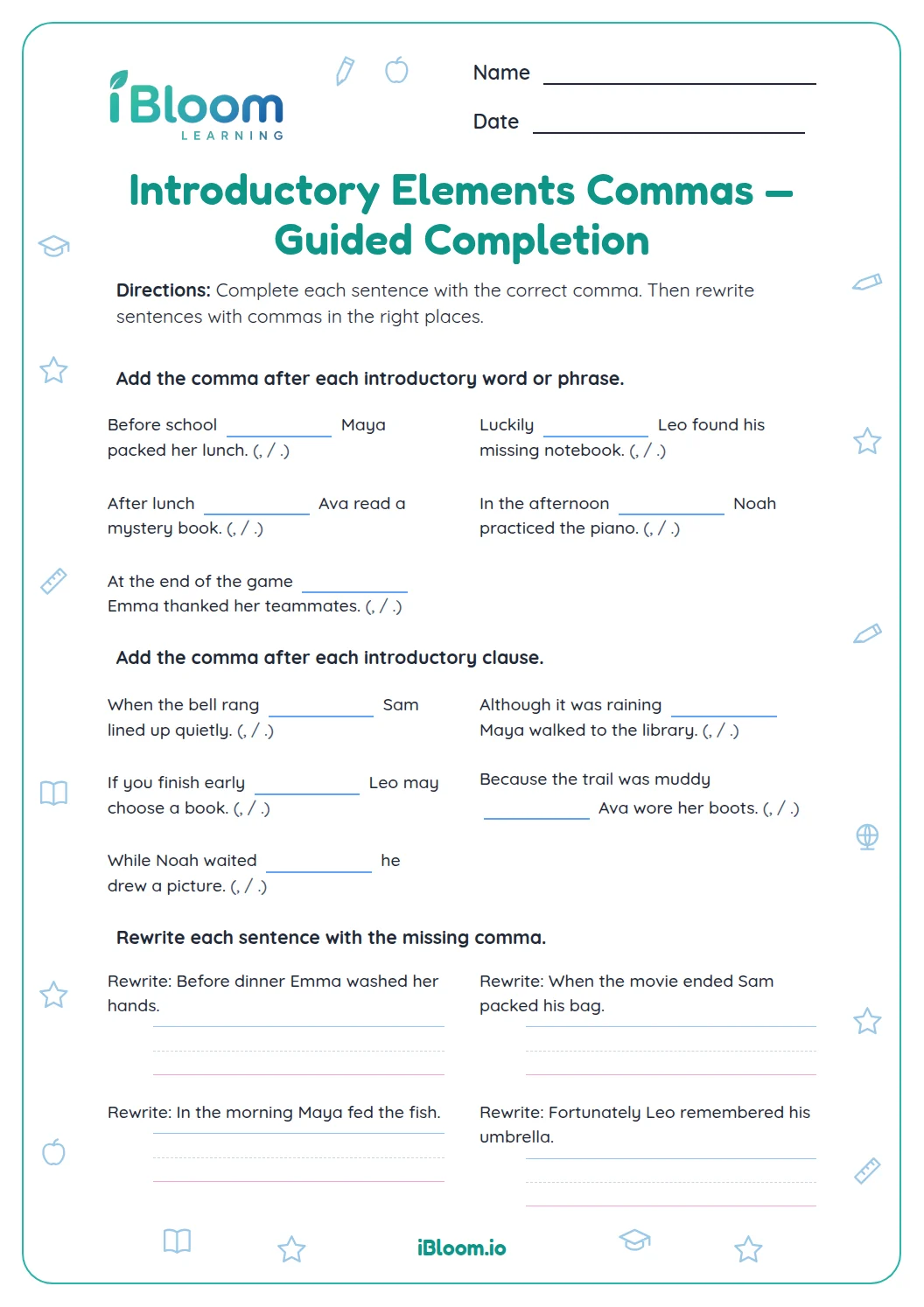
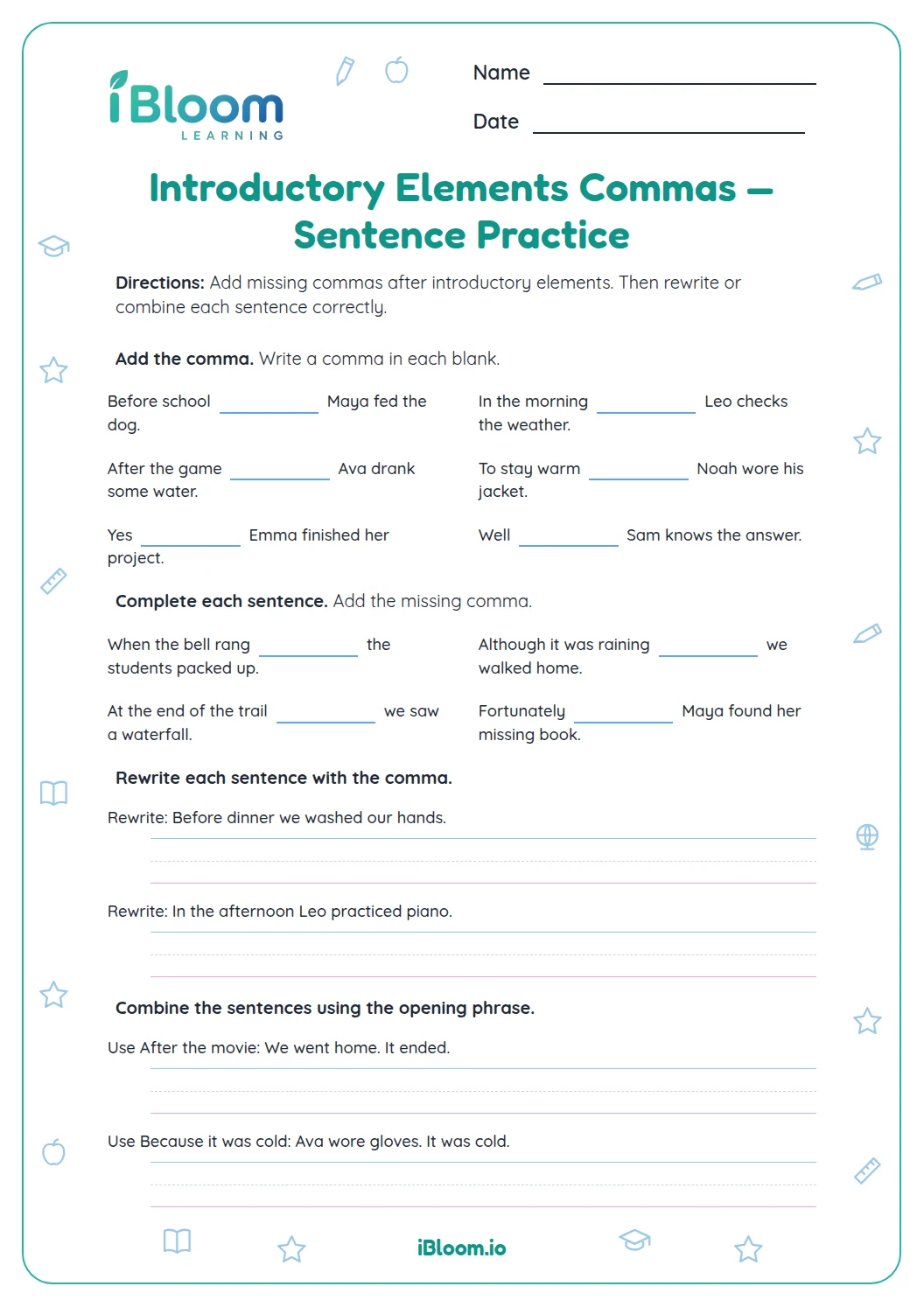
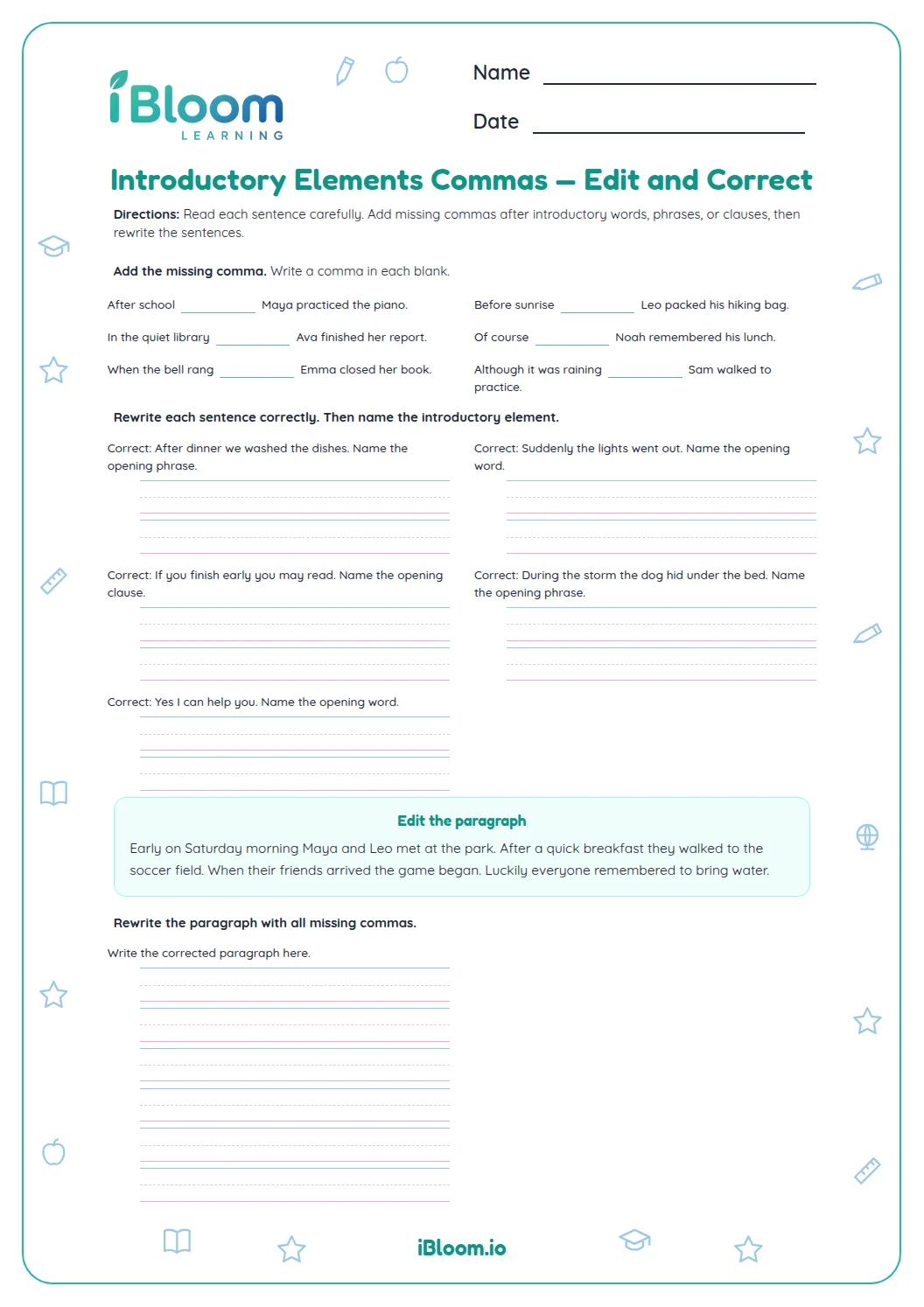
This Grade 5 printable gives students 16 concise items to punctuate. Openings include time phrases, transitions, and response words. Each blank takes a comma and the next word or words, so students identify where the opening ends. A separate answer key shows the completed sentences.
Aligned to L.5.2b
What does this punctuation worksheet ask students to do?
Parts A–C ask students to insert commas after introductory words and phrases such as Before lunch, Fortunately, and At first. The sentences are short so students can focus on the boundary between the opening and the main clause.
Part D continues the same editing practice with additional opening words and phrases. The answer key shows the comma location for every item.
- Insert commas after introductory words
- Edit phrases that set time or sequence
- Punctuate response words such as Yes and No
- Check the whole opening before adding punctuation
How do you punctuate an introductory phrase?
Read the opening phrase, then find where the main sentence begins. In “After the final song the choir bowed,” the opening phrase ends at “song,” so place the comma there.
- 1After the final song, the choir bowed.
- 2Introductory phrase: After the final song
- 3Main sentence: the choir bowed
How can students check their comma edits?
Read the sentence aloud and notice whether it starts with a word or phrase that sets up the rest. Confirm that the comma follows the whole opening element, not a word inside it.
How to use the worksheet
- 1Read each entire sentence before editing it.
- 2Underline the introductory word or phrase.
- 3Place a comma after that complete opening element.
- 4Read the sentence again to check that the main idea still flows.
- 5For the written response, include both an introductory phrase and a complete main clause.
Common mistakes and quick fixes
The mistake
Leaving out the comma after “Yes” or “No” at the start of a sentence.
The fix
Treat these introductory response words as a short opening and add a comma after them.
The mistake
Putting the comma in the middle of an introductory phrase, as in “In, the morning.”
The fix
Keep the phrase together and place the comma at its end: “In the morning, …”
The mistake
Adding a comma after the subject instead of after the opening phrase.
The fix
Mark the full introductory element first, then place the comma before the main clause begins.
Common Core alignment
Use a comma to separate an introductory element from the rest of the sentence.
On this sheet:
Show the official wordingHide the official wording
Use a comma to separate an introductory element from the rest of the sentence.
What to practice next
Make more practice
Further reading
Questions parents and teachers ask
Where does the comma go after an introductory phrase?
Place it at the end of the entire introductory phrase, just before the main part of the sentence. In “After the final song, the choir bowed,” the opening phrase is “After the final song,” so the comma follows “song.” This keeps the opening together.
Do introductory words like “Yes” need a comma?
In these sentence patterns, yes: write “Yes, I can bring the map.” The comma separates the response word from the rest of the sentence. The worksheet also practices openings such as “Fortunately” and “Meanwhile,” which introduce the sentence. Students can refer to the worked examples and answer key to check each step.
What is an introductory element?
An introductory element is a word or phrase at the beginning of a sentence that sets up the main statement. Examples on the page include time phrases such as “Before lunch” and transitions such as “At first.” The comma marks where that opening ends.
How should students approach the editing questions?
Read to the end first, then identify the opening element and mark its last word. Place the comma after that word, not after the subject or in the middle of a phrase. Read the edited sentence once more to check it.
Can more than one sentence be a correct answer?
The correction items have a specific punctuation target, but students may write different valid sentences for the final prompt. The answer key gives a sample sentence; accept another complete sentence that begins with an introductory phrase and places the comma correctly.
Is an answer key included?
Yes. The key fills each blank with the comma and the opening word or words of the main clause. Students can check that the comma follows the complete introductory element. They can then read the sentence aloud to confirm the opening stays together and the rest of the sentence makes sense.