









About this worksheet
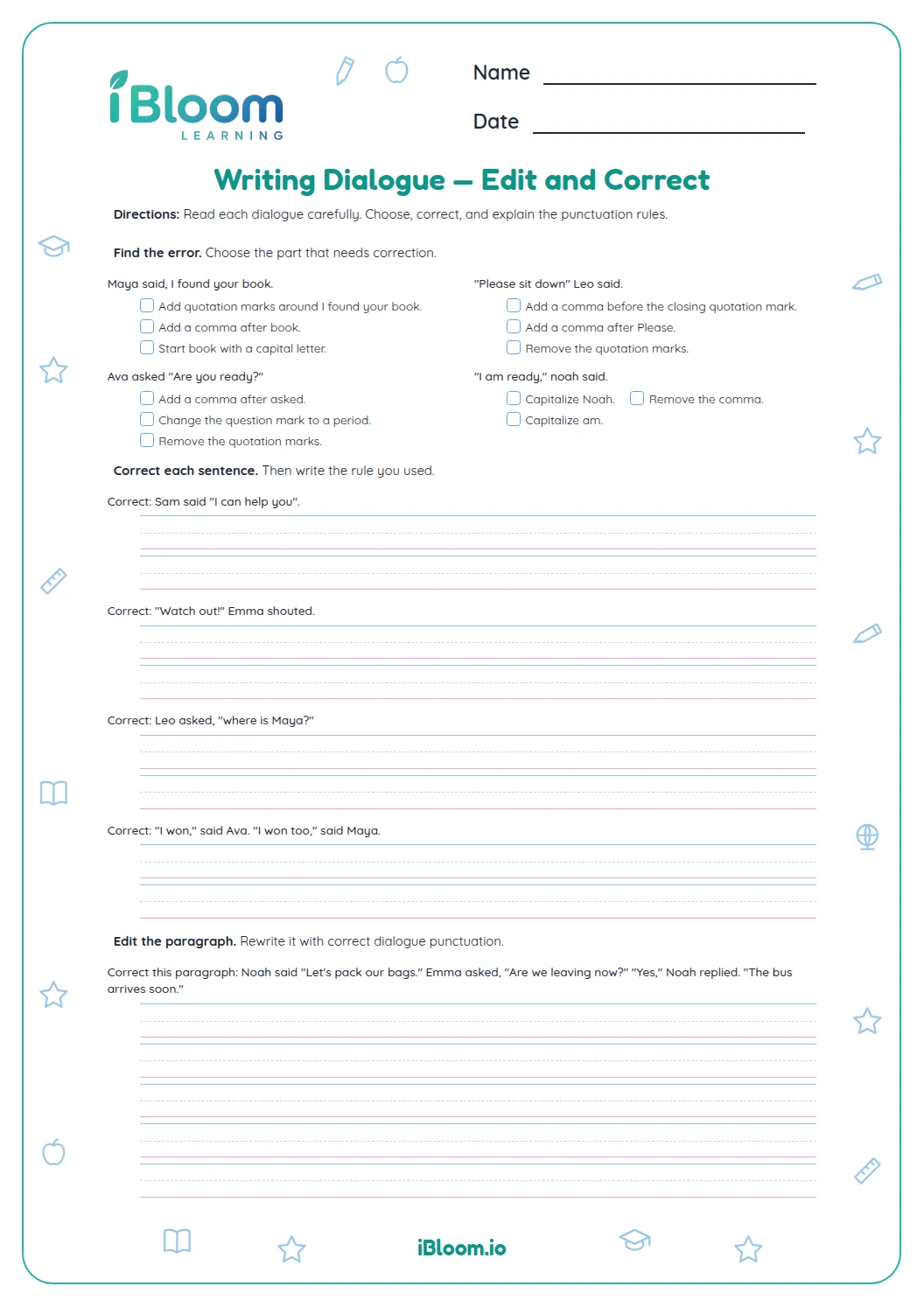
This Grade 5 writing worksheet offers 14 questions in three parts. Students recognize quotation marks and punctuation around dialogue tags, fill in missing marks, revise a line of dialogue, and write a short two-speaker exchange. The writing prompt asks them to begin a new line when the speaker changes. The answer key shows the selected answers and sample responses for writing. These conventions and composition tasks connect to CCSS L.5.2 and W.5.3.b.
Aligned to L.5.2 and W.5.3.b
Which dialogue marks should students notice?
Part A asks students to recognize quotation marks, commas, end punctuation, capitalization, dialogue tags, and the paragraph break when the speaker changes.
- 1“Are you ready?” asked Nia. The question mark belongs to the spoken question, inside the quotation marks; the tag follows.
How do students complete the punctuation blanks?
Part B removes one mark from a short line. Read the spoken words and the tag together to decide which punctuation is missing.
- 1“Please wait___” called Ana. The comma separates the spoken words from the tag.
What does the writing part ask students to create?
Part C includes a revision line and a short exchange between two speakers. The second prompt specifically asks for a new line when the speaker changes.
- 1A sample revision is “We can build a bridge,” said Iman. The dialogue begins with a capital letter and the comma sits inside the closing quotation mark.
How can I support this practice?
- 1Find the words spoken aloud and place quotation marks around them.
- 2Check whether the spoken words are a question, statement, or exclamation.
- 3Look for a dialogue tag such as said Eli or asked Nia.
- 4Use a new paragraph when the speaker changes in the original exchange.
- 5Compare the punctuation and paragraphing with the sample key.
What should students check?
The mistake
Putting the question mark after the dialogue tag.
The fix
Keep punctuation that belongs to the spoken question inside the closing quotation mark.
The mistake
Capitalizing a dialogue tag that continues the same sentence.
The fix
After a comma inside the quote, continue the tag in lowercase.
The mistake
Keeping both speakers in one paragraph.
The fix
Begin a new paragraph when the next speaker talks.
Curriculum alignment
This worksheet practices the Common Core skill named below.
Demonstrate command of punctuation when writing.
On this sheet: Fourteen items build dialogue punctuation from recognition to completion, revision, and original writing.
Show the official wordingHide the official wording
Demonstrate command of the conventions of standard English capitalization, punctuation, and spelling when writing.
Use dialogue to develop experiences and events.
On this sheet: Fourteen items build dialogue punctuation from recognition to completion, revision, and original writing.
Show the official wordingHide the official wording
Use narrative techniques, such as dialogue, description, and pacing, to develop experiences and events or show the responses of characters to situations.
What to practice next
Make more practice
Further reading
Questions parents and teachers ask
Are there open-ended writing questions?
Yes. Part C includes a revision and an original two-speaker exchange. The key gives samples for both, but students can use different words as long as the dialogue is punctuated clearly and the second speaker begins a new line where requested.
Do students practice speaker paragraphs?
Yes. The final prompt asks students to write a two-speaker exchange and start a new line for the second speaker. This makes the speaker change visible. When checking the response, look at paragraph breaks as well as quotation marks, punctuation and dialogue tags.
Where does punctuation go with quotation marks?
In the dialogue examples on this page, punctuation that belongs to the spoken words sits inside the closing quotation mark. A comma can separate a statement from a following dialogue tag, while a question mark or exclamation mark closes the spoken sentence before the tag.
When does a new speaker need a new paragraph?
Start a new paragraph when the speaker changes. This helps the reader follow who is talking in an exchange. The original writing prompt asks for a two-speaker conversation and specifically reminds students to place the second speaker on a new line.
Can students write different dialogue from the answer key?
Yes. The key provides model responses rather than the only possible dialogue. A response can use different characters and words if it revises the sentence as requested or creates a clear exchange with correctly marked speech and a new paragraph for the second speaker.