



About this worksheet
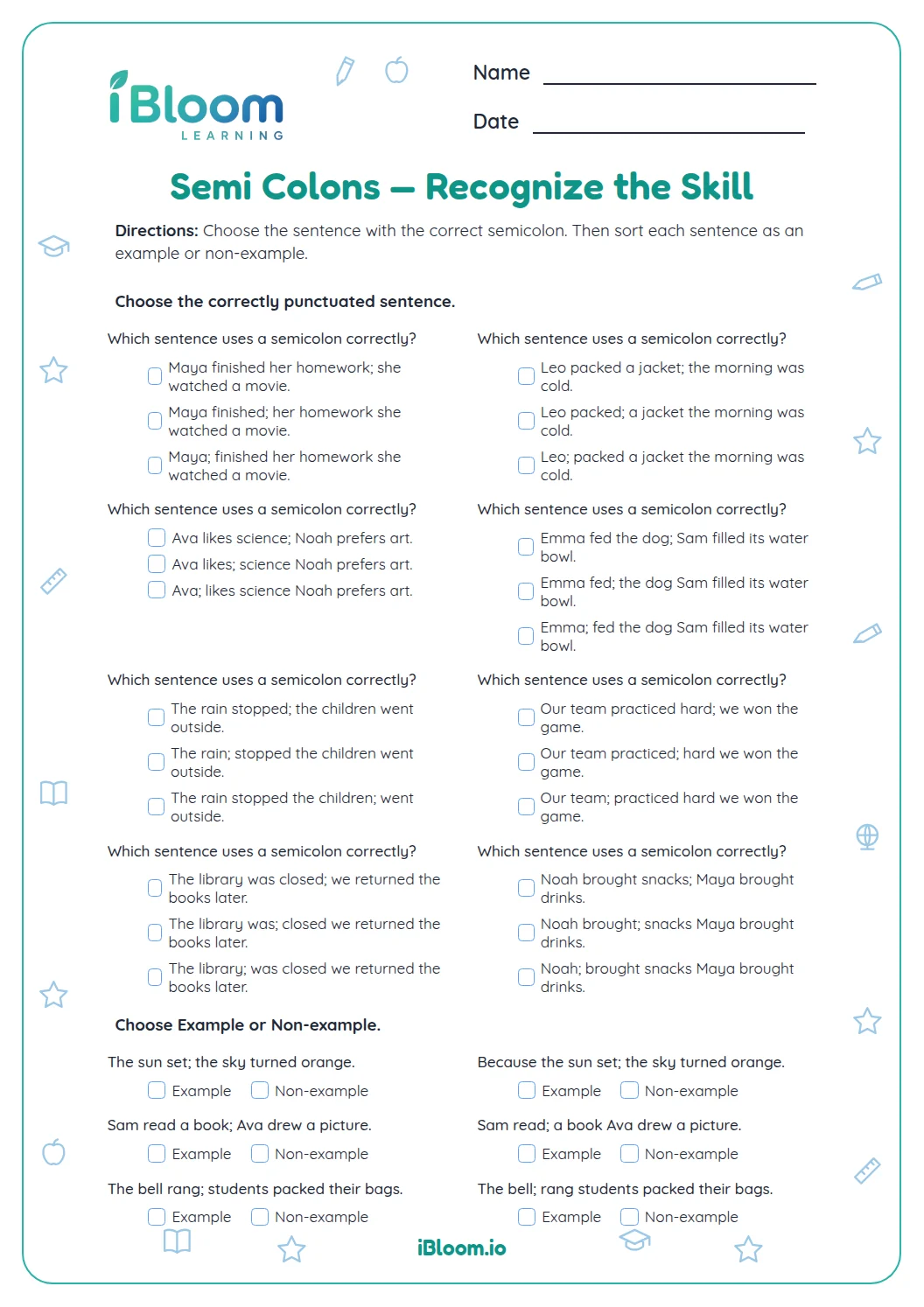
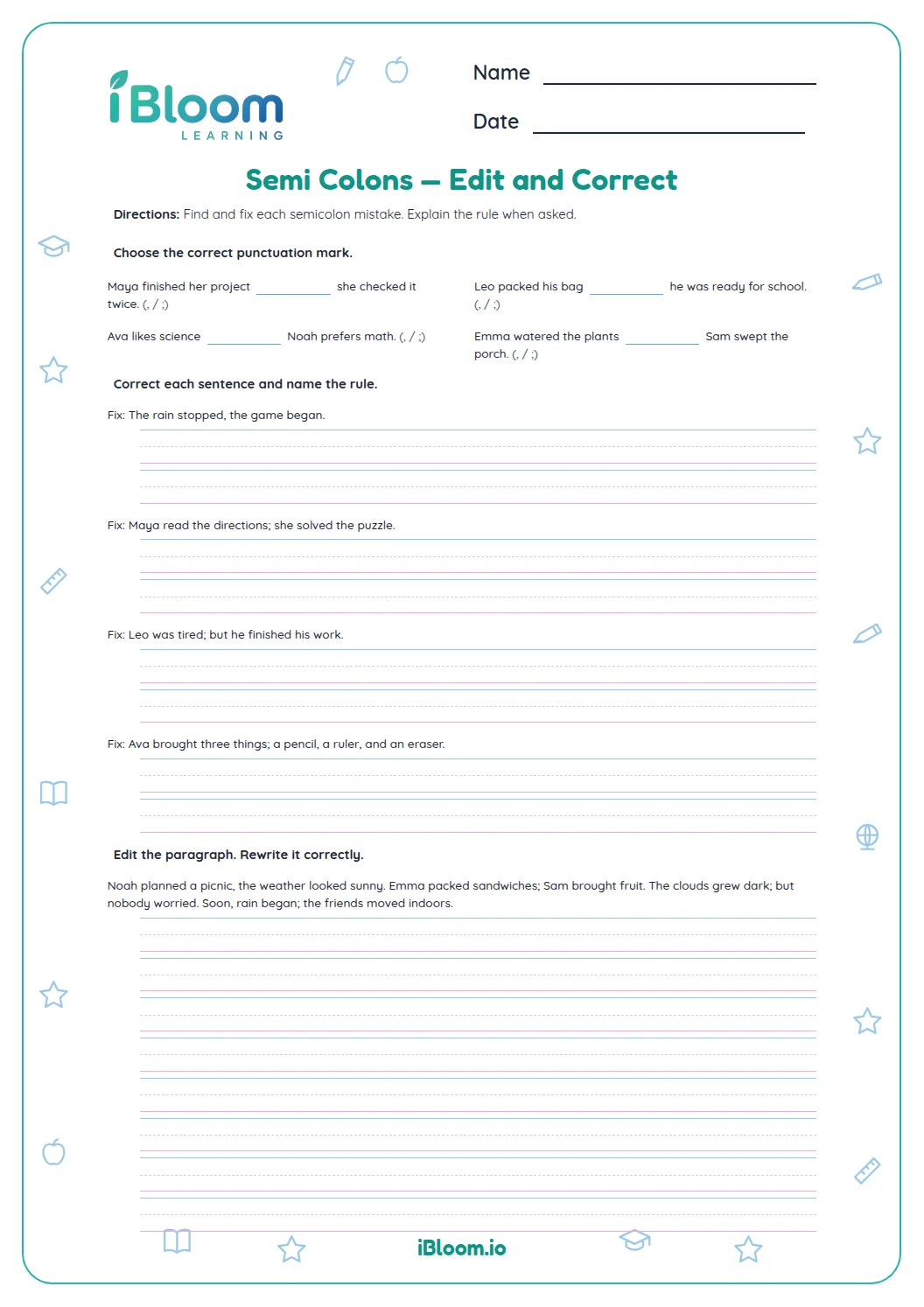
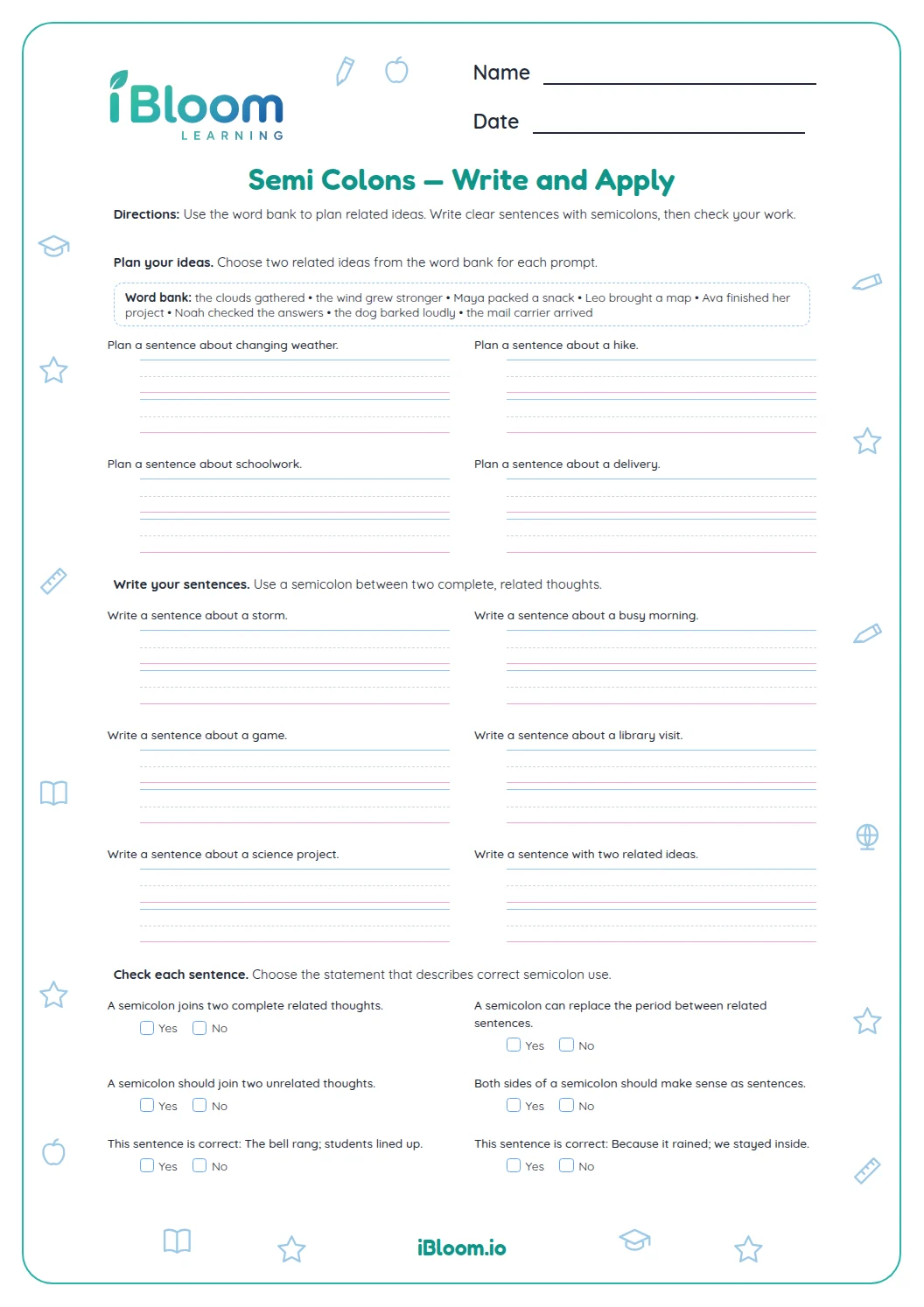
This Grade 5 punctuation worksheet gives students 14 concise semicolon joins. Each prompt presents two related complete thoughts with a blank at their boundary; students supply the semicolon and the next clause’s opening words. The separate key shows each completed sentence.
Aligned to L.5.2
How can you spot a correct semicolon?
Read the words on each side as separate sentences. If both sides make sense alone and express related ideas, a semicolon can join them. A semicolon does not repair an incomplete clause.
- 1“The tent was small ___ it held three bags.” → The tent was small; it held three bags.
How do you add a semicolon?
Find the boundary between two independent clauses, then put the semicolon there. Do not add a coordinating conjunction such as “but” immediately after it in this practice.
- 1The trail was muddy ___ we walked slowly. → The trail was muddy; we walked slowly.
How can you check both sides of a semicolon?
Read each side as a sentence. If both are complete thoughts and the ideas are related, a semicolon can connect them.
How to use this worksheet
- 1Read both thoughts and check that each can stand alone.
- 2Find where the second complete thought begins.
- 3Write a semicolon and the opening words of that thought.
- 4Read the joined sentence to check that the ideas are related.
- 5Compare the completed sentence with the answer key.
What should students check?
The mistake
Mistake: using a semicolon before a dependent clause.
The fix
Make sure both sides can stand alone.
The mistake
Mistake: keeping a comma between two complete sentences.
The fix
Use a semicolon or period.
The mistake
Mistake: adding “but” directly after the semicolon.
The fix
Use the semicolon alone, or use a comma before “but.”
Common Core alignment
The questions give students direct practice with the listed skill.
Use standard English punctuation accurately in writing.
On this sheet: Students place semicolons between two related independent clauses and edit comma splices.
Show the official wordingHide the official wording
Demonstrate command of the conventions of standard English capitalization, punctuation, and spelling when writing.
What to practice next
Make more practice
Further reading
Questions parents and teachers ask
When should a writer use a semicolon?
Use a semicolon between two closely related independent clauses when no conjunction joins them. Each side must make sense as a complete sentence. “The trail was muddy; we walked slowly” works because both the trail condition and the response are complete thoughts.
Can a semicolon join an incomplete thought to a sentence?
No. A semicolon needs a complete clause on each side. “When the rain stopped” cannot stand alone, so a semicolon after it would leave the reader waiting for the rest of the thought. Finish the clause first, then decide how to connect it.
How does a semicolon fix a comma splice?
A comma splice happens when a comma alone joins two complete sentences. Replace that comma with a period, or use a semicolon when the ideas are closely connected. This worksheet practices inserting the semicolon between complete thoughts, so students can apply the same rule when editing.
Is the semicolon worksheet answer key included?
The key shows the semicolon and the opening words of the second clause for all 14 prompts. Read each finished sentence to confirm that both sides are complete thoughts. Students can also check that the two ideas are related and that the semicolon sits between, rather than inside, the clauses.
What should a student check after writing a semicolon sentence?
Read each side separately. If either side is only a dependent clause or phrase, revise it into a complete thought. Then read the two ideas together to see whether the semicolon makes their relationship clear and whether a comma or conjunction would be needed elsewhere.