




About this worksheet
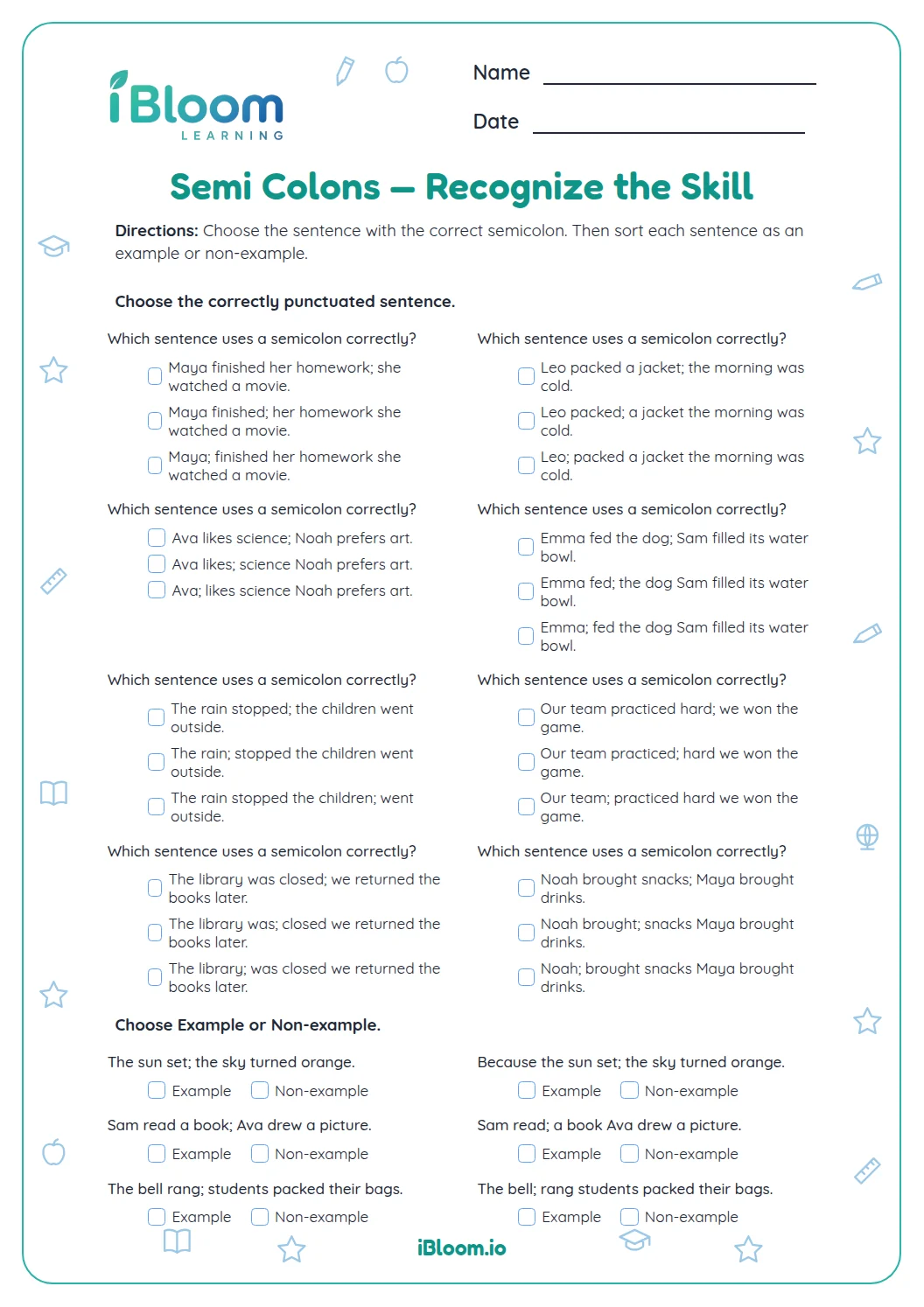
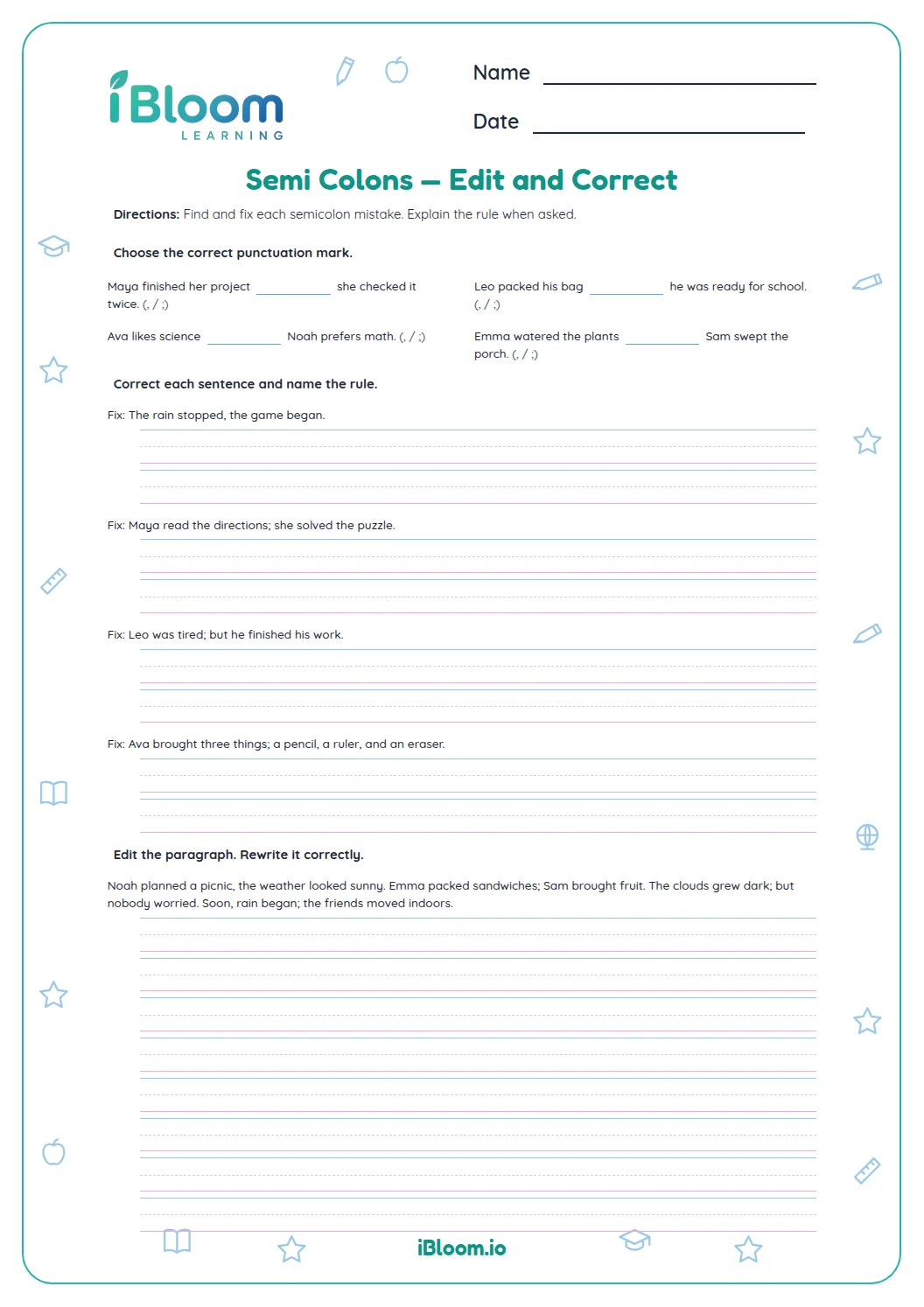
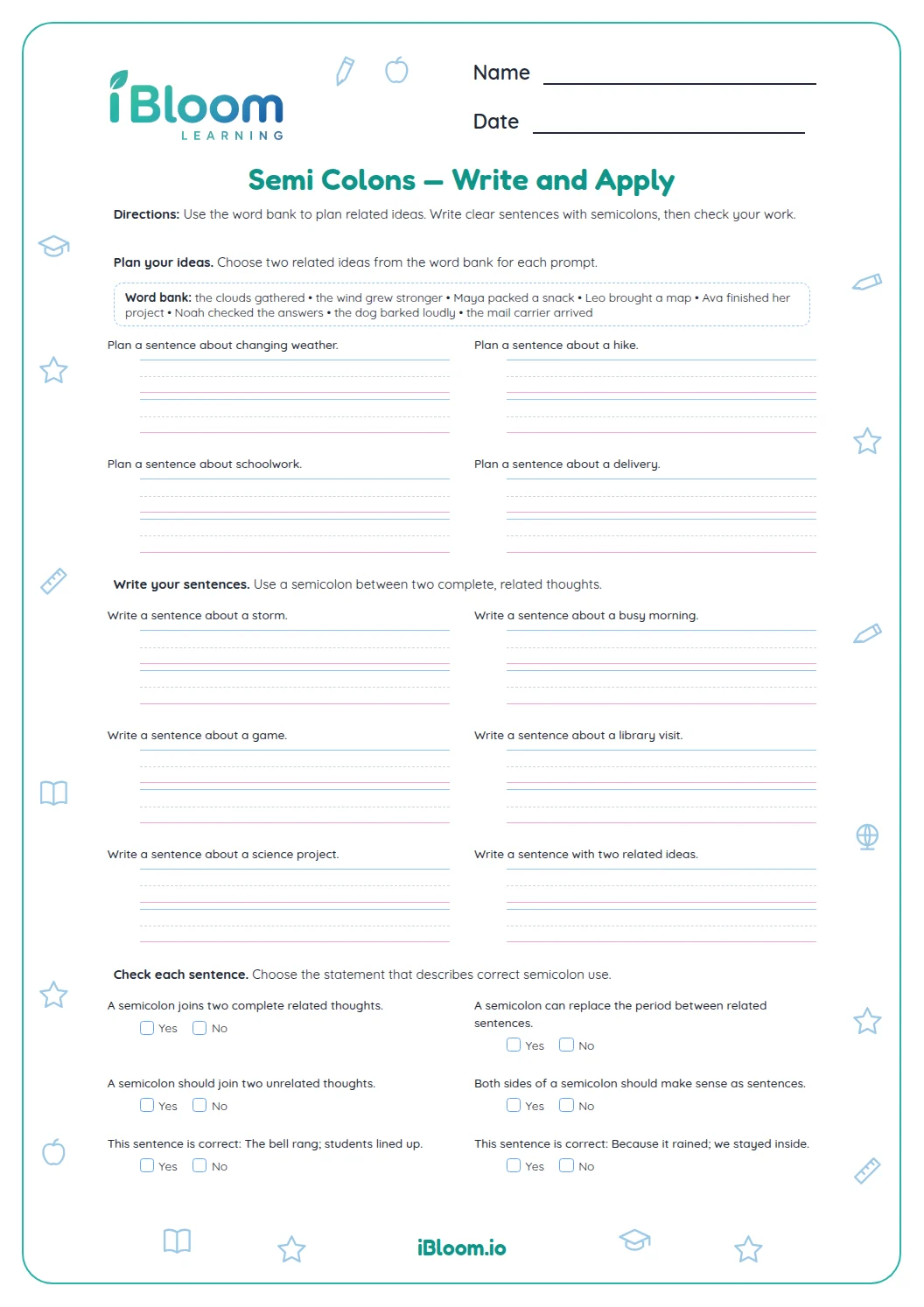
This Grade 5 printable teaches one clear semicolon pattern: use a semicolon between two related complete thoughts when no conjunction joins them. Students identify correct examples, complete sentences, revise comma splices, and write a sentence of their own. The page has 14 questions and a separate answer key.
What does a semicolon join?
A semicolon can join two closely related independent clauses without a coordinating conjunction. In question 1, “The rain stopped” and “the field dried” are each complete thoughts, so a semicolon joins them.
- 1The rain stopped; the field dried.
- 2The rain stopped = complete thought
- 3The field dried = complete thought
How do you fix a comma splice?
A comma splice joins two complete thoughts with only a comma. Replace the comma with a semicolon when the ideas are related. Question 7 becomes “We finished the mural; it looked bright.” A comma plus and is another valid way to join the thoughts, as question 8 shows.
How can students apply the rule?
Check both sides before inserting punctuation. If one side cannot stand alone, a semicolon does not fit. The final questions ask students to correct examples and write a related pair of complete thoughts.
How to use this worksheet
- 1Read the whole sentence before choosing punctuation.
- 2Check whether the words on each side form complete thoughts.
- 3Check whether the thoughts are closely related.
- 4Use a semicolon without adding a conjunction after it.
- 5Read the revised sentence aloud and check its meaning.
Common mistakes and quick fixes
The mistake
Putting a semicolon between a subject and its verb.
The fix
Read each side separately; each side must be a complete thought.
The mistake
Using a comma alone between two complete thoughts.
The fix
Replace the comma with a semicolon or rewrite with a conjunction.
The mistake
Adding and immediately after a semicolon.
The fix
Use the semicolon by itself, or use a comma with and.
What to practice next
Make more practice
Questions parents and teachers ask
What is a complete thought?
A complete thought has a subject and a verb and can stand as a sentence. In “The rain stopped; the field dried,” both clauses work alone. Students should test both sides before deciding whether a semicolon belongs between them. Ask the student to read each clause aloud separately.
Can a semicolon join any two sentences?
The two complete thoughts should be closely related. A semicolon is useful when the writer wants to connect the ideas clearly without a conjunction. If the ideas are unrelated, a period may be a better choice. The second clause must also work as a complete sentence.
How is a comma splice corrected here?
The sheet practices replacing a comma between two complete thoughts with a semicolon. It also accepts a comma plus a coordinating conjunction when that revision is appropriate, as in “My sister likes chess, and I like checkers.” Check that neither side begins with an extra conjunction.
Why does the worksheet include answer choices and writing?
The early questions let students recognize the semicolon pattern. Later items ask them to revise sentences and create one, so they apply the same rule instead of only selecting a punctuation mark. Ask the student to compare the meaning of both revisions.
How should I check the final written answer?
Look for two related complete thoughts with a semicolon between them and no conjunction immediately after it. The answer key gives one sample sentence; other sentences are correct if they follow the same rule. The sample is one possible answer, not a required sentence.