


About this worksheet
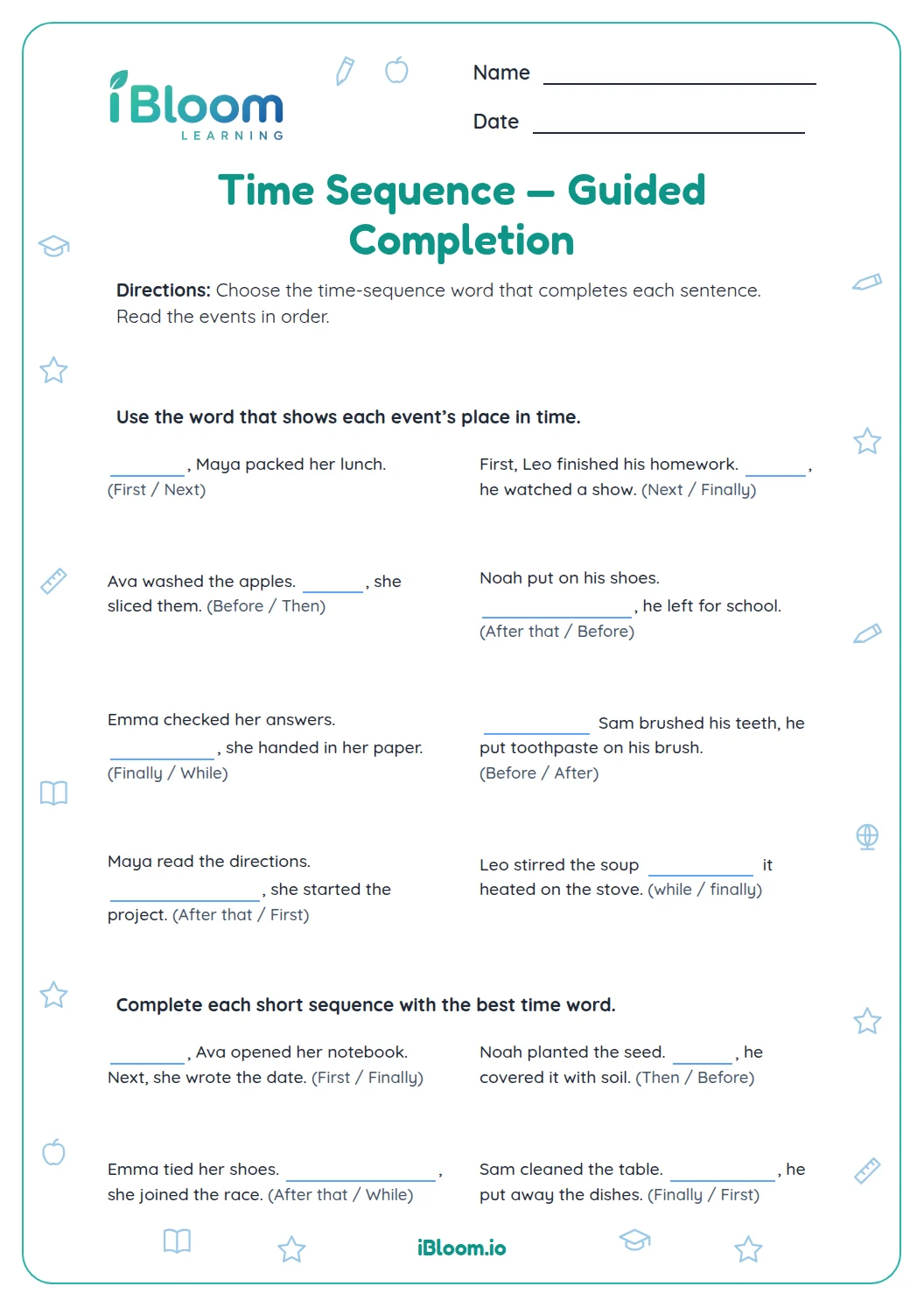
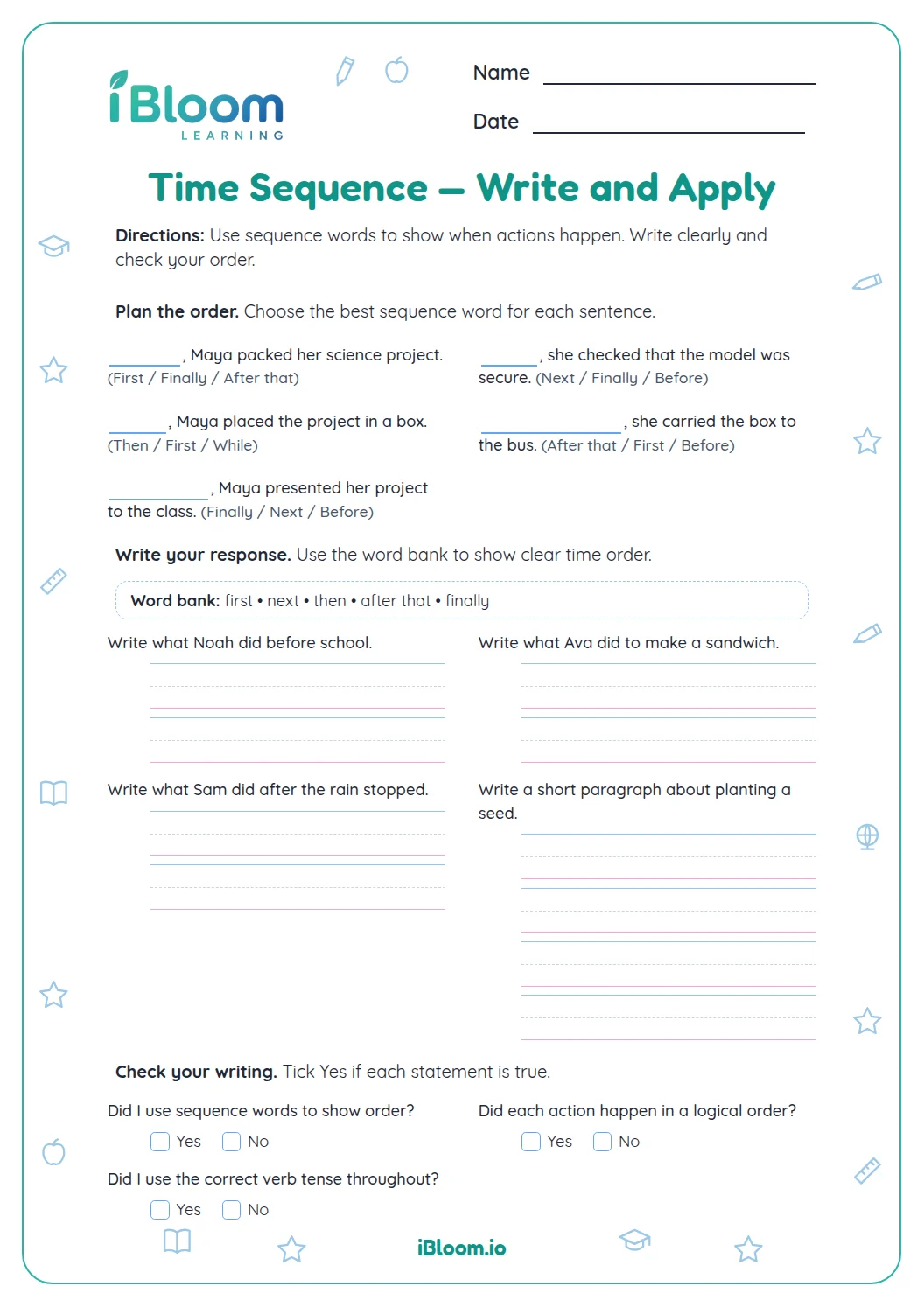
This Grade 5 printable practices time sequence with 14 short fill-in questions. Students complete transitions, identify earlier or simultaneous events, and connect actions with before, after, and while. The answer key lists the intended word or phrase. It practices CCSS W.5.3.c.
Aligned to W.5.3.c
What will students practice?
The 14 fill-ins practice time words and event relationships. Students complete short sentences about familiar routines, then identify events that happen first or together.
- Part A: add a transition that fits the sequence
- Part B: identify event order and overlap
How do time words clarify events?
Before and after place events in sequence; while connects actions that overlap. First, then, and finally help readers follow a series. Choose a word that matches the described order.
- 1Noah put on his coat before he went outside.
- 2Putting on the coat happens first.
How can students check the event order?
Name the two actions and decide which happened first or whether they happened together. Then reread the sentence with its time word. A sequence word should make the relationship clear without changing the order.
What does the answer key include?
The key lists one intended word or phrase for each blank. Some time relationships can be expressed in more than one way; use the surrounding sentence to confirm the intended order.
Read each time relationship
- 1Name the actions in the sentence.
- 2Decide whether they happen first, later, or together.
- 3Choose a transition that expresses that relationship.
- 4Fill in the blank and reread the whole sentence.
- 5Check the event order with the answer key.
Common sequence-word mix-ups
The mistake
Using while when one event happens before another.
The fix
Use while for overlapping actions and before or after for order.
The mistake
Reversing the event order when rewriting a pair.
The fix
Name the first event before choosing a transition.
The mistake
Leaving out one action when combining two sentences.
The fix
Check that the new sentence still includes both events.
Common Core alignment
Students practice transitions that make event order clear.
Use transitions to manage the sequence of events in narrative writing.
On this sheet: Students choose and write transitional words that clarify the order and timing of events.
Show the official wordingHide the official wording
Use a variety of transitional words, phrases, and clauses to manage the sequence of events.
What to practice next
Make more practice
Further reading
Questions parents and teachers ask
What does while mean in a sentence?
While connects actions that happen at the same time or overlap. “Sam stirred soup while his sister set the table” describes two activities happening together. Check whether both actions were underway before choosing while instead of before or after.
Can a sentence begin with before or after?
Yes. A sentence can begin with a time clause such as “After the bell rang,” followed by a comma and the main event. The time clause tells when the other action happened. Read both clauses together to make sure their order is clear.
How does first differ from then?
First names the earlier event in a sequence. Then introduces a later event. Use the words in that order when describing steps, such as packing a lunch first and filling a water bottle next. The worksheet asks learners to add these transitions in context.
How does this sheet practice event order?
Students fill in time words, identify an earlier event, and connect actions with before, after, or while. The items use short sentences rather than long written responses, and the answer key gives the intended word or phrase for each blank.
How should students check a sequence word?
Identify which event happens first and whether either action overlaps another. Fill in the time word, then read the entire sentence. If the word changes the event order or suggests the wrong relationship, choose a different transition and check the answer key.