




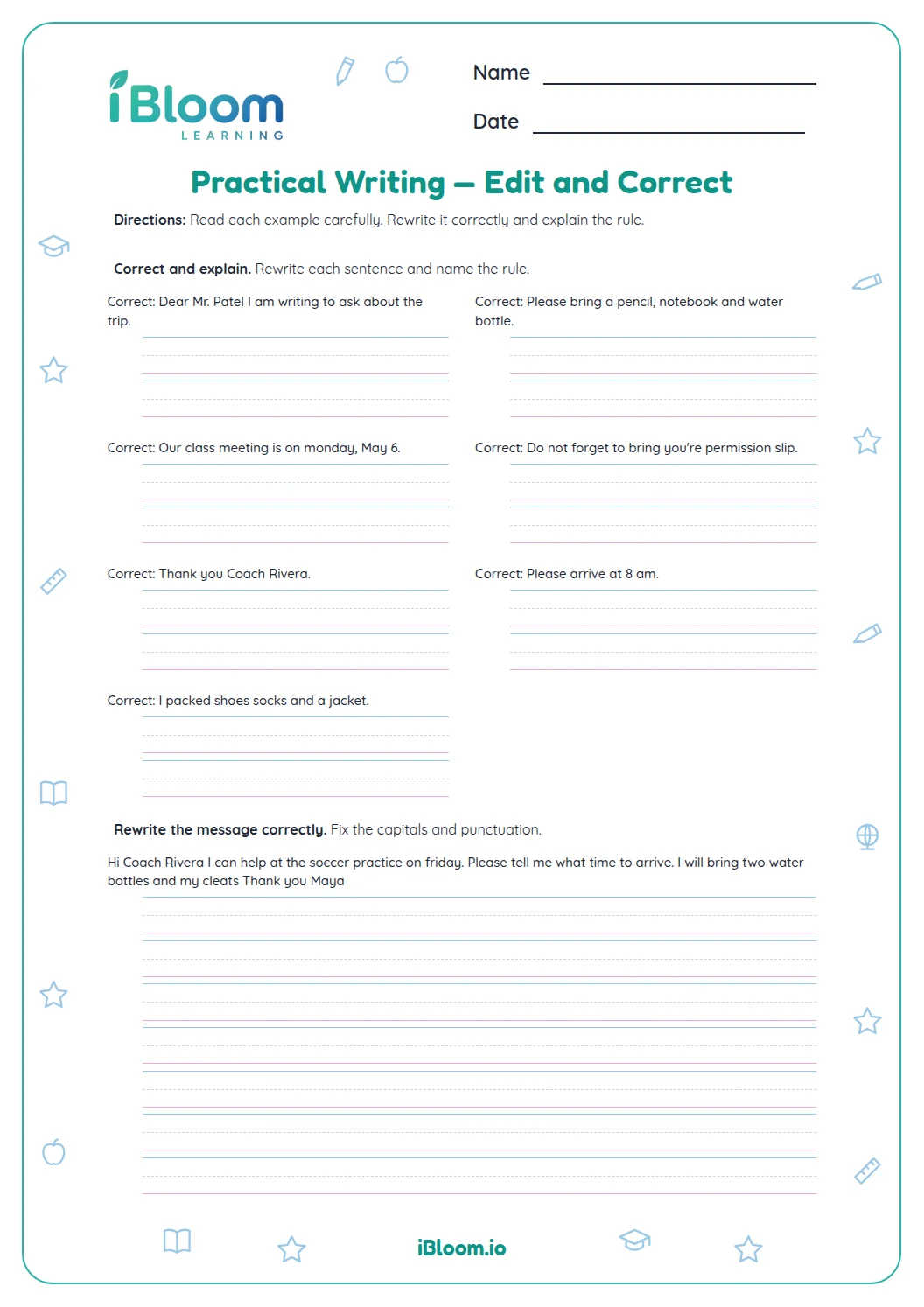
About this worksheet
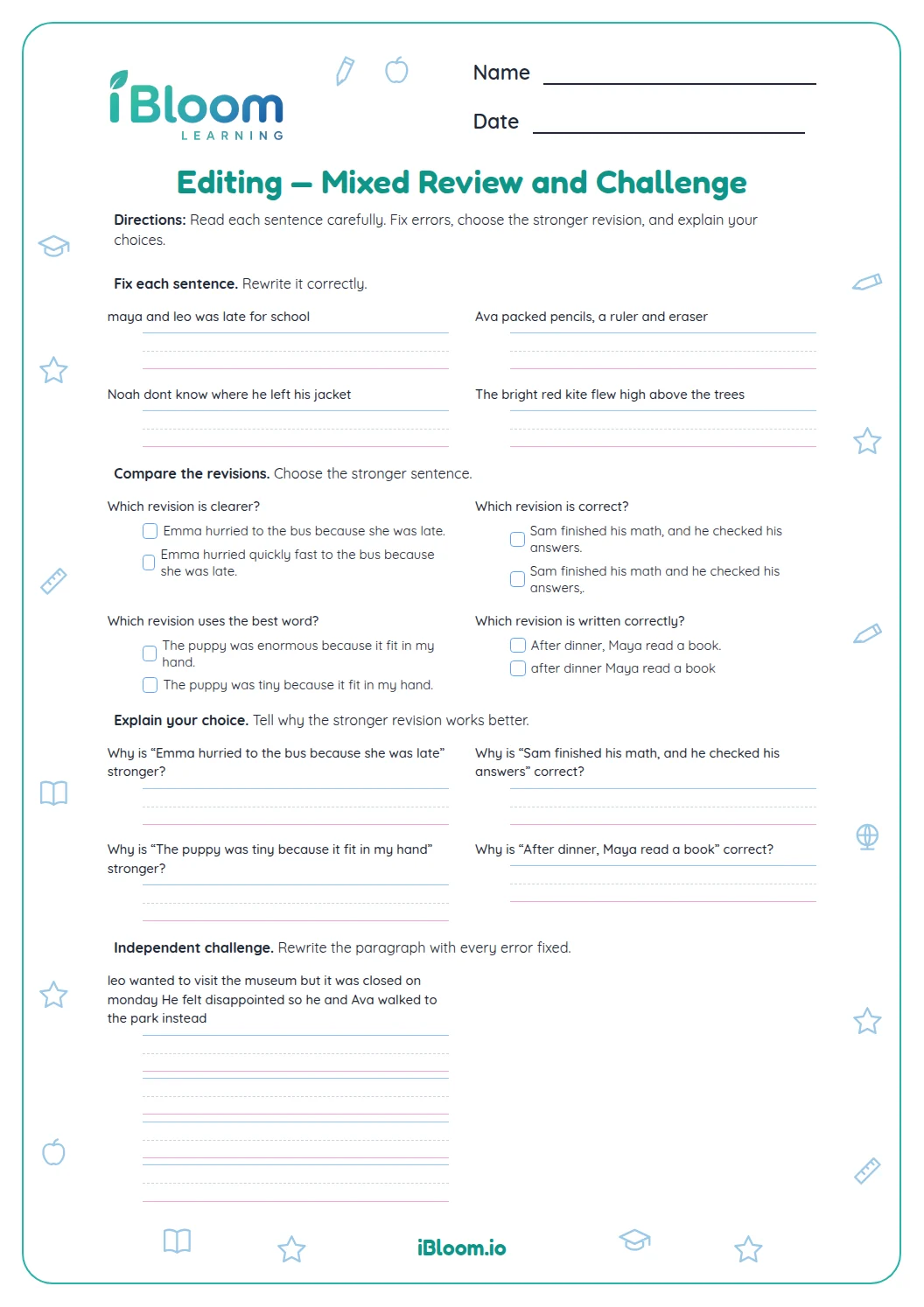
This Grade 5 editing worksheet gives students 14 guided completion questions in capitalization, punctuation, grammar, and sentence clarity. They supply missing capitals and punctuation, choose verb forms through context, clarify pronouns, check subject-verb agreement, and complete sentence edits. The practice supports CCSS L.5.1 and L.5.2. The answer key shows each missing word or mark.
Aligned to L.5.1 and L.5.2
Which conventions appear in the practice?
The first part completes capitalization and punctuation edits, including a day name, a list, dialogue, a book title, and a plural possessive.
How do the grammar blanks work?
The next questions use sentence context to choose verb forms, clarify a pronoun, match a subject and verb, and connect ideas with a conjunction.
What can students check while editing?
Read each completed sentence aloud, then check that the word or mark makes the sentence clear and preserves its intended meaning.
A practical editing sequence
- 1Read the whole sentence for meaning before changing it.
- 2Check capitals at sentence beginnings and in names and titles.
- 3Review commas, quotation marks, and apostrophes.
- 4Check that verbs agree with subjects and match the time.
- 5Reread revised sentences for clear pronouns and connections.
Common editing slips
The mistake
Adding commas between two complete sentences without a joining word.
The fix
Use a period or add a conjunction after the comma.
The mistake
Making a nearby noun control the verb instead of the subject.
The fix
Find the sentence’s main subject, then match its verb.
The mistake
Using an unclear pronoun when two people are named.
The fix
Repeat a person’s name when the pronoun could point to either person.
Curriculum alignment
This practice builds the named skill through the worksheet activities.
Use standard English grammar and usage.
On this sheet: Parts B and C revise agreement, tense, pronouns, and sentence structure.
Show the official wordingHide the official wording
Demonstrate command of the conventions of standard English grammar and usage when writing or speaking.
Use standard English capitalization, punctuation, and spelling.
On this sheet: Part A and the passage edits practice capitalization and punctuation.
Show the official wordingHide the official wording
Demonstrate command of the conventions of standard English capitalization, punctuation, and spelling when writing.
What to practice next
Further reading
Questions parents and teachers ask
What conventions are included?
Students complete blanks involving capitals, commas, dialogue punctuation, titles, apostrophes, verb forms, pronoun clarity, agreement, and sentence connections. The last items apply those conventions in short sentence edits. Students see conventions in context rather than as isolated rules, and the key lists each word or mark that completes the item.
How many questions are included?
The worksheet has 14 questions in three parts. It starts with convention choices, continues with grammar edits, and ends with short revisions and sentence combining. Open responses have sample edits in the key. Students can reread the corrected sentence to confirm that the edit fixes the issue and preserves the intended meaning.
Can an edited sentence have more than one correct version?
Some open-response prompts can be revised in more than one sound way. The answer key gives a sample; accept a revision that follows the requested convention, keeps the intended meaning, and forms a clear sentence. Students can reread the corrected sentence to confirm that the edit fixes the issue and preserves the intended meaning.
What is the passage-editing question asking students to notice?
It asks students to complete “Last ___, our class visited River ___.” with the missing words from a short sentence edit. The key supplies “Friday” and “Park,” completing the sentence with proper capitalization and punctuation. The completed sentence reads naturally with both place and day names capitalized and the needed punctuation in place.
How should families use the key?
Have the student make an edit first, then compare it with the key. For a different revision, check whether the punctuation and grammar are correct and whether the sentence still expresses the original idea clearly. Students can reread the corrected sentence to confirm that the edit fixes the issue and preserves the intended meaning.
Which standards does the worksheet practice?
The questions practice Grade 5 conventions of grammar and usage as well as capitalization and punctuation. The page lists CCSS L.5.1 and L.5.2 with an official standards link below for reference. Students can reread the corrected sentence to confirm that the edit fixes the issue and preserves the intended meaning.