



About this worksheet
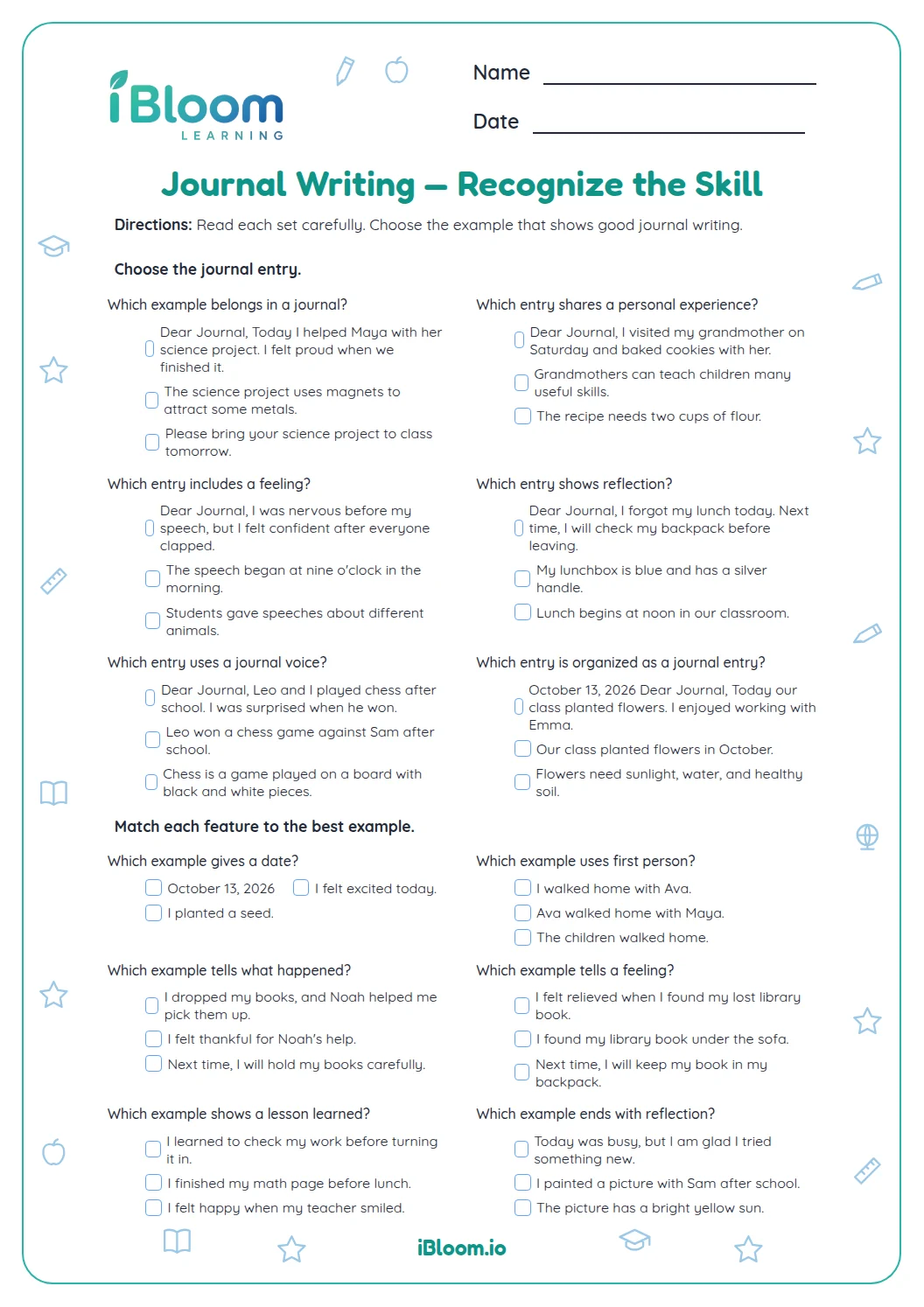
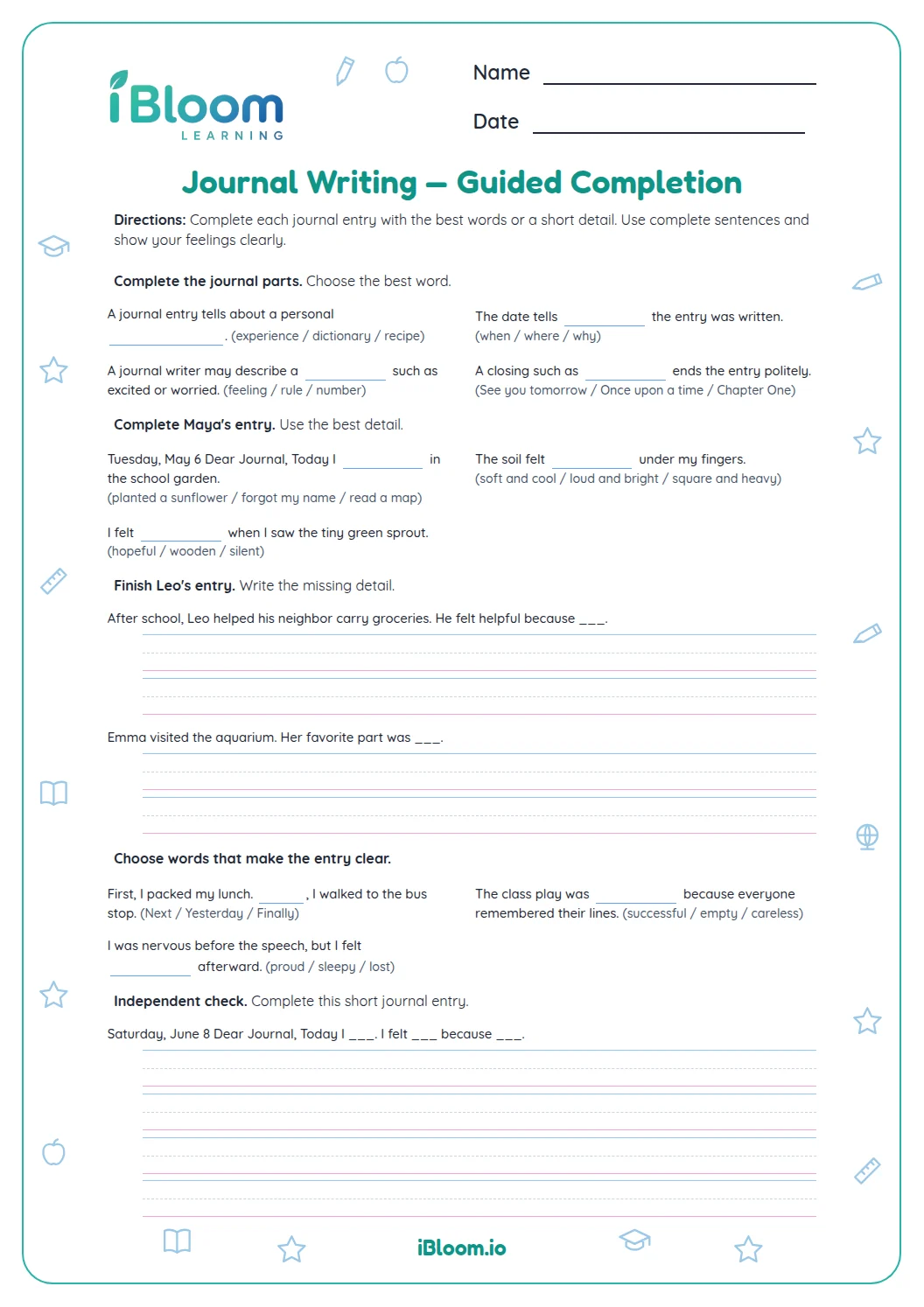
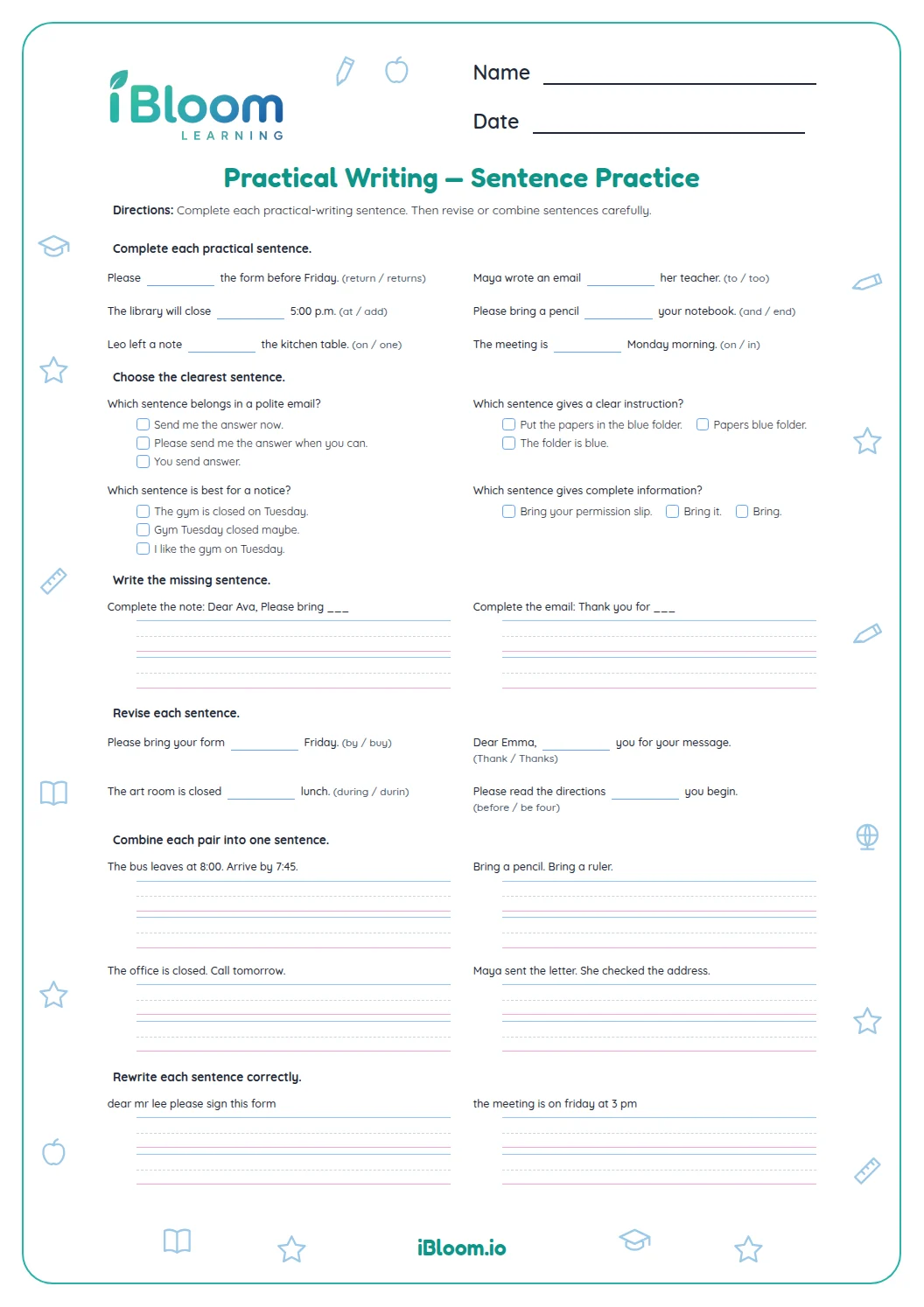
This Grade 5 printable gives fourteen sentence-level journal writing tasks. Students identify clear personal sentences, connect ideas with transitions, revise vague or repeated wording, and write original journal lines. A separate answer key includes sample responses for open-ended prompts.
How can you tell whether a journal sentence is complete?
A complete sentence shares a full thought with a subject and a verb. A specific detail helps the reader picture the experience.
- 1The shady park had a quiet pond and benches.
- 2The detail makes “nice” more precise.
How can revision make a journal sentence clearer?
Replace repeated names or vague words with precise language. Keep the meaning while making the sentence easier to follow.
- 1Mia found her sketchbook.
- 2The pronoun her avoids repeating Mia’s name.
How can a journal ending reflect on an event?
A closing sentence can name what the writer learned or how an experience felt. A transition can also show how events connect.
- 1I left tired, but glad I helped the garden grow.
- 2The ending shares a feeling about the experience.
How to use this worksheet
- 1Read the sentence and identify its main thought.
- 2Choose or write a revision that keeps the meaning clear.
- 3Add a detail that a reader can picture.
- 4Use a transition when the prompt asks how ideas connect.
- 5Read your sentence again for a complete thought and punctuation.
Common mistakes and quick fixes
The mistake
Leaving a phrase without a full thought.
The fix
Check that the sentence names who did what.
The mistake
Repeating a name several times.
The fix
Use a clear pronoun when its meaning is obvious.
The mistake
Using a vague word such as “nice.”
The fix
Replace it with a detail the reader can picture.
What to practice next
Make more practice
Further reading
Questions parents and teachers ask
Are there single correct answers for these prompts?
Most prompts invite original writing, so the key provides a sample rather than the only possible response. Check that the sentence follows the requested move, stays connected to the topic and reads clearly. Ask the student to explain how the response meets the direction before checking the answer key together.
What should a complete sentence include?
A complete sentence expresses a full thought and usually includes a subject and a verb. A phrase such as “Running through the sprinklers” needs a subject and a verb form to become a complete sentence. Ask the student to explain how the response meets the direction before checking the answer key together.
How do transitions help journal writing?
Transitions help readers follow how ideas relate. Words such as “afterward,” “because” and “as a result” can show time, reason or outcome when they accurately describe the connection between events. Ask the student to explain how the response meets the direction before checking the answer key together.
Why revise a vague sentence?
Specific details help a reader picture an experience. Replacing “The place was nice” with a description of the shade, pond or benches makes the journal sentence clearer and more informative. Ask the student to explain how the response meets the direction before checking the answer key together.
Can students write about their own experiences?
Yes. Many prompts ask students to choose a real moment, feeling or goal. The sample key shows one possible response; students should use details that fit their own experience and voice. Ask the student to explain how the response meets the direction before checking the answer key together.