



About this worksheet
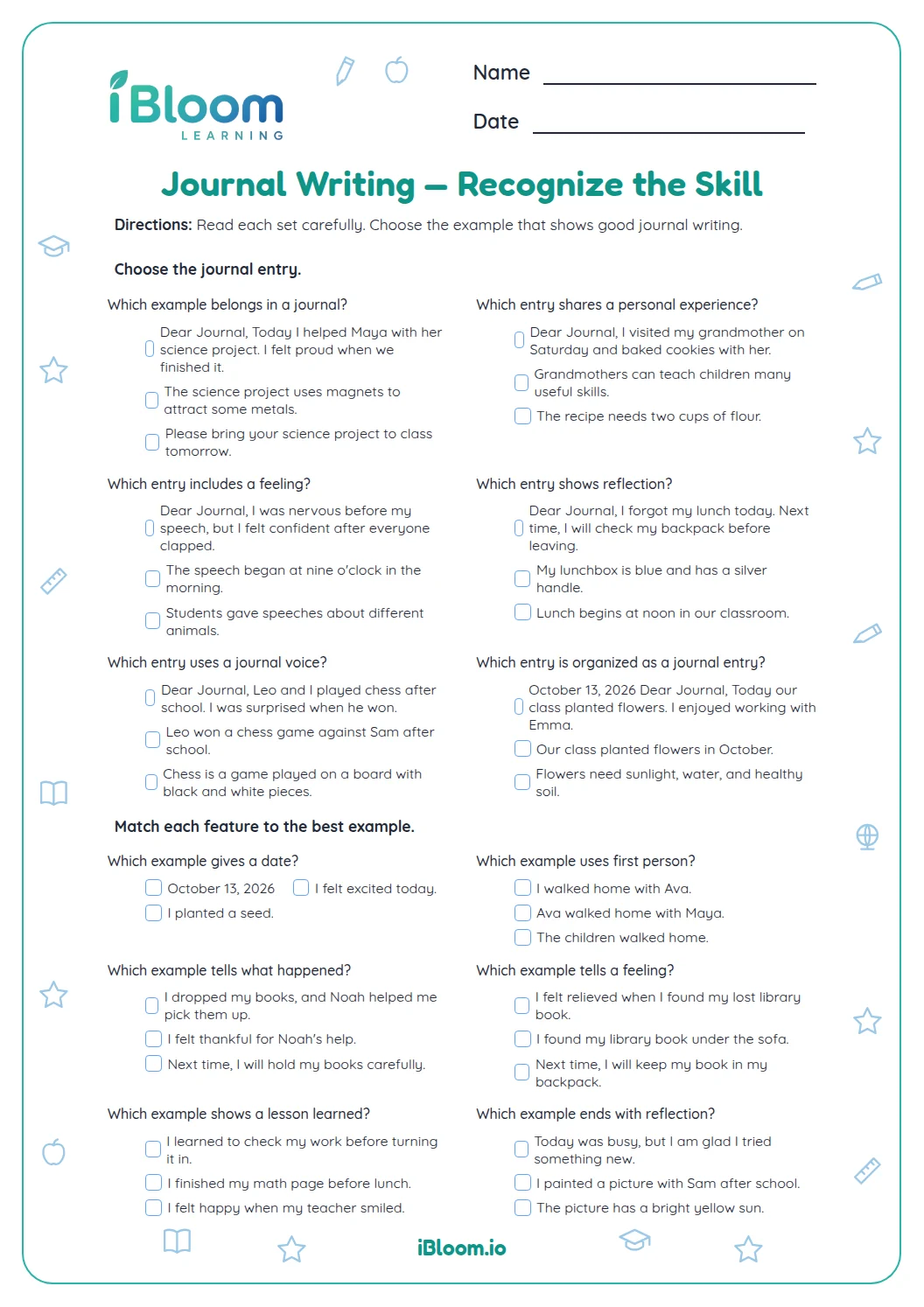
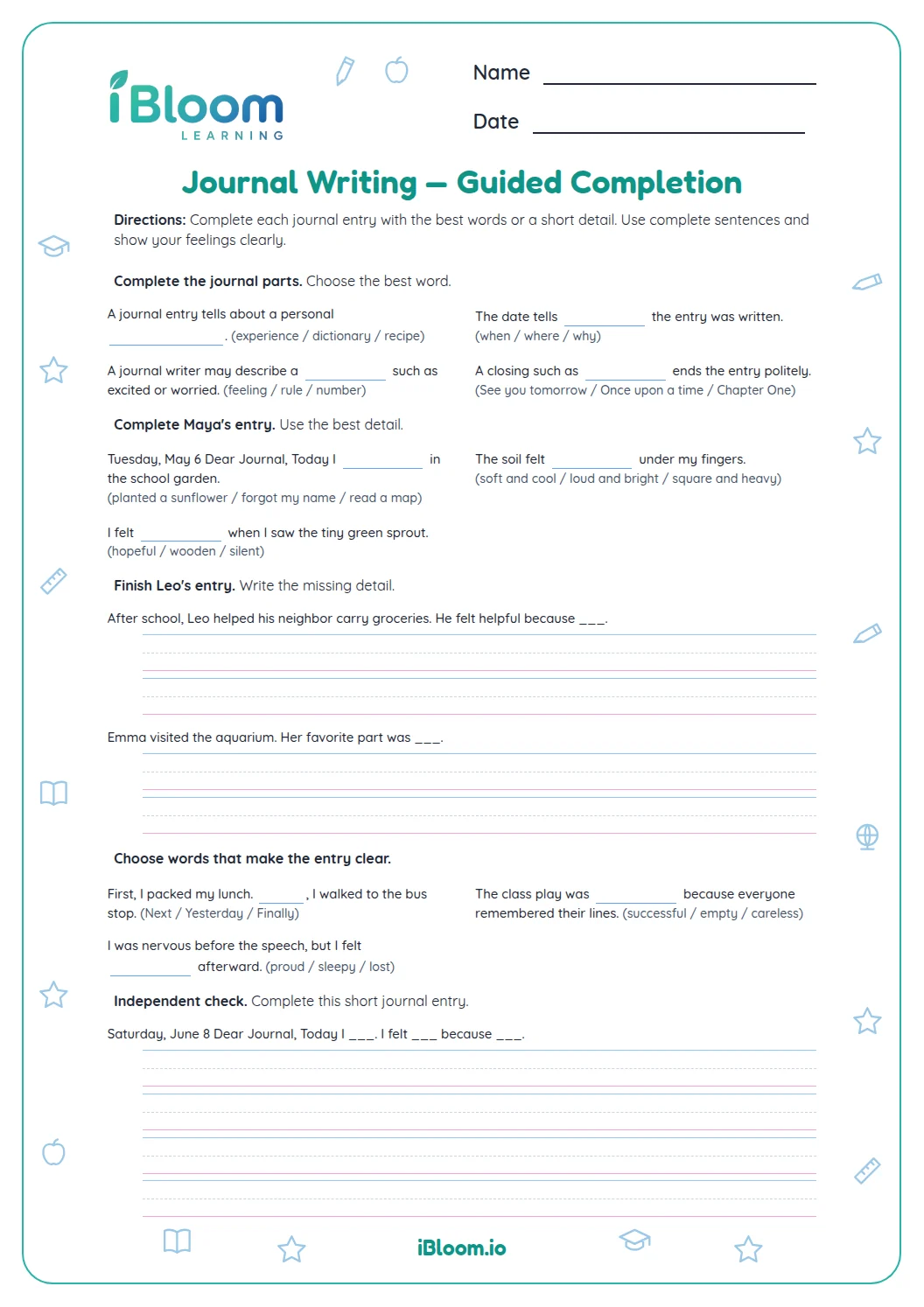
This free Grade 5 journal writing worksheet combines detail, sequence, revision, and reflection practice. Part A has three choices about sensory language, connected endings, and organization. Part B asks students to edit three journal lines. Part C asks for a more precise sentence and a reflection on a supplied event. Part D guides a four-sentence entry about a real or imagined success, with two details and a connected ending. The work practices Common Core W.5.3d and W.5.3e. The separate answer key gives fixed choices and sample written responses.
Aligned to W.5.3d and W.5.3e
Which details make a journal moment clear?
Concrete language names an action, object, sound, texture, or other detail a reader can imagine. “I stacked six chairs” names what the writer did and how many chairs were involved. “I did a lot” leaves the activity unclear.
Question 7 puts that distinction into practice: students revise “I helped clean up” with a specific action and amount. Accept different actions, such as collecting eight cups or shelving ten books, when the sentence describes helping clean.
- 1Original: I helped clean up.
- 2What action? Stacked chairs.
- 3How many? Six.
- 4Revision: I stacked six chairs beside the door.
What do the editing questions review?
Part B checks past tense, time order, and a precise verb. Yesterday signals found; first prepares for next. Scraped describes chairs making contact with the floor. These choices make the event and its sequence easier to follow.
Read the completed lines aloud. Check both grammar and meaning: a word must fit the sentence and make the connection between ideas clear.
How does an ending connect to an experience?
A journal ending can explain a lesson, a change in thinking, or a next step. It should grow from the event already described. After a tower falls, planning a wider base connects directly to what happened.
Question 2 recognizes a reflection about learning a knot. Question 8 asks students to supply their own next step after a tower falls. Question 10 applies that same connection to the student’s own entry.
What is the final writing challenge?
Questions 9 and 10 form one four-sentence journal entry. Students first describe a real or imagined success in three sentences, including an event and two details, one sensory. They then add a final sentence about learning or a next step.
The key models baking rolls: it names the success, counts six balls of dough, describes a buttery smell, and ends with a plan to shape the rolls more evenly. Other topics work when the details and reflection all belong to the same experience.
How to use this worksheet
- 1Complete Part A, explaining how each answer fits its question.
- 2For Part B, use yesterday, first, and the surrounding ideas to choose the missing words.
- 3Revise question 7 by naming a specific cleanup action and amount.
- 4For question 8, connect the next step to the falling tower.
- 5Plan an event and two details for question 9, including something seen, heard, smelled, tasted, or touched.
- 6Write question 10 as the ending of that entry, then read all four sentences together.
Mistakes to discuss
The mistake
Writing find after Yesterday I.
The fix
Yesterday places the event in the past. Use found to keep the verb in past tense.
The mistake
Revising “I helped clean up” as “I helped a lot.”
The fix
Name what was done and how much: for example, “I stacked six chairs beside the door.”
The mistake
Starting a new topic in question 10.
The fix
Reread question 9 and write a final thought about that same success.
Common Core alignment
Choose concrete language and use sensory details in a journal entry.
On this sheet: Parts A and B identify concrete language; Parts C and D use precise actions and details.
Show the official wordingHide the official wording
Use concrete words and phrases and sensory details to convey experiences and events precisely.
Write an ending that follows the event in a journal entry.
On this sheet: Parts A and C practice connected endings; Part D asks for an ending to the student’s own entry.
Show the official wordingHide the official wording
Provide a conclusion that follows from the narrated experiences or events.
What to practice next
Make more practice
Further reading
Questions parents and teachers ask
Does the journal entry have to describe a real event?
This worksheet allows a real or imagined success. Students can choose an ordinary moment, such as finishing a puzzle or baking rolls. Their entry should stay with that experience, include two specific details with one sensory detail, and end with something learned or a next step.
How much writing is required in the final part?
The final part asks for four connected sentences. Question 9 asks for three sentences describing a success and two details, including one sensory detail. Question 10 adds one sentence about learning or a next step. Read the responses together to check that they form one focused entry.
What counts as a sensory detail here?
A sensory detail describes something a person sees, hears, smells, tastes, or feels through touch. Rain tapping the roof and chairs scraping across the floor supply sound details on this sheet. In the final entry, students should choose a detail that belongs to the experience they describe.
How should I check the two Part C answers?
Check each answer against its own task. Question 7 needs a revised cleanup sentence with a specific action and amount. Question 8 needs a next step connected to the fallen tower. The sample key shows one possible response for each; other relevant actions and plans are acceptable.
What do the three editing blanks practice?
They practice past tense, sequence, and precise language. Students choose found after yesterday, Next after first, and scraped for moving chairs. Ask students to read each completed line and identify the word or idea that guided their choice, then use those habits in their own entry.