


About this worksheet
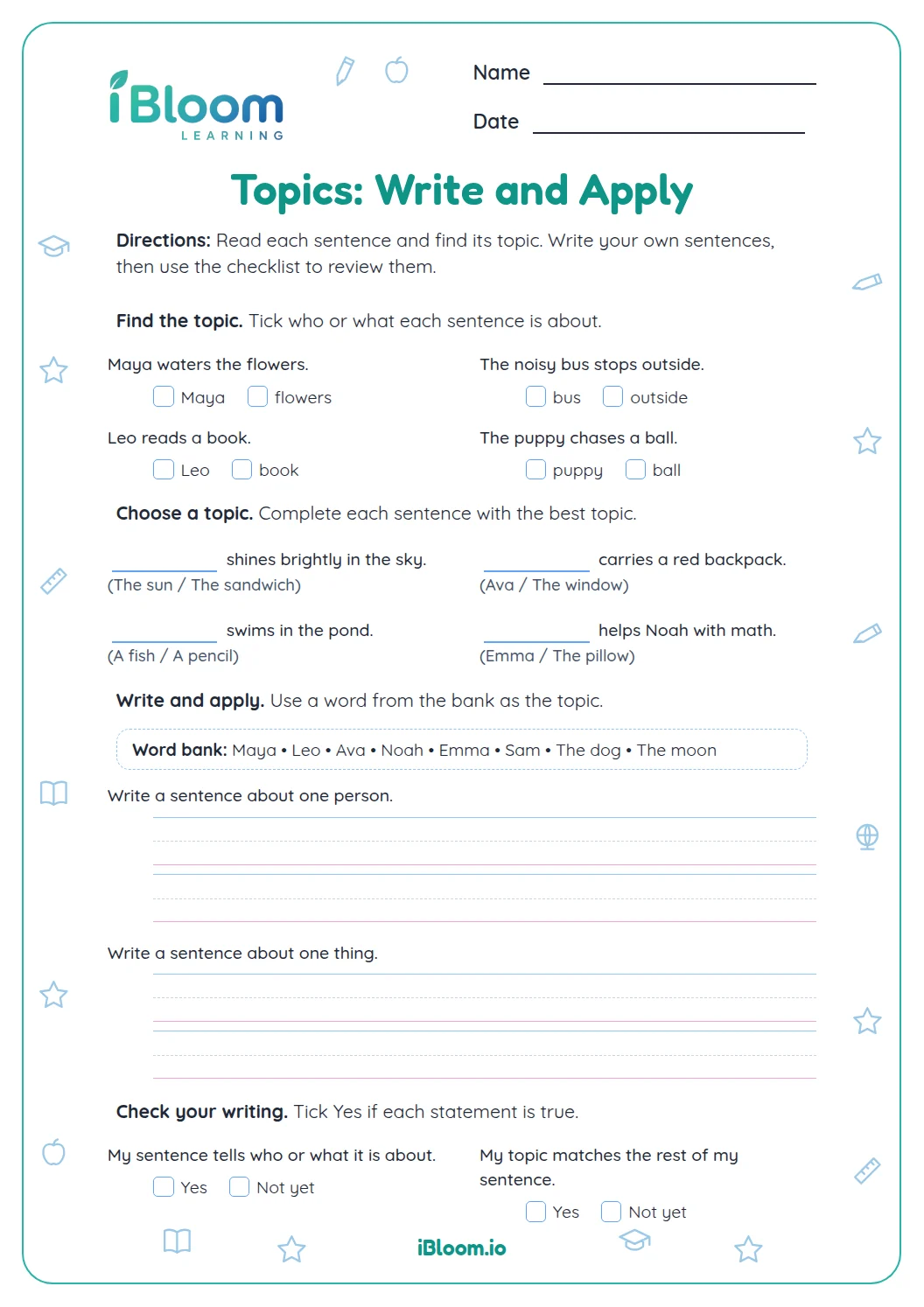
This Grade 3 writing worksheet practices introducing a topic and adding related information. Children write topic sentences for familiar subjects, add details that explain a main idea, and finish with two open responses. The answer key gives sample responses for the writing prompts, so answers can be checked for a clear connection to the topic.
Aligned to W.3.2a
What writing practice is on this page?
The worksheet has four parts. First, write topic sentences for six subjects. Next, add a supporting detail to five topics. The final two prompts ask for a topic sentence and a detail. Sample responses in the key show one way each open response can fit.
How does a detail support a topic?
A supporting detail gives information about the main idea. For “owl hunting,” a detail such as “Owls can hear small animals moving” explains one way an owl finds food. Keep the detail connected to the exact topic.
- 1Topic: ways to save water
- 2Turn off the tap while brushing teeth.
- 3This detail gives one action that saves water.
How can I check a topic sentence?
A topic sentence tells the reader what the group of details will be about. For the topic “bees and flowers,” “Bees carry pollen from flower to flower” introduces a clear connection.
- 1Topic: bees and flowers
- 2Bees carry pollen from flower to flower.
- 3This sentence introduces the topic.
How to use this worksheet
- 1Read the topic named in the prompt.
- 2For choices, ask which sentence gives the main idea or supports it directly.
- 3Cross out choices that are only loosely related.
- 4For writing prompts, name the topic and state one clear idea.
- 5Check sample responses and accept other relevant wording.
Common mistakes and quick fixes
The mistake
Choosing a sentence that is only a small fact
The fix
Ask whether the sentence could introduce the whole paragraph.
The mistake
Picking a detail that is related but not supportive
The fix
Check that the detail explains or gives an example of the topic.
The mistake
Writing a topic sentence that is too broad
The fix
Name a specific subject and one main point about it.
Common Core alignment
This practice connects the worksheet skill to classroom learning goals.
Introduce each topic and add details that explain it.
On this sheet: Learners choose clear topic sentences and add relevant supporting details.
Show the official wordingHide the official wording
Introduce a topic and group related information together; include illustrations when useful to aiding comprehension.
What to practice next
Make more practice
Further reading
Questions parents and teachers ask
What makes a good topic sentence?
A topic sentence introduces the main idea of a paragraph or group of details. On this worksheet, children write topic sentences for subjects such as bees and flowers, puppy care, and garden care. They then practice adding details that explain topics, with sample responses in the answer key.
Does the printable include an answer key?
Yes. A separate answer key gives the expected answers for checking completed work. For an open-ended response, it offers a sample so an adult can compare the child’s idea without expecting identical wording. Review it after the learner finishes, then discuss any answer that needs another look.
How should I introduce the activity?
Read the short directions together and model one item from the first part. Then let the learner work through the remaining questions at a comfortable pace. Check the key after finishing and talk through one item that felt tricky.
Can a child complete this independently?
A child who knows the skill can try most items independently. An adult can read directions aloud or talk through one example first, then invite the child to explain a choice or check a result. Offer help with directions as needed, and give the learner time to think when useful, too.
How long does this worksheet take?
About 15 minutes. Let the learner pause between parts if needed; careful practice matters more than finishing quickly. A short review afterward can help the child name a strategy that worked. Adults can adjust the pace and reread directions together.