




About this worksheet
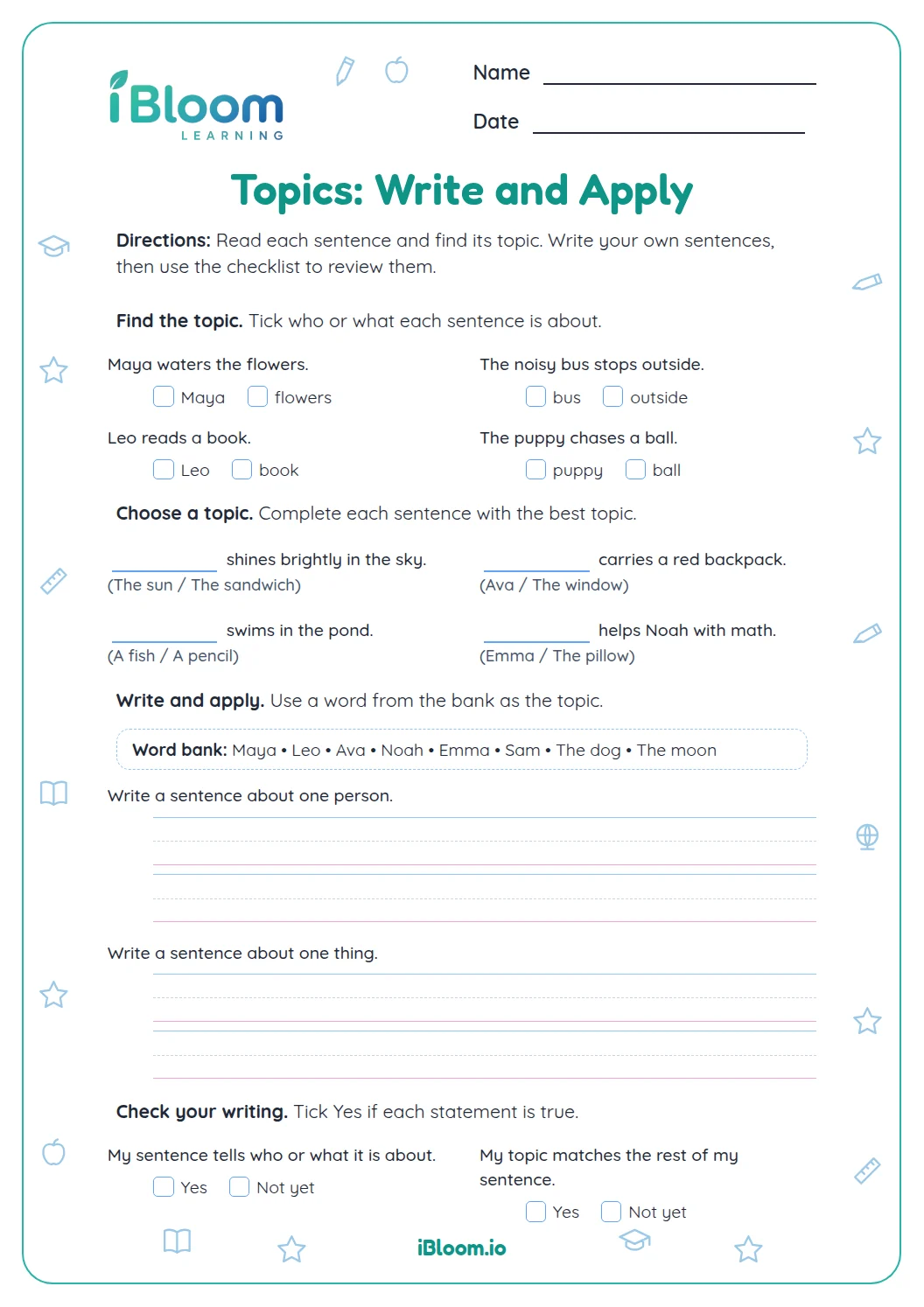
This free printable worksheet teaches children to find the topic of a sentence: the person, animal or thing the sentence tells about. It is written for Grades 1 to 3 and supports complete-sentence writing in Common Core L.1.1j. Children circle the topic in four short sentences, choose it from three words in four more, pick the sentence that tells about each of three topics, and write sentences of their own for two topics. Two of the sentences open with a place or time, so the topic is not always the first word. The answer key is a separate two-page file.
Aligned to L.1.1j
What is the topic of a sentence?
The topic of a sentence is the person, animal, place or thing that the sentence tells about. In "Maya reads a book," the topic is Maya. Grammar books call this word or group of words the subject, and children will meet that term in later grades. For now, "topic" is a friendlier word and carries the same idea.
Finding the topic matters because it is half of every complete sentence. A sentence needs someone or something to tell about, and it needs to say what that someone or something does or is. A child who can name the topic is much less likely to write a fragment like "Runs across the yard."
How do children find the topic?
Teach one question: "Who or what is this sentence about?" Then test the answer by asking what the sentence says about it. If the sentence says what the word does or is, you have found the topic.
Descriptive words and places often tempt children. In the example below, red is a color and tire is only a part of the bicycle, so the sentence is about the bicycle.
- 1The red bicycle has a flat tire.
- 2Ask: who or what is this sentence about?
- 3red tells the color. tire is a part of something. The bicycle is the one that has a flat tire.
- 4Test: "The bicycle has a flat tire" tells something about the bicycle.
- 5Topic: bicycle
What is on this worksheet?
Part A has four short sentences with a circle row each: Pablo kicks the ball hard, The tall giraffe eats leaves, Our bus stops at the corner, and Grandma bakes bread on Sunday. Children circle one word, which makes this the quickest way into the skill. Part B moves to multiple choice with three words each, and two sentences begin with a place or time phrase ("In the park," and "After lunch,") so that the topic is not always the first word.
Part C reverses the task. Given a topic such as the moon, Sam or the baby ducks, children choose the sentence that tells about it. Part D asks for two sentences of their own, one for the puppy and one for a best friend, with writing lines for each.
- Part A: 4 sentences, circle the topic word
- Part B: 4 sentences, choose from 3 words
- Part C: 3 topics, choose the matching sentence
- Part D: 2 topics, write a complete sentence for each
Is the topic of a sentence the same as a topic sentence?
No, and it helps to say so out loud. A topic sentence is the sentence in a paragraph that names the paragraph's main idea. The topic of a sentence is who or what that one sentence tells about. This worksheet is about the second meaning.
Children who learn to find the topic of a single sentence are building the habit of noticing what each sentence is about. That makes it easier later to see what a whole paragraph is about, and then to write a topic sentence for it.
How to use this worksheet at home or in class
- 1Warm up out loud. Say "Our dog sleeps by the sofa" and ask, "Who or what is this sentence about?"
- 2Read the directions together. Explain that the topic is the word for who or what the sentence tells about.
- 3Do question 1 as a pair, circling Pablo. Then let your child finish the circle row alone.
- 4In Part B, have your child say the question before choosing, then read the sentence back with only the chosen topic and what it does.
- 5For Part D, say the sentence aloud before writing. Check that it begins with a capital letter, ends with a period, and tells what the topic does or is.
- 6Use the answer key last. For a wrong answer, ask the question again and cover the extra words.
Common mistakes and quick fixes
The mistake
Choosing a describing word as the topic, such as red in "The red bicycle has a flat tire."
The fix
Ask, "Is the sentence about red, or about the thing that is red?" Cover the describing word and read the sentence again.
The mistake
Choosing the place or time instead of the topic, such as park in "In the park, two dogs chase a ball."
The fix
Ask who or what does the action. The dogs chase, so dogs is the topic. Show that the place can be moved: "Two dogs chase a ball in the park."
The mistake
Writing only a topic in Part D, like "The puppy."
The fix
Ask, "What does the puppy do?" A complete sentence names the topic and says something about it, such as "The puppy chases a red ball."
Common Core alignment
Most US states use the Common Core Language standards or a close state version. This sheet practices the Grade 1 standard below on writing complete sentences.
Write complete sentences: here, children name who or what a sentence is about, then write two of their own.
On this sheet: Part D asks children to write a complete sentence about a given topic, and Parts A to C build the awareness of who or what a sentence is about.
Show the official wordingHide the official wording
Produce and expand complete simple and compound declarative, interrogative, imperative, and exclamatory sentences in response to prompts.
What to practice next
Make more practice
Further reading
Questions parents and teachers ask
What is the topic of a sentence for a first grader?
It is the person, animal or thing the sentence tells about. In "Grandma bakes bread on Sunday," the topic is Grandma. Children find it by asking, "Who or what is this sentence about?" Grammar books call it the subject, a word they will learn in later grades.
Why is the topic not always the first word?
Sentences can start with a place or time, like "In the park" or "After lunch." On this sheet, question 7 is about two dogs, not the park, and question 8 is about the teacher, not lunch. Moving the phrase to the end of the sentence shows who or what it is really about.
Does the topic have to be one word?
No. On Parts A and B children circle or choose one word, such as giraffe in "The tall giraffe eats leaves," but the full topic is often a group of words: the tall giraffe. Part C uses longer topics like the baby ducks. Saying the whole group aloud is a good habit and is never wrong.
What counts as a correct sentence in Part D?
A complete sentence names the topic, says what it does or is, starts with a capital letter and ends with a period. Many sentences work, such as "The puppy chases a red ball." The answer key shows one sample, but accept any complete sentence about the topic.
Is this the same as a topic sentence in a paragraph?
No. A topic sentence names the main idea of a whole paragraph, while the topic of a sentence is who or what a single sentence tells about. Finding the topic of one sentence is an early habit that later helps children see what a whole paragraph is about.
How long does the worksheet take, and is there an answer key?
Most children finish in about 20 minutes, with the two writing tasks in Part D taking the longest. There is a separate two-page answer key with all 13 answers, including a sample sentence for each writing task. Younger children can do Parts A and B in one sitting and the rest later.