

About this worksheet
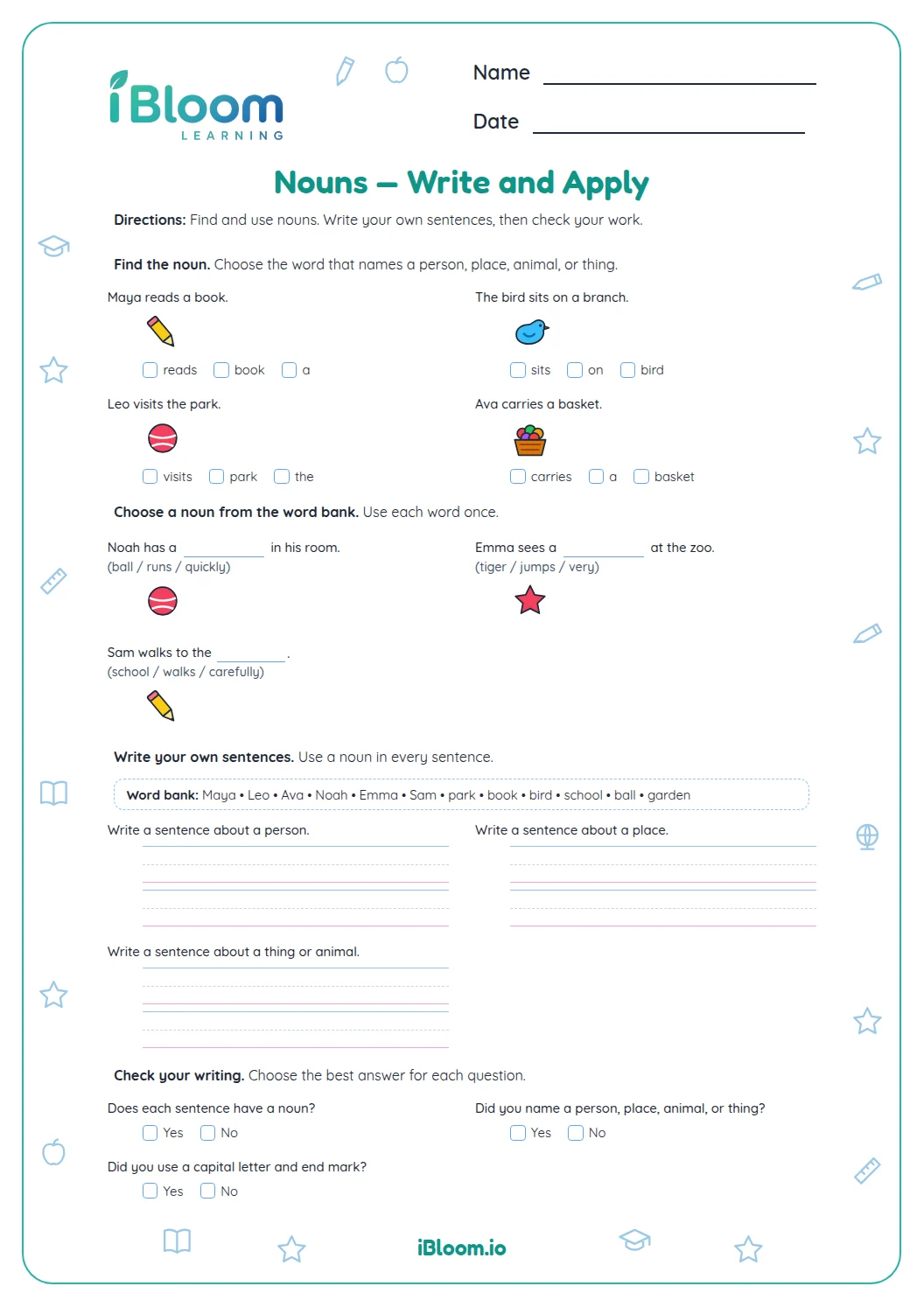
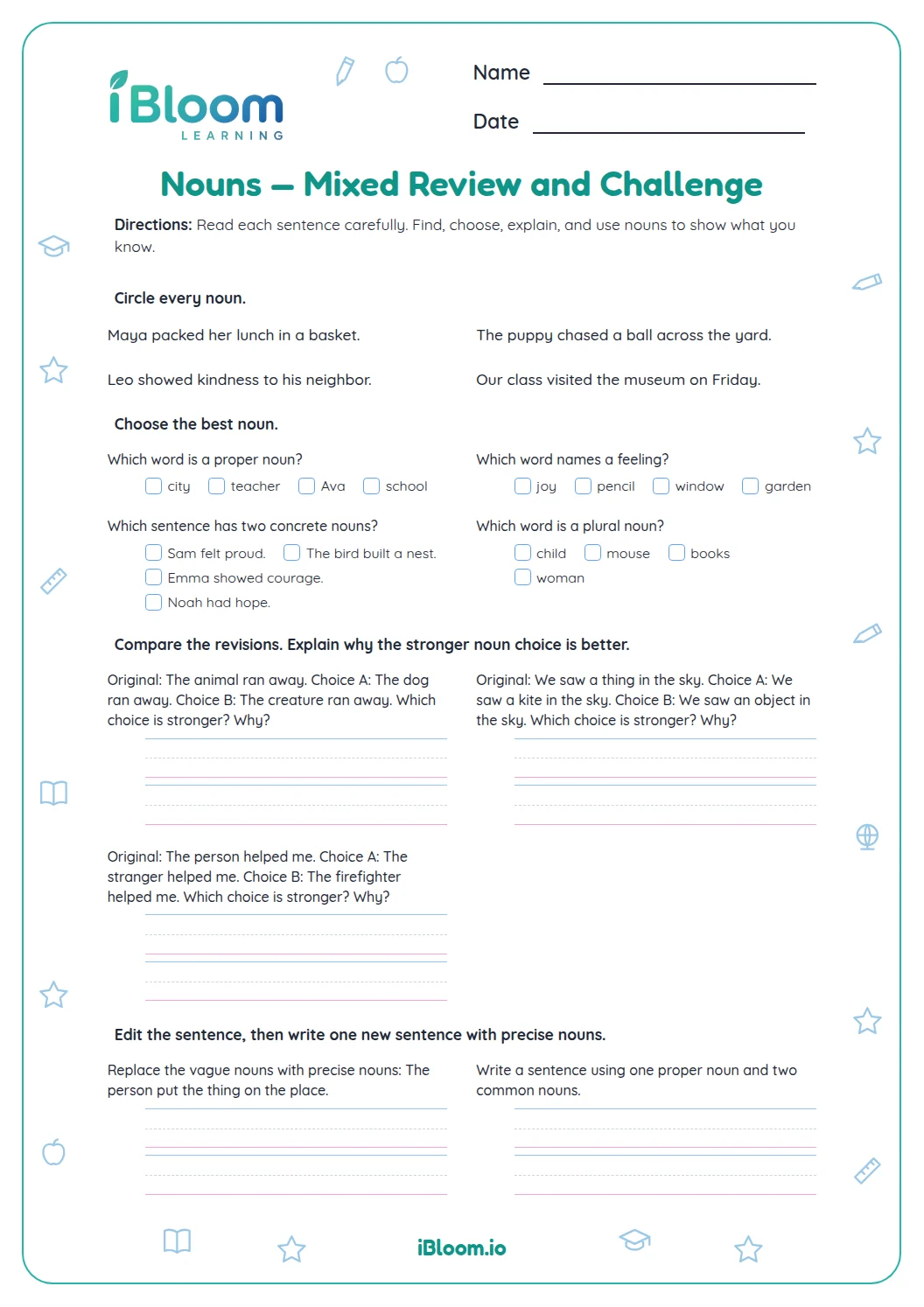
This printable builds from recognizing nouns to using them in complete sentences. Across 14 questions, learners choose nouns, circle nouns in four short sentences, and write four sentence responses using common, proper, or possessive nouns. It supports Common Core L.1.1.b. A separate answer key gives choices and sample sentences.
Aligned to L.1.1.b
How can you tell whether a word is a noun?
Ask whether the word names a person, place, animal, or thing. In question 1, teacher names a person, while quickly tells how an action happens.
- 1teacher names a person
- 2quickly tells how an action happens
- 3Answer: teacher
How do you find nouns in a whole sentence?
Read the sentence and look for the words naming who or what it is about. In “Maya feeds her puppy,” Maya names a person and puppy names an animal.
What is the difference between a common and proper noun?
A common noun names a general person, place, animal, or thing. A proper noun names a particular one and begins with a capital letter. Question 13 also asks the learner to use a possessive noun to show ownership.
How can a noun make a complete sentence?
Choose a noun and add a subject and an action or description. “The teacher reads a story” includes the noun teacher and tells what the teacher does. Use the answer key’s sample as one possible sentence, not the only acceptable wording.
How to use this worksheet
- 1Read each word and ask what it names.
- 2For a proper noun, look for a specific name and its capital letter.
- 3In a sentence, circle every naming word.
- 4For writing prompts, include the required noun in a complete thought.
- 5Check that your sentence begins with a capital and ends with punctuation.
Common mistakes and quick fixes
The mistake
Circle an action word instead of a noun.
The fix
Ask whether it names a person, place, animal, or thing.
The mistake
Forget that proper names begin with capital letters.
The fix
Check whether the word names one specific person or place.
The mistake
Write a phrase instead of a complete sentence.
The fix
Add who or what the sentence is about and what happens.
Common Core alignment
This worksheet gives children focused practice with the listed skill.
Identify common and proper nouns and use a possessive noun in a sentence.
On this sheet: Learners identify common and proper nouns, then use a possessive noun in a sentence.
Show the official wordingHide the official wording
Use common, proper, and possessive nouns.
What to practice next
Make more practice
Further reading
Questions parents and teachers ask
What does this nouns worksheet include?
There are 14 questions in three parts: six word choices, four sentences for circling nouns, and four prompts for writing complete sentences. The page practices common and proper nouns. Invite the learner to say which detail, number, or clue in the prompt helped them choose, then check the result together with the key.
Which words should a child circle in question 8?
In “The baker puts fresh bread in a bag today,” circle baker, bread, and bag. These words name a person or things; the other words tell actions, qualities, or time. Invite the learner to say which detail, number, or clue in the prompt helped them choose, then check the result together with the key.
Does the worksheet ask children to write sentences?
Yes. Questions 11–14 ask for four complete sentences using named nouns or specified kinds of nouns. The key gives one sample for each prompt; a different correct sentence can also work. Invite the learner to say which detail, number, or clue in the prompt helped them choose, then check the result together with the key.
Is an answer key included?
Yes. A separate key lists the word choices and nouns to circle, followed by sample sentences for the four open prompts. Check that each written response is a complete thought and uses the requested noun. Invite the learner to say which detail, number, or clue in the prompt helped them choose, then check the result together with the key.
How long does the noun practice take?
About 20 minutes is a useful estimate for 14 questions, including the four sentence-writing prompts. A learner may need extra time to reread each sentence and check capitalization and ending punctuation. Invite the learner to say which detail, number, or clue in the prompt helped them choose, then check the result together with the key.
How can children tell a common noun from a proper noun?
A common noun names a general person, place, animal, or thing, such as river. A proper noun names a particular one and begins with a capital letter, such as Maya. Invite the learner to say which detail, number, or clue in the prompt helped them choose, then check the result together with the key.