


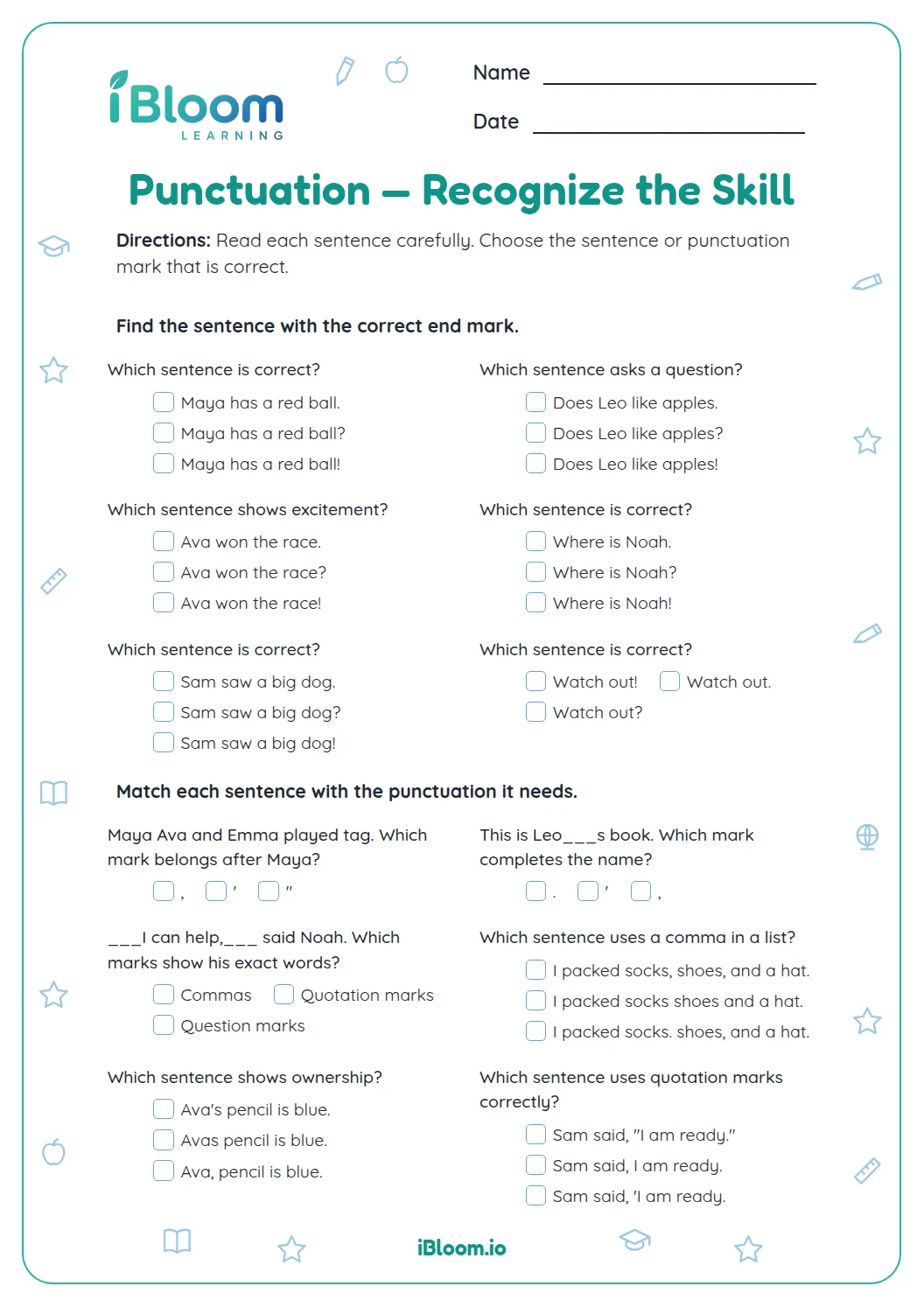
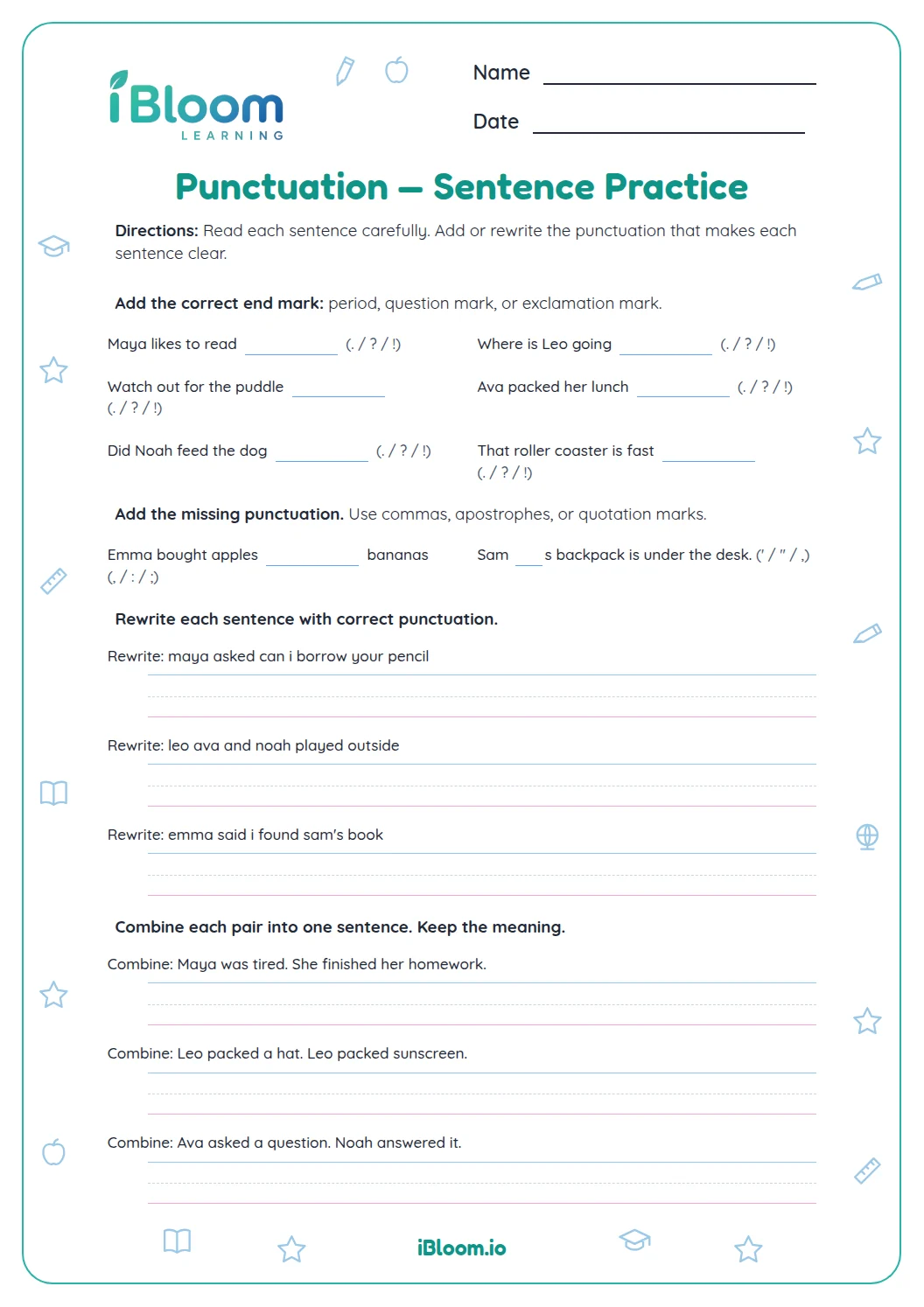
About this worksheet
This free printable worksheet helps children in Grades 1 to 3 tell a complete sentence from a group of words that only sounds like one. In Part A, they pick the complete sentence from three choices. In Part B, they decide whether eight word groups, such as "Ben found a smooth rock." and "Blue shoes by the door.", are a sentence or a fragment. In Part C, they choose the words that finish four sentences, and in Part D they turn two fragments into complete sentences. It practices Common Core L.1.1.j and L.2.1.f, and a separate answer key is included.
Aligned to L.1.1.j and L.2.1.f
What makes a group of words a complete sentence?
A complete sentence tells a whole thought. It has a naming part (who or what the sentence is about) and a telling part (what that someone or something does or is). "Rosa waters the plants" has both. "Waters the plants" has no naming part, and "The plants in the pot" has no telling part.
Capital letters and periods help, but they are not the test. A fragment can start with a capital and end with a period and still leave the reader waiting. That is why every word group on this sheet is written with a capital letter and a period, including fragments like "Waiting at the bus stop." and "When the bell rang." Children have to listen to the meaning.
How do children sort a sentence from a fragment?
Teach a two-question test. First: who or what is this about? Then: what happens, or what is it like? If either answer is missing, the words are a fragment. Reading the words aloud and asking "Then what?" works well, especially for fragments that start with when or because.
Questions 11 and 12 make a good pair to practice on. "The girl in the red hat." is six words long and sounds important, but no one does anything. Question 11 adds one word, waved, and the idea is complete.
- 111) The girl in the red hat waved.
- 2Who or what? The girl in the red hat. What happens? She waved. → Sentence
- 312) The girl in the red hat.
- 4Who or what? The girl in the red hat. What happens? Nothing is said. → Fragment
What is on this worksheet?
Eighteen questions in four parts, over two pages. The word groups start short and familiar and end with longer ones, including fragments that begin with when or because.
Part A has four questions with three choices each, such as "My cat naps in the sun.", "Naps in the sun." and "My cat in the sun." Part B has eight word groups to label, three sentences and five fragments, so children cannot guess that the answer is always sentence. In Part C, children choose the missing naming part or telling part that finishes a sentence. In Part D, they turn two given fragments into complete sentences.
- Part A, Pick the sentence: 4 questions with 3 choices each
- Part B, Sentence or fragment?: 8 questions, 3 sentences and 5 fragments
- Part C, Finish the sentence: 4 questions, pick the words that finish the thought
- Part D, Write your own: 2 fragments to turn into sentences
- Answer key on separate pages, with model sentences for the two written answers
How to use this worksheet at home or in class
- 1Say "The dog barked" and then just "The big brown dog." Ask which one feels finished, and why.
- 2Teach the two questions: who or what is it about, and what happens?
- 3Do question 1 together. Ask both questions about each of the three choices.
- 4Let your child finish Parts A and B alone, then check them with the answer key.
- 5For Parts C and D, have your child read each finished sentence aloud to hear whether it sounds complete.
- 6Ask for one more sentence from a fragment you pick, such as "on the top shelf."
Common mistakes and quick fixes
The mistake
Trusting the capital letter and the period. Question 9, "Waiting at the bus stop.", has both, so many children call it a sentence.
The fix
Ask "Who is waiting?" The words never say, so something is missing. Remind your child that punctuation shows where a sentence ends but cannot make an unfinished idea whole.
The mistake
Thinking a long group of words must be a sentence, as with "The girl in the red hat" in question 12.
The fix
Count the actions, not the words. Ask what the girl did. If the words do not answer, add an action word (waved, ran, smiled) and read it again.
The mistake
Hearing "When the bell rang." as finished because it names something that happened.
The fix
Read it aloud and add "Then what?" A word like when or because makes the listener wait. Fix it by finishing the thought: "When the bell rang, we lined up."
Common Core alignment
Most US states use the Common Core Language standards or a close state version. These two standards name the complete-sentence skills this sheet practices.
Write complete sentences: here, children pick out complete sentences and write two of their own.
On this sheet: Parts A and B ask children to recognize complete sentences, and Part D asks them to produce two from fragment prompts.
Show the official wordingHide the official wording
Produce and expand complete simple and compound declarative, interrogative, imperative, and exclamatory sentences in response to prompts.
Build complete sentences: here, children add a missing naming or telling part to finish one.
On this sheet: Parts C and D: children complete fragments such as "The tall girl ___." and "the sleepy kitten" into whole sentences.
Show the official wordingHide the official wording
Produce, expand, and rearrange complete simple and compound sentences (e.g., The boy watched the movie; The little boy watched the movie; The action movie was watched by the little boy ).
What to practice next
Make more practice
Further reading
Questions parents and teachers ask
What is a complete sentence for kids?
A complete sentence is a group of words that tells a whole thought. It says who or what the sentence is about and what happens. "Ben found a smooth rock" is complete. "Blue shoes by the door" is not, because it never tells what the shoes do or what happens to them.
What is a sentence fragment?
A fragment is a group of words missing a who, a what-happens, or part of the idea. It can still start with a capital letter and end with a period. On this sheet, "Waiting at the bus stop." and "When the bell rang." both look finished, but each leaves the reader asking what comes next.
Which grades is this worksheet for?
It is written for Grades 1 to 3. Part A and the first items in Part B use short sentences that suit Grade 1 and 2 readers. The last items in Part B, with longer groups of words and fragments that start with when, give confident Grade 3 readers a challenge.
What are the answers to Part B?
Questions 5, 8 and 11 are sentences. Questions 6, 7, 9, 10 and 12 are fragments. Question 12, "The girl in the red hat.", is a fragment because nobody does anything, while question 11 adds the word waved. The answer key lists every answer, including model sentences for Part D.
My child can't read every word yet. Can I read it aloud?
Yes. Reading the word groups aloud is a good way to practice, because children often hear that something is missing before they can explain it. Read each group, ask "Does that feel finished?", and let your child mark the answer. Children who read well should try Part A on their own first.
How long does it take, and is there an answer key?
Yes, the answer key is printed on separate pages. Most children finish in about 20 minutes. Parts A and B go quickly, and the two written sentences in Part D take the longest. Because there are 18 questions on two pages, you can also split the sheet and do Parts A and B on one day.