


About this worksheet
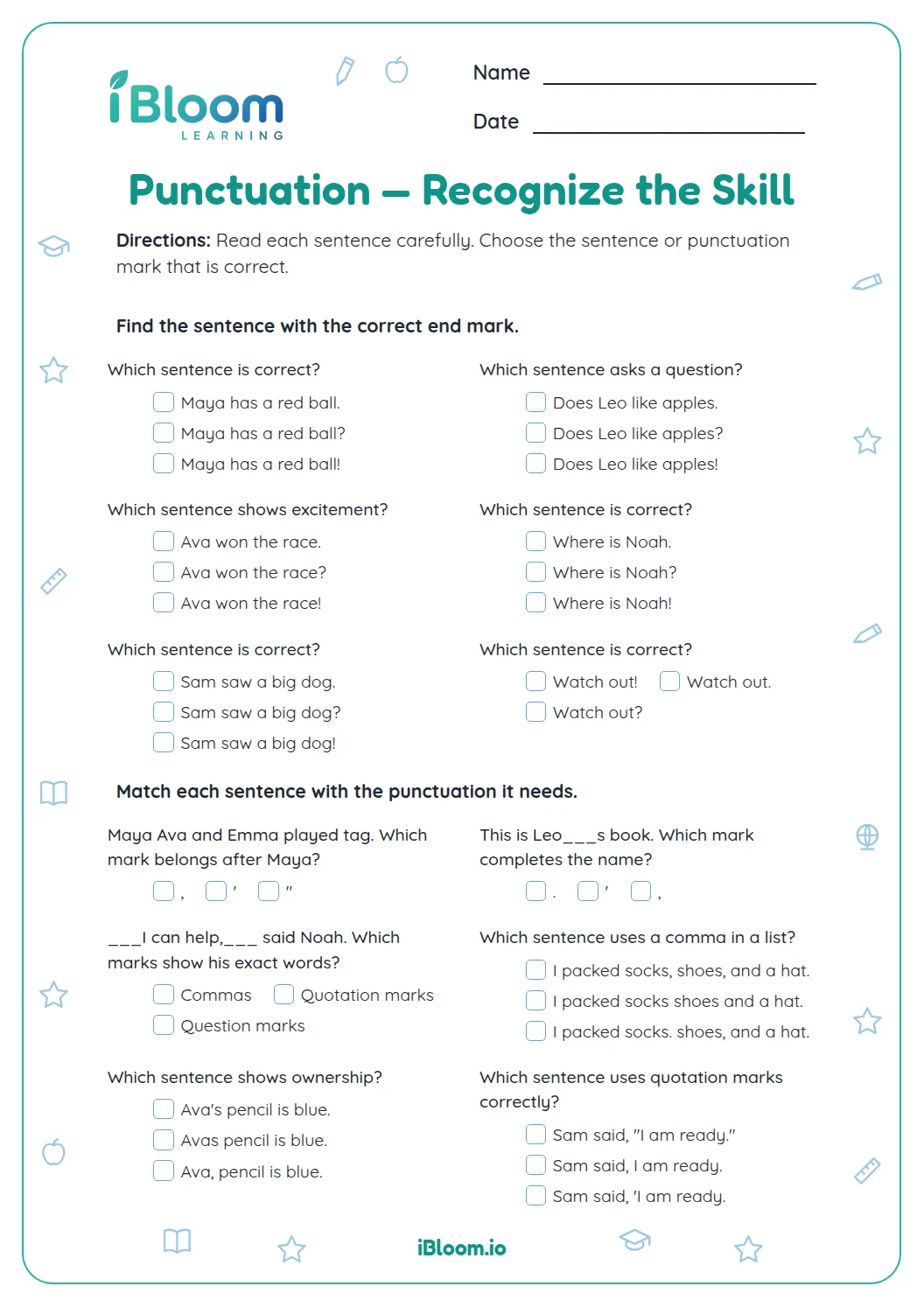
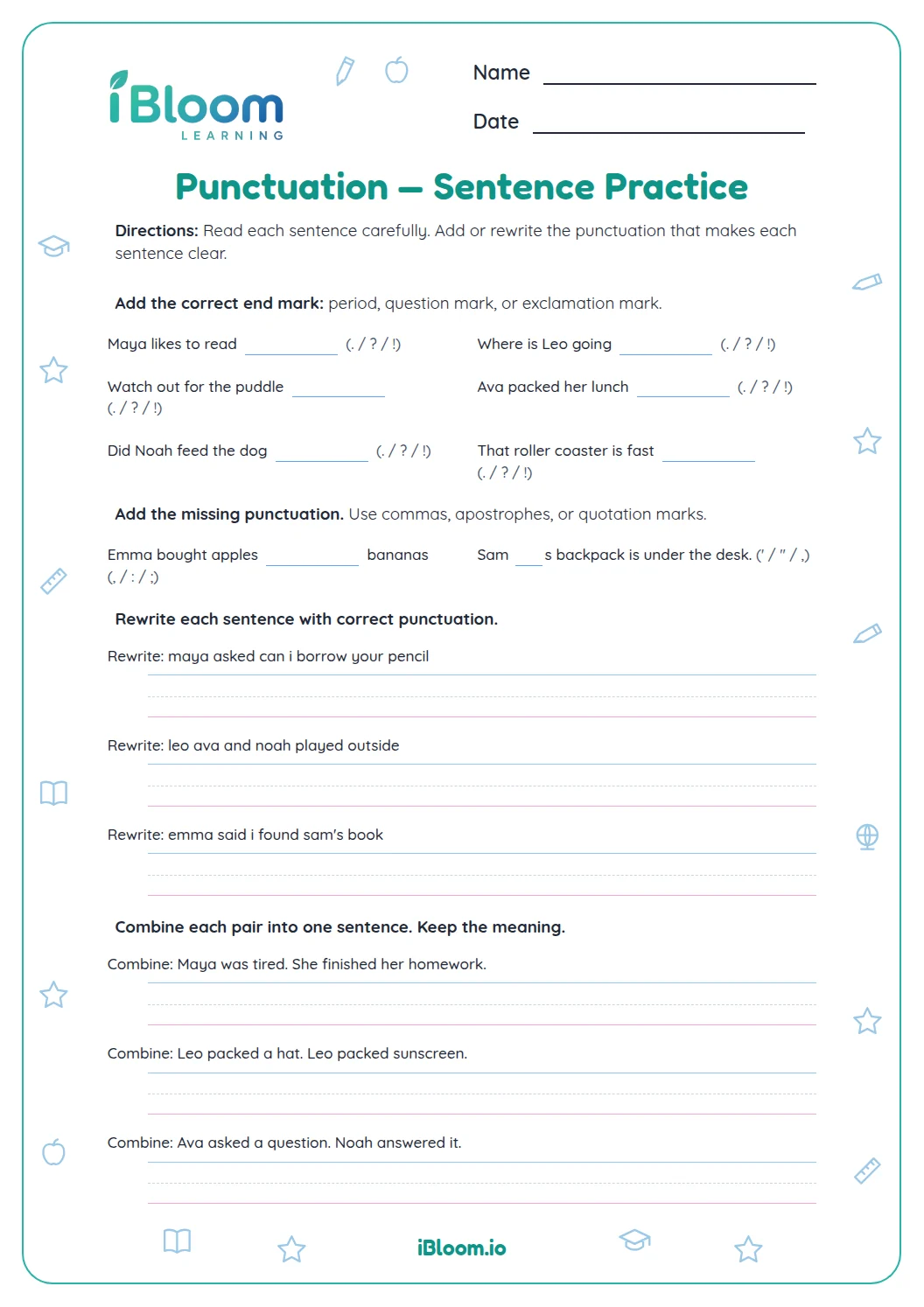
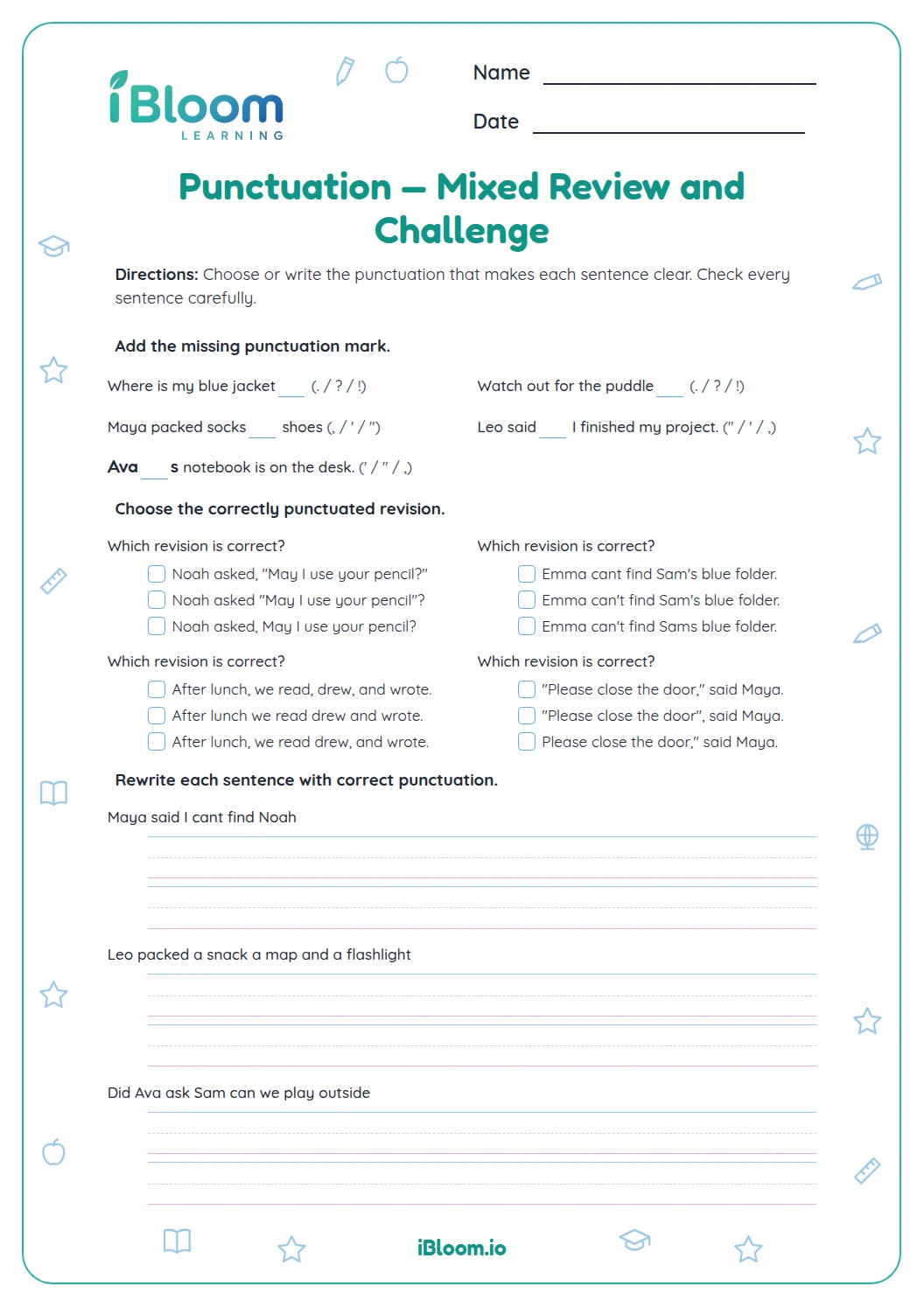
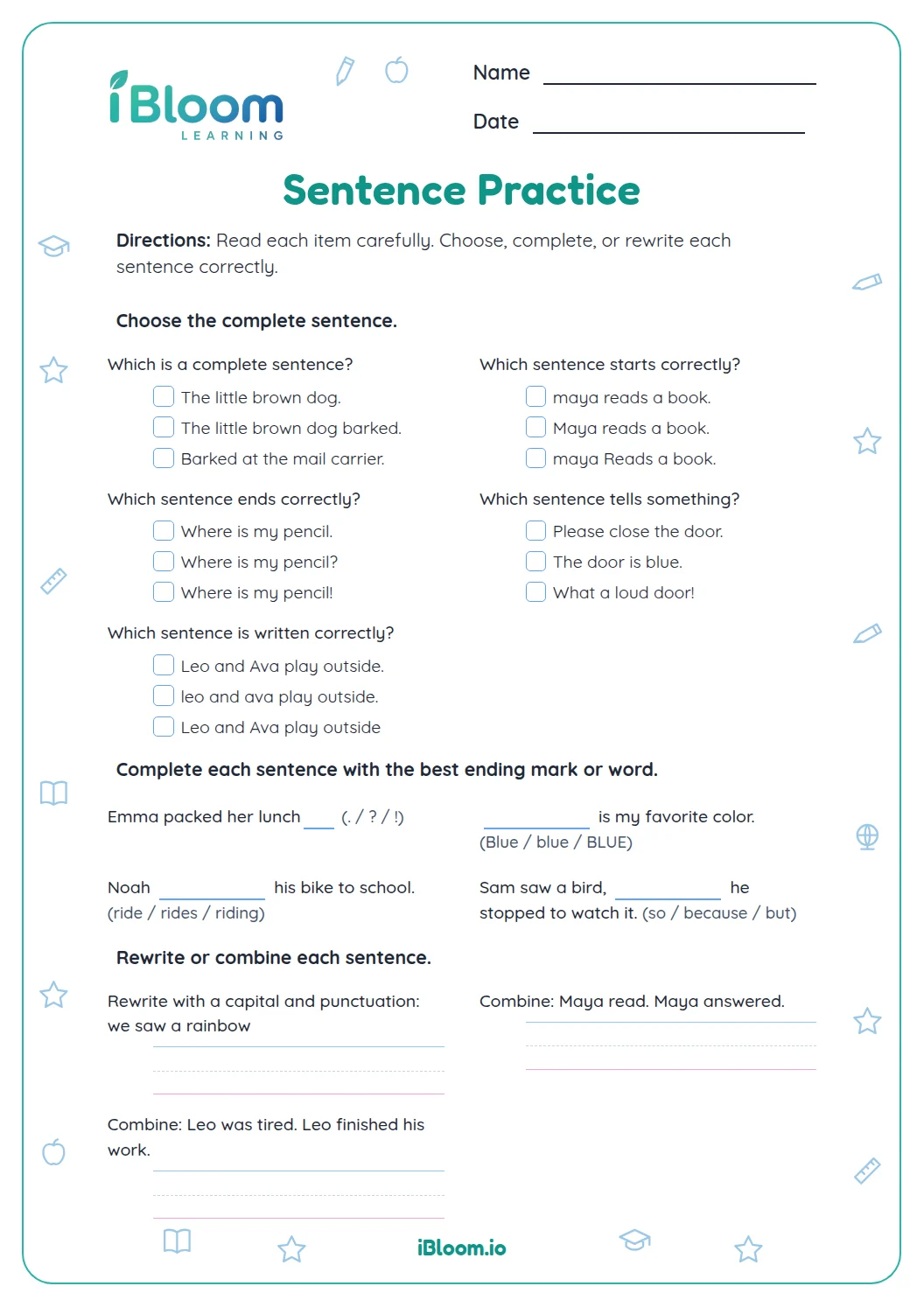
This free printable worksheet gives Grade 2 and Grade 3 students guided practice with the four punctuation jobs that come up most in their own writing. Part A asks for the end mark in five sentences. Part B asks for the comma in a list and after the word said. Part C is about apostrophes in contractions and possessives, with a choice of three spellings each time. In Part D, children rewrite two talking sentences on their own, adding every missing mark and capital letter. It practices Common Core L.2.2.c and L.3.2.c and reviews Grade 1 end marks and list commas. A two-page answer key shows every mark in place.
Aligned to L.2.2.c and L.3.2.c
Which punctuation marks does this worksheet cover?
Four groups of marks appear in order. Part A covers the end marks: a period for a telling sentence, a question mark for an asking sentence and an exclamation point for strong feeling. Part B covers commas, in a list of three and after said before a quotation. Part C covers the apostrophe in contractions such as don't and I'm, and in a possessive such as dog's.
Part D brings in quotation marks. Children rewrite two sentences where nothing has been added: maya asked where is my book and leo said i can help you.
How do you help children choose the right mark?
Ask what the sentence is doing. If it tells something, use a period. If it asks, use a question mark. If someone would say it loudly or with surprise, it may need an exclamation point. Reading the sentence aloud in the right voice usually settles it.
For commas in a list, have children count the things named. Three or more things need a comma between them, and the last comma comes before the word and. For apostrophes, ask "Which two words are squeezed together?" or "Who owns it?" before choosing.
- 1One dog owns the bowl. The ___ bowl is empty.
- 2Choices: dogs, dog's, dogs'
- 3Who owns the bowl? One dog, so we show ownership with 's.
- 4Answer: dog's
What is on this worksheet?
Part A has five sentences with a blank where the mark goes, such as "Our class has a pet turtle___". Part B has four sentences with one comma missing. Part C gives three choices for each of four blanks: three contractions (do not, I am and does not) and one possessive, dog's.
Part D asks for two full rewrites on writing lines. Each one needs a comma, quotation marks, capital letters and an end mark, so the rewrites pull the whole sheet together.
- Part A: 5 end marks (period, question mark, exclamation point)
- Part B: 4 missing commas (3 in lists, 1 after said)
- Part C: 4 apostrophe questions, 3 choices each
- Part D: 2 rewrites with comma, quotation marks, capitals and end mark
How to use this worksheet at home or in class
- 1Review the three end marks aloud. Say "We won" in three voices and ask which mark fits each voice.
- 2Do question 1 together and ask your child to explain why the sentence needs that mark, not only which one.
- 3Have your child finish Parts A and B alone, reading each sentence aloud before writing the mark.
- 4Go through Part C slowly. For each blank, ask "Which words were squeezed together?" or "Who owns it?"
- 5In Part D, read both rewrite sentences aloud. Ask where the speaker's actual words start and stop, then have your child add the quotation marks first.
- 6Check with the answer key. Circle any missed mark and have your child write one new sentence that uses it.
Common mistakes and quick fixes
The mistake
Using a period for every sentence, even a question such as "Can we eat lunch outside today___".
The fix
Have your child read it in their own voice. If their voice goes up at the end, the sentence asks something and needs a question mark.
The mistake
Putting the end mark outside the closing quotation marks in Part D, as in Maya asked, “Where is my book”?
The fix
Explain that the mark belongs to the speaker's words, so it goes inside. Show the shape: the mark first, then the closing quotation mark.
The mistake
Choosing dogs' or dogs for a single dog's bowl, or writing dont without the apostrophe.
The fix
Ask how many dogs. One dog owns it, so 's. For contractions, say the long form, such as do not, and show that the apostrophe takes the place of the missing o.
Common Core alignment
Most US states use the Common Core Language standards or a close state version. These standards name the marks that this sheet practices.
Use an apostrophe in contractions like don't and I'm and in possessives like dog's.
On this sheet: Main standard for Part C: don't, I'm, doesn't and dog's.
Show the official wordingHide the official wording
Use an apostrophe to form contractions and frequently occurring possessives.
Punctuate speech: a comma after said, quotation marks around the words, the end mark inside.
On this sheet: Part D rewrites two speech sentences from scratch, and Part B includes the comma after said.
Show the official wordingHide the official wording
Use commas and quotation marks in dialogue.
What to practice next
Make more practice
Further reading
Questions parents and teachers ask
What is punctuation and why does it matter for young writers?
Punctuation is the set of marks that show where a sentence stops, pauses or changes voice. It matters because the same words can mean different things: "Let's eat, Grandma" is not the same as "Let's eat Grandma." Young writers who use marks correctly are easier to read and understand.
What are the answers to Part C?
The answers are I'm, don't, doesn't and dog's. The first three are contractions: I am becomes I'm, do not becomes don't and does not becomes doesn't. The apostrophe replaces the missing letters. The fourth, dog's bowl, shows that one dog owns the bowl, which is why dogs and dogs' are wrong.
Where does the comma go in a list?
A comma goes between each item in a list of three or more, and before the word and in front of the last item. On this sheet, "Mom bought milk, eggs, and bread" has two commas. The sheet gives you one comma already and asks for the missing one.
Why do the rewrite questions need a capital letter too?
Quotation marks are only one part of correct dialogue. The first word inside the quotes starts with a capital, so "Where is my book?" needs a capital W. Questions 14 and 15 check several skills together, which is why the answer key shows the whole sentence.
Can I use this worksheet with a younger or older child?
Yes. Grade 1 children can do Part A and the list commas with help, since those are Grade 1 skills. Grade 4 students can use the sheet as a quick review, and then move on to commas in compound sentences and direct quotations that are longer than one sentence.
How long does it take and is there an answer key?
Most children finish in about 15 minutes. The last two rewrites take the longest, so have them take a short break before starting them. The answer key is a separate two-page copy that shows every mark in place, including the full corrected sentences for the two rewrites.