



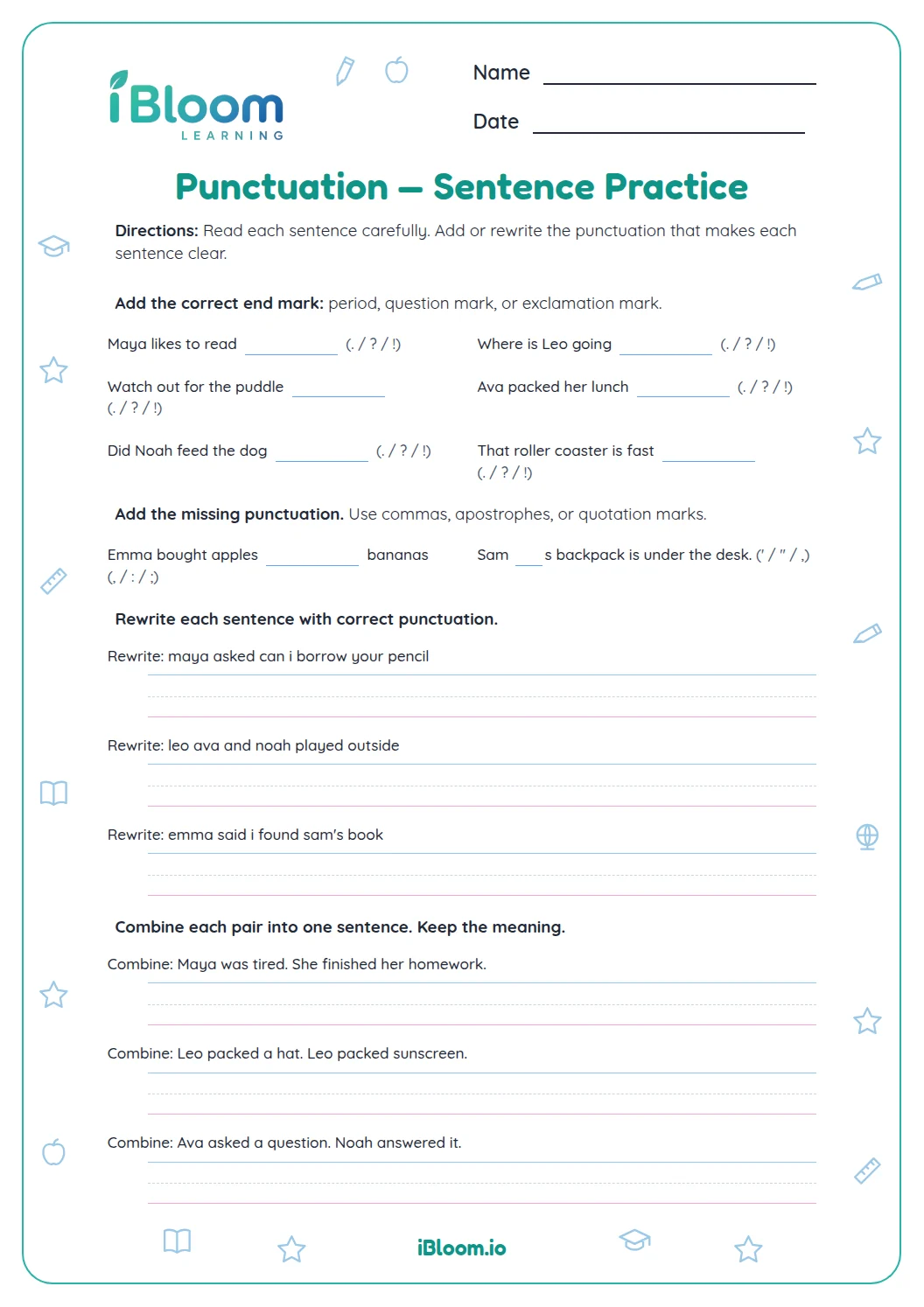
About this worksheet
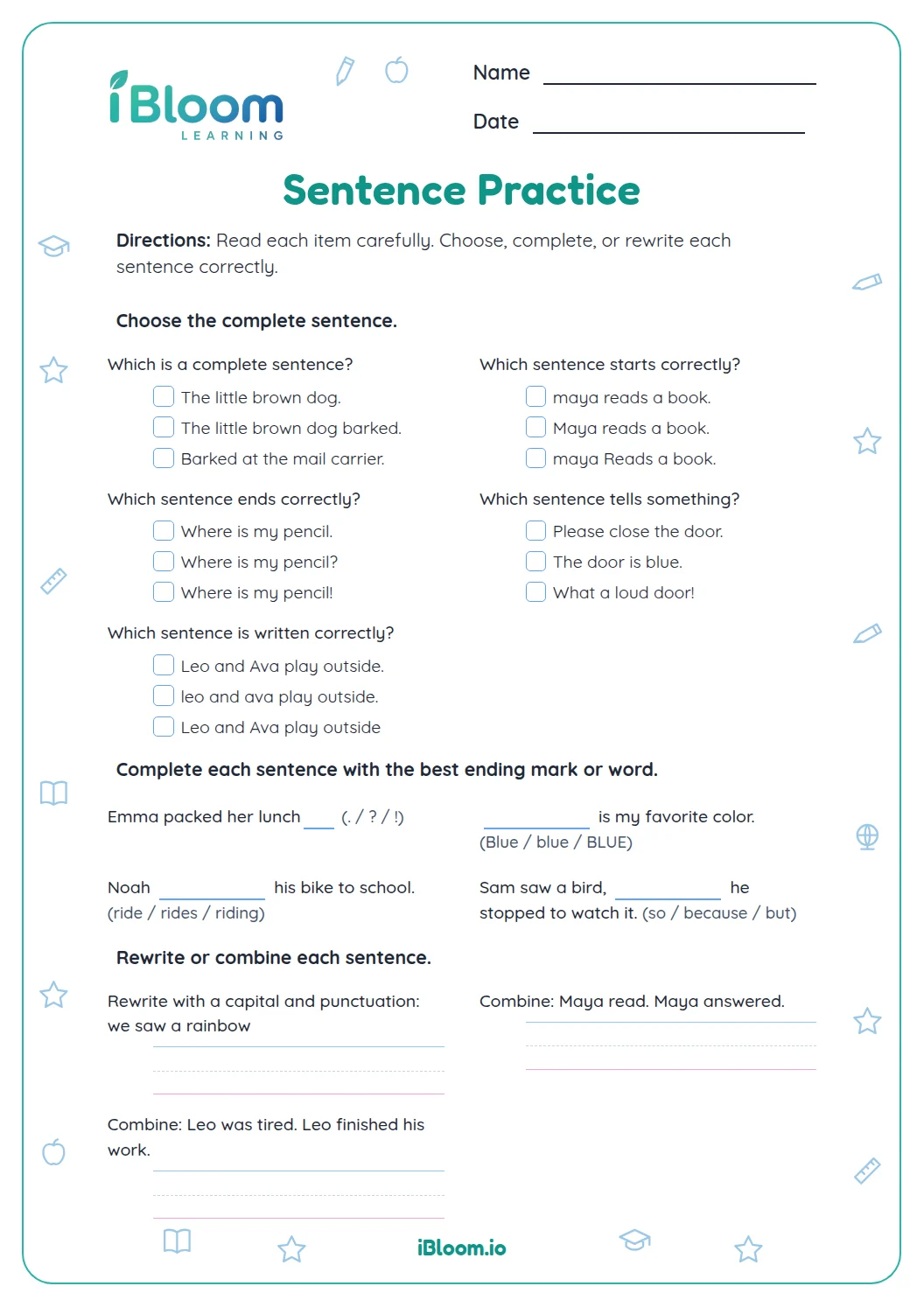
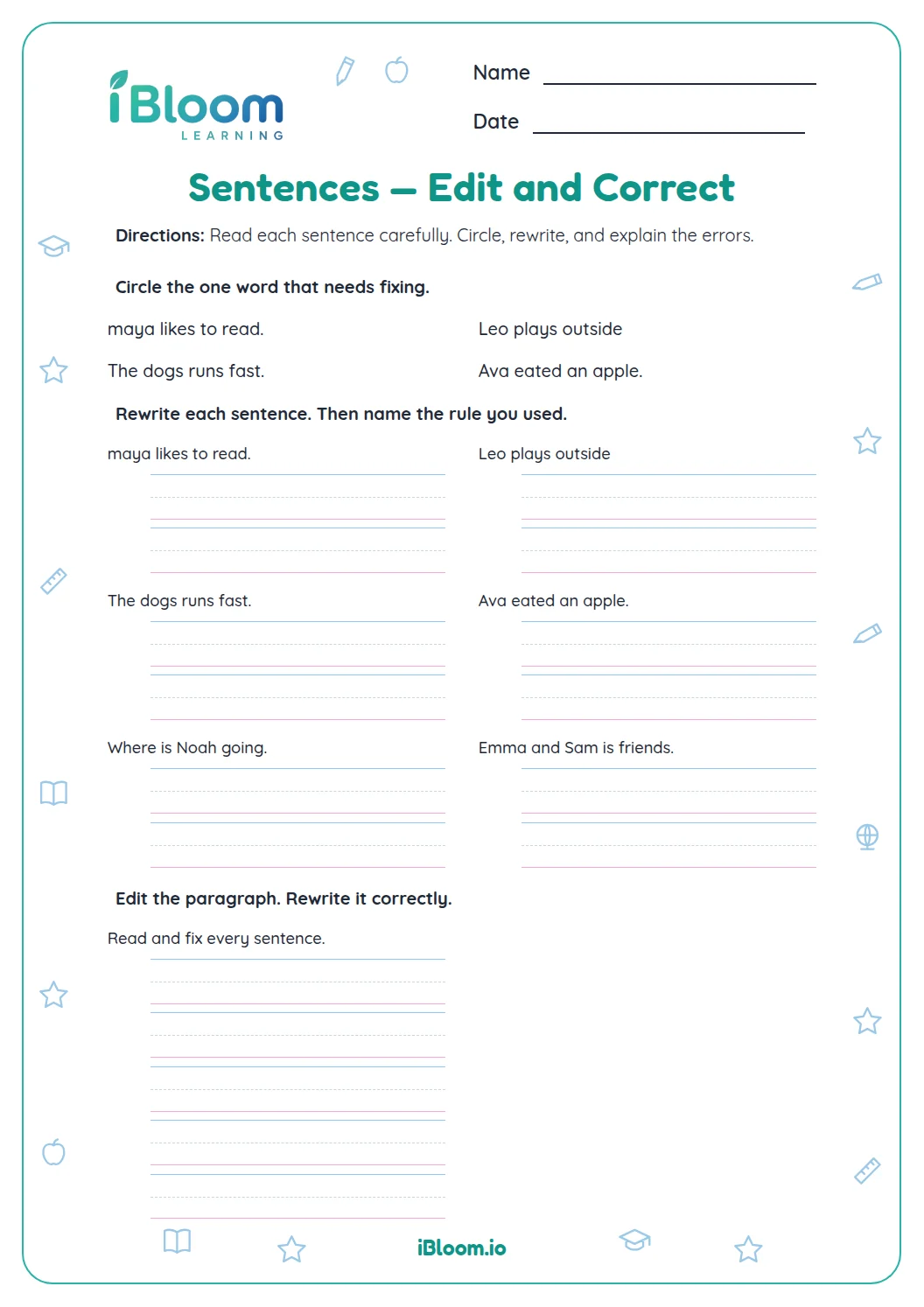
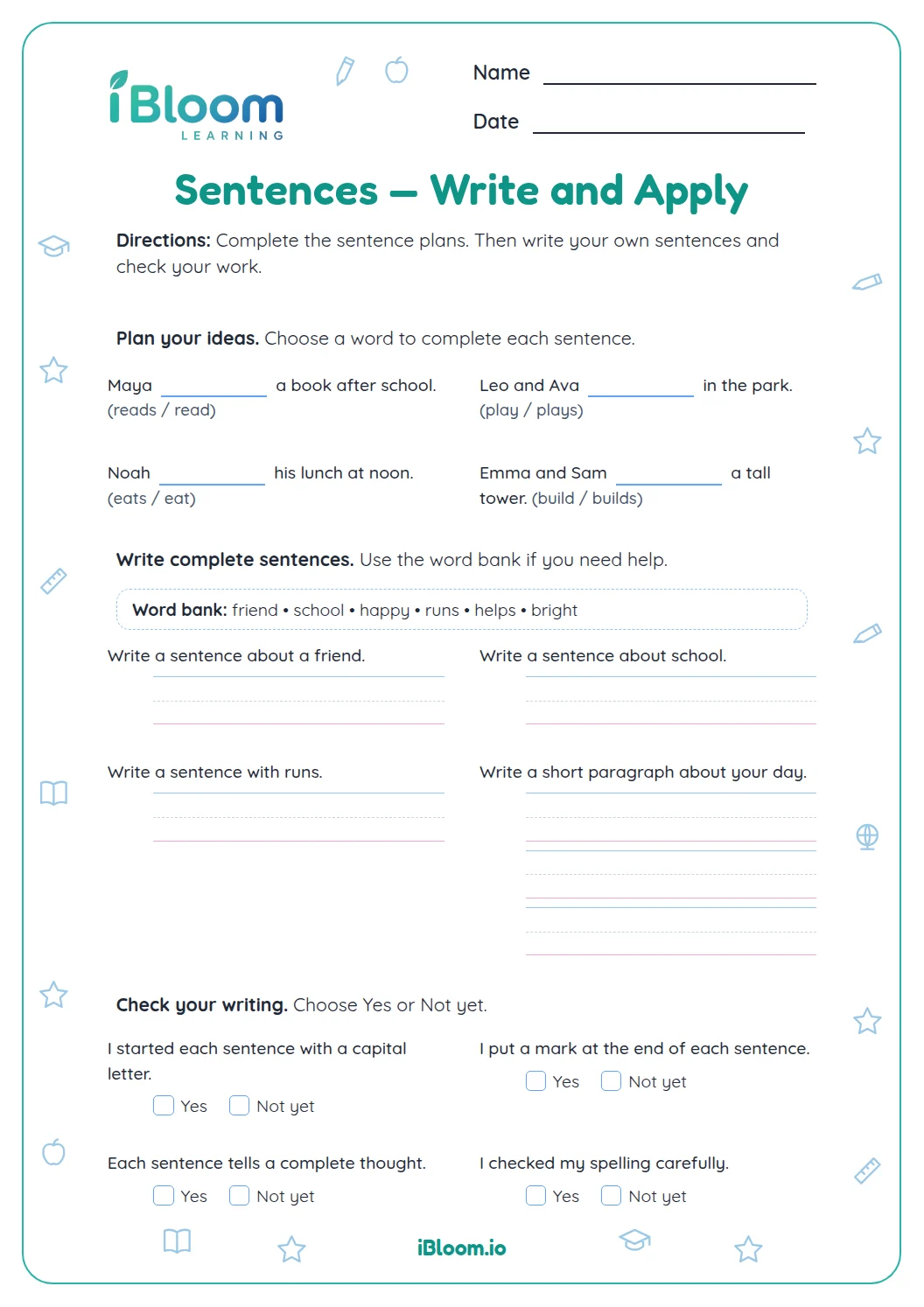
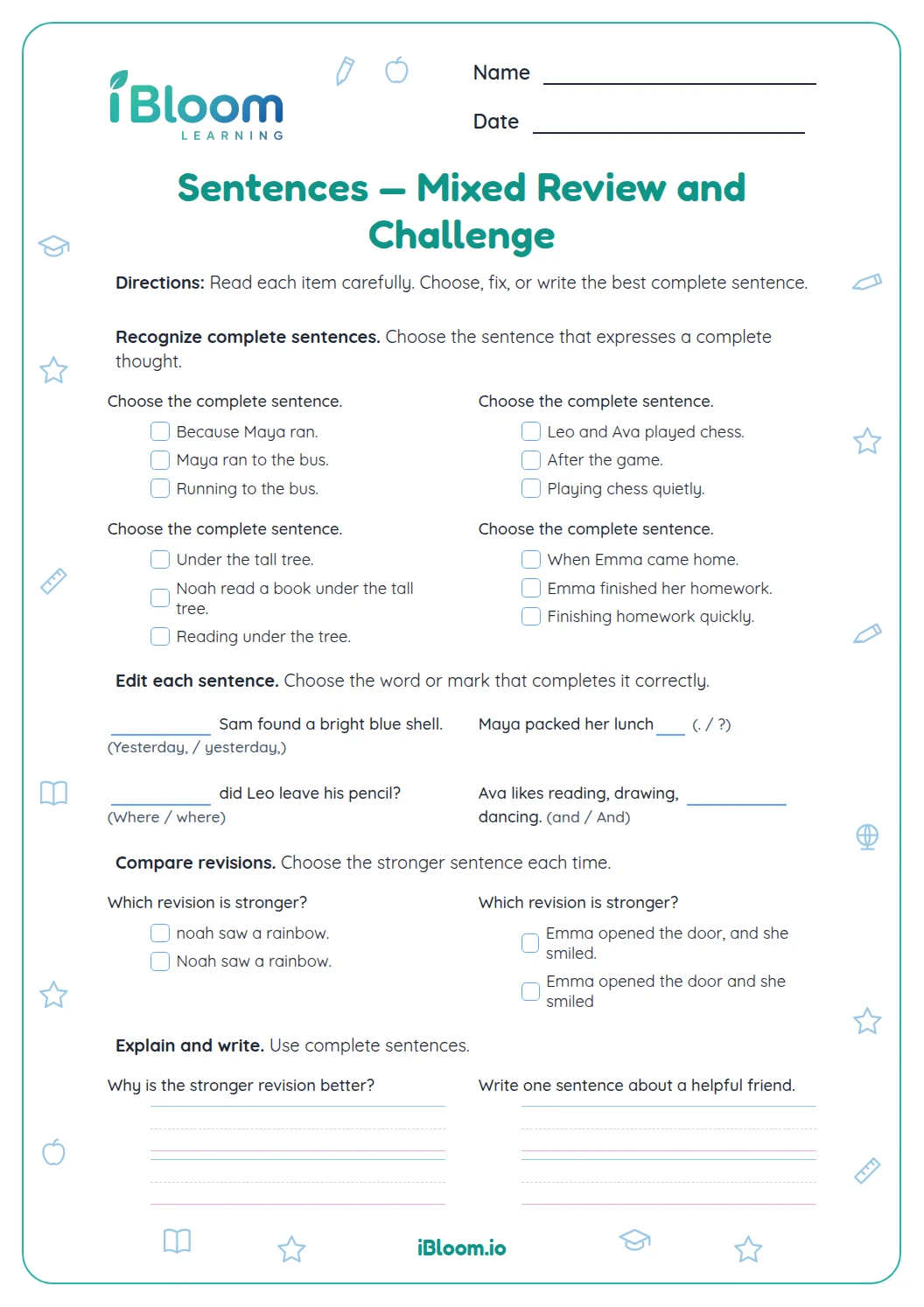
This free printable supports Grades 1–5 learners practicing complete sentences. Children choose complete thoughts, fill a missing word that makes a sentence clear, and add their own subject or action to finish a thought. The tasks move from recognizing a complete sentence to composing a short one. A separate answer key gives the fixed choices and sample responses. The worksheet connects to Common Core L.1.1.j, which calls for producing and expanding complete sentences in response to prompts.
Aligned to L.1.1.j
What kinds of sentence practice are included?
Part A gives eight choices. Children identify a complete thought or select words that finish one. Part B asks children to write a missing word that makes a sentence clear. Part C asks children to supply a subject or action, then finish a thought in their own words.
- Recognize a subject and predicate in a whole thought
- Choose words that fit the sentence meaning
- Add a subject or an action to complete a thought
- Check open responses against the sample key
How can a child complete a sentence?
Look for the part that is missing. In a sentence such as “The sleepy cat ___,” the subject is already there, so the blank needs an action that tells what the cat did.
- 1The prompt gives a subject: “The sleepy cat…”
- 2Add an action word and finish the thought.
- 3Sample: The sleepy cat stretched.
- 4The words now tell who and what happened.
How should open answers be checked?
The final two items ask children to supply a subject or an action. Check that each response forms a complete thought and fits the prompt. A child may write a different sentence from the sample key and still be correct.
How to use this worksheet
- 1Read the whole prompt, including the words before the blank.
- 2For a choice question, say each option aloud with the prompt.
- 3Check that the combined words express a whole thought.
- 4For the last part, add the missing person, thing, or action.
- 5Use the key for fixed answers and accept other complete sentences.
Common mistakes and quick fixes
The mistake
Choosing a phrase that names a thing but gives no complete thought.
The fix
Ask what happened or what the subject does; add an action if that part is missing.
The mistake
Putting a second subject in a blank that needs an action.
The fix
Read the sentence aloud and ask, “What did the subject do?”
The mistake
Treating the sample sentence as the only possible answer.
The fix
Accept any response that completes the thought and makes sense with the prompt.
Common Core alignment
Produce and expand complete sentences in response to prompts.
On this sheet: Children complete prompted thoughts and build complete sentences.
Show the official wordingHide the official wording
Produce and expand complete simple and compound declarative, interrogative, imperative, and exclamatory sentences in response to prompts.
What to practice next
Make more practice
Further reading
Questions parents and teachers ask
What makes a sentence complete?
A complete sentence expresses a whole thought. It usually tells who or what the sentence is about and what that subject does or is. The worksheet gives examples where a subject or action is missing, so children can notice what the sentence needs before filling the blank.
Which grades can use this worksheet?
It is labeled for Grades 1–5 because sentence completion is useful across the elementary grades. Younger learners can focus on the multiple-choice and fill-in sections. Older learners can use the final prompts to create more detailed complete thoughts and explain why their words fit.
How many questions are on the page?
There are 15 questions across three parts: eight multiple-choice items, five fill-in-the-blank sentences, and two open sentence completions. The sequence starts with recognition, moves to completing a sentence with a fitting word, and ends with children supplying words of their own. The answer key gives sample responses for those last two items.
Can answers differ from the answer key?
Yes. The first 13 items provide a word or sentence to complete, while questions 14 and 15 ask children to finish a thought in their own way. The key gives a sample for each. For the fill-ins, accept another word if it makes a sensible, complete sentence with the prompt.
What should I do if my child writes only a phrase?
Read the phrase aloud and ask what information is still missing. If it names a person or thing, ask what that person or thing did. If it gives an action but no subject, ask who or what performed it. Then have the child add the needed words and reread the complete thought.