



About this worksheet
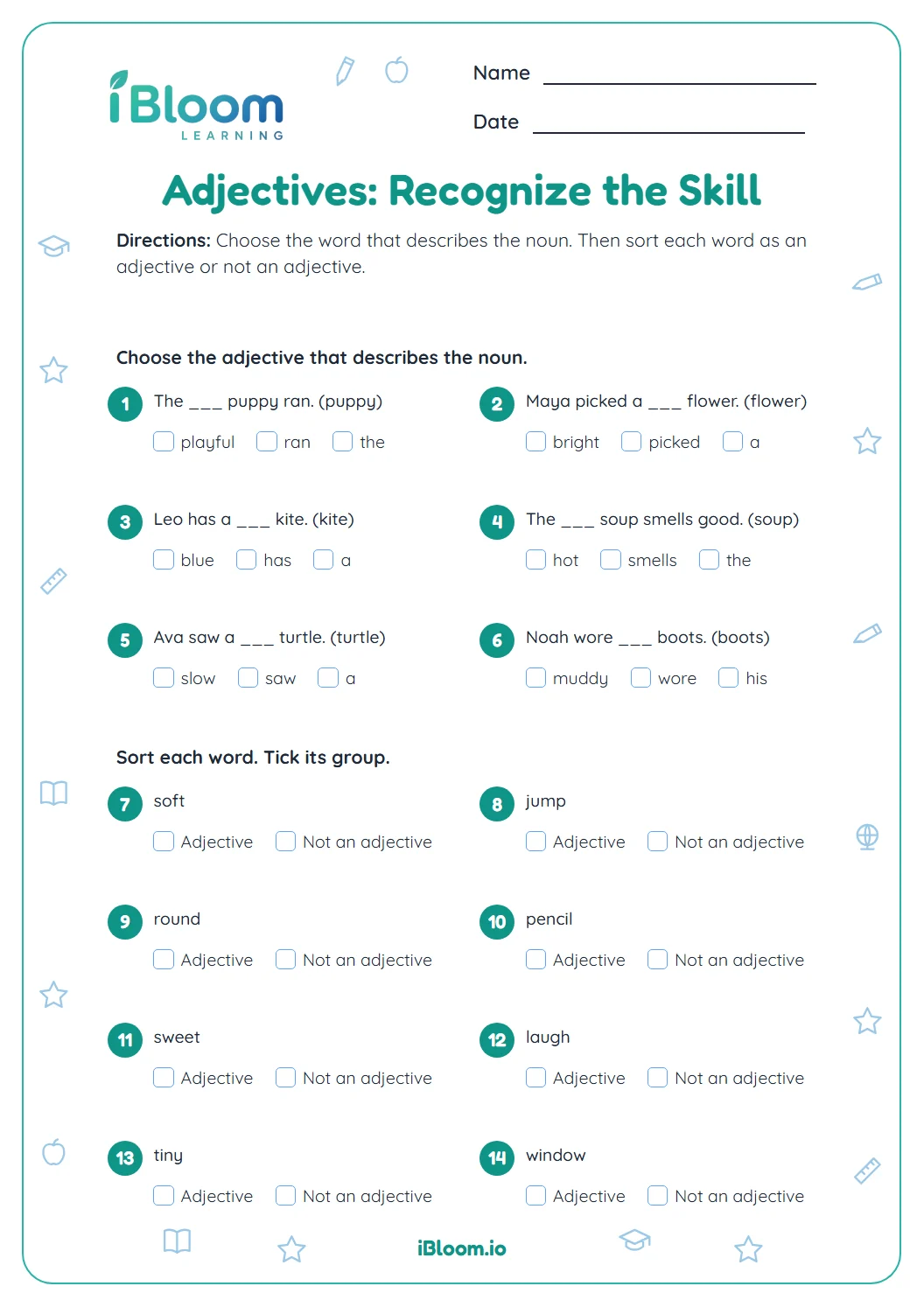
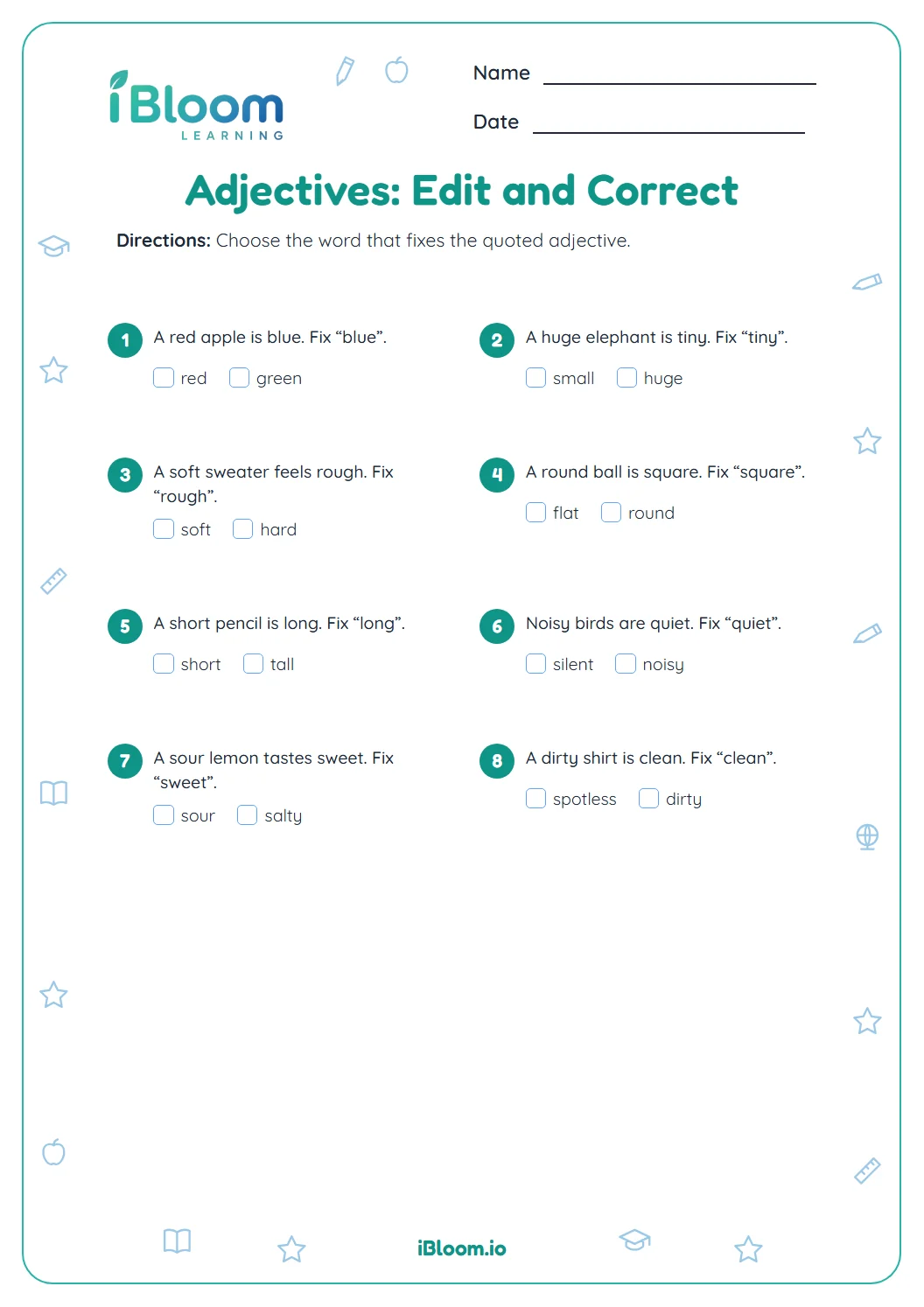
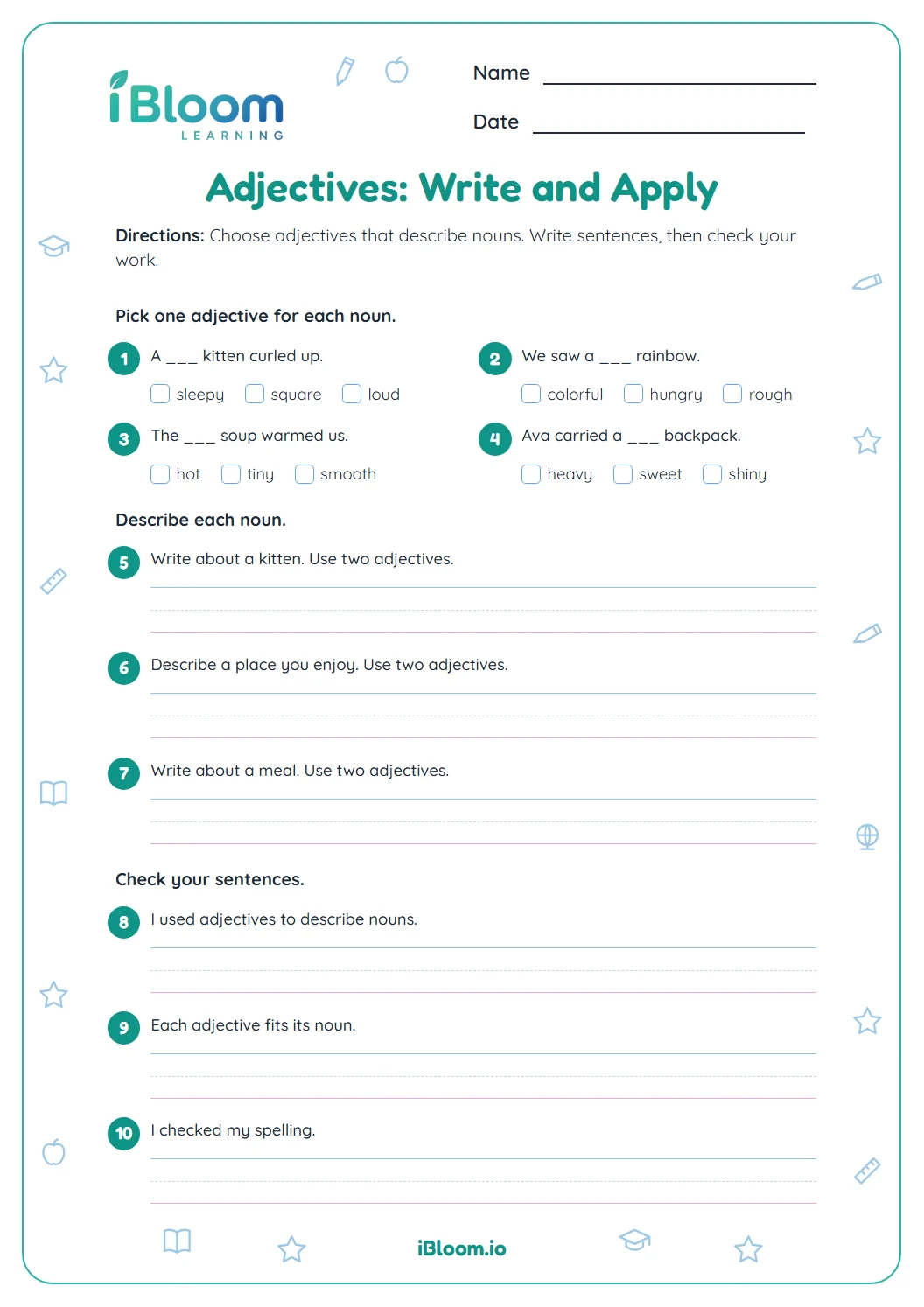
This free printable worksheet gives children sentence-level practice with adjectives, the words that tell what kind of person, place or thing a noun is. It is written for Grades 1 to 5 and fits Grades 2 and 3 best, when children move from spotting adjectives to using them. In Part A, children circle the adjective in four short sentences. In Part B, they pick the adjective that fits a blank, choosing it over an -ly adverb and an action word. In Part C, they rewrite three sentences with an adjective of their own. It practices CCSS L.1.1f and L.2.1e, and the answer key is on a separate page.
Aligned to L.1.1f and L.2.1e
What is an adjective, and how do children spot one?
An adjective is a word that describes a noun. It answers questions such as "What kind?" and "How many?" In "The cold wind blew all day," cold tells what kind of wind it was. Take the word out and the sentence still works, but it tells you less.
A quick test for children is to find the noun and ask which word describes it. Most of the time the adjective sits right before the noun, as in giant turtle or yellow raincoat, which is where Part A of this sheet starts.
- 1Dad baked a ___ loaf of bread.
- 2The noun is loaf. Which word tells what kind of loaf?
- 3slowly tells how Dad baked, so it is not an adjective.
- 4bake is an action, so it does not fit before a noun.
- 5crusty describes the loaf. Answer: crusty
Why does the sheet put loud next to loudly?
Question 7 offers loud, loudly and rumble for "We heard a ___ thunderclap last night." Loudly can look like the right answer because it is built from loud. But thunderclap is a noun, and a noun is described by an adjective, so loud is the right choice.
Each question in Part B has one adjective and two words that cannot describe a noun: an -ly adverb and an action word. Reading the sentence aloud with each choice in the blank is the habit this part builds.
What is on this worksheet?
Eleven questions over two pages, in three parts that move from finding adjectives to choosing them to writing with them.
- Part A, Find the adjective: four short sentences, circle the one word that describes the noun
- Part B, Choose the adjective: four sentences with a blank and three words to pick from
- Part C, Add an adjective: three plain sentences to rewrite with one adjective added
- Answer key on a separate page, with sample sentences for Part C
Why do children rewrite sentences with an added adjective?
Choosing from a list shows that a child recognizes an adjective. Adding one shows that the child can use it. Question 9 gives "The girl opened the box," and the answers will differ: the old box, the big box, the heavy box. Each one changes the picture in the reader's mind.
Any adjective that fits the noun and keeps the sentence sensible is correct. The sample answers on the key are only examples.
How to use this worksheet at home or in class
- 1Warm up by describing something in the room with three words, such as a round, blue, soft pillow. Tell your child these describing words are adjectives.
- 2Do question 1 together. Ask which word is the noun, then which word tells more about it.
- 3Let your child finish Parts A and B alone, reading each sentence aloud with their choice in the blank.
- 4For Part C, ask your child to say the new sentence before writing it, so it sounds right.
- 5Check with the answer key. Count a Part C sentence as correct if the new word describes the noun and the sentence still makes sense.
- 6Ask your child to read a favorite picture book page and point to two adjectives.
Common mistakes and quick fixes
The mistake
Circling the noun instead of the describing word, such as circling cloud in "A fluffy cloud floated by."
The fix
Ask, "Which word is the thing, and which word tells about the thing?" The thing is the noun. The word that tells about it is the adjective.
The mistake
Choosing an -ly word, such as loudly, to describe a noun.
The fix
Read the sentence with the word in the blank. "A loudly thunderclap" sounds wrong. A word before a noun usually needs to be an adjective, like loud.
The mistake
Adding a word that is not an adjective, such as "The girl opened the box quickly."
The fix
Quickly tells how she opened it, so it is an adverb. Ask which word could describe the box itself: size, color, shape or how it feels, as in old box, red box or heavy box.
Common Core alignment
Most US states use the Common Core standards or a close state version. This sheet practices the two language standards below.
Use common adjectives, like fluffy, giant and yellow, in sentences.
On this sheet: Children find, choose and add everyday adjectives such as tall, deep and crusty.
Show the official wordingHide the official wording
Use frequently occurring adjectives.
Choose an adjective, not an adverb, when the word describes a noun.
On this sheet: Part B picks loud over loudly and crusty over slowly because each blank describes a noun.
Show the official wordingHide the official wording
Use adjectives and adverbs, and choose between them depending on what is to be modified.
What to practice next
Make more practice
Further reading
Questions parents and teachers ask
What is an adjective in simple words?
An adjective is a word that describes a noun. It tells what kind, how many or which one. In "We saw a giant turtle today," giant is the adjective because it tells what kind of turtle it was. Children can find it by locating the noun first.
What is the difference between loud and loudly in question 7?
Loud is an adjective and describes a noun, while loudly is an adverb and describes how something happens. In "We heard a ___ thunderclap," thunderclap is a noun, so loud fits. Loudly would describe a verb, as in "The thunder rumbled loudly."
Can my child use any adjective in Part C?
Yes. Any adjective that describes the noun and keeps the sentence sensible is correct. For "A truck drove down the road," a red truck, a loud truck or a long road all work. The key gives one sample each, but your child's own word counts.
Which grades is this adjectives worksheet for?
It is written for Grades 1 to 5 and fits Grades 2 and 3 best. Younger children can do Parts A and B with help and say their Part C sentence aloud before a grown-up writes it. Older children can add two adjectives in Part C or explain why each wrong choice in Part B cannot describe the noun.
Where does the adjective go in a sentence?
Most often, an adjective comes right before the noun it describes, as in yellow raincoat or tall giraffe. It can also come after a linking verb, as in "The soup is hot." This sheet uses the before-the-noun pattern, which is the easiest for young children to see.
Is there an answer key for this worksheet?
Yes. The separate answer key page shows the circled adjective in each Part A sentence, the correct choice for every Part B question, and a sample rewritten sentence for each Part C question. Print the worksheet alone, keep the key for checking, or download both pages as a PDF.