



About this worksheet
This Grade 3 grammar worksheet helps students recognize adverbs and notice what information they add to an action. Sixteen questions move from selecting adverbs in sentences to identifying whether an adverb tells how, when, or where, then completing original examples. The answer key includes sample responses for open-ended items.
How do students spot an adverb?
An adverb can describe an action by telling how, when, or where it happens. Students first select an adverb in a sentence or identify a word group made up of adverbs.
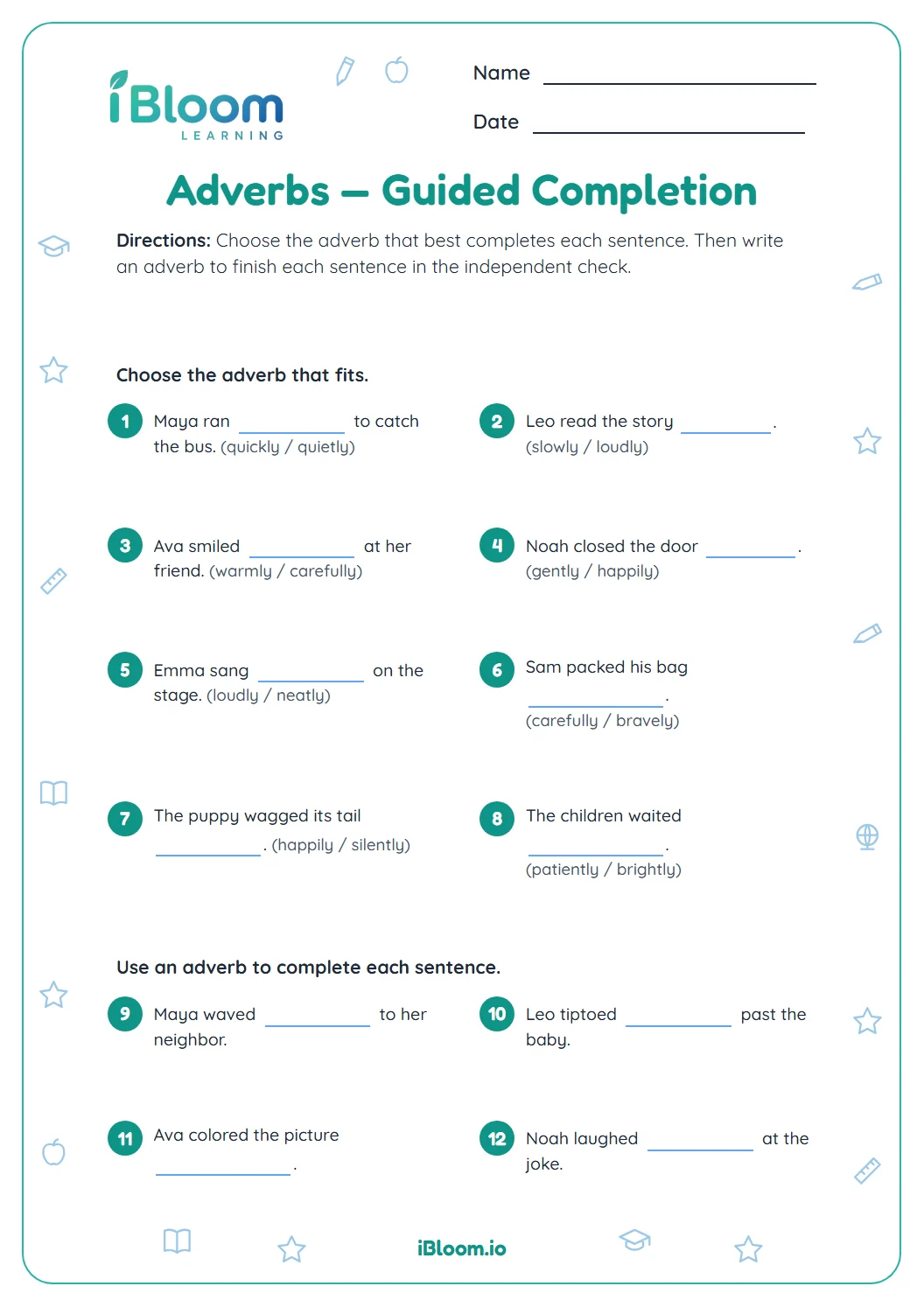
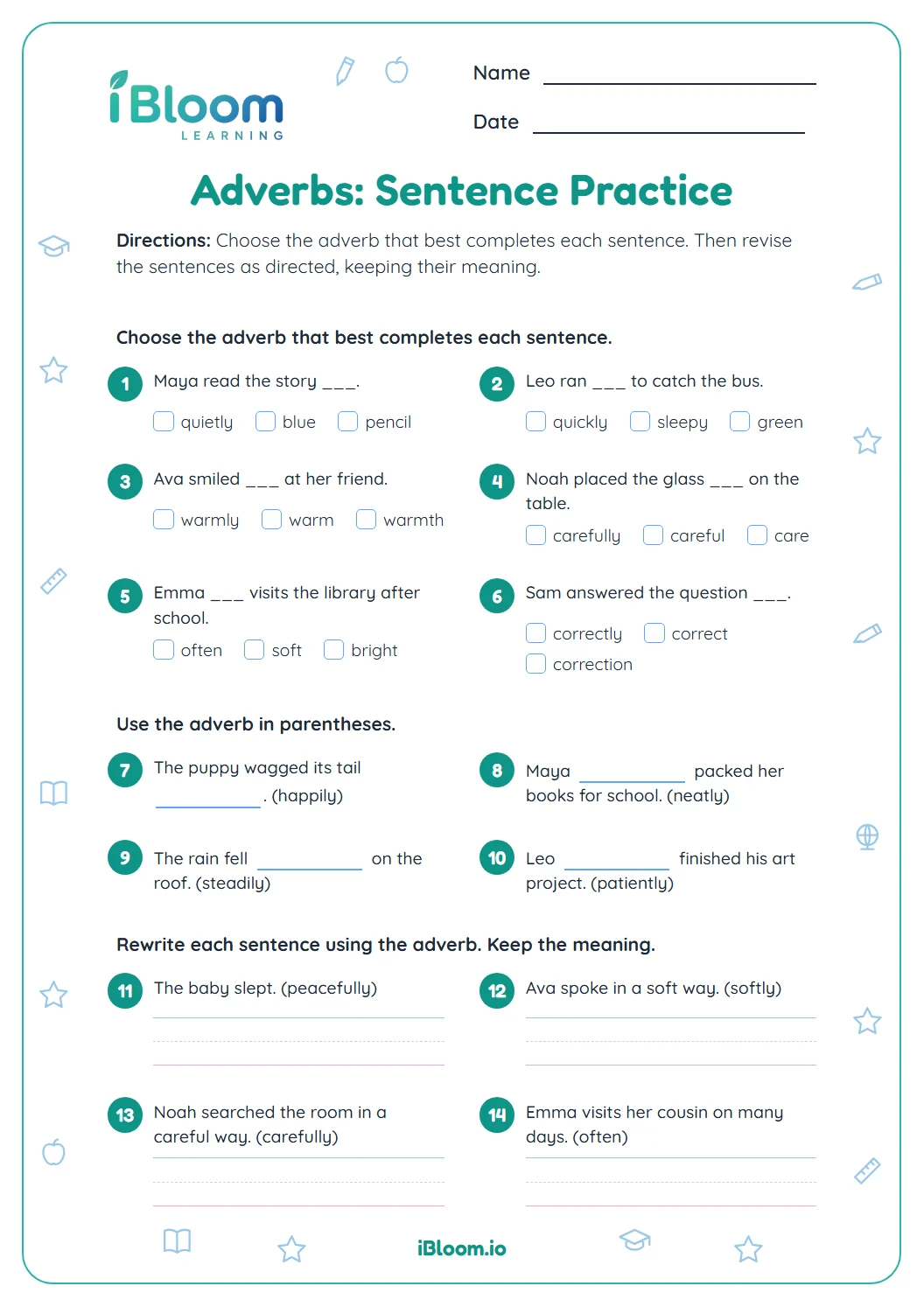
- Questions 1–8 focus on finding adverbs.
- Questions 9–12 ask what an adverb tells.
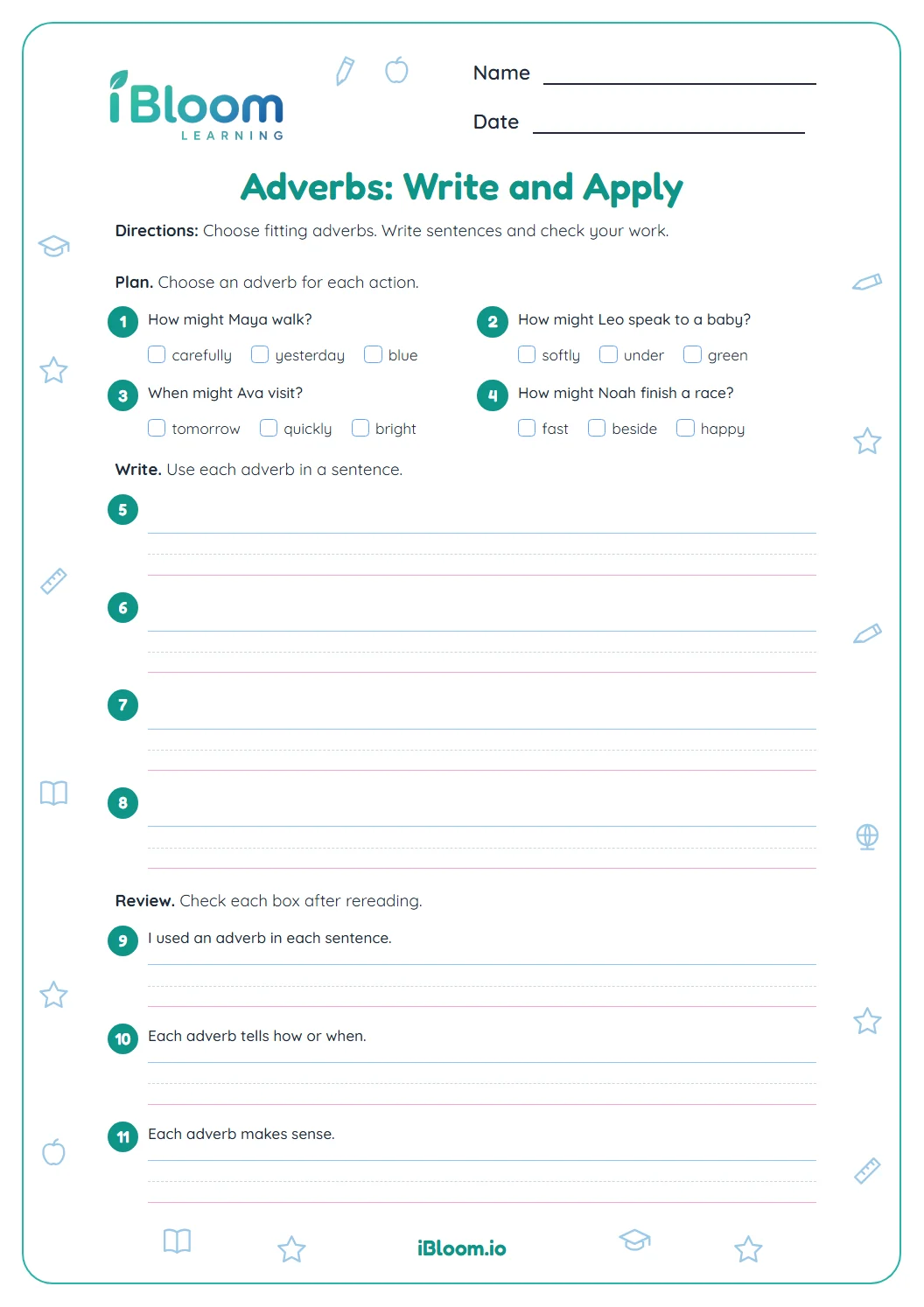
- Questions 13–16 ask students to supply an adverb or write a sentence.
How can students tell what an adverb describes?
Find the action word, then ask what extra detail the adverb adds. In a sentence such as “The puppy barked loudly,” loudly tells how the puppy barked.
- 1“The rain fell steadily.” Steadily tells how the rain fell.
Can an adverb tell more than how?
Yes. Some adverbs tell when an action happens, such as “yesterday,” and some tell where, such as “nearby.” Read the whole sentence to see which question the adverb answers.
How can students write their own examples?
Choose an action, then add an adverb that clearly tells how, when, or where it happens. Check that the word describes the action rather than naming a person, place, or thing.
How to use this worksheet
- 1Read the complete sentence before choosing a word.
- 2Find the action the word describes.
- 3Ask whether the adverb tells how, when, or where.
- 4For open-ended blanks, choose an adverb that fits the sentence.
- 5Check written examples for an action and an adverb that describes it.
Common mistakes and fixes
The mistake
Choosing a word because it ends in -ly.
The fix
Check how the word works in the sentence; use meaning as well as its ending.
The mistake
Confusing an adjective with an adverb.
The fix
Ask whether the word describes a noun or tells more about an action.
The mistake
Giving an adverb that does not fit the sentence.
The fix
Read the completed sentence aloud and check that the adverb answers the requested question.
What to practice next
Make more practice
Questions parents and teachers ask
How many questions are included?
The worksheet contains 16 questions in four parts. Students find adverbs, decide what information they add, and write their own examples. Most items are multiple choice, followed by short responses in the final part. Look at each word’s role in its sentence.
What kinds of information can adverbs give?
On this page, students practice adverbs that tell how, when, or where an action happens. For example, “softly” tells how, “yesterday” tells when, and “nearby” tells where. Use the sentence to understand the word’s job. Check the word group against the sentence meaning.
Does every adverb end in -ly?
No. Many adverbs end in -ly, but not all do. Words such as “soon,” “high,” and “nearby” can act as adverbs depending on the sentence. Decide by asking what the word tells about the action. The surrounding words make the adverb’s job clearer.
How can students tell an adverb from an adjective?
Look at the word the describing word goes with. An adjective describes a noun, while an adverb on this page adds information about an action. In “The turtle moved slowly,” slowly tells how the turtle moved. Sentence context helps distinguish the word’s function.
Are there written-response questions?
Yes. The final part includes short responses: students supply an adverb that tells how or when, then write a sentence using an adverb that tells where. The answer key gives sample responses; other correct answers may also fit. The model answers illustrate one possible correct response.
Is an answer key included?
Yes. The separate answer key lists the multiple-choice answers and sample responses for the open-ended items. If a student gives a different adverb, check that it fits the sentence and tells the kind of information requested. Use the sentence context to confirm that the response makes sense.