



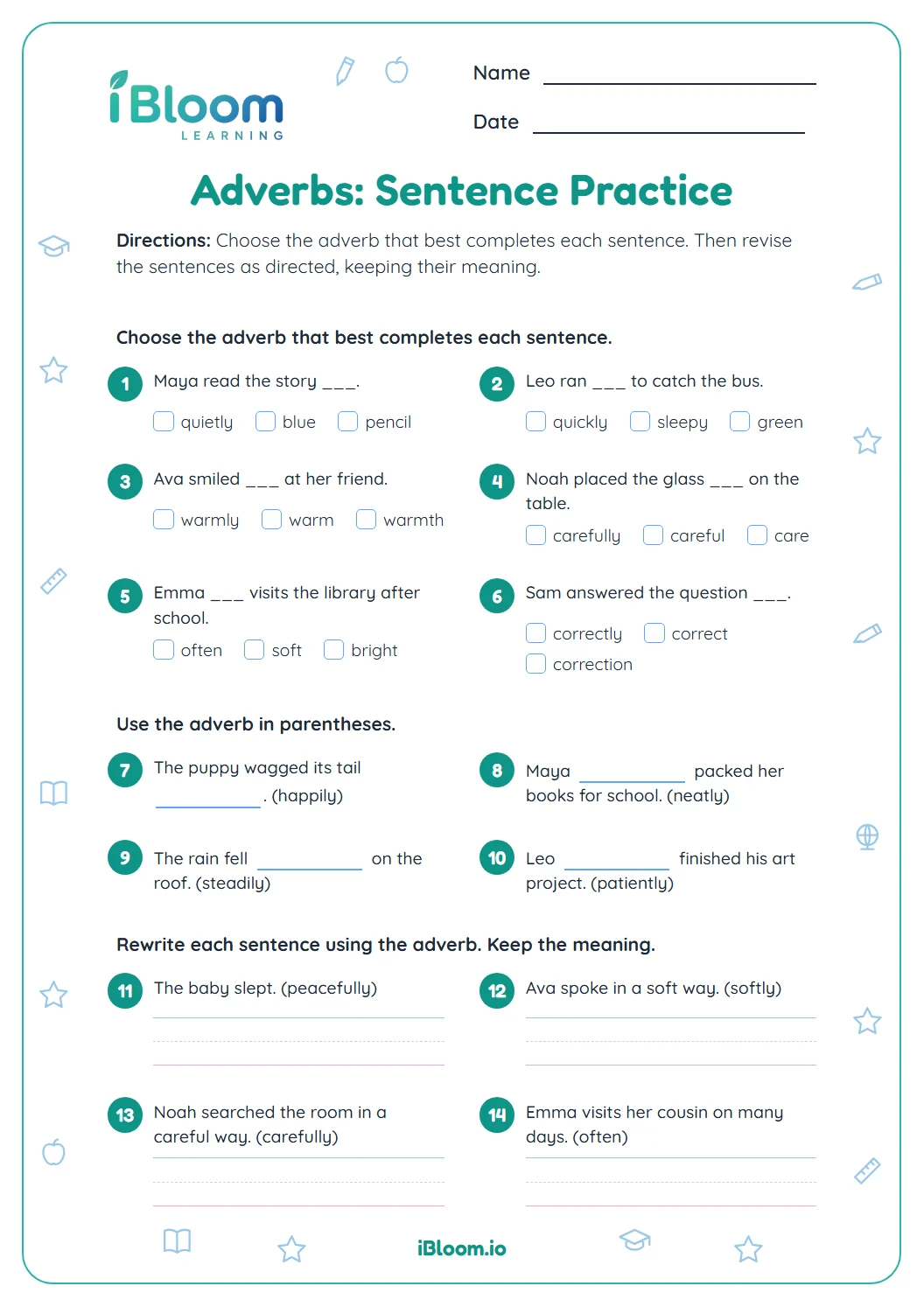
About this worksheet
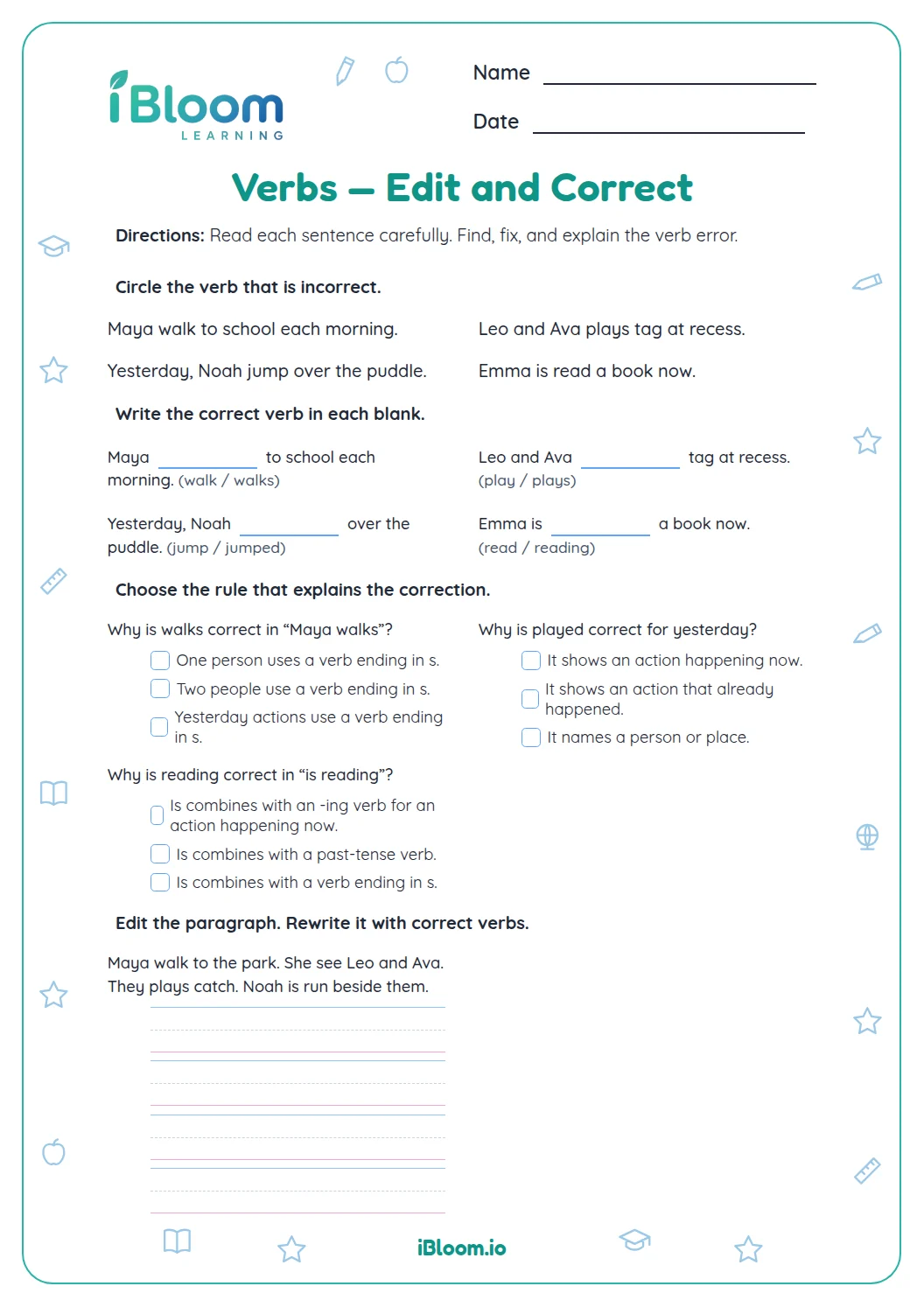
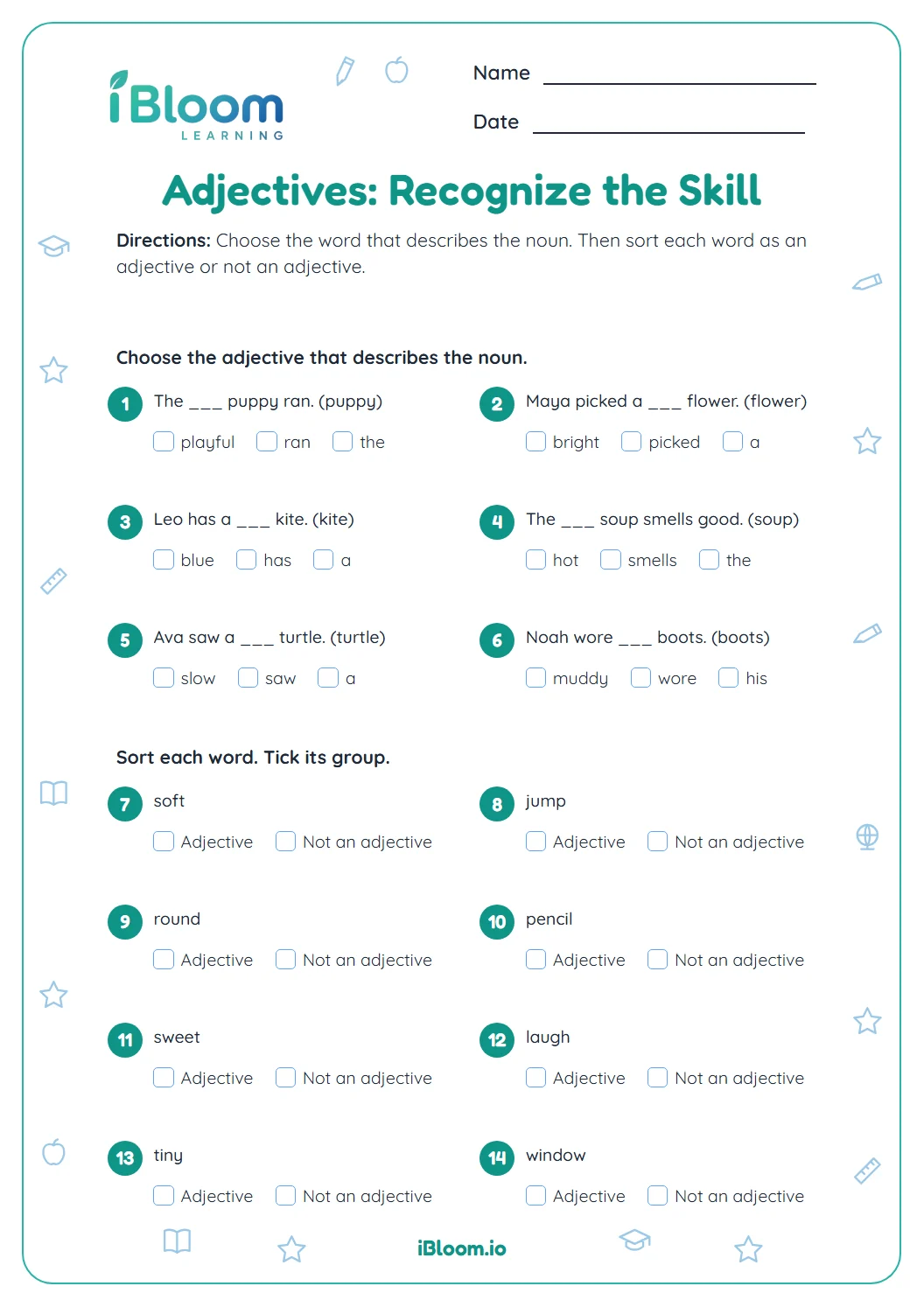
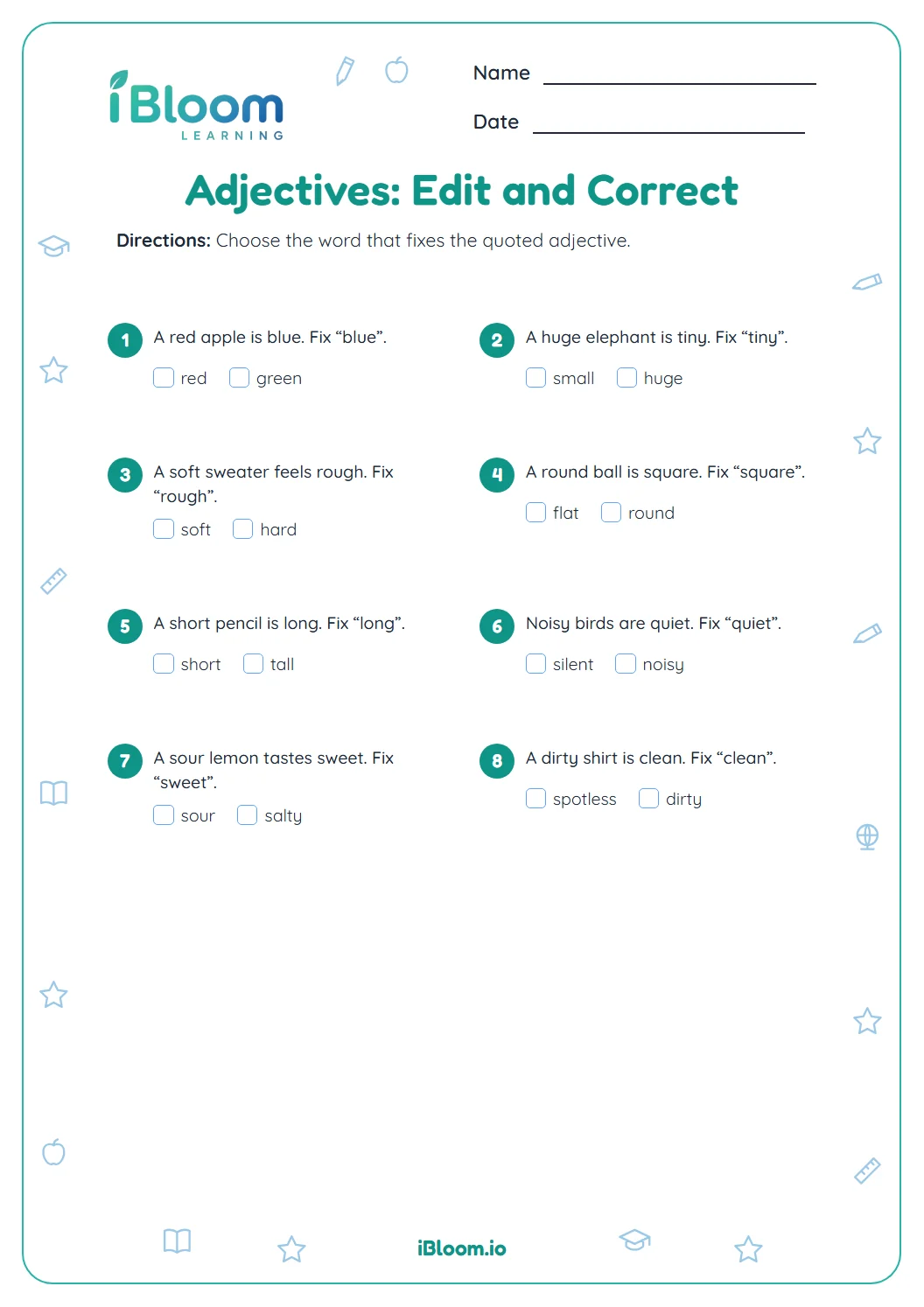
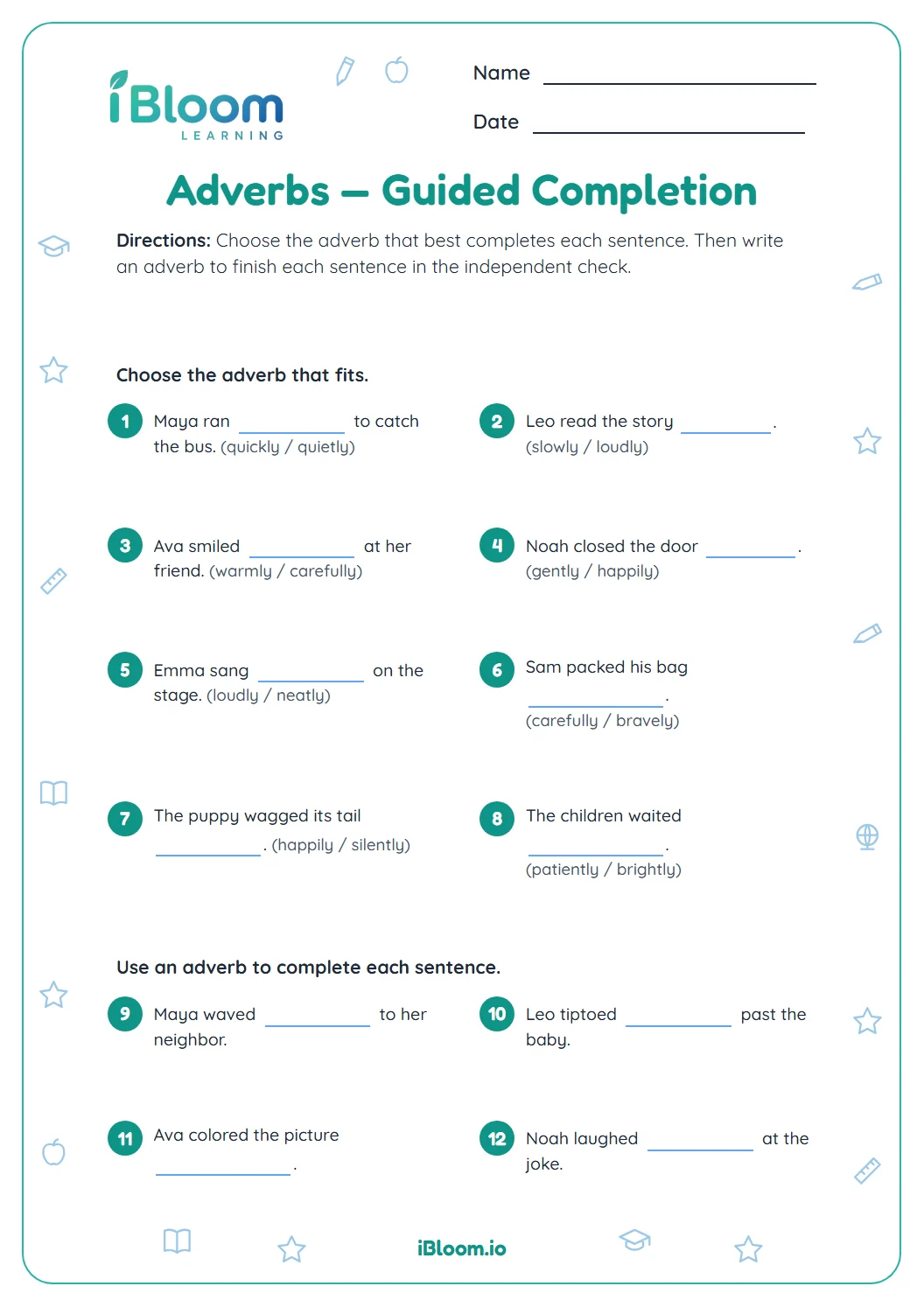
This printable gives Grades 1–5 learners 14 sentence tasks in four parts. Students circle a named word, identify a bold word’s part of speech, complete sentences with a requested word job, then revise and write sentences. The key marks the exact words and offers sample revisions. The skill focus stays on recognizing how nouns, verbs, adjectives, and adverbs work in sentences.
Aligned to L.3.1a
How does the first part review word recognition?
Students circle a noun, verb, adjective, and adverb in complete sentences. These are the same kinds of words they will classify and use later on the sheet.
How do students name a word’s part of speech?
Part B asks children to classify a bold word in its sentence. For example, “puppy” names an animal, so it is a noun. The sentence provides context for identifying the word job.
- 1Question 5: Choose the part of speech for “puppy.”
- 2Answer: noun
- 3Puppy names an animal.
What do students write at the end?
The final part asks students to combine two sentences with and and add a descriptive word. Sample answers show possible revisions; other grammatical sentences can also work.
How to use this worksheet
- 1Read each sentence before naming a word job.
- 2Circle only the word named in Part A.
- 3Use the surrounding sentence to classify each bold word.
- 4Choose a word that fits both the sentence and the requested job.
- 5Compare written revisions with the sample key, accepting other correct sentences.
Mistakes to notice and how to help
The mistake
Choosing a word only because it fits the topic.
The fix
In “The bird can ___,” choose an action the bird can do, such as fly.
The mistake
Confusing an adverb with a noun in a sentence.
The fix
Ask whether the word tells how an action happens or names a person, place, or thing.
The mistake
Adding a describing word that does not fit the noun.
The fix
In “Leo saw a ___ dog,” choose an adjective that can describe a dog.
Common Core alignment
Identify and use parts of speech in the sentences on the worksheet.
On this sheet: Students identify and use nouns, verbs, adjectives, and adverbs in particular sentences.
Show the official wordingHide the official wording
Explain the function of nouns, pronouns, verbs, adjectives, and adverbs in general and their functions in particular sentences.
What to practice next
Make more practice
Further reading
Questions parents and teachers ask
Which ages can use this sentence practice?
The sheet belongs to the Grades 1–5 collection and works best when the child can read short sentences. Younger children can answer aloud before writing with help. Older students can complete it independently and explain why each chosen word performs the requested job.
Which parts of speech does this worksheet practice?
The sheet practices nouns, verbs, adjectives, and adverbs through fourteen tasks. Students circle examples, identify a word in context, complete sentences, and revise their own sentences. The practice includes both recognition and use, with a sample key for the open-ended writing.
What word jobs do the first eight questions ask students to identify?
Questions 1–4 ask students to circle a noun, verb, adjective, and adverb in that order. Questions 5–8 ask for the part of speech of puppy, red, and, and smiled. The key identifies each target word and gives the matching category.
Can the written answers differ from the key?
Yes. Questions 13 and 14 ask students to combine two sentences and add an adjective. The answer key offers one possible revision, but other complete sentences that follow the prompt can also be correct. Read the sentence aloud to check that the added word fits.
How can I help a child who confuses adjectives and adverbs?
Ask which word is being described in the sentence. In “The pillow feels soft,” soft describes the pillow. In “The snail moves slowly,” slowly tells how the snail moves. Point to pillow or moves as the child explains, then try the same question with a new sentence.