

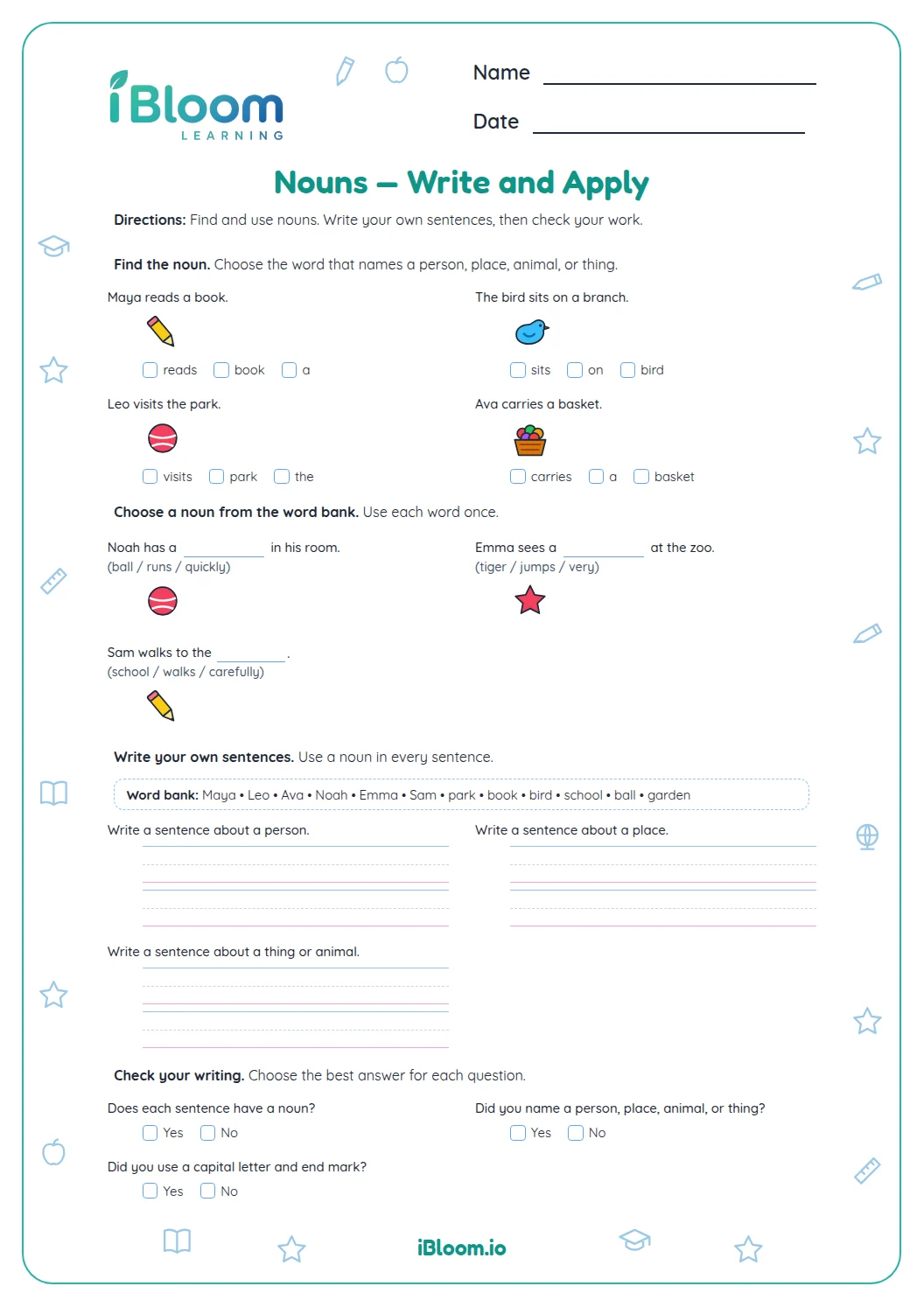
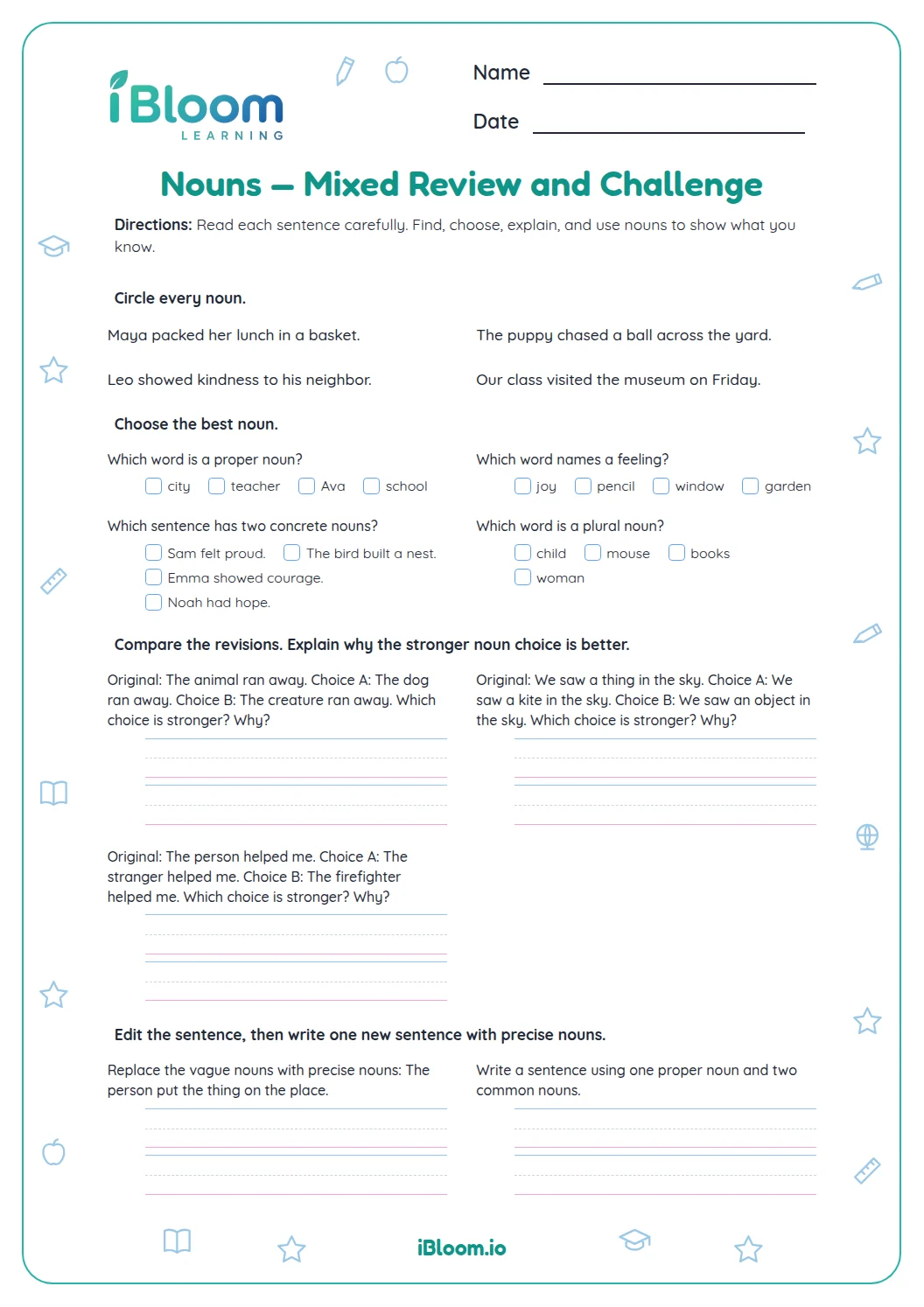
About this worksheet
This Grade 3 printable revisits a foundational grammar skill: recognizing nouns. Students find naming words in sentences, sort common and proper nouns, then distinguish nouns from verbs and describing words. The 15 questions are grouped into three parts, with a separate answer key for checking sentence answers.
Aligned to L.1.1.b
What noun practice is on the page?
Part A asks students to find the naming words in five complete sentences. Part B focuses on whether a named person, place, or day is common or proper. Part C contrasts nouns with verbs and describing words.
Some Part A sentences contain two target nouns, so students should read the whole sentence and include both. The key makes the expected pair explicit.
- Part A: identify nouns in sentences
- Part B: classify common and proper nouns
- Part C: choose the noun in a word pair
- 15 questions and a separate key
How can a student recognize a noun?
Ask whether the word names a person, place, thing, or idea. In “The rabbit nibbled a carrot,” rabbit names an animal and carrot names a thing, so both are nouns.
- 1The rabbit nibbled a carrot.
- 2Nouns: rabbit, carrot
- 3Both words name something.
How are common and proper nouns different?
A common noun names a general person, place, or thing, such as teacher or park. A proper noun names a particular one, such as Jordan or Lake Erie, and begins with a capital letter. Part B asks students to classify the named word.
How can we review a missed answer?
Have the student point to the word and say what it names. For a proper noun, also ask whether it names a particular person, place, or day. Then make a new sentence using a common and a proper noun.
How to use this worksheet
- 1Read each sentence in Part A and list every naming word requested.
- 2For Part B, look at the specific word named in each prompt.
- 3Decide whether it names something general or a particular name.
- 4In Part C, test each choice: does it name something, show an action, or describe?
- 5Use the key to check the exact words and explain one choice.
Common mistakes and quick fixes
The mistake
Listing just one noun when a sentence has two.
The fix
Reread the full sentence and check for another person, place, thing, or idea.
The mistake
Calling every noun proper because it starts a sentence.
The fix
Ask if it is a specific name; sentence position alone does not make it proper.
The mistake
Choosing an action word as a noun.
The fix
Ask what the word names. Sing tells an action; courage names an idea.
Common Core alignment
This worksheet gives focused practice with a Common Core language or writing skill.
Name and sort common and proper nouns in short sentences.
On this sheet: Name and sort common and proper nouns in short sentences.
Show the official wordingHide the official wording
Use common, proper, and possessive nouns.
What to practice next
Make more practice
Further reading
Questions parents and teachers ask
What is the difference between a common and proper noun?
A common noun names a general person, place, or thing, such as teacher or park. A proper noun names a specific one, such as Jordan or Lake Erie. Part B asks students to classify a named word, and the key shows which category fits. Ask the learner to point to the clue that supports the answer.
How many questions are on the worksheet?
There are 15 questions in three parts. Students find nouns in sentences, classify common and proper nouns, and choose nouns from mixed word pairs. A separate answer key gives the expected response for every question. Ask the learner to point to the clue that supports the answer.
Why does Part A ask for more than one word?
Several Part A sentences contain two nouns. In “The rabbit nibbled a carrot,” rabbit names an animal and carrot names a thing. Students should include both words, as listed in the answer key. Ask the learner to point to the clue that supports the answer.
What does the answer key include?
The key lists the nouns expected in Part A, the common or proper classification in Part B, and the noun choice in Part C. Review an answer by asking what the word names and whether it is a specific name. Ask the learner to point to the clue that supports the answer.
Can this page be used for extra practice?
Yes. The worksheet can be used for independent work, a short grammar review, or practice with an adult. After checking the key, ask the student to write a sentence with one common noun and one proper noun. Ask the learner to point to the clue that supports the answer.